7 Powerful B2B E Commerce Example Models to Inspire Your 2026 Strategy
B2B e-commerce has evolved far beyond simple online ordering. Today, it is a sophisticated ecosystem of specialized marketplaces, direct-from-brand platforms, and robust software solutions designed to streamline complex procurement processes. For small businesses and professional service firms, understanding these models is no longer optional-it is essential for competitive advantage. This article moves past surface-level descriptions to provide a strategic breakdown of what makes a successful B2B e-commerce example.
We will dissect seven leading platforms, from global marketplaces like Alibaba.com to integrated systems like Shopify Plus B2B. For each example, you will find:
- Actionable Takeaways: Replicable strategies for your own business.
- In-depth Analysis: A breakdown of their business model and key features.
- Visuals & Links: Screenshots for context and direct links to explore further.
This curated list provides a blueprint of specific tactics you can apply directly to your digital sales strategy. Prepare to learn how top companies enhance the B2B user experience, automate complex sales cycles, and build a more resilient and profitable online channel. We will show you exactly how they solve critical procurement challenges, helping you find the best approach for your specific needs.
1. Amazon Business
Amazon Business leverages its massive consumer e-commerce infrastructure to create a powerful, accessible B2B marketplace. It effectively translates the familiar Amazon shopping experience into a procurement tool designed for companies of all sizes, making it an essential b2b e commerce example for its sheer scale and ease of use.
The platform provides a one-stop shop for everything from office supplies to industrial equipment, solving the fragmented purchasing problem many businesses face. It moves beyond a simple product catalog by integrating business-centric features directly into the shopping experience.
Strategic Analysis: Why It Works
What makes Amazon Business a standout is its low barrier to entry combined with sophisticated, scalable features. A small business can start with a free account to access business-only pricing and tax-exempt purchases. As the business grows, it can upgrade to a Business Prime plan to unlock powerful procurement controls.
This tiered approach allows the platform to serve a vast range of customers, from a five-person startup needing basic supplies to a large corporation requiring detailed spend analytics and policy-driven purchasing.
Key Strategy: Amazon Business masters the "freemium-to-premium" model in a B2B context. It hooks users with the convenience and selection of its free tier, then upsells them on advanced management and control features as their organizational needs become more complex.
Actionable Takeaways for Your Business
- Implement Tiered Access: Offer a basic, free version of your service or platform to attract a wide user base. Gate more advanced, high-value features behind a paid subscription to create a clear upgrade path.
- Simplify Complex Processes: Amazon Business takes complex procurement tasks like setting spending limits and managing approvals and presents them in a user-friendly dashboard. Identify complex workflows in your own industry and find ways to simplify them through your digital interface.
- Leverage Existing Strengths: Amazon built its B2B platform on its existing logistics and marketplace foundation. Consider what core competencies your business has (e.g., expert customer service, unique supply chain) and build your e-commerce strategy around them.
Website: https://business.amazon.com
2. Alibaba.com (with Trade Assurance)
Alibaba.com is the world's largest global B2B sourcing marketplace, connecting manufacturers and wholesalers directly with business buyers. It serves as a foundational b2b e commerce example by demonstrating how digital platforms can facilitate complex international trade, from product discovery and customization to secure payments and logistics.
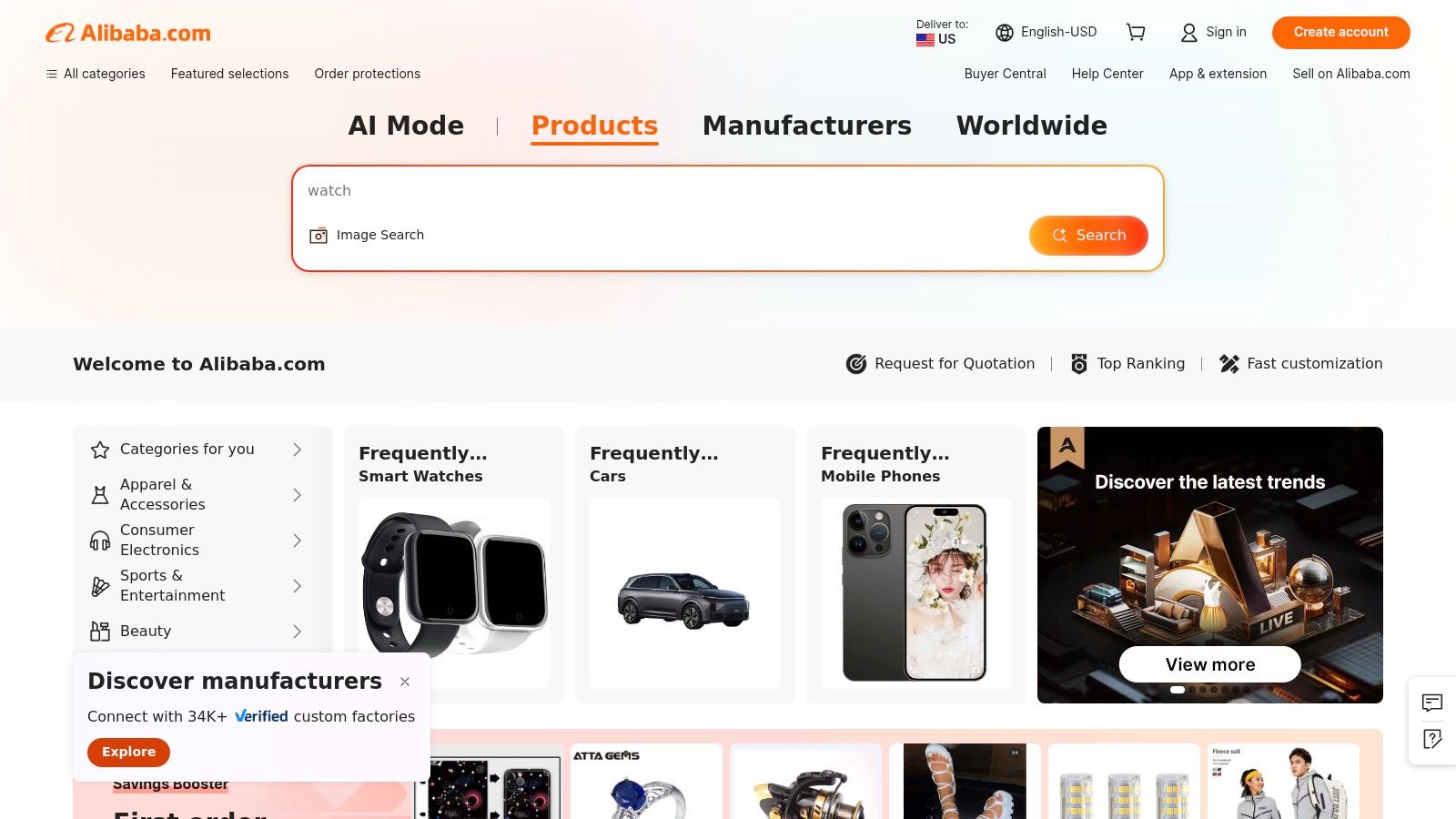
The platform specializes in bulk and custom-manufactured goods, making it an indispensable tool for e-commerce retailers, private-label brands, and businesses needing large-volume inventory. It tackles the primary challenges of overseas sourcing, like trust and payment security, through its integrated Trade Assurance program, which acts as an escrow service.
Strategic Analysis: Why It Works
Alibaba.com’s success lies in its ability to digitize and de-risk the entire global sourcing process. Historically, finding and vetting international suppliers was a high-cost, high-risk endeavor reserved for large corporations. Alibaba.com democratized access by creating a centralized, searchable database of suppliers complete with verification tiers, user reviews, and transaction history.
The addition of Trade Assurance was a masterstroke. It provides an escrow service that holds payment until the buyer confirms the order meets the agreed-upon quality and shipping terms. This single feature transforms a potentially hazardous transaction into a structured, protected process, giving small and medium-sized businesses the confidence to source globally.
Key Strategy: Alibaba.com built a "trust infrastructure" for global trade. By integrating verification, escrow (Trade Assurance), and logistics into a single platform, it created a secure ecosystem that mitigates the inherent risks of cross-border B2B commerce.
Actionable Takeaways for Your Business
- Build Trust Mechanisms: If your business involves high-stakes transactions, implement features that build buyer confidence. This could be a money-back guarantee, a verified partner program, or transparent customer reviews and case studies.
- Create an All-in-One Ecosystem: Don't just sell a product; facilitate the entire process around it. Alibaba.com offers communication tools, payment processing, and logistics tracking. Consider what adjacent services you can integrate to make your customer's journey seamless. Many businesses also use social platforms to build relationships, and you can learn more about B2B social marketing strategies on rebusadvertising.com.
- Offer Layered Verification: Use badges or tiers to signify quality and reliability (e.g., "Verified Supplier," "Gold Supplier"). This helps buyers quickly assess options and guides them toward your most dependable partners or premium products.
Website: https://www.alibaba.com
3. Grainger
Grainger is a titan in the Maintenance, Repair, and Operations (MRO) supply industry, and its digital platform is a prime b2b e commerce example of how to translate a legacy distribution model into a modern, efficient online experience. It serves as a critical procurement hub for businesses needing reliable access to industrial, safety, and facility maintenance products.
The platform excels by digitizing a traditionally relationship-driven sales process. It offers over 1.5 million products online, complete with real-time inventory data, detailed technical specifications, and advanced order tracking. This digital-first approach complements its physical network of branches, providing customers with a true omnichannel purchasing experience.
Strategic Analysis: Why It Works
Grainger’s strength lies in its blend of massive product depth with sophisticated procurement tools tailored for established businesses. Unlike open marketplaces, Grainger is built for controlled, high-volume purchasing. Features like punchout catalog integration, EDI, and custom contract pricing are not just add-ons; they are core to its value proposition for medium to large enterprises.
This focus on integration makes Grainger an indispensable part of its customers' procurement software stack. It’s less about one-off purchases and more about becoming an embedded, long-term supply partner, streamlining the entire purchasing workflow from request to reconciliation.
Key Strategy: Grainger masters the “High-Tech, High-Touch” model. It combines a powerful, self-service e-commerce platform with dedicated account management and technical support, ensuring customers can operate efficiently online while still accessing expert help for complex needs.
Actionable Takeaways for Your Business
- Integrate with Customer Workflows: Don't just build a website; build a tool that fits into your customers' existing processes. Investigate what ERP, procurement, or accounting software your key clients use and explore possibilities for integration via APIs or punchout catalogs.
- Merge Digital and Physical Service: If you have a physical presence or a sales team, use your website to enhance their effectiveness. Grainger’s site allows users to check local branch inventory for same-day pickup, seamlessly connecting their digital and physical assets.
- Provide Deep Product Data: B2B buyers require extensive information. Go beyond basic descriptions and provide technical spec sheets, CAD drawings, safety data sheets, and compatibility guides directly on your product pages to build trust and accelerate purchasing decisions.
Website: https://www.grainger.com
4. Uline
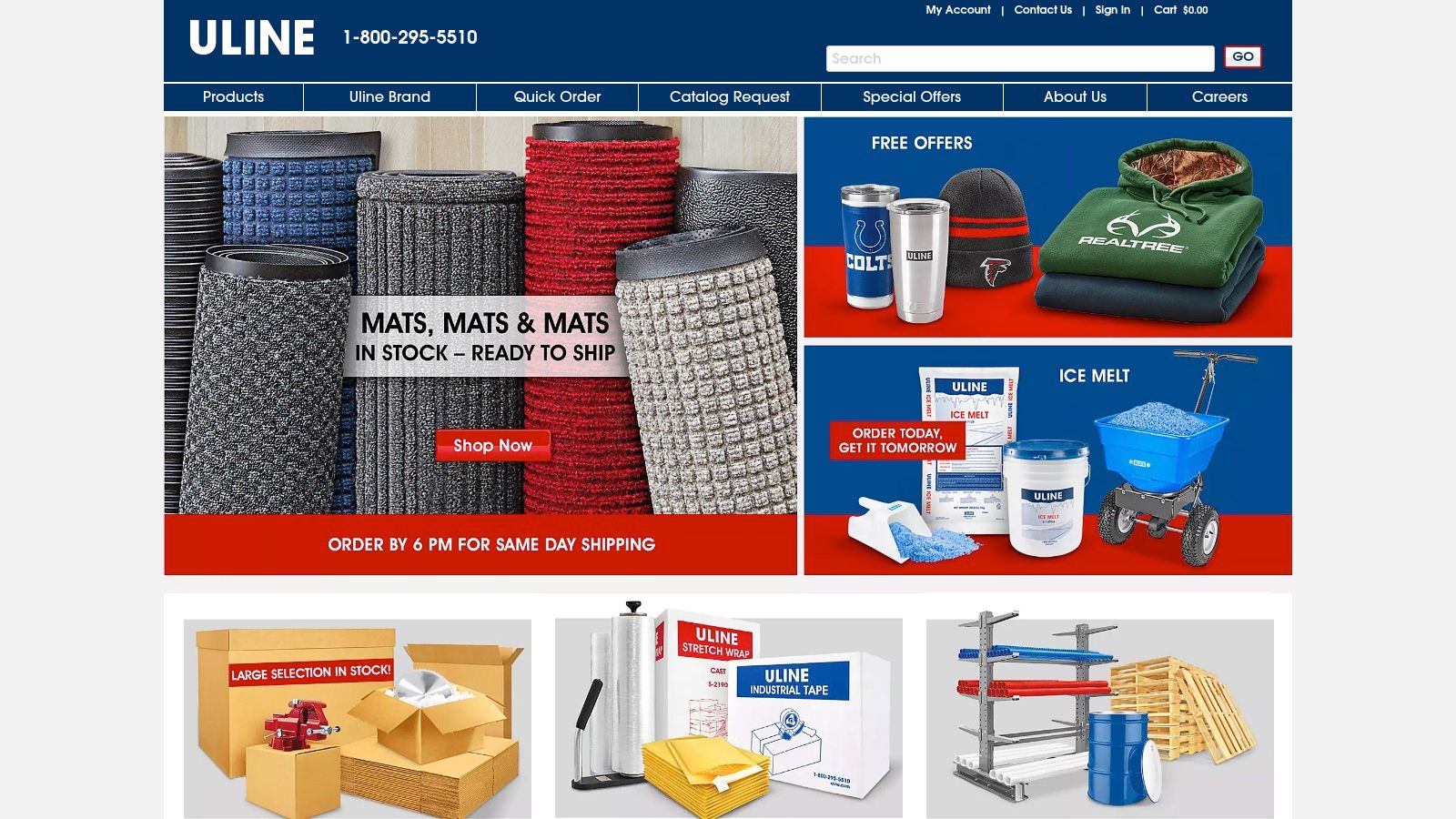
Uline has perfected the B2B e-commerce model for operational supplies by combining a massive, in-stock catalog with an incredibly efficient logistics network. It serves as a prime b2b e commerce example of how to build an online presence centered on reliability and speed for businesses that depend on a consistent supply chain for their daily operations.
The platform is the digital equivalent of a massive, well-organized warehouse, offering everything from cardboard boxes and packing tape to industrial shelving and safety equipment. For operations managers, Uline solves the critical problem of sourcing essential supplies quickly and predictably, minimizing downtime and inventory headaches.
Strategic Analysis: Why It Works
Uline's success is built on a foundation of operational excellence translated directly into its e-commerce experience. Its website is not flashy; it is functional, fast, and designed for repeat, high-volume orders. The core strength lies in its network of regional warehouses, which enables next-day delivery to a vast majority of its customers, a critical differentiator in the B2B supplies space.
This focus on logistics and inventory consistency allows businesses to treat Uline as a just-in-time inventory partner. An e-commerce company doesn't need to stockpile boxes because they know Uline can deliver them tomorrow. This reliability is the central pillar of its customer loyalty and business model.
Key Strategy: Uline masters the art of "operational e-commerce" by making its logistical superiority the core feature. The website's primary function is to provide a simple, fast interface to its powerful, real-world distribution network, turning reliability into its main selling point.
Actionable Takeaways for Your Business
- Make Reliability Your Product: If your business excels at logistics, speed, or consistency, make that the star of your e-commerce platform. Display real-time stock levels, offer guaranteed delivery dates, and build your site navigation around getting customers what they need as fast as possible.
- Design for Reordering: Uline’s customers are repeat buyers. The website facilitates this with features like saved order lists and easily accessible product SKUs. If your business relies on repeat purchases, optimize your user experience for quick reordering, not just initial discovery.
- Align Digital with Physical: Uline’s website is a direct reflection of its physical warehouse and shipping capabilities. Ensure your online promises (like "in-stock" or "ships today") are directly and accurately tied to your real-world operational capacity to build trust.
Website: https://www.uline.com
5. Thomasnet
Thomasnet is a powerhouse of supplier discovery, operating as the largest and most established B2B sourcing platform for industrial products and services in North America. It serves as a comprehensive digital directory rather than a direct transactional marketplace, making it a unique and crucial b2b e commerce example focused on the critical first step of procurement: finding and vetting qualified suppliers.
The platform excels at connecting buyers with over 500,000 North American suppliers, providing deep company profiles that include certifications, diversity status, and operational details. It digitizes the traditionally cumbersome Request for Quote (RFQ) process, allowing buyers to manage initial outreach and compare proposals from multiple vendors within a centralized system. This is especially vital for industries requiring specific certifications or domestic sourcing.
Strategic Analysis: Why It Works
Thomasnet's enduring success lies in its strategy of being the definitive source of trusted supplier data. While other platforms focus on the transaction, Thomasnet owns the discovery and qualification phase. For businesses in manufacturing, engineering, and government contracting, finding a supplier that meets strict criteria (like ISO 9001 or ITAR registration) is the most challenging part of procurement.
By providing this granular, verified data for free to buyers, Thomasnet becomes an indispensable tool. It monetizes its rich buyer intent data and directory dominance by selling advertising and lead-generation services to the suppliers on its platform, creating a powerful, data-driven business model.
Key Strategy: Thomasnet masters the "lead-generation marketplace" model. It attracts high-intent buyers by offering a free, high-utility sourcing tool, then sells targeted access to this audience to suppliers who need to win new business.
Actionable Takeaways for Your Business
- Become the Definitive Resource: Instead of selling a product, sell information. Identify a critical data gap in your industry and build a free tool or resource that becomes the go-to solution for your target audience. Monetize through advertising or premium data services.
- Facilitate, Don't Transact: Not every B2B model needs a shopping cart. If your industry involves complex negotiations or custom quotes, focus your digital efforts on tools that simplify the connection and quoting process, leaving the final transaction to occur offline.
- Build a Two-Sided Platform: Consider how you can serve both buyers and sellers in your niche. By creating value for one side (e.g., free sourcing tools for buyers), you can build an audience that is highly valuable to the other side (e.g., qualified leads for suppliers).
Website: https://www.thomasnet.com
6. Shopify Plus (B2B on Shopify)
Shopify Plus extends its dominant D2C e-commerce engine into the wholesale world, offering a powerful, unified platform for brands that serve both consumers and business clients. It provides a native B2B solution that avoids the need for separate systems, making it a leading b2b e commerce example for companies seeking operational synergy and a modern user experience.
The platform allows merchants to run a password-protected, separate wholesale storefront or blend B2B functionality directly into their existing D2C site. This flexibility enables businesses to manage complex B2B needs, such as custom pricing, net payment terms, and company-specific product catalogs, all from a single, familiar Shopify admin panel.
Strategic Analysis: Why It Works
The genius of Shopify Plus is its "unified commerce" approach. Instead of treating B2B and D2C as separate channels requiring different technologies, it integrates them into one ecosystem. This allows brands to leverage their existing product data, marketing efforts, and operational workflows across both sides of the business, dramatically reducing complexity and overhead.
Merchants can assign company profiles to wholesale customers, giving them access to unique price lists, product selections, and checkout options. For businesses leveraging Shopify Plus for their B2B operations, exploring specialized top inventory management system tools for Shopify can significantly enhance efficiency by ensuring stock levels are accurately reflected across all sales channels.
Key Strategy: Shopify Plus democratizes powerful B2B functionality by building it on top of an accessible, world-class D2C platform. It removes the traditional barriers between wholesale and retail, allowing brands to scale both verticals from a single backend.
Actionable Takeaways for Your Business
- Unify Your Sales Channels: If you sell to both consumers and businesses, seek a platform that can manage both from a single dashboard. This simplifies inventory, customer data, and order management, saving time and preventing errors. Explore B2B website design best practices to ensure a seamless experience for all users.
- Offer Self-Service B2B Portals: Empower your wholesale customers with their own portal where they can view custom pricing, place orders, and check order history without contacting a sales rep. This improves their experience and frees up your team.
- Leverage an App Ecosystem: Shopify's strength is its app store. Identify gaps in your B2B process (e.g., complex quoting, specialized shipping) and find apps that solve these specific problems, allowing you to build a customized solution without expensive development.
Website: https://www.shopify.com/plus/solutions/b2b
7. BigCommerce B2B Edition
BigCommerce B2B Edition is an e-commerce platform built specifically to handle the complex transactions and relationships inherent in business-to-business sales. It extends the core BigCommerce platform with a suite of integrated tools designed for manufacturers, wholesalers, and distributors, serving as a prime b2b e commerce example for businesses needing a robust, all-in-one solution.
The platform directly addresses common B2B challenges like complex quoting, customer-specific pricing, and managing multiple buyers under a single company account. It provides a dedicated buyer portal that empowers customers with self-service capabilities for reordering, managing invoices, and creating shopping lists.
Strategic Analysis: Why It Works
BigCommerce B2B Edition excels by embedding sophisticated B2B functionalities natively into a powerful and flexible SaaS platform. Unlike generic e-commerce solutions that require heavy customization or a patchwork of third-party apps, B2B Edition offers core features like Configure-Price-Quote (CPQ), role-based access, and company account management out of the box.
This approach significantly reduces the time to market and total cost of ownership for mid-market businesses. Furthermore, its headless-ready architecture allows companies to build highly customized front-end experiences while relying on the BigCommerce backend for commerce logic, offering the best of both SaaS convenience and API-first flexibility. As an in-depth ecommerce platform comparison often shows, this hybrid capability is a key differentiator.
Key Strategy: BigCommerce provides an "integrated-but-open" ecosystem. It bundles essential B2B workflows natively to solve 80% of a company's needs immediately, while its open API and app marketplace allow for deep customization to solve the remaining 20%.
Actionable Takeaways for Your Business
- Prioritize Self-Service: Empower your B2B customers with a portal where they can manage their own accounts, view order histories, pay invoices, and place quick reorders. This reduces administrative overhead for your team and improves customer satisfaction.
- Offer Flexible Purchasing Options: Not all B2B transactions are simple credit card purchases. Integrate quoting, invoicing, and purchase order capabilities directly into your e-commerce flow to accommodate how your customers actually buy.
- Build for Scalability: Choose a platform that can grow with you. BigCommerce's ability to support multiple storefronts from a single backend and its headless capabilities are perfect examples of planning for future expansion, whether into new regions or new sales channels.
Website: https://www.bigcommerce.com/solutions/b2b-ecommerce-platform/
Top 7 B2B E-Commerce Platforms Comparison
| Amazon Business | Low–Medium 🔄: quick signup; advanced controls need Business Prime | Business Prime for advanced features; minimal IT; vet marketplace sellers 💡 | Centralized procurement, fast US fulfillment, basic spend analytics 📊 ⭐⭐⭐ | SMBs centralizing purchasing with fast US delivery | Huge selection, fast shipping, multi-user controls ⚡ |
|---|---|---|---|---|---|
| Alibaba.com (Trade Assurance) | Medium–High 🔄: global sourcing, supplier verification, logistics | Requires due diligence, QC/inspections, manage import logistics and duties 💡 | Low unit costs at scale and customization; variable QC and longer lead times 📊 ⭐⭐ | Global sourcing, private-label manufacturing and bulk orders | Massive supplier breadth + Trade Assurance protections ⚡ |
| Grainger | Low 🔄: straightforward account setup; optional punchout/EDI integrations | Contract/account setup for best pricing; integrate with procurement systems 💡 | Reliable in-stock availability, quick fulfillment, strong technical support 📊 ⭐⭐⭐ | MRO, industrial & safety procurement with need for dependable fulfillment | Deep US assortment, same-day shipping, procurement integrations ⚡ |
| Uline | Low 🔄: catalog-based ordering with predictable workflows | Minimal IT; budget for prepaid shipping/handling fees and price changes 💡 | Consistent SKUs and predictable supply for operations; fast regional shipping 📊 ⭐⭐ | Packaging, shipping, and warehouse supplies for ecommerce ops | Predictable availability and fast regional delivery ⚡ |
| Thomasnet | Low–Medium 🔄: directory research and offline RFQ/outreach | Time-intensive supplier comparison, certification checks and RFQs 💡 | Access to certified US manufacturers and competitive quotes; variable response times 📊 ⭐⭐ | Sourcing domestic/certified manufacturers and multi-vendor RFQs | Detailed supplier profiles and certification filters ⭐ |
| Shopify Plus (B2B) | Medium–High 🔄: enterprise build/customization for B2B workflows | Plus fees, developer or agency for complex builds; large app ecosystem 💡 | Unified D2C + B2B storefronts, fast time-to-market with apps 📊 ⭐⭐⭐ | Brands/wholesalers wanting unified D2C and B2B platform | Unified stack, extensibility and modern checkout ⚡ |
| BigCommerce B2B Edition | Medium–High 🔄: sales-led deployment, CPQ and multi-store setup | Requires scoping/demo, enablement, and possible development resources 💡 | Robust B2B workflows (quotes, CPQ, buyer portal) and localization capabilities 📊 ⭐⭐⭐ | Mid-market distributors/manufacturers needing quoting and multi-store support | Native B2B workflows, CPQ support and headless-ready flexibility ⚡ |
Building Your B2B E-Commerce Blueprint
The journey through each B2B e-commerce example, from the massive marketplace of Alibaba.com to the bespoke brand experiences powered by Shopify Plus, reveals a powerful, unifying truth: successful B2B digital commerce is never one-size-fits-all. The most effective strategies are meticulously crafted to serve a specific buyer, solve a unique industry problem, and align with core business objectives. The era of clunky, outdated portals is over, replaced by a demand for intuitive, efficient, and consumer-grade purchasing experiences.
We saw how giants like Grainger and Uline master logistics and product accessibility, making reliability their core value proposition. In contrast, platforms like BigCommerce B2B Edition empower brands to build direct relationships through customization and control. Thomasnet thrives by being an indispensable discovery tool, connecting buyers with qualified suppliers. Each model demonstrates a different path to success, proving that your strategy must be as unique as your business.
From Inspiration to Implementation
Translating these insights into action is the critical next step. Your goal is to construct a blueprint that guides your digital transformation. Before you select a platform or invest in new technology, consider these foundational elements:
- Define Your Customer's Journey: Who are your buyers, and what do they really need? Do they require complex quotes, tiered pricing, and purchase order capabilities, or do they value speed and self-service simplicity? Map their entire purchasing process, from initial research to reordering.
- Align Technology with Operations: Your e-commerce platform must integrate seamlessly with your existing ERP, CRM, and inventory management systems. A disconnected tech stack creates friction for both your team and your customers. Analyze how each potential solution supports your current and future operational workflows.
- Prioritize the User Experience (UX): A frictionless UX is non-negotiable. This means powerful on-site search, detailed product information, easy reordering, and a mobile-responsive design. Every feature should be designed to make your customer's job easier.
- Build a Lead Generation Engine: Your B2B website is more than a sales channel; it's a powerful marketing asset. When constructing your B2B E-Commerce Blueprint, it's crucial to grasp the fundamental principles of lead generation marketing to effectively build a sales pipeline and attract qualified buyers long before they are ready to purchase.
Your Path Forward
The diversity of the B2B e-commerce example landscape highlights the immense opportunity available to businesses willing to innovate. Whether you are a manufacturer moving into direct-to-buyer sales, a distributor optimizing your online catalog, or a professional service firm digitizing your client intake, the right digital strategy can unlock unprecedented growth.
The key is to move beyond simply listing products online and toward creating a valuable, indispensable digital resource for your customers. By focusing on their needs, leveraging the right technology, and committing to a seamless experience, you can build a powerful e-commerce presence that not only drives revenue but also solidifies your position as an industry leader.
Ready to turn these examples into your reality? The experts at Rebus specialize in crafting bespoke B2B e-commerce strategies that drive measurable growth. We can help you navigate the complexities of platform selection, user experience design, and digital marketing to build a powerful, revenue-generating online presence. Learn how Rebus can build your B2B e-commerce blueprint.