B2B Website Design That Converts Visitors Into Leads
Think of your B2B website design as more than just a digital brochure. It’s your hardest-working salesperson, the one pulling shifts 24/7 to build credibility, educate buyers, and keep your sales pipeline full. This isn't just a website; it’s a strategic business asset built for the long, complex sales cycles that define B2B deals, where trust and expertise trump impulse buys every time.
Why Your B2B Website Is Your Most Valuable Sales Tool

Unlike a B2C site gunning for quick, emotional sales, a B2B website has to navigate a completely different journey. The buying process often involves a whole committee of decision-makers, each showing up with their own questions and priorities. A technical manager needs detailed specs, while the CFO is hunting for ROI calculators and pricing models. Your website’s real job is to serve all these people at once.
This requires a total shift in thinking. Instead of obsessing over flashy aesthetics, effective B2B website design prioritizes clarity, trust, and education. It's about crafting a digital experience that guides sophisticated buyers through their research phase—which, by the way, almost always happens long before they ever dream of talking to a sales rep. A professional, intuitive design instantly signals that your company is credible and knows its stuff.
To give you a clearer picture, B2B and B2C website design operate in two different universes. Here’s a quick breakdown of what sets them apart.
Key Differences Between B2C and B2B Website Design
| Primary Goal | Lead generation, education, building trust | Direct sales, driving transactions |
|---|---|---|
| Audience | Multiple stakeholders, rational decision-makers | Individual consumers, emotional buyers |
| Sales Cycle | Long, complex (weeks to months) | Short, simple (minutes to days) |
| Content Strategy | In-depth, educational (whitepapers, case studies) | Product-focused, persuasive (reviews, promos) |
| Call-to-Action | "Request a Demo," "Download Guide" | "Buy Now," "Add to Cart" |
| Pricing | Often customized, requires a quote | Transparent, fixed pricing |
| Design Tone | Professional, credible, informative | Aspirational, engaging, visually exciting |
In short, while a B2C site is a storefront, a B2B site is more like a trusted consultant, guiding buyers toward a smart, calculated decision.
Establishing Credibility from the First Click
First impressions are made in the blink of an eye, and online, they're almost entirely visual. In fact, a staggering 75% of website visitors admit to judging a company’s credibility based purely on its site design. This makes a professional look a non-negotiable for any business targeting other businesses. You can discover more insights about the impact of website design from recent studies.
A clunky, outdated, or confusing website can vaporize trust in seconds, sending potential clients straight to your competitors.
Your B2B website isn't just a marketing tool; it's the digital handshake that precedes every conversation. It has to scream competence, expertise, and a deep understanding of your customer's world.
To make that happen, your site needs to be engineered to:
- Educate and Inform: Offer a library of in-depth resources—case studies, whitepapers, and detailed service pages that tackle the tough questions head-on.
- Build Trust: Flaunt your social proof. Client logos, glowing testimonials, and industry certifications are your way of saying, "We've done this before, and we're good at it."
- Generate Qualified Leads: Use clear, compelling calls-to-action (CTAs) that guide visitors to the next logical step, whether that's scheduling a demo or downloading a guide.
Ultimately, a great B2B website design transforms your online presence from a passive brochure into an active, predictable engine for growth, nurturing leads until they’re primed and ready for a real conversation.
Defining Goals and Measuring What Matters
A slick-looking B2B website is nice, but if it’s not engineered around clear, measurable goals, it's just an expensive digital brochure. Before you even think about mockups or code, you have to answer the big question: what does a “win” actually look like for your business? Without a destination, you're just driving blind.
Too many businesses get hooked on vanity metrics—things like overall traffic or page views. While those numbers feel good to report in a meeting, they don’t pay the bills. The real mission is to build a website that acts as a predictable growth engine, and that means zeroing in on actions that directly feed your sales pipeline.
Moving Beyond Traffic to Tangible Outcomes
The most critical mindset shift is from passive information display to active lead generation. Your website's #1 job is to find potential customers and gently nudge them toward a conversation with your sales team. This all starts with defining specific conversion goals—the moments a visitor raises their hand and shows genuine interest.
In the B2B world, a "conversion" isn't just a sale. It's any meaningful action that pulls a prospect deeper into your sales funnel. It’s a signal of intent, giving your team a qualified lead to follow up with.
These actions are your Key Performance Indicators (KPIs). They’re the specific, trackable metrics that tell you if your B2B website is actually doing its job. They are the bridge between your marketing efforts and real sales results.
Primary Conversion Goals for B2B Websites
For most B2B companies, the primary goals are all about generating high-quality leads. These are the most valuable clicks a visitor can make.
- Demo or Consultation Requests: This is the big one—the highest-intent conversion you can get. A user is literally asking to see your product or talk to sales.
- Contact Form Submissions: A direct line from a prospect who has a question or wants to kick off a conversation about what they need.
- Quote or Pricing Requests: This signals strong commercial interest. The visitor is moving from "learning" to "buying" mode and evaluating your solution for purchase.
Tracking these is non-negotiable for measuring ROI. Tools like Google Analytics 4 are built for this, letting you set up event tracking for every form submission. If you want to dive deeper, our guide on setting up and tracking Google Analytics goals walks you through it step-by-step.
Important Secondary and Engagement Goals
While not a direct "call me now" signal, secondary goals are vital for building trust and educating prospects on their often long journey to a decision. These actions are all about nurturing future leads and cementing your authority.
- Gated Content Downloads: When someone trades their email for a whitepaper, case study, or ebook, they officially become a marketing-qualified lead (MQL).
- Newsletter Subscriptions: This gives you a direct channel to nurture leads over time with valuable content, keeping your brand top-of-mind.
- Webinar Registrations: An awesome way to engage prospects, flex your expertise, and capture lead information for the sales team to follow up on.
By mapping out a clear hierarchy of primary and secondary goals, your entire B2B website design becomes purpose-driven. Every design choice, piece of content, and call-to-action can be measured against its ability to deliver these tangible business outcomes.
Building a User-Focused Information Architecture

So, how do you guide a whole committee of decision-makers through a complex sales journey without anyone getting lost or frustrated? The secret sauce is a rock-solid Information Architecture (IA).
Think of IA as the blueprint for your website. A building’s blueprint tells you where to put hallways, rooms, and elevators so people don't wander into a broom closet looking for the boardroom. Your site’s IA does the same thing, organizing everything so every visitor finds what they need, effortlessly.
This is a massive deal in B2B. You’re not just selling to one person; you’re selling to the CFO, the IT manager, and the person who will actually use your product—all at the same time. They all show up with different questions and priorities. A smart IA makes sure your b2b website design serves all of them without causing a headache, building their confidence with every single click.
Without this structure, even the slickest design is dead on arrival. Users will get lost, bounce, and never come back. A logical IA, on the other hand, keeps them engaged and smoothly guides them from "who are you?" to "take my money."
Mapping the Journey for Multiple Buyer Personas
First things first: you can't build a good blueprint if you don't know who you're building it for. B2B purchases are almost never a solo mission. You need to create detailed buyer personas for every key stakeholder who has a say in the decision.
And I don't mean generic, fluffy profiles. These need to be specific and actionable, outlining each person's goals, their biggest headaches, and exactly what info they need from your site to get their job done.
- The Technical Evaluator (think: IT Director): This person is all about the nitty-gritty. They need detailed specs, integration guides, security docs, and case studies that prove your tech won't blow up their systems. Their path should lead straight to a resource hub or a deep-dive on product features.
- The Economic Buyer (think: CFO or VP of Finance): They live and breathe ROI. They're hunting for pricing pages, cost-benefit breakdowns, and testimonials from companies their size that scream financial wins.
- The End-User (think: Department Manager): They have one simple question: "Will this make my life easier?" Their journey needs product tours, video demos, and specific use cases that solve the exact problems they face every day.
Once you’ve got these personas dialed in, you can start mapping out a clear, intuitive user flow for each one. This process is what tells you how to structure your navigation and content so nobody ever hits a dead end.
A great B2B website speaks to each decision-maker in their own language. The architecture must create clear, distinct pathways that deliver the right information to the right person at the right time in their buying process.
Designing Navigation That Drives Discovery
With your user flows mapped, it's time to build a navigation system that actually makes sense. The goal is to make all that complex product info, dense case studies, and crucial pricing details easy to find. Let's be real—a confusing menu is one of the top reasons people smash the back button.
Here are a few core principles for B2B navigation that just works:
Use Clear and Familiar Language: Ditch the internal jargon and clever-but-confusing labels. Stick to terms your audience actually uses, like "Services," "Solutions," "Pricing," and "Resources."
Organize by Audience or Use Case: If you serve different industries or types of users, make their lives easier by creating navigation paths just for them (e.g., "Solutions for Healthcare," "Solutions for Finance").
Limit Main Menu Items: A cluttered navigation bar is overwhelming. Aim for five to seven top-level items and use clean, logical sub-menus for everything else. A well-organized site is a non-negotiable part of effective b2b website design.
Prioritize Your Main CTAs: Make it painfully obvious what you want users to do next. "Request a Demo" or "Get a Quote" should be impossible to miss, usually slapped right in the top-right corner of the header.
Getting the IA right is one of the most critical parts of web design. For anyone looking to go deeper on this, digging into user experience design best practices will give you more insight into creating these intuitive digital journeys. And to help make sure your IA translates perfectly to any screen size, using a REM converter tool can be a lifesaver for managing CSS units.
Ultimately, a solid IA transforms your website from a digital brochure into a strategic machine that nurtures leads and closes deals faster.
Designing for Trust and Conversion
Alright, you’ve got the blueprint for your site. Now it’s time to build the rooms, hallways, and signposts that actually turn curious visitors into qualified leads. This is where the magic happens—where smart user interface (UI) design and killer content strategy team up to build credibility and get people to act.
An effective B2B website design is more than just a pretty face. Every single element, from the button color to the headline font, has a job to do: guide the user and build their confidence in you.
In the B2B world, decisions aren’t made on a whim. They’re calculated, logical, and weighed down by risk. Your website's design needs to scream competence and reliability from the first second. The data doesn't lie: a well-executed UI can boost conversions by up to 200%, and a truly seamless user experience can send them soaring by a wild 400%. Why? Because a clear, intuitive design removes friction and makes a skeptical buyer feel secure.
Crafting a Professional and Credible Visual Identity
Your website’s visual design is the handshake. It’s the first signal of your company's quality, and you don’t get a second chance to make that impression. For B2B audiences, clarity and professionalism crush flashy trends every single time. The goal is to create an environment that feels trustworthy and effortless to navigate.
Color psychology plays a huge part here, even if it's subconscious. Blues tend to communicate security and reliability (think banks and tech giants), while greens can suggest growth and stability. Clean whites and grays create a minimalist backdrop that makes your actual message pop.
Typography is just as critical. Clean, easy-to-read fonts like sans-serifs (think Helvetica or Open Sans) improve readability and give off a modern, professional vibe. No one wants to squint to figure out what you do.
The best B2B designs are invisible. They don't distract or overwhelm; they create a seamless and confident path from a user's problem to your solution, making the decision to engage feel like the most natural next step.
Placing Trust Signals for Maximum Impact
Let's face it: B2B buyers are a skeptical bunch. They need proof that you can walk the walk before they’ll even think about talking the talk. This is where trust signals become your secret weapon. These are the little nuggets of proof that provide third-party validation and show you have a real track record of success.
You need to sprinkle these signals strategically throughout your site, especially near the finish line—like right next to a contact form or on a pricing page.
- Client Logos: A "logo wall" featuring recognizable companies you've worked with is pure gold. It’s instant social proof that says, "Hey, these credible businesses already trust us."
- Testimonials and Reviews: Quotes from happy clients are great, but quotes detailing specific, tangible results are unstoppable. Always include the person’s name, title, and company to make them feel real.
- Case Studies: These are the ultimate B2B trust-builders. In-depth stories of how you solved a specific client’s painful problem provide concrete evidence of your expertise and the ROI you deliver.
- Industry Awards and Certifications: Got official badges or certifications? Flaunt them. They show your company meets high industry standards and has been recognized for its excellence.
These elements aren't just website decorations; they are core parts of your sales argument, working behind the scenes to smash objections and build the confidence someone needs to finally reach out. To make sure your B2B website is a lead-generating machine, you also have to nail the search engine game. For a deeper look, it's worth checking out the qualities of the best SEO consultant for B2B companies.
Developing Solution-Oriented Content
While design builds that initial trust, your content does the heavy lifting. It's what convinces a prospect you're the one. B2B buyers aren't searching for clever marketing slogans; they're looking for answers to complex business problems. Your messaging has to shift from being all about you ("We are the best") to being all about them ("Here's how we solve your specific pain point").
Every single piece of content should be engineered to educate, build authority, and gently nudge the user toward a conversion.
- Detailed Service Pages: Don't just list features. Explain the benefits and outcomes of your services. Directly address the challenges your ideal customer is struggling with.
- Insightful Case Studies: Frame these as simple stories: problem, solution, result. Use hard data and metrics to show the real impact you made for that client.
- Valuable Whitepapers and Guides: Gated content like in-depth reports or how-to guides positions you as a thought leader and doubles as a powerful tool for generating leads.
When you focus on solving problems instead of just selling products, your website transforms from a boring sales pitch into an indispensable resource. This approach doesn't just attract qualified leads; it nurtures them through their long decision-making journey. So when they're finally ready to pull the trigger, your company is the first one they call. If you want to dive deeper into this, you can learn about our conversion optimization best practices in our detailed guide.
Choosing Your B2B Technology Stack
Let's get one thing straight: a killer B2B website is way more than a collection of pretty pages. It’s an engine. The choices you make for its parts—the tech stack—determine whether you’re building a sputtering lawnmower or a high-performance race car that fuels your entire sales process.
Your tech stack is the guts of your digital operation—the software and tools that work together to run your site, capture leads, and pass them seamlessly to your sales team. Getting this right is non-negotiable. It dictates how fast your marketing team can move, how secure your data is, and whether your website actually talks to the rest of your business.
Selecting the Right Content Management System
At the heart of it all is the Content Management System (CMS). This is the control panel that lets your team publish blog posts, update landing pages, and make changes without having to ping a developer every five minutes. For B2B, the big showdown is usually between flexibility and an all-in-one convenience.
Most companies land on one of two major players: WordPress or HubSpot.
- WordPress: This is the open-source beast known for its insane flexibility. With a universe of plugins and themes, you can make a WordPress site do just about anything you can dream up. It’s the go-to for businesses that want total control or have very specific, custom needs. The trade-off? You're the captain of the ship, which means you’re also responsible for security, updates, and keeping things running smoothly.
- HubSpot CMS Hub: Think of this as the tightly integrated ecosystem. HubSpot is built from the ground up for marketing and sales. Its biggest selling point is how it connects natively to its own CRM and marketing automation tools. Your website, lead data, and email campaigns all live under one roof, which makes life a whole lot simpler. You'll sacrifice some of the deep customization of WordPress, and it usually comes with a higher price tag.
Your CMS isn't just a backend tool. It’s the foundation for your entire digital marketing operation. Pick the one that fits your team's tech skills, your budget, and where you plan to be in three years.
Essential Integrations for a Lead Generation Machine
A B2B website that doesn't connect to your other business systems is just a fancy, expensive brochure. The real magic happens when you plug it into your sales and marketing tools, creating a smooth flow of data that turns visitors into qualified leads automatically.
Without these connections, you're stuck in the soul-crushing world of manually exporting and importing spreadsheets. Don't be that person.
Here are the integrations you absolutely cannot skip:
Customer Relationship Management (CRM): This is the big one. Hooking your website forms directly into your CRM (think Salesforce, HubSpot, or Zoho) means every single lead gets zapped straight to your sales team. No delays, no human error. It closes the loop and gives you a crystal-clear picture of which marketing efforts are actually turning into revenue.
Marketing Automation Platforms: This is how you nurture leads without driving yourself crazy. Tools like Marketo or Pardot let you set up automated email sequences. Someone downloads a whitepaper? Boom—they're now getting a series of helpful follow-up emails that gently guide them toward a sales conversation. It’s all happening while you sleep.
Analytics Tools: You can't improve what you don't measure. Connecting your site to Google Analytics 4 is baseline, but layering on tools like Hotjar gives you the real story. You can see heatmaps of where people click, watch recordings of user sessions, and pinpoint exactly where they’re getting stuck or dropping off. This is the data that fuels smart decisions, not just guesses.
When your CMS, CRM, and marketing tools are all talking to each other, you've built a powerful, automated ecosystem. This is how a B2B website design stops being a cost center and starts becoming your most predictable, revenue-generating asset.
A Look Inside the B2B Website Design Process
Kicking off a B2B website design project can feel like staring up at a mountain. But it's not about one giant leap; it's a series of manageable steps. When you break it down into a structured process, that intimidating peak transforms into a clear, walkable path to the summit.
A solid roadmap keeps everyone—from your leadership team to the designers and developers—on the same page, moving in the same direction, and working toward the same goals.
Think of it like building a house. You wouldn't just start nailing boards together and hope for the best. You start with a detailed blueprint, pour a rock-solid foundation, and frame the structure long before you even think about picking out paint colors. This methodical approach is what prevents costly re-dos and ensures the final product is built to last.
The Five Phases of a B2B Website Project
A typical B2B website project moves through five distinct phases, each with its own focus and set of deliverables. This framework brings order to what can be a chaotic mix of creative and technical work, ensuring a smooth journey from idea to a launch that actually drives business.
Discovery and Strategy (Weeks 1-3): This is the blueprint phase. It's all about deep-diving into your business goals, sketching out your target audience personas, and sizing up the competition. We're talking stakeholder interviews, defining what success looks like (KPIs), and crafting a project brief that maps out the entire scope. The key outcome here is a comprehensive strategy document that will act as the north star for every decision that follows.
UX/UI Design (Weeks 4-7): With a clear strategy, the focus shifts to how the site will look, feel, and function. This is the user experience (UX) and user interface (UI) stage. It starts with wireframes—the bare-bones skeleton of your site—and mapping out how users will move through it. From there, it moves into high-fidelity mockups, which are the full-color, pixel-perfect designs that bring the final vision to life.
Content Creation (Happens Alongside Design): Your website is just an empty container without compelling content. This phase shouldn't be an afterthought; it should run in parallel with the design process. It involves writing persuasive copy for service pages, developing compelling case studies, and creating valuable lead magnets like whitepapers. The goal is to craft content that speaks directly to your ideal customer's biggest headaches and offers a clear solution.
Development and Coding (Weeks 8-12): This is where the approved designs are translated into a living, breathing website. Front-end developers build the visual and interactive elements you see, while back-end developers handle the server-side logic and database connections. This is also when the CMS gets set up, your CRM is integrated, and the site is built to be fully responsive on any device.
Testing and Launch (Weeks 13-14): Before the big reveal, the website goes through a rigorous quality assurance (QA) process. Testers become professional bug hunters, checking for cross-browser compatibility and making sure every form and integration works flawlessly. After a final review and sign-off from your team, the site is deployed to the live server for the world to see.
A disciplined process is what separates website projects that succeed from those that spiral into chaos. Following these phases ensures every single part of the build is intentional, strategic, and tied directly to your core business objectives.
This visual helps illustrate how your core tech—like your CMS, CRM, and analytics tools—work together to make it all happen.
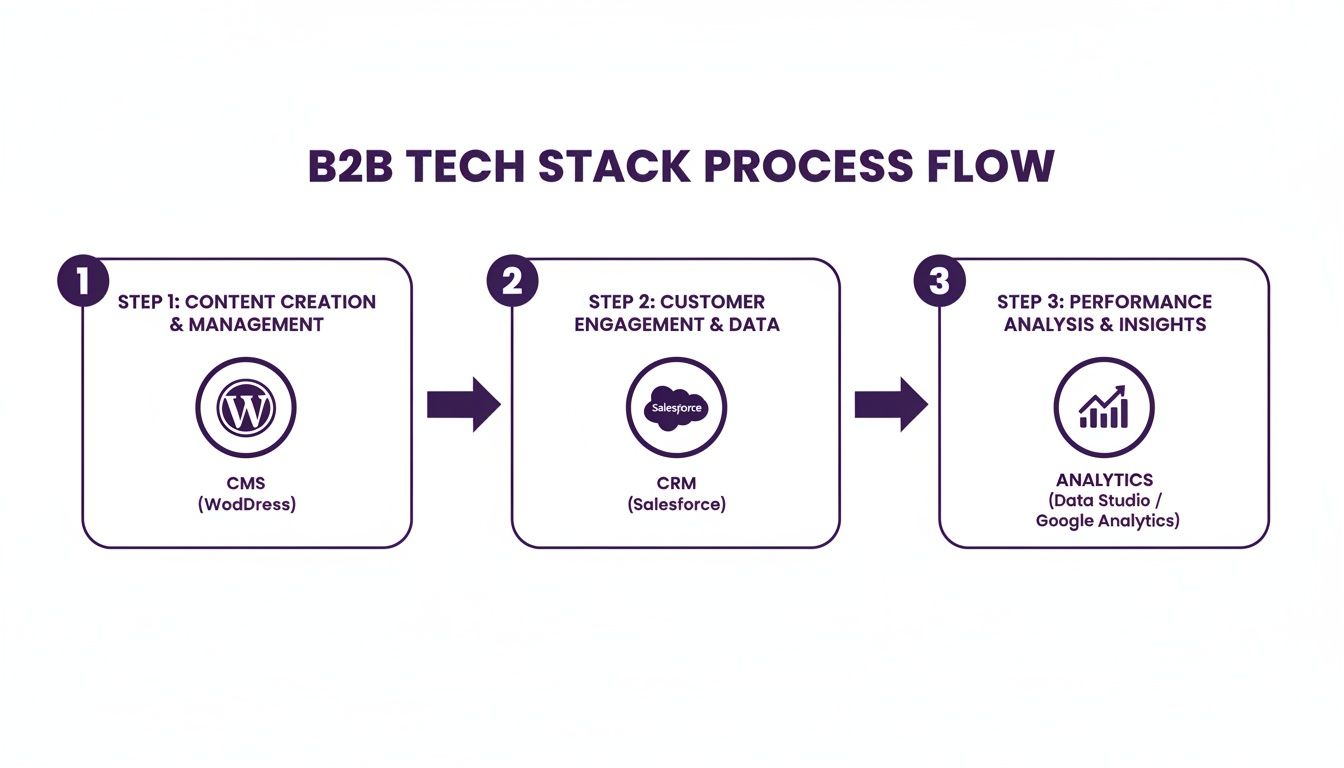
The flow is simple: you create content in a CMS like WordPress, that content fuels engagement tracked in a CRM like Salesforce, and you measure the performance of everything with analytics.
Tips for a Smooth Project Flow
To keep the project chugging along, clear communication and collaboration are everything.
When you give feedback to your agency or freelancer, make sure it’s consolidated and actionable. Try to stick to the agreed-upon plan to avoid "scope creep," that sneaky villain that blows up timelines and budgets.
If you treat the process like a true partnership, you’ll navigate the redesign with confidence and end up with a powerful new asset for your business.
The Big B2B Website Questions, Answered
Alright, let's get down to brass tacks. Kicking off a B2B website design project always opens up a can of worms, and if you're a business leader or marketing manager, you need straight answers to make smart moves. Here’s the real talk on the questions we hear most often.
How Much Does a B2B Website Actually Cost?
This is always question number one, and the honest-to-goodness answer is: it depends. Could you get a simple, template-based site off the ground for a low five-figure sum? Sure. But that’s not what most ambitious businesses are after.
A fully custom build for a mid-sized company—the kind with serious lead-gen goals and integrations with your CRM and marketing tools—is typically going to land somewhere in the $25,000 to $75,000 range, and often higher.
What drives that number? A few key things:
- Custom vs. Template: Are we tailoring a suit from scratch or buying one off the rack? A unique design costs more for a reason—it’s built to fit your business perfectly.
- Sheer Scope: The more unique pages and complex content you need, the more design and development hours it takes. Simple as that.
- Fancy Features: Need a slick customer portal? An interactive ROI calculator? Complex integrations that make your systems talk to each other? Each of these adds to the bottom line.
- Words and Pictures: Don't forget, professional copywriting, photography, and video are their own investments. And they're worth every penny.
How Long Is This Going to Take?
Patience, grasshopper. A standard B2B website project usually takes between 12 to 16 weeks from our first kickoff call to the big launch day.
That timeline can stretch or shrink depending on the project's complexity and—just as importantly—how fast your team can provide feedback and content. A more streamlined site might get done faster, while a massive, feature-heavy build could easily take six months or more.
Think of the timeline as a direct reflection of the strategy involved. Rushing the process often means skipping crucial discovery and UX phases, leading to a site that looks good but fails to generate a single lead.
Do We Have to Write All the Content Ourselves?
Not entirely, but let’s be real: you’re the expert on your business. No agency can fake that. We’ll lean on you for the core insights, the industry knowledge, and the raw material that makes your company special.
The best approach is a true collaboration. Your team brings the brainpower and subject matter expertise, and our copywriters shape it into crisp, conversion-focused messaging that actually connects with your audience.
This way, the final content is both authentically you and perfectly optimized to climb the search rankings and engage users. At the end of the day, a top-tier B2B website isn't just an expense; it’s an asset that works around the clock to generate qualified leads and build unshakable brand credibility.
Ready to build a B2B website that works as hard as your best salesperson? The team at Rebus specializes in crafting high-performance digital experiences that drive measurable growth. Let's talk about your project.