Bounce Rate vs Exit Rate A Practical Guide for Website Growth
Alright, let's untangle two of the most mixed-up metrics in website analytics: bounce rate and exit rate. On the surface, they sound like the same thing—someone leaving your site. But they tell two completely different stories about why and when people hit the road.
Getting this right is the first step to plugging the leaks in your conversion funnel. It’s the difference between knowing if your landing page is a dud versus knowing which page in your checkout process is scaring everyone away.
So, What's the Real Difference?
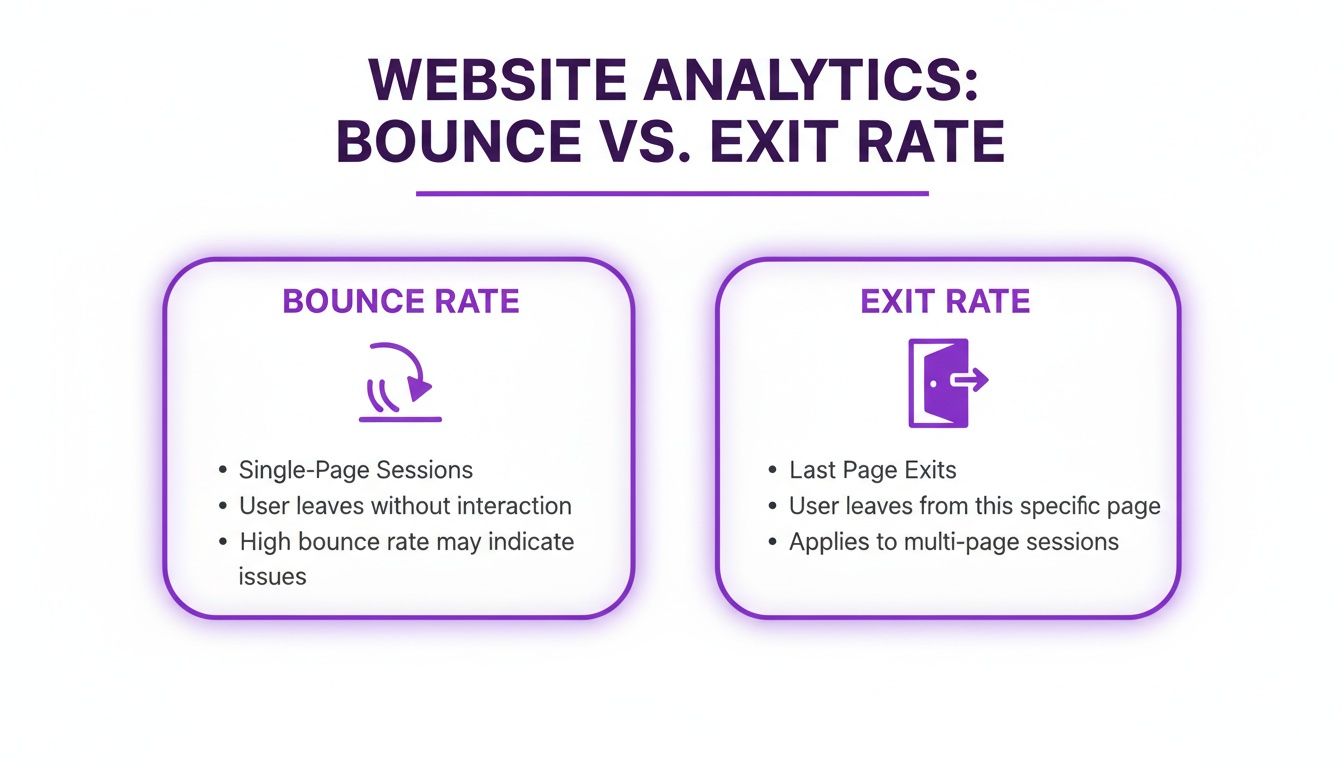
The core distinction is simple. Bounce rate is all about first impressions. It measures the percentage of visitors who land on a single page and leave without doing anything else—no clicks, no form fills, no navigating to another page. It's a one-and-done visit.
Exit rate, on the other hand, measures the percentage of people who left your site from a specific page, regardless of how many other pages they saw first. It's the "last page seen" metric.
This visual breaks it down perfectly. A bounce is always an exit, but an exit isn’t always a bounce.
Think of it like this: a high bounce rate on your homepage means your welcome mat is failing to draw people inside. A high exit rate on your checkout page means something is going wrong just before they buy.
The game has changed a bit with Google Analytics 4 (GA4), which now prioritizes engagement rate. This is essentially the inverse of bounce rate, focusing on whether a user was engaged, even if they only visited one page. It’s a smarter way of looking at things, acknowledging that a single-page visit isn't always a bad thing (like when someone finds the answer they need and leaves happy).
One comprehensive survey found the median bounce rate across all industries was a whopping 44.04%, which means nearly half of all visitors bail after seeing just one page. For more industry-specific benchmarks, the folks at UpwardEngine.com have some solid data.
To make it even clearer, let's put these two metrics side-by-side.
Bounce Rate vs Exit Rate At a Glance
This table cuts through the noise and gives you a quick rundown of the essential differences.
| Bounce Rate | The percentage of single-page sessions with no interaction. | (Total Bounces ÷ Total Sessions) x 100 | Effectiveness of a landing page at grabbing initial interest. |
|---|---|---|---|
| Exit Rate | The percentage of exits from a specific page. | (Total Exits ÷ Total Pageviews for that Page) x 100 | Identifies the last page a user views before leaving your site. |
Ultimately, both metrics are clues. Bounce rate tells you about the quality of your entrances, while exit rate points to the weakest links in your user journey. You need to pay attention to both to get the full picture of your website's performance.
How Bounce and Exit Rates Are Calculated
To really get the difference between bounce rate and exit rate, you have to look at the math. It’s simple, but it tells two completely different stories about how people behave on your site. While both metrics are about users leaving, their formulas measure entirely separate scenarios.
Let's break down how each one gets calculated.

The formula for bounce rate is laser-focused on one thing: single-page sessions. It tells you the percentage of visitors who landed on a page and bailed without doing anything else. No clicks, no form fills, nothing.
Bounce Rate = (Total Number of Single-Page Sessions ÷ Total Number of Sessions) x 100
Picture this: your homepage gets 1,000 total sessions in one day. Out of those, 400 were people who landed, looked around, and left right away. Your homepage's bounce rate would be 40%. Simple as that. This number is a gut check on your landing page's first impression.
The Exit Rate Formula Explained
On the flip side, the exit rate formula couldn't care less about single-page visits. Instead, it measures how often a specific page was the last one someone saw before they decided to leave, no matter how many other pages they visited first.
Here’s how that math works:
Exit Rate = (Total Number of Exits from a Page ÷ Total Pageviews for that Page) x 100
Let's say your "About Us" page got 2,000 total pageviews this month. Of all the user journeys that included that page, 300 of them ended there. Your "About Us" page’s exit rate would be 15%. That tells you for every 100 views, 15 people decided they'd seen enough and closed the tab from that specific page.
This is where the classic distinction comes in: a bounce is always an exit, but an exit is not always a bounce. A user can browse five pages on your site and then leave—that final page gets tagged with an exit, but no page gets a bounce because they interacted.
From Universal Analytics to GA4
Now, the game has changed. The big switch from Universal Analytics (UA) to Google Analytics 4 (GA4) completely redefined this conversation. UA's bounce rate was notoriously rigid—it only cared about single-page sessions with zero interactions. This was often misleading. Someone could land on your blog, read an entire 2,000-word article, find exactly what they needed, and leave feeling satisfied. UA would still call that a bounce. Ouch.
GA4 threw that old model out and introduced the concept of an "Engaged Session". A session is now considered engaged if the user does one of these three things:
- Stays on the site for longer than 10 seconds (you can adjust this).
- Triggers a conversion event.
- Views at least two pages.
In GA4, the bounce rate is just the inverse of the Engagement Rate. If a session doesn't meet any of the engagement rules, it's a bounce. This new approach gives you a much more nuanced view of user intent and helps you properly configure your Google Analytics goals. It's a smarter metric that better reflects actual user satisfaction, even on those single-page visits.
Interpreting High Rates: What the Data Is Telling You
High numbers in your analytics reports aren’t just data points; they’re a direct line to your users’ brains. A sudden spike in bounce rate or a stubbornly high exit rate is telling you a story about your website’s user experience. Learning to read that story is the difference between guessing what’s wrong and making sharp, data-driven fixes.
A high bounce rate usually signals a fundamental disconnect. It’s the metric that screams, "My first impression blew it." This could be anything from a misleading ad that promises one thing while the landing page delivers another, or a painfully slow page load time that makes visitors give up before they even start.
On the other hand, a high exit rate needs a little more context. It’s not always a red flag. Think about it: a high exit rate on a "Thank You" or order confirmation page is perfectly normal. That’s the logical end of a successful journey—the user got what they came for and left happy.
When High Rates Signal a Problem
The context of the page is everything. While an exit from a confirmation page is great, a high exit rate on a critical step in your checkout process is a five-alarm fire. It points a finger directly at friction, like unexpected shipping costs or a confusing form field that caused users to ditch their carts.
This is where you have to roll up your sleeves and dig into page-level data in Google Analytics.
A report like this lets you pinpoint the exact pages with high exit or bounce rates, giving you a starting point for your investigation.
The meaning of a high bounce rate also changes completely depending on the page.
- Blog Post: A visitor might land on your article, find the exact answer they needed, read it, and leave. That’s a successful single-page session, even though it counts as a bounce. Mission accomplished.
- Product Page: A high bounce rate here is way more concerning. It suggests the product description, images, or pricing failed to convince the visitor to even click "Add to Cart" or explore another product.
- Homepage: If your homepage has a high bounce rate, it’s a clear sign your core value proposition isn't compelling enough to pull visitors deeper into your site. Ouch.
A crucial part of the bounce rate vs. exit rate analysis is understanding this: one flags a poor first impression, while the other points to a breakdown somewhere in the user's journey. Both are absolutely essential for growth.
Keeping a close eye on these metrics is non-negotiable. For many businesses, a bounce rate over 70% on anything other than a blog post is alarmingly high. While industry benchmarks often show that many sites fall into the 26-40% range for both bounce and exit rates, context is king. You can explore more detailed benchmarks and see how they apply to your specific industry by checking out these insights on FullSession.com.
Putting Theory Into Practice: Real-World Scenarios
Knowing the definitions is one thing. Seeing how bounce rate vs exit rate plays out in the wild is where the real money is made (or saved). Let's ditch the textbook talk and look at how these metrics diagnose real problems for both e-commerce shops and service-based businesses.
Picture an online store that sells custom laptop cases. Their analytics for a specific product page look… weird. The bounce rate is fantastic—super low. This is a good sign, right? It means when people land on the page from an ad or a search, they’re hooked. They don’t immediately hit the back button.
But here’s the kicker: the same page has a sky-high exit rate. This combo is a classic breadcrumb trail leading straight to a problem that happens after the first impression. People arrive, they look around, they're interested… and then they hit a brick wall and leave.

Uncovering Friction on E-commerce Sites
When you see a high exit rate and a low bounce rate, you can stop worrying about your ad copy or SEO title. The problem isn't getting people in the door; it's what happens once they're inside. Your investigation should pivot from landing page appeal to on-page functionality.
It’s not the what (the product) that’s failing, it’s the how (the user experience).
So, what could be causing this?
- A busted "Add to Cart" button that doesn't do anything when clicked.
- Confusing product options, like a dropdown for colors that's frozen or empty.
- Key information is missing—things like shipping costs, delivery estimates, or a sizing guide that users need before they’ll commit.
Here’s a real-world example: one e-commerce team noticed that while most of their product pages had a 40% exit rate, one particular page was bleeding users at a 60% rate. The culprit? A tiny glitch in a dropdown menu that prevented customers from selecting a color. They literally couldn't buy it if they wanted to. That’s the kind of granular insight that’s central to smart conversion rate optimization best practices.
Key Insight: A low bounce rate means you’ve successfully grabbed their attention. A high exit rate on that same page tells you there’s a roadblock somewhere further down the path, stopping them from taking the next step.
Diagnosing Trust Gaps for Service Businesses
Now, let's flip the script. Imagine a marketing agency or a law firm. Their main services page is getting crushed with a ridiculously high bounce rate. This is the complete opposite of our e-commerce problem, and it signals a failure at the most critical moment: the first impression.
A high bounce rate here is a huge red flag. It means visitors land, take a quick look around, and decide—almost instantly—that this isn't the right place for them. Maybe it feels untrustworthy, or it doesn't immediately answer the one question they came to solve. For service businesses where credibility is everything, this is a five-alarm fire.
A high bounce rate in this context is screaming one of these things:
- Weak Value Prop: Your headline and opening sentence are failing to communicate what you do and for whom. It’s confusing, vague, or full of jargon.
- No Trust Signals: The page is a ghost town. There are no testimonials, case studies, client logos, or certifications to show you’re legit.
- Clunky Navigation: Visitors have no idea where to click to find pricing, see your work, or get in touch. They feel lost, so they leave.
By spotting that high bounce rate, the firm knows exactly where to start. They don't need to rebuild their entire checkout process—they need to sharpen their message, plaster the page with social proof, and make the next step painfully obvious.
Look, understanding the difference between bounce rate and exit rate is a great start. But let's be real—the numbers don't mean squat until you do something with them. High metrics aren't just red flags; they're giant, blinking signs pointing to opportunities for improvement.
This is your practical playbook for turning those data points into a website that actually works harder for you. Whether you're fighting a brutal bounce rate on a landing page or plugging a leaky exit rate in your checkout funnel, the right tweaks can change everything.
How to Reduce a High Bounce Rate
A high bounce rate is a punch to the gut. It means you failed the first impression test. Visitors show up, take one look around, and immediately hit the back button. Your mission is simple: align your page with what they expected to find and give them a damn good reason to stick around.
Here are four strategies that actually move the needle:
Speed Up Your Page Load Time: We live in an instant gratification world. A slow-loading page is a conversion assassin. It’s been proven time and again that even a one-second delay sends bounce rates through the roof. Get in there, compress your images, minify your code, and invest in decent hosting. Your page should feel almost instantaneous.
Nail Your Mobile-First Design: The majority of your traffic is probably on a phone, so a clunky mobile experience is just not an option anymore. Your site has to be fully responsive, with buttons that are easy to tap, text you don't have to pinch-and-zoom to read, and dead-simple navigation. If your mobile users are bouncing, your design is almost certainly the culprit.
Align Ad Copy with Landing Page Content: This is a classic rookie mistake. Your ad promises one thing, but your landing page delivers something else entirely. That disconnect creates instant distrust. Make sure your headlines, visuals, and core message are perfectly in sync. It’s all about reassuring visitors that they've landed in the right place.
Craft Killer Above-the-Fold Content: The content a visitor sees without scrolling is your most valuable real estate. You have about three seconds to hook them. Use a powerful headline, a ridiculously clear value proposition, and an engaging visual to immediately answer their unspoken question: "What's in it for me?"
For a much deeper dive, check out our complete guide on how to reduce bounce rate for more advanced tactics.
How to Fix a High Exit Rate
A high exit rate on a key page screams "friction." Someone was interested enough to get that far, but something on that specific page made them give up and leave. Your job is to play detective, find that roadblock, and smash it.
A high exit rate isn't always a bad thing—think 'Thank You' or confirmation pages. But when it's happening on a page meant to push users forward, you've got a problem that needs fixing, fast.
Here are four powerful ways to patch those leaks:
- Simplify Your Forms: Long, complicated forms are where conversions go to die. Be ruthless. Only ask for what is absolutely essential. Use features like auto-fill, clear field labels, and progress bars to make the whole process as painless as possible.
- Strengthen Your Internal Linking: Never let a user hit a dead end. Guide them to the next logical step with obvious internal links. Point them toward related products, helpful articles, or other useful resources. You want to create a clear path forward, not show them the exit door.
- Load Up on Trust Signals: On pages where you’re asking for a commitment—like a pricing or checkout page—trust is everything. Sprinkle in testimonials, security badges (like SSL certificates), and clear return policies to crush anxiety and build confidence.
- Write Stronger, Clearer CTAs: Vague calls-to-action like "Submit" or "Continue" are just plain lazy and uninspiring. Use action-oriented language that reinforces the benefit of clicking. Think "Get Your Free Quote" or "Complete My Secure Order." Tell them what they get.
As you put these strategies into action, you'll want to measure their impact on what really matters: conversions. A good conversion rate calculator can be a handy tool for tracking your progress.
Optimization Checklist for Bounce and Exit Rates
Fixing these metrics isn't about guesswork; it's about targeted action. A high bounce rate points to problems at the start of the user's visit, while a high exit rate signals a breakdown somewhere within their journey.
This checklist breaks down where to focus your energy depending on which metric you're trying to fix.
| Page Content & Messaging | Make the value proposition crystal clear above the fold. Ensure headlines match the ad or link that brought the user here. | Reinforce value right before the final step. Add trust signals like testimonials or security badges. |
|---|---|---|
| User Experience (UX) | Improve page load speed. Ensure a flawless mobile-first design. Use high-quality, engaging visuals. | Simplify forms and reduce the number of fields. Make sure the next step is obvious and compelling. |
| Navigation & Flow | Improve site search functionality. Make the main navigation intuitive so users can easily explore. | Add clear internal links to related content or products. Ensure the Call-to-Action (CTA) is strong and visible. |
| Technical Health | Check for broken links or 404 errors that might frustrate new visitors immediately. | Look for technical glitches on the specific exit page (e.g., a broken button or slow script). |
Use this as your roadmap. Identify the problem page, diagnose whether it's an entry (bounce) or journey (exit) problem, and apply the right fix. Small, focused changes often lead to the biggest wins.
Frequently Asked Questions

Even after breaking down the definitions, the real-world application of bounce rate vs. exit rate can get a little fuzzy. Let’s tackle the most common questions that pop up when you're staring at your analytics dashboard, trying to figure out what it all means.
Think of this as the final debrief—the part where we clear up any lingering confusion so you can start making smarter decisions with your data.
What Is a Good Bounce Rate to Aim For
Ah, the million-dollar question. The honest answer is: there's no magic number. A "good" bounce rate depends entirely on your industry, your goals, and the specific page you're looking at.
That said, some general benchmarks can help you figure out if you're in the right ballpark.
- 26% to 40%: You're killing it. This is considered excellent.
- 41% to 55%: This is a solid, average range for most sites.
- 56% to 70%: A bit on the high side, but not necessarily a code-red situation, depending on the context.
- Over 70%: If this isn't a blog, a news article, or a simple contact page, you've likely got a problem.
For e-commerce product pages or lead-gen landing pages, you absolutely want to be on the lower end of that spectrum. A high bounce rate in those spots is practically money walking out the door.
Is a High Bounce Rate Always a Bad Thing
Nope, not at all. A high bounce rate isn't an automatic sign of failure. Context is king here. Sometimes, a high bounce rate means you did your job perfectly.
For example, a visitor lands on your blog post titled "How to Unclog a Sink," finds the answer in 30 seconds, and leaves. Mission accomplished. Or maybe they hit your "Contact Us" page, grab your phone number, and call you without clicking anything else. That's a win, even though it counts as a bounce.
The critical distinction is user intent. If a page’s purpose is to deliver information quickly (like a blog or an FAQ), a high bounce rate is often fine. If the page is meant to pull users deeper into your site (like a homepage or service page), then a high bounce rate signals that something's wrong.
Which Metric Is More Important Bounce Rate or Exit Rate
This is like asking if a hammer is more important than a screwdriver. Neither is "better"—they're just different tools for different jobs. The one you should focus on depends entirely on what you're trying to figure out.
Here’s how to think about it:
- Bounce rate is your first-impression metric. It's crucial for judging how well your landing pages are performing and whether they're hooking new visitors.
- Exit rate helps you find the leaks in your funnel. It's essential for diagnosing where people are abandoning their journey deeper within your site.
To get the full picture, you need both. One tells you how you're doing at the front door, and the other shows you where people are sneaking out the back.
Can a Page Have Both a High Bounce Rate and a High Exit Rate
Absolutely, and it's a super common scenario. This usually happens when a page is a major entry point for your site but also fails to convince visitors to stick around.
Think about a popular blog post that ranks #1 on Google for a hot keyword. It gets tons of traffic, so it's a major entrance. But many people will land, get the info they need, and leave immediately. This drives up both the bounce rate (single-page sessions) and the exit rate (last page in a session).
Remember, every single bounce is also an exit, so on pages with high traffic and high bounce rates, the exit rate will naturally be high, too.
By understanding these metrics, you can transform confusing website data into a clear roadmap for growth. At Rebus, we specialize in turning analytics into actionable strategies that captivate audiences and drive conversions. If you're ready to optimize your digital experience and achieve measurable results, let's talk. Visit us at https://rebusadvertising.com to learn how we can help.