Winning Copywriting for Facebook Ads That Converts
Look, killer Facebook ad copy isn't born from clever slogans or a thesaurus full of "power words." It's forged in the trenches of customer research. The entire process starts way before you write a single headline. It’s about figuring out who your customer really is, what they secretly want, and what your competitors are too lazy to offer.
Get this right, and the words practically write themselves.
The Foundation of High-Converting Ad Copy

The single most expensive mistake you can make on Facebook is trying to write for everybody. When you do that, your message becomes a bland, beige, watered-down mess that’s ridiculously easy to ignore.
The bedrock of an ad that stops the scroll isn’t witty wordplay—it’s a deep, almost obsessive-level understanding of one ideal customer. Before you even think about hooks or calls-to-action, your first job is to put on your detective hat.
This research phase is what separates the ads that get scrolled past from the ones that feel like they're reading your mind. It’s about building a crystal-clear picture of your audience that goes miles beyond basic demographics. You need to uncover their real-world problems, their hidden desires, and the exact words they use to talk about them.
Building a Rich Customer Profile
To write copy that truly connects, you can't just know what your audience wants; you have to understand why they want it. This is about moving from simple data points to a full-blown psychological profile. My go-to starting point? Creating a detailed customer avatar.
Here’s how you can dig up the gold:
- Mine Customer Reviews: Seriously, go read your own reviews and, more importantly, your competitors'. Hunt for recurring complaints, emotional language, and the specific benefits people are raving about.
- Survey Your Email List: Don't be shy. Ask your subscribers direct questions about their biggest headaches related to your industry. A simple survey can hand you a treasure trove of raw, authentic language to swipe for your ads.
- Become a Fly on the Wall: Lurk in Facebook Groups, Reddit threads, and forums where your ideal customers hang out. Just listen to their conversations. What frustrates them? What are they desperately searching for?
When you truly know your audience, you can enter the conversation that’s already happening in their head. Your ad stops feeling like an interruption and starts feeling like the perfect solution they were just thinking about.
If you need a more structured way to tackle this, our guide on how to create buyer personas breaks the whole process down step-by-step. This foundational work ensures your message always hits the mark.
Conducting Smart Competitor Analysis
Understanding your audience is half the battle. The other half is knowing what your competition is up to. Analyzing other ads in your space isn't about copying them—it's about spotting patterns, identifying gaps in their messaging, and finding your unique angle to stand out.
Try to answer these questions as you scroll:
- What’s the main benefit they're all shouting about?
- What emotional levers are they pulling (e.g., fear, belonging, status)?
- What kinds of offers and CTAs are they using over and over?
When you see what everyone else is saying, you can figure out how to say something different. If every competitor is screaming about low prices, maybe you lean into premium quality or white-glove customer service. This analysis is how you carve out a distinct space for yourself in a very crowded feed. To get a better handle on the principles of persuasion, it helps to understand how to write ad copy that converts on any platform.
Clarifying Your Core Message and Offer
Once you've done your homework on your audience and competitors, the final piece of the puzzle is to lock in your core message. Every successful ad is built on a simple, powerful framework you need to define before you start writing. This keeps your ad focused on a single goal.
Here’s a quick table to help you map it out.
Core Ad Copy Framework at a Glance
This simple breakdown summarizes the essential components you need to define before writing your Facebook ad copy to ensure it's clear, focused, and impactful.
| Target Audience | A specific individual you are speaking to. | "Busy small business owners worried about legal compliance." |
|---|---|---|
| Core Problem | The primary pain point you are solving. | "The fear of making a costly legal mistake." |
| Unique Solution | What makes your offer different or better. | "Affordable, flat-fee legal review packages." |
| Desired Action | The single next step you want them to take. | "Book a free 15-minute consultation." |
Nailing this down gives you the clarity to write sharp, persuasive, and effective copywriting for Facebook ads. It turns your ad from a hopeful shot in the dark into a precision-guided message designed to connect and convert.
Crafting Hooks and Headlines That Stop the Scroll
Let's be real. On Facebook, your beautifully crafted ad isn't just up against your competitors. It's fighting for attention with your cousin's new puppy, your high school friend's vacation photos, and a dozen viral videos.
You get maybe two seconds—if you’re lucky—to convince someone to stop scrolling. That’s it. In that tiny window, your hook and headline are everything.
Think of them as the gatekeepers. If they don't do their job, the rest of your brilliant copy might as well not exist. It's just more noise in an already crowded feed. The whole game of copywriting for Facebook ads comes down to that first impression. Your opening line and your headline have to work together to create an irresistible "wait, what's this?" moment.
Proven Frameworks for Compelling Hooks
You don't have to reinvent the wheel every time. Smart marketers lean on proven copywriting formulas because they’re built on real human psychology. They just work.
Two of the most reliable are the PAS and AIDA models.
- Problem-Agitate-Solution (PAS): This one is a classic for a reason. It meets people right where they are—feeling a pain point. You state the problem, poke the bruise a little (agitate), and then swoop in with your product as the perfect solution.
- Attention-Interest-Desire-Action (AIDA): This framework is more of a journey. You grab their attention with a bold statement, build their interest by making it relevant to them, create desire by showing them the amazing outcome, and then push for action with a clear call to action.
Here’s PAS in action for a local house cleaning service:
Problem: Sick of torching your entire Saturday just to scrub floors and clean bathrooms?
Agitate: That’s precious time you could be spending with family, kicking back, or doing literally anything else. Don’t let chores hijack your weekend.
Solution: Get your weekend back. Our pros will leave your home spotless, so you can actually enjoy your time off.
See how that works? It connects with a very specific frustration and makes the solution feel like a massive relief.
The Power of Punchy Headlines
While the opening line reels them in, the headline often seals the deal. It’s the last thing they read before deciding whether to click that button.
And when it comes to headlines, short and sweet wins. An analysis of thousands of Facebook ads found that the most common headline length was just 4-6 words, with 5 words being the magic number. The ad copy itself is often just as brief; another study of over 37,000 ads showed the median primary text was only 14 words long. You can dig into more of this data on effective Facebook ad messaging on Klientboost.com.
The takeaway? Brevity is your best friend. Your headline has to land its punch in a single glance.
Here are a few headline angles that almost always deliver:
- The Question: Ask something your target audience is already thinking. ("Ready to Finally Scale Your Business?")
- The Benefit: State the big win, plain and simple. ("Generate More Leads This Month.")
- The Curiosity Gap: Make them feel like they're missing out on a secret. ("The #1 Mistake Most Coaches Make.")
Pro Tip: Spend as much time on your headlines as you do on the rest of the ad. I'm serious. A single, killer headline can completely turn around a struggling campaign. Test them relentlessly.
Using Emotional Triggers to Your Advantage
People buy on emotion and justify with logic later. The best ads get this. They don't just list features; they tap into core human feelings.
Think about triggering emotions like:
- Fear (of missing out): "Don't get left behind. Seats are filling up fast."
- Hope (for a better future): "Imagine a world where your finances are completely automated."
- Curiosity (the need to know more): "This simple marketing trick increased our ROI by 300%."
When you anchor your hooks and headlines to these emotional triggers, you create a much stronger bond. You’re no longer just selling a product; you’re speaking directly to your audience’s deepest wants and needs. That’s how you make an ad they actually remember.
Writing Primary Text That Persuades and Converts
Your hook and headline did their job—you’ve stopped the scroll. Now the real work begins. The primary text is where you turn that flicker of curiosity into a genuine desire to act.
This is your chance to connect the dots between your reader's problem and your solution. You've made a promise with the headline; the main copy has to deliver on it, build trust, and smoothly guide them toward that final click.
The single most common mistake I see here? A boring list of features. Let's be blunt: nobody on Facebook cares about your product's specs. They care about what it does for them. Your goal is to paint a vivid picture of a better life, one made possible by what you're offering.
Show What They Gain, Not Just What You Do
To make your copy impossible to ignore, you have to translate every feature into a real-world, tangible benefit. Think of it as switching from your product's language to your customer's language.
Don’t just state what your service includes—explain the outcome. A personal trainer isn’t just selling "customized workout plans"; they're selling the confidence to feel amazing at the beach. An accountant isn't selling "tax preparation services"; they're selling peace of mind and freedom from IRS-induced anxiety.
Here's a simple mental framework I use to make this shift:
- Feature: "Our software has a real-time analytics dashboard."
- Benefit: "See exactly which marketing efforts are driving sales, so you can stop wasting money on what doesn't work and double down on what does."
This approach gets right to their core motivation. It speaks directly to their goals and fears, making your offer feel not just helpful, but absolutely essential.
The most powerful ad copy doesn’t just describe a product; it describes the customer’s life once they have that product. It’s not about what your offer is, it’s about who your customer becomes.
If you're staring at a blank page, don't be afraid to lean on tools for a little inspiration. A specialized Facebook Caption Generator can be great for getting the creative juices flowing.
Overcome Objections Before They Even Surface
As someone reads your ad, little doubts and questions will inevitably pop into their head. "Is this too expensive?" "Will this actually work for someone like me?" "Is it a pain to get started?" Your primary text is the perfect place to tackle these objections head-on.
Anticipating their skepticism and answering it proactively builds an incredible amount of trust. It proves you understand their concerns and have already thought through the solutions.
For example, if you're selling a high-ticket course, you could add a line like: "And you don't need a huge budget to see results. Our students start implementing these strategies with as little as $10 a day."
That one sentence can be the difference between a user scrolling past and clicking "Learn More." You're removing the mental roadblocks that would otherwise stop them cold.
Crafting Calls-to-Action That Create Urgency
Finally, every great ad funnels down to a single, crystal-clear call-to-action (CTA). This is where you tell the reader exactly what you want them to do next. A weak or vague CTA will kill all the momentum you’ve just built.
Ditch generic phrases like "Click Here." Instead, make your CTA specific and benefit-driven. This reinforces the value they're about to receive and makes the click feel like a win.
Your CTA should feel like the obvious and irresistible next step. Here’s how to tailor them for different goals and create a little urgency without sounding desperate:
For E-commerce Sales:
- Instead of: "Shop Now"
- Try: "Get Your 50% Off Today" or "Claim Your Limited-Edition Tee"
For Lead Generation (like a webinar):
- Instead of: "Register Now"
- Try: "Save My Free Spot" or "Unlock the Training"
For Service Inquiries:
- Instead of: "Contact Us"
- Try: "Get My Free Quote" or "Book Your 15-Min Strategy Call"
Notice how each example focuses on what the user gets? It frames the action around their benefit, making the click feel like a gain, not a chore. This final command is your last, best chance to turn attention into action.
Tailor Your Ad Copy for Every Placement (Or Lose Money)
Here’s a rookie mistake that burns through ad budgets faster than anything else: writing one ad and then blasting it across every single placement Facebook offers. It’s lazy, and it just doesn’t work.
Think about it. An ad that feels right at home in the relaxed scroll of a Facebook Feed is going to be a total dud in the blink-and-you'll-miss-it world of Instagram Stories. Context is everything. You wouldn't give the same speech at a formal board meeting as you would at a casual backyard barbecue, right? The same logic applies here. Each placement has its own vibe and user expectations, and your copy has to play by those rules to win.
Single Image and Video Ads
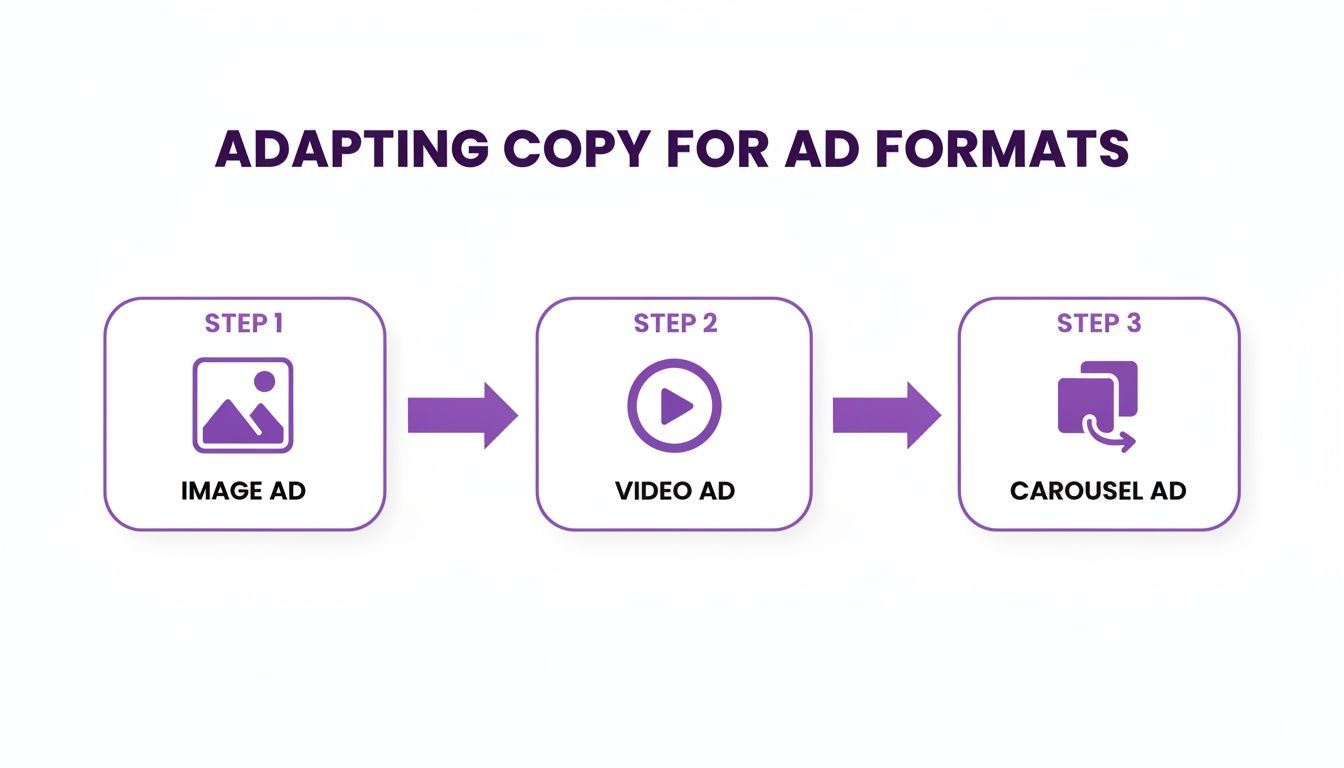
For a classic single-image ad, your visual is the scroll-stopper. It's the hook. The copy’s job is to give that image meaning and shove the user toward the click. They need to work together like a well-oiled machine. If your image shows a business owner drowning in paperwork, your headline better hit that exact pain point head-on.
Video ads are a completely different animal. Your script is the copy. You have about 3 seconds to grab someone's attention before they swipe away forever. Tell a quick, compelling story that moves from a clear problem to your brilliant solution. And remember, most people watch videos with the sound off. Burned-in captions or bold text overlays aren't optional—they're essential.
Carousel Ads
Carousels are your best friend for showing off multiple products, walking through a process, or stacking up benefits. The secret is to make each card a tiny, irresistible chapter that begs the user to swipe to the next one.
- Benefit Stacking: Use each card to highlight a different killer feature or benefit.
- Tell a Story: Unfold a narrative across the cards, building curiosity with every single swipe.
- Showcase Products: Give each product its own card, complete with a unique headline and direct link.
The copy on each carousel card has to be short and punchy. Treat each headline like a micro-CTA, giving them a powerful reason to keep going until the very end.
Your ad’s success is directly tied to the format you choose. When your message, copy, and placement all align with how a user is actually behaving at that moment, you create a frictionless path from ad to action. That's how you print money.
The right mix of copy and placement can change everything. For example, lead generation campaigns often pull a 2.53% click-through rate (CTR), which blows traffic campaigns (at 61% lower) out of the water. Placement is just as huge—Instagram Stories can deliver CTRs 61% higher than the standard Facebook Feed. You can see more industry benchmarks for Facebook ad performance on focus-digital.co.
Instagram Stories and Reels Copy
Welcome to the fast lane. On Stories and Reels, you've got seconds—literally—to make your point. Forget long paragraphs of primary text; nobody's reading them. Here, your copy lives on the creative as text overlays.
Your mission is to be quick, direct, and look like you belong there. Use snappy, bold text that adds to the video or image. Think bullet points, big keywords, and quick questions. The CTA isn't just a button; it's often an animated sticker or a direct command like "Swipe Up to Shop!" Your copy needs to feel native, like it could have been posted by a friend.
To really nail these platform-specific strategies, check out our deep dive on the best practices for Facebook ads. Mastering these little details is what ensures your message hits hard, no matter where your audience sees it.
Testing and Optimizing Your Ad Copy for Better Results
So you’ve launched your Facebook ad. Pop the champagne? Not quite. Launching isn’t the finish line—it’s the starting gun. The real work of turning a decent campaign into a high-octane conversion machine happens now, through relentless testing and listening to what the data tells you.
Great ad copy is rarely a stroke of genius on the first try. It’s a process of scientific refinement. This means getting comfortable with A/B testing, where you run a couple of ad variations against each other to see which one your audience actually responds to. By changing just one thing at a time, you can figure out exactly what works and systematically make your ads better.
Prioritizing Your A/B Tests for Maximum Impact
You can test nearly anything, from a comma placement to a different emoji. But your time and budget aren't infinite. The key is to start with the elements that have the biggest potential to move the needle. Don't get bogged down testing minor details when your headline isn't even stopping the scroll.
Focus your first wave of tests on these high-impact components:
- The Hook (Your First Sentence): This is your first impression, and you only get one. Pit a question-based hook against a bold, declarative statement. Or try leading with a surprising statistic versus a line that speaks directly to a customer's biggest frustration.
- The Headline: After your visual, this is the most prominent text on the ad. Test a clear benefit-driven headline ("Get Flawless Skin in 30 Days") against something that sparks curiosity ("The #1 Skincare Mistake You're Making").
- The Call-to-Action (CTA): This is the final nudge. Your last instruction is crucial. Test a direct command like "Shop Now" against a value-focused CTA like "Claim Your 50% Off." You'd be amazed how small wording changes here can dramatically affect click-through rates.
- The Core Angle: Are you framing the problem from a place of fear or aspiration? Test different psychological approaches. Does your audience respond better to a fear-of-loss message ("Stop Wasting Money on Ads") or one focused on the promise of gain ("Double Your ROI This Month")?
The goal of testing isn't just to find a "winner." It's to learn about your audience. Every test, win or lose, gives you a valuable insight into their motivations, fears, and desires that you can apply to all future marketing efforts.
Ad Copy A/B Testing Priority Matrix
To make it even clearer, here’s a guide to prioritizing which copy elements to tackle first for the biggest performance lift. Start at the top and work your way down.
| High | Headline | It's the most-read piece of text after the visual. A strong headline can double your click-through rate. | Benefit-Driven: "Automate Your Invoicing in 5 Mins" vs. Curiosity: "The Invoice Hack That Saved Us 10 Hours/Week" |
|---|---|---|---|
| High | Hook (First 1-2 lines) | This determines if someone stops scrolling or keeps going. It's your ad's entire first impression. | Pain Point: "Tired of marketing that doesn't work?" vs. Bold Statement: "Most marketing agencies are ripping you off." |
| Medium | Call-to-Action (CTA) | The final instruction can make or break the conversion. It needs to be clear, compelling, and low-friction. | "Learn More" vs. "Get Your Free Guide" |
| Medium | Core Angle/Framing | This tests the underlying psychology. Do customers respond to logic, emotion, scarcity, or social proof? | Scarcity Angle: "Only 50 spots left..." vs. Social Proof Angle: "Join 10,000+ happy customers..." |
| Low | Ad Body Length | Some audiences prefer short, punchy copy, while others need more detail to feel confident before clicking. | Short Copy (2-3 lines) vs. Long-Form Copy (3+ paragraphs) |
| Low | Offer Phrasing | How you present the offer can change its perceived value, even if the offer itself is the same. | "Get 50% Off" vs. "Buy One, Get One Free" |
Once you’ve found winning combinations for the high-priority elements, you can start fine-tuning the lower-priority ones to squeeze even more performance out of your campaigns.
Interpreting Key Metrics to Make Smart Decisions
Okay, your tests are running. Now what? It’s easy to get lost in the sea of data inside Facebook Ads Manager. The trick is to focus on the metrics that actually tell you if your copy is doing its job.
Here are the main indicators to watch:
- Click-Through Rate (CTR): What percentage of people who saw your ad actually clicked on it? A low CTR is a classic sign that your hook, headline, or visual just isn't grabbing attention.
- Cost Per Click (CPC): How much are you paying for each of those precious clicks? Better, more relevant copy often leads to a higher CTR, which Facebook’s algorithm rewards with a lower CPC. It’s a beautiful cycle.
- Conversion Rate: This is the ultimate test. Of the people who clicked, how many actually did the thing you wanted them to do (like make a purchase or fill out a form)? A high CTR but a low conversion rate can signal a disconnect between your ad's promise and your landing page's offer. For a deeper dive, our guide on conversion optimization best practices is a great next step.
By looking at these metrics together, you get the full story. A winning ad isn't just cheap to run; it’s an effective tool for turning clicks into customers.
Combating Ad Fatigue with Strategic Creative Rotation
You’ve found a winning ad—congratulations! But don't get too comfortable. Your audience will eventually get tired of seeing the same message over and over again. It’s a real thing called ad fatigue, and it’s when your performance starts to tank simply because people are bored.
The data on this is startling. One analysis of thousands of campaigns found that once an ad's frequency hits an average of two views per person, the cost per click (CPC) jumps by nearly 50%. Ouch.
To fight this, you need to have fresh copy variations ready to go before your current winner burns out. When you see your frequency climbing and your CTR dipping, it's time to swap in a new ad. This doesn't mean starting from scratch. Use what you learned from your A/B tests to launch new angles, hooks, and headlines that keep your message feeling fresh.
This proactive approach is essential for maintaining momentum and getting the most out of every dollar you spend.
Answering Your Nagging Facebook Ad Copy Questions
Even with the best game plan, you're going to have questions when you're deep in the trenches writing ad copy. The world of copywriting for Facebook ads is full of little "what-ifs" and "should-Is," and sometimes you just need a straight answer.
Think of this as your quick-reference guide. We're tackling the most common questions marketers and business owners get stuck on, from word count debates to dealing with the inevitable trolls.
How Long Should My Facebook Ad Copy Really Be?
Ah, the million-dollar question. The honest-to-goodness answer? It depends. There’s no magic number, but there are some solid rules of thumb depending on who you're talking to.
- For the strangers at the top of your funnel (cold audiences): Keep it short. Get to the point. Fast. Your only job is to stop their scroll and make them curious. The median ad copy length is just 14 words, which tells you everything you need to know. Think one to three punchy sentences.
- For your fans and potential buyers (warm/hot audiences): You’ve earned the right to go longer. These folks already know you, so you can dive deeper into the details, dismantle their objections, and tell a more complete story to nudge them over the finish line.
The best length is whatever it takes to be persuasive without wasting a single word. Test a short, snappy version against a longer, more detailed one. Let the data—not a guru's blog post—tell you what your audience actually wants to read.
Always remember: clarity is king. If you need more words to make your offer crystal clear and compelling, use them. Just make sure every sentence earns its keep.
Should I Use Emojis in My Ad Copy? Or Is That Tacky?
Yes, you absolutely should—but strategically. Emojis aren't just for your family group chat; they're powerful visual tools in a super-crowded feed. They break up walls of text, pull the eye to what matters, and inject a little personality way faster than words ever could.
Here's how to use them like a pro:
- Guide Their Eyes: Use checkmarks ✅ or arrows 👉 to spotlight your call-to-action or tick off key benefits. It's like a little visual breadcrumb trail.
- Show Some Personality: Emojis make your brand feel more human and less like a faceless corporation. That’s a huge win on a social platform.
- Replace Words: Why say "this is a hot deal" when a single 🔥 does the job? It saves space and communicates the vibe instantly.
A word of warning: don't go crazy. A paragraph that looks like a bowl of Lucky Charms just screams "spam." Use emojis to enhance your message, not to become the message. And for the love of all things marketing, make sure they match your brand's voice.
How Do I Handle Negative Comments on My Ads?
First, take a deep breath. It's not personal. Negative comments are just part of the price of admission when you're advertising in a public square. How you handle them says a lot more about your brand than the original comment ever will.
Here’s a simple playbook for when the haters show up:
Reply Publicly (and Quickly): Jump on it with a calm, professional, and helpful public response. This shows everyone else scrolling by that you're on top of things and you actually care.
Move It to a Private Channel: Offer to solve their specific problem offline. Something like, "We're sorry you had that experience. Could you send us a DM with your order details so we can sort this out for you?" works wonders.
Hide, Don't Delete: If a comment is just plain abusive, spammy, or full of foul language, just hide it. Deleting a comment can feel like poking a bear—they might come back even angrier. Hiding it makes it invisible to everyone except the person who posted it and their friends.
Treat every negative comment as a free focus group. It’s a chance to publicly display some killer customer service and maybe even uncover a real pain point you didn't know you had.
At Rebus, we turn these copywriting principles into high-performing campaigns every day. If you're ready to stop guessing and start getting real results from your ads, let's talk. Learn more about how we can elevate your brand at https://rebusadvertising.com.