
Choosing a Digital Marketing Agency for Law Firms
A digital marketing agency for law firms isn't just another vendor. They're a specialized partner who gets the unique ethical rules, the high-stakes client acquisition game, and the brutal competition baked into the legal industry.
Unlike a generalist agency that might be running campaigns for a local pizza shop one day and an e-commerce brand the next, these specialists build strategies to attract high-value cases—not just random website traffic. Their deep know-how in legal SEO, compliant advertising, and intake processes makes them a must-have for any growth-focused practice.
Why Specialized Law Firm Marketing Is Non-Negotiable

Let's be blunt: marketing your law firm isn't like promoting a restaurant. The stakes are immensely higher, the ethical guardrails are rigid, and the journey from a frantic Google search to a signed retainer is filled with nuance.
A generic marketing agency, used to broad consumer campaigns, can accidentally torch your firm's reputation or blow your budget on metrics that look good on paper but mean nothing to your bottom line.
This is why specialized expertise is no longer a "nice-to-have"—it's a fundamental requirement for winning. A generalist might get excited about a spike in website visitors, but a legal marketing specialist knows that attracting the right kind of visitor is the only thing that matters. They understand that a single catastrophic injury case can be worth millions, justifying a much higher cost-per-acquisition than in almost any other field.
The High Cost of a Generalist Approach
Imagine a family law firm hires a standard digital agency. Eager to show results, the agency launches a broad Google Ads campaign targeting keywords like "divorce help." They generate hundreds of clicks and proudly report a low cost-per-click.
The problem? The firm’s paralegals are now drowning in calls from people looking for pro bono advice or asking about legal issues completely outside their practice area. The leads are junk, the budget is vaporized, and zero new clients are signed. It’s a classic case of being busy but not productive.
Now, picture the same firm working with a digital marketing agency for law firms. This specialist agency gets surgical. They target long-tail keywords like "contested divorce attorney for high-net-worth individuals in [City]." The campaign might get fewer clicks, but nearly every lead is a potential high-value client. This targeted approach respects the firm's time and produces a clear, undeniable return on investment.
Of course, this is just one piece of the broader debate of in-house vs agency marketing, but the need for niche expertise remains constant.
The core difference lies in focus. A generalist agency chases vanity metrics like traffic and impressions. A legal marketing specialist relentlessly pursues the only metric that matters to a law firm: signed cases.
Navigating a Complex and Competitive Arena
The legal world is hemmed in by strict advertising rules set by state bar associations and the American Bar Association (ABA). A generalist agency could easily create an ad that makes a misleading claim or violates attorney advertising ethics, putting your firm at risk of disciplinary action. Ignorance isn't a defense.
On top of that, the competition in legal marketing is absolutely ferocious. The U.S. legal marketing industry now represents an estimated $2.5 billion in annual spend. A whopping 65% of firm marketing budgets are now dedicated to online channels, and that spending shot up by 39% between 2020 and 2024 alone. More firms are fighting for the same limited space on Google's front page, driving up costs and complexity.
To help you compare your options, here’s a quick breakdown of what separates a specialist from a generalist.
Generalist Agency vs. Legal Marketing Specialist
| Industry Knowledge | Broad, multi-industry experience. | Deep expertise in the legal sector, including specific practice areas. |
|---|---|---|
| Ethical Compliance | Limited or no understanding of state bar and ABA advertising rules. | In-depth knowledge of ethical guidelines is core to their strategy. |
| KPIs & Metrics | Focuses on traffic, clicks, and impressions. | Focuses on qualified leads, cost-per-case, and signed retainers. |
| Content Strategy | Creates generic content aimed at broad audiences. | Develops content that addresses specific legal pain points and builds trust. |
| SEO Approach | Standard SEO tactics that work for any business. | Specialized in Local SEO for lawyers and dominating the Google Map Pack. |
| Campaign Targeting | Targets broad, high-volume keywords (e.g., "car accident lawyer"). | Targets high-intent, long-tail keywords (e.g., "truck accident lawyer for TBI cases"). |
A specialized agency lives and breathes this competitive environment every single day. They just get it. They understand the nuances of:
- Local SEO: Dominating the Google Map Pack for moneymaking terms like "personal injury lawyer near me."
- Content That Converts: Writing practice area pages that don't just list facts but build trust and speak directly to a client's fears and needs.
- Ethical Compliance: Making sure every ad, landing page, and blog post adheres to ABA Model Rules and your state's specific guidelines.
Choosing the right partner means investing in someone who already speaks your language. Our guide on effective law firm marketing strategies goes deeper into what actually moves the needle in this unique sector.
Ultimately, a specialist agency doesn't just run ads for you; they build a sustainable, predictable client acquisition engine designed for the realities of a modern legal practice.
First Things First: Set Your Budget and Define What “Winning” Looks Like
Before you even think about sending out that first email to an agency, you need to get your own house in order. Jumping into the agency search without a clear budget and concrete goals is like walking into court without a case strategy. You’re handing over the keys to your firm’s growth without a map or a full tank of gas.
Most firms start with a vague wish for "more leads" or "a better website." That's fine for a casual chat, but it's not nearly enough to build a successful partnership on. You need specifics. You need numbers. You need a clear definition of success that you can hold an agency accountable to.
From Fuzzy Ideas to SMART Goals
The best marketing campaigns aren't built on hopes and dreams; they're driven by SMART goals. That’s an old-school acronym, but it works: goals should be Specific, Measurable, Achievable, Relevant, and Time-bound. This simple framework turns a wish into a battle plan.
Let’s see it in action:
- Vague Goal: "I want more personal injury cases."
- SMART Goal: "Increase the number of qualified leads for catastrophic injury cases from organic search by 20% within the next six months."
See the difference? The second one is a real target. It tells an agency the exact practice area (catastrophic injury), the channel to focus on (organic search), the metric that matters (qualified leads), the growth target (20%), and a deadline (six months). Now, an agency can build a real strategy with actual KPIs, not just throw spaghetti at the wall and see what sticks.
How Much Should You Actually Spend on Marketing?
Ah, the million-dollar question. Budgeting for digital marketing can feel like guesswork, but it doesn't have to be. Your investment should be directly tied to how fast you want to grow and where your firm is right now.
Here are a few ways to land on a realistic number:
- The Percentage of Revenue Rule: A common benchmark in the legal world is to allocate 7-12% of your firm's gross revenue to marketing. If you’re a newer firm trying to make a splash, you might push that closer to 15%. More established practices with a steady stream of referrals can often get by on the lower end.
- The Goal-Driven Approach: This one is my favorite because it works backward from your ambition. Say you want to add $500,000 in new revenue this year, and your average case is worth $25,000. That means you need 20 new cases. If you know your historical lead-to-client conversion rate, you can figure out exactly how many qualified leads you need and what you can afford to spend on each one.
- The Market-Reality Check: Sometimes, your budget has to be based on what it actually costs to compete. If you're a personal injury firm in a major city, the cost for a single click on a keyword like "mesothelioma lawyer" can run into the hundreds of dollars. That reality demands a much bigger war chest than a family law practice in a less competitive suburban market.
A well-defined budget isn't just an expense line on your P&L; it's a strategic investment in your future caseload. The moment you start seeing marketing spend as a revenue driver instead of a cost center is the moment you unlock serious growth.
What Your Budget Can Realistically Get You
Money talks. The size of your budget will directly impact the strategies an agency can deploy and how quickly you can expect to see a return. Here’s a rough breakdown of what different investment levels can typically achieve.
| Solo / Small Firm | $2,000 - $5,000 | Get the foundations right. This covers local SEO, optimizing your Google Business Profile, and creating targeted content for one core practice area. |
|---|---|---|
| Small to Mid-Sized Firm | $5,000 - $15,000 | Time for a full-court press. This budget supports a strong SEO campaign, a modest Google Ads spend, a consistent social media presence, and content for 2-3 of your most important practice areas. |
| Mid-Sized / Growth Firm | $15,000+ | Go on the offensive. We're talking aggressive, multi-channel campaigns with significant PPC budgets, advanced SEO, video marketing, and a dedicated content engine to establish your firm as the authority. |
Obviously, these are just ballpark figures. A digital marketing agency for law firms will tell you that a budget in a hyper-competitive market like New York City will need to be much larger to move the needle compared to a firm in a smaller metro area.
The goal here isn't to have all the answers, but to be prepared. Walk into those initial agency conversations with a clear budget range and specific goals. It will ensure everyone’s expectations are aligned from day one.
Finding and Vetting Potential Marketing Agencies
Okay, you’ve got your budget locked in and your goals are crystal clear. Now for the real work: finding an agency that can actually deliver. This is where you shift from internal planning to external evaluation, aiming to build a shortlist of agencies that do more than just talk a good game. You need proof.
The legal marketing world is smaller than it looks, and a firm's reputation follows it. Your first move should be to cast a wide net, tapping into both your professional network and digital resources. Frankly, the best place to start is by asking peers at firms you respect (but don't directly compete with). A warm referral from a happy client is worth more than any slick sales deck.
This first phase is all about gathering names and doing a quick gut check. Don't get lost in the weeds yet. Just focus on identifying agencies that live and breathe legal marketing.
Where to Look for Potential Partners
Building a solid list of candidates means looking in the right places. Just Googling "law firm marketing" will throw a million results at you, and most of them won't be worth your time. A multi-pronged approach is much smarter.
Here are the best channels to find a digital marketing agency for law firms:
- Peer Referrals: This is the gold standard. Ask managing partners or marketing directors at successful firms who they use and trust. Their experience is invaluable.
- Legal Directories and Publications: Reputable legal industry publications often feature or list agencies that have a proven track record in the legal space. They've already done some of the vetting for you.
- Industry Awards: Check out agencies that have won awards specifically for their work with law firms. It's not a guarantee, but it shows they're recognized for getting results.
- LinkedIn Searches: Use targeted searches on LinkedIn. Find agency leaders specializing in legal marketing and see which firms they’re connected with or what kind of content they're sharing.
Once you have a list of five to seven potentials, it's time to do some light stalking. Their own website is their #1 sales tool. If it’s slow, confusing, or packed with generic fluff, that’s a huge red flag.
There’s a reason firms are leaning on outside experts. Recent data shows a staggering 83% of law firms now hire external teams to run their marketing. And it's paying off—a cross-firm analysis puts the average three-year ROI from well-managed digital marketing at around 526%. That's the power of having specialists in your corner.
The simple visual below hammers home the two foundational steps—defining goals and setting a budget—that have to come before you even think about hiring.
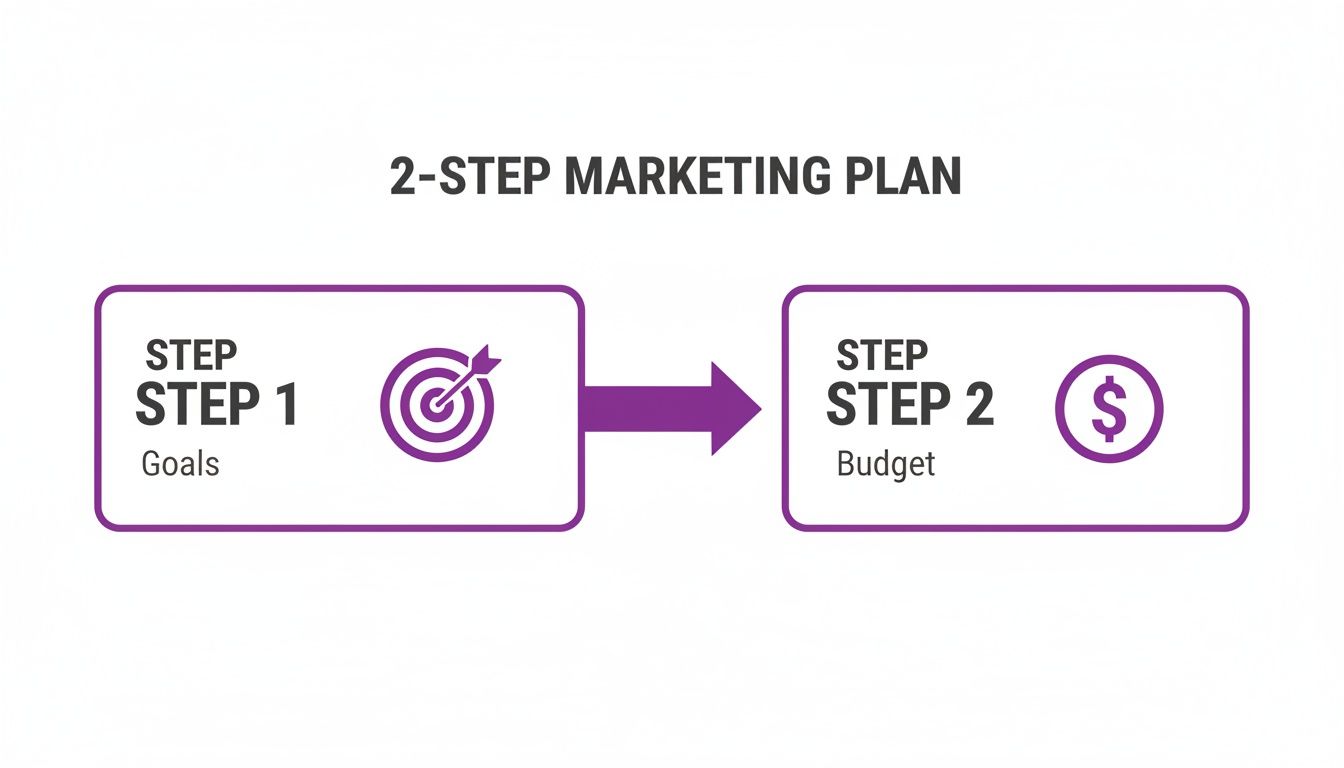
A successful partnership is built on this foundation. Without clear objectives and a realistic financial commitment from your firm, you're just setting everyone up for failure.
Key Questions for Your Initial Calls
Your first calls aren't sales pitches; they're interviews. You're the one in control. The goal is to cut through the polished presentation and get to the heart of their process, their expertise, and how they think. The best way to do that is with a list of sharp, direct questions.
Be ready to ask things that reveal what they're really made of:
"Walk me through a few law firm case studies. What were the initial goals and what was the final ROI?" You're listening for specific numbers here—cost per signed case, qualified leads, and actual revenue, not just fuzzy metrics like "increased traffic."
"How do you define the difference between a marketing lead and a case-ready lead in your reporting?" This question immediately shows if they understand the legal sales funnel. It's all about quality, not quantity.
"What's your team's experience with the legal ethics and advertising rules in my state?" A confident, detailed answer is non-negotiable. Any hesitation or vague response is a deal-breaker.
"Can you show me a sample monthly performance report?" It should be clean, transparent, and focused on business metrics that matter to a law firm—signed cases and revenue—not vanity metrics that just look good on paper.
A top-tier agency will love these questions. They should be proud of their process and eager to show you they understand the legal industry inside and out. If they get defensive or try to deflect, it’s a clear sign to move on.
As you vet them, also ask about the tools they use. For example, inquire if they offer things like white-label chatbot solutions for agencies to improve lead capture. A modern agency should have a full stack of technology to back up its strategy.
If you want more tips on narrowing down your list, check out our guide on how to choose a digital marketing agency. Ultimately, you’re not just hiring a vendor; you’re looking for a true partner who will feel like an extension of your own team.
How to Analyze Agency Proposals and Pricing
The proposals have landed. Now, the real work begins. This is your chance to peel back the curtain, look past the slick sales presentation, and figure out what each digital marketing agency for law firms is actually putting on the table. A beautiful proposal is worthless if the strategy is half-baked or the pricing makes no sense for your firm.
Honestly, learning to read between the lines is a skill. Most proposals are built to impress, packed with industry jargon and promises that sound a little too good to be true. Your job is to slice through the fluff and zero in on three things: the scope of work, the pricing model, and the Key Performance Indicators (KPIs) they're willing to be judged on.
Decoding Common Pricing Models
Agency pricing isn’t a one-size-fits-all game. You're going to see a few different models, and each comes with its own set of pros and cons for a law firm. Getting a handle on these will help you see whose financial approach actually lines up with your need for predictable costs and real-world results.
Here’s a quick rundown of what you’ll likely see:
- Monthly Retainer: This is the most common setup by far. You pay a flat fee every month for a specific set of services—think SEO management, content creation, and regular reporting. It’s great for budgeting and encourages a true long-term partnership. The only catch? You pay that same fee even if it’s a slow month.
- Project-Based Fees: This is for one-and-done jobs with a clear finish line, like a total website overhaul or a deep-dive local SEO audit. It's perfect for hitting specific needs but won't give you that ongoing marketing momentum you need to grow.
- Performance-Based Pricing: This one can be really tempting. The agency’s pay is tied directly to results, like the number of qualified leads they generate. While it sounds perfect—your goals are their goals!—it usually comes with a higher base fee. You also have to be careful that the contract doesn't incentivize them to chase quantity over quality.
We've found a hybrid model often hits the sweet spot. A modest base retainer combined with performance bonuses keeps the agency focused on your account while giving them a serious incentive to deliver what matters most: signed cases.
The Side-by-Side Comparison
Whatever you do, don't look at proposals in a vacuum. The only way to make a truly objective call is to line them up and compare them apples-to-apples. Fire up a simple spreadsheet and track how each agency measures up against the same criteria. This is how you turn a gut feeling into a smart, data-driven decision.
You can use the checklist below to systematically compare what each agency is offering and spot the right fit for your firm.
Agency Proposal Comparison Checklist
Use this checklist to systematically compare proposals from different digital marketing agencies and identify the best fit for your law firm's goals.
| Monthly Retainer Cost | Enter Price | Enter Price | Enter Price |
|---|---|---|---|
| Scope of SEO Services | E.g., On-page, Local SEO | E.g., Content, Link Building | E.g., Technical, Local |
| PPC Ad Spend Included? | Yes/No | Yes/No | Yes/No |
| Primary KPIs Proposed | Qualified Leads, CPL | Website Traffic, Rankings | Signed Cases, ROI |
| Reporting Frequency | Monthly | Bi-weekly | Monthly |
| Contract Length | 12 months | 6 months | Month-to-month |
| Legal Industry Expertise | Generalist | Legal Specialist | PI & Family Law |
This kind of structured comparison makes the important differences jump right out. Agency A might be cheaper, but they’re focusing on flimsy metrics. Agency C costs more, but they’re betting their success on the one thing that actually grows your firm—signed cases. You need a partner who eats, sleeps, and breathes ROI. To get a better sense of fair market rates, it helps to understand the factors that determine search engine optimization cost for Google before making a final call.
Red Flags to Watch Out For
A great proposal doesn't just sell you; it builds confidence and sets clear, honest expectations. A bad one, on the other hand, is usually littered with red flags that point to a lack of real expertise or, even worse, a focus on cashing your checks without delivering real value.
A proposal should be a strategic roadmap, not a book of empty promises. If it feels vague or too good to be true, it almost certainly is. The best agencies are transparent about their process and realistic about the timeline for results.
Keep your eyes peeled for any agency that tries to pull these moves:
- "Guaranteed #1 Rankings on Google": This is the oldest, most tired trick in the book—and it's a flat-out lie. Nobody can guarantee rankings because Google’s algorithm is a black box. It's the fastest way to spot an agency you can't trust.
- Focus on Vanity Metrics: Be very skeptical if the proposal is obsessed with metrics like "impressions," "website traffic," or "keyword rankings" without tying them directly to your business goals. Traffic doesn't pay the bills; new clients do.
- Vague or Unclear Scope of Work: The proposal needs to spell out exactly what you're paying for. If you see vague phrases like "ongoing optimization" without any specifics, you need to push back. What does that actually mean? How many hours? Which specific tasks?
At the end of the day, this decision comes down to value, not just cost. The cheapest agency is almost never the best one. You want to partner with the team that proves they understand legal marketing, lays out a clear strategy tied to your firm's growth, and is willing to measure their success by your bottom line.
Ensuring a Successful Partnership from Day One

Signing the contract isn't the finish line; it’s the starting pistol. The real success of your partnership with a digital marketing agency for law firms is forged in what happens next. A structured, collaborative onboarding process during the first 90 days is absolutely critical for setting the right tone and making sure everyone is on the same page.
Think of this initial period less as a sprint for immediate leads and more as laying the foundation for long-term growth. This is where your new agency goes from being an outsider to an integrated part of your firm's growth engine. The groundwork you lay here will directly impact the results you see six months down the road.
Kicking Things Off the Right Way
It all starts with a formal kickoff meeting. This isn’t just a quick "hello"—it's a deep-dive strategy session where both teams get aligned. Make sure your firm’s key stakeholders are in the room so nothing gets lost in translation.
This meeting needs to cover a few essential items to ensure a smooth technical handoff and strategic alignment. A clear agenda turns what could be a simple meet-and-greet into an actionable planning session.
- Granting Access: Your agency will need admin access to your website backend, Google Analytics, Google Business Profile, and any ad accounts you already have. Delays here can stall the entire campaign before it even starts.
- Defining Communication Channels: Establish a clear rhythm for communication from the get-go. Will you have weekly calls? Use a shared Slack channel? Who is the single point of contact on each side? Nail this down now.
- Reviewing Goals and Timelines: Reiterate the SMART goals you agreed upon. The agency should come prepared with a 30-60-90 day plan outlining their immediate priorities, like technical SEO audits, competitor analysis, and building out the initial campaigns.
A great agency won't wait for you to lead the onboarding. They'll show up to the kickoff meeting with a detailed checklist and a clear plan of action. Their proactivity in these first few weeks is one of the strongest indicators of their overall competence.
Measuring What Truly Matters for a Law Firm
Once the initial setup is complete, the focus has to shift to performance measurement. Let's be blunt: generic business metrics are useless for a law firm. Your dashboard shouldn't be cluttered with vanity metrics like "impressions" or "click-through rate." While they can be useful for diagnostics, they don't tell you what you really need to know.
The KPIs you track must directly reflect your firm's business objectives. Your reports should answer one simple question: "Is this marketing investment bringing in valuable cases?" This means tracking metrics that connect online activity directly to your firm’s bottom line—the only true measure of ROI.
Your Monthly Performance Dashboard
Your monthly report should be a clean, concise snapshot of business impact. It needs to be easy to understand at a glance, allowing you to see progress without needing a degree in data science. A good dashboard for a law firm should prominently feature these KPIs:
| Total Qualified Leads | The number of inquiries that actually meet your criteria for a potential case. This separates real opportunities from spam. | Increase qualified leads by 15% quarter-over-quarter. |
|---|---|---|
| Cost Per Qualified Lead (CPL) | Exactly how much you're spending in marketing to generate one legitimate potential case. | Keep CPL for family law leads under $250. |
| Lead-to-Client Conversion Rate | The percentage of qualified leads your intake team successfully signs up as new clients. | Achieve a 25% lead-to-client conversion rate. |
| Cost Per Signed Case (CPSC) | The ultimate ROI metric. This tells you the exact marketing cost required to acquire a new, paying client for your firm. | Reduce CPSC for personal injury cases by 10% in 6 months. |
This intense focus on business outcomes is what separates a true partner from a mere vendor. A top-tier digital marketing agency for law firms understands that their success isn't measured in clicks or traffic, but in the tangible, profitable growth of your practice. They build their entire strategy around the metrics that finance your firm's future.
Answering the Tough Questions About Law Firm Marketing Agencies
Alright, you've got a process, you've shortlisted a few agencies, but the practical, nitty-gritty questions are probably swirling. That’s normal. This is a huge investment, and you need to be sure about timelines, costs, and what happens if things don't quite click.
Let's tackle the questions that managing partners are really asking behind closed doors. Getting clear answers here is what separates a confident decision from a hesitant one.
How Long Until We Actually See a Return on Our Investment?
This is the big one, isn't it? The question every partner wants answered before signing anything. While paid campaigns, like a sharp Google Ads strategy, can get the phone ringing in a matter of weeks, the real, sustainable growth from SEO and content is a long game.
Think of it like building a case:
- Months 1-3: Discovery and Foundation. This is where the groundwork happens. The agency is deep in technical audits, competitor analysis, keyword research, and getting all the tracking right. You might see a few early wins, but this is about building the engine, not flooring it.
- Months 4-6: Gaining Momentum. By now, you should start feeling the pull. Keyword rankings should be climbing, organic traffic ticking up, and a more consistent stream of qualified leads should be hitting your inbox. This is where the strategy starts to show its teeth.
- Months 7-12 and Beyond: The Compounding Effect. This is where the magic happens and the real ROI kicks in. Consistent, high-quality SEO and content efforts start to compound, driving a significant volume of organic leads. This is how you dramatically lower your average cost per signed case over time.
A classic mistake is yanking the cord too early. SEO for a competitive field like law is a marathon, not a sprint. The firms that win big are the ones that commit to a consistent, long-term strategy.
What If We Already Have a Marketer on Staff?
That’s fantastic—it’s not an "either/or" situation. In fact, some of the most successful partnerships are a hybrid model where an agency acts as a force multiplier for your in-house talent.
Your in-house marketer knows your firm’s culture, your attorneys, and your voice inside and out. They’re perfect for handling social media, coordinating firm events, and giving the final sign-off on content to ensure it feels authentic.
An agency brings a different arsenal to the table—specialized, technical expertise that’s incredibly difficult (and expensive) to hire for full-time. We’re talking about:
- Deep technical SEO audits and implementation
- Advanced paid media management and optimization
- Competitive backlink analysis and outreach strategies
- Conversion rate optimization (CRO) to turn more clicks into clients
This setup lets your team focus on the brand and internal culture while the agency executes on the highly technical, lead-generating work.
Are We Going to Be Locked into a Long-Term Contract?
Most agencies worth their salt will ask for an initial commitment of at least six to twelve months. This isn’t a trap; it’s a reflection of reality. It simply takes that long to execute a strategy and deliver meaningful results, especially with something like SEO.
An agency needs that runway to build, implement, measure, and optimize.
However, you should be wary of anyone demanding an ironclad, multi-year contract with no performance clauses or escape hatches. A fair agreement should feel like a partnership. A very common and reasonable structure is a 12-month initial term that rolls into a month-to-month agreement afterward. This gives you long-term flexibility once the foundational strategy is in place and working.
Who Actually Owns the Website and Ad Accounts?
This is non-negotiable. It’s a critical point that absolutely must be crystal clear in your contract.
Your law firm must always retain 100% ownership of all digital assets.
That includes:
- Your website domain
- All website files, content, and code
- Your Google Ads account
- Your Google Analytics profile
- All of your social media profiles
An agency will need administrative access to manage these things for you, but they should never, ever be the legal owner. If you decide to part ways, you need to be able to take everything with you, no questions asked. An agency insisting on owning your accounts is waving a giant red flag. Run, don't walk.
Choosing the right digital partner is one of the most important growth decisions you'll make. At Rebus, we combine deep legal industry knowledge with data-driven strategies to build client acquisition engines for law firms. If you’re ready for a marketing partnership that’s focused on tangible results, let's connect.