
Display Ads vs Search Ads A Guide to Choosing the Right Strategy
Here’s the thing about display ads versus search ads: it all boils down to pull vs. push.
Search ads pull in people who are already looking for you (or something you sell). Display ads push your message in front of people to create that demand from scratch. Think of it this way: search ads are the answer to a question someone is actively asking, while display ads are the billboard they see on their way to somewhere else.
Understanding the Core Difference in Advertising
Before we get into the weeds, you have to nail this fundamental concept. Search advertising is like putting your business in the Yellow Pages (remember those?). Someone has a problem—a leaky faucet, a need for new running shoes—and they go looking for a solution. Your ad shows up right at that moment of need. It’s a reactive play, but it’s incredibly powerful for snagging sales and leads from people who are ready to buy.
Want to get better at capturing that high-intent traffic? We break it down in our guide to paid search advertising.
Display advertising, on the other hand, is the highway billboard. It interrupts someone’s day while they’re reading the news, watching a YouTube video, or scrolling through a blog. The goal isn’t to make a sale right then and there. It’s about planting a seed, building brand recognition, and making sure your name is the first one they think of when they do eventually have that problem.
This image nails the push vs. pull dynamic perfectly. Search meets an active need on a phone, while display broadcasts a message to a wider, less-focused audience.

The key takeaway is simple: one channel cashes in on existing interest, while the other has to create it.
Search Ads vs Display Ads At a Glance
To give you a quick cheat sheet, here’s a high-level look at how these two channels stack up. This table breaks down the biggest differences before we dive deeper.
| User Intent | High (Actively searching for a solution) | Low to Medium (Browsing content, not actively looking) |
|---|---|---|
| Primary Goal | Lead Generation, Sales, Direct Conversions | Brand Awareness, Reach, Retargeting |
| Ad Format | Primarily Text-Based (Headlines, Descriptions) | Visual (Images, Videos, Animated Banners) |
| Targeting | Keyword-Based (Matching user search queries) | Audience-Based (Demographics, Interests, Behaviors) |
| Placement | Search Engine Results Pages (SERPs) | Websites, Apps, Videos (e.g., Google Display Network) |
This stuff changes fast, so for more ongoing insights and expert takes, it’s always a good idea to keep resources like Branditok's Digital Marketing Blog in your reading rotation. They frequently cover the latest shifts in digital ad strategies.
Search vs. Display: High-Intent Hunters vs. Passive Prospectors
The absolute biggest difference between search and display ads comes down to one thing: user intent. Get this, and everything else—targeting, creative, and what you can expect in return—snaps into focus.
Think of it like this: search ads are about capturing demand that already exists. Display ads are for creating it from scratch.
Search Ads: Targeting People on a Mission
Search advertising is a direct response to a user's action. Someone heads to Google with a problem to solve or a question to ask, and they type it into the search bar. That action is a massive signal of high intent. Your ad’s job is to be the best, most relevant answer they can find.
This is where you target based on the exact words people are typing. It's incredibly precise, letting you show up the second a potential customer is looking for you.
You'll fine-tune this with a few key tools:
- Broad Match Keywords: This is like casting a wide net. It's great for discovering new search terms but can pull in some less-than-perfect traffic.
- Phrase Match Keywords: A solid middle ground. Your ads show for searches that include the meaning of your keyword, balancing reach with relevance.
- Exact Match Keywords: The sniper rifle. You're targeting queries with the same meaning as your keyword, giving you maximum control and usually the highest-quality clicks.
A law firm, for example, wouldn't just bid on "lawyer." That's way too broad. They’d get specific with high-intent phrases like "personal injury attorney near me" (perfect for Exact Match) or "find a business lawyer" (a great Phrase Match candidate) to grab people actively hunting for legal help. Nailing this is critical, and you can go deeper in our guide on what is search intent.
Display Ads: Targeting People, Not Keywords
Display ads flip the entire model around. Instead of targeting keywords, you're targeting people. The user isn't actively searching for your brand; they’re just living their digital life—reading an article, watching a YouTube video, or scrolling through an app. Your visual ad pops up alongside that content, aiming to spark their interest.
The whole strategy shifts from "What are they searching for?" to "Who are they, and what are they interested in?" This opens up a huge, but far less direct, world of targeting possibilities.
With display, you’re focusing on audience behaviors and characteristics. Some of the most powerful options include:
- In-Market Audiences: Targeting users Google has flagged as actively researching products or services like yours and getting close to a purchase.
- Affinity Audiences: Reaching people based on their long-term passions and habits, like "avid investors" or "home decor enthusiasts."
- Demographic Targeting: Filtering by the basics—age, gender, parental status, and even household income.
- Custom Audiences: Building your own ideal audience by plugging in keywords, URLs, and apps you know your customers frequent.
- Remarketing: This is a big one. You show your ads to people who've already visited your website, making it a super-effective way to stay top-of-mind with warm leads.
This difference in approach has a huge impact on your wallet. The fierce competition for high-intent keywords makes search ads much pricier per click. On average, you can expect to pay $2.41 to $2.69 for a search click, while display ad CPCs hover between $0.59 to $0.63.
That means display can be up to 75% cheaper per click, letting you build massive brand awareness and test creative without breaking the bank. You’re tapping into Google's network that reaches over 90% of all internet users—a massive stage for a much smaller price tag. You can dive into more of these numbers and strategies in this strategic performance comparison on CyberOptik.net.
Ad Formats and Creative Potential: Words vs. Pictures
Alright, let's get into what people actually see. Moving past the technical stuff like targeting, the creative side of the display vs. search ads debate is where the rubber really meets the road. This is what shapes your message, your team’s skills, and ultimately, your results.
Think of it this way: one is a game of razor-sharp language, and the other is a sprawling visual playground.
Search Ads: The Art of the Perfect Answer
Search advertising is a world built entirely on words. You’re meeting someone who is actively looking for a solution, so your only job is to give them the most relevant, compelling text-based answer to their question. Success here isn’t about flashy graphics; it’s about killer copywriting and owning every pixel of space you’re given on the search results page.
In search, your ad is a headline, a couple of lines of description, and a URL. The whole creative challenge is cramming maximum impact into a tiny space. Every single character matters.
A search ad that actually works has to do a few things, and it has to do them instantly:
- Match Their Brainwaves: The copy has to mirror the user's keyword, giving them that instant "aha, I'm in the right place" feeling.
- Serve Up the Solution: Don’t be coy. State exactly how you solve their problem.
- Give a Clear Command: Use strong, no-nonsense calls to action like "Get a Free Quote" or "Shop Now & Save 25%."
- Build Instant Trust: Little things like "Official Site" or mentioning "Since 1998" can make a huge difference.
Beyond the basic text, ad extensions are your secret weapon. These are the add-ons—sitelinks, callouts, location info—that let you gobble up more real estate on the page. They push competitors down and give users more reasons to click your ad. Think of them as free upgrades that make your ad bigger, better, and more useful.
For search ads, your copy is the entire creative. It needs to be a perfect cocktail of relevance, persuasion, and clarity. There's zero room for fluff when a user is actively comparing their options.
Display Ads: The Visual Playground
Display ads play by a completely different set of rules. Here, the visuals aren’t just part of the message; they are the message. You're interrupting someone while they’re reading an article or checking the weather, so your ad has to be visually stunning enough to hijack their attention and tell a story in a split second.
This channel gives you a whole toy box of creative formats to play with.
Common Display Ad Formats:
- Static Image Ads: Your classic JPG or PNG banners. They’re simple, effective, and great for getting a clear, straightforward message out there fast.
- Animated GIFs: These looping animations can tell a quick story or just use movement to catch the eye, making them way more engaging than a flat image.
- HTML5 Ads: This is where things get fun. These are the most dynamic ads, allowing for interactive elements and rich animations that feel more like a mini-app than a banner.
- Responsive Display Ads: This is Google’s go-to format for a reason. You just feed it a bunch of assets—images, logos, headlines, and descriptions—and Google's AI becomes your creative director, mixing and matching them to build ads that fit perfectly across millions of websites.
Let’s put it into context. An e-commerce brand drops a new sneaker. They’ll run search ads with direct copy like “Buy the New Aero-Runners | Free Shipping” to grab people who are ready to buy. At the same time, they’ll blast vibrant HTML5 display ads showing the shoe in action, targeting audiences of "runners" and "fitness enthusiasts" to build hype and brand recognition long before those people ever think to search for it.
Breaking Down Performance Metrics and Costs
When you pit display ads against search ads, the differences in performance and cost aren't just numbers on a spreadsheet—they're a direct reflection of user intent. Getting a grip on these key performance indicators (KPIs) is the only way to set realistic goals and spend your budget wisely.
Think of it this way: Search ads are built for the now. Display ads are for building the next.
The most telling difference pops up in the Click-Through Rate (CTR), which measures how often people who see your ad actually bother to click it. The gap here tells a powerful story about what's going through a user's head.
This chart lays out the stark reality of that difference.
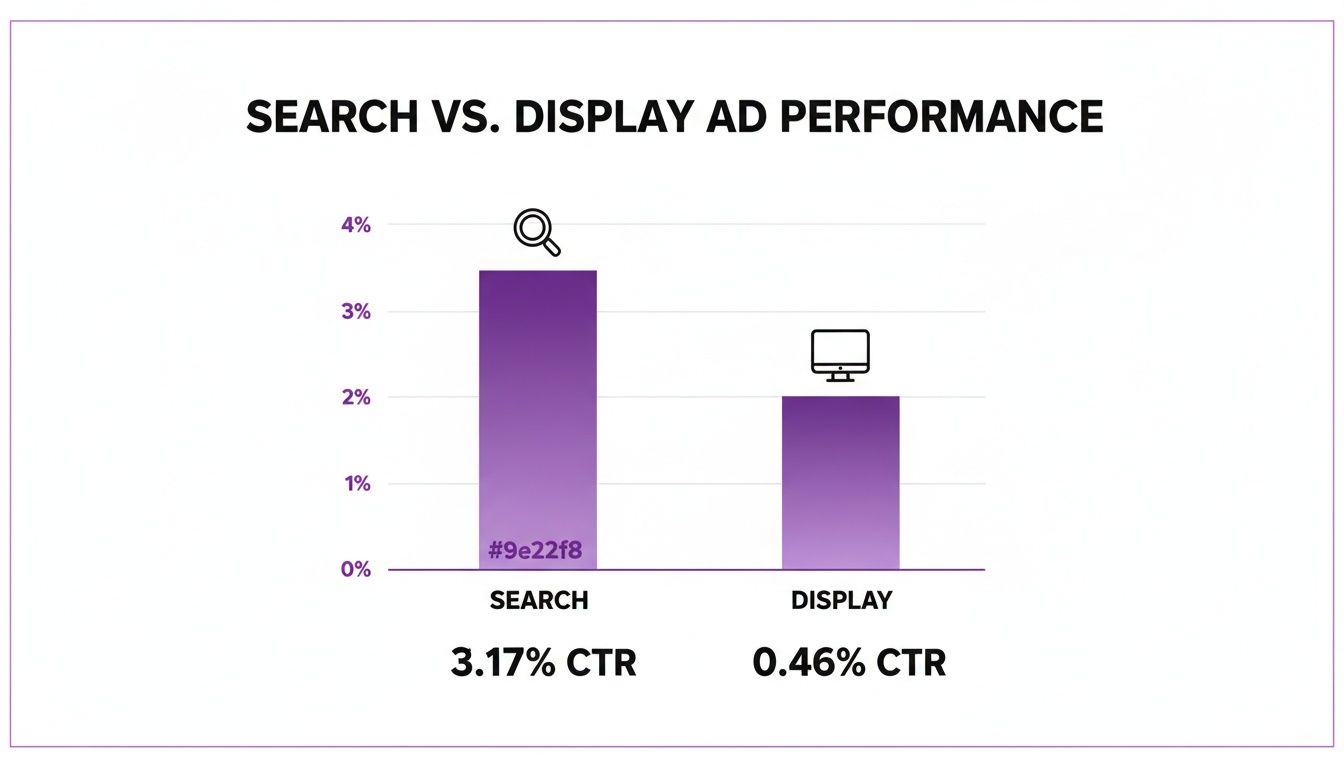
As you can see, search ads absolutely crush display ads in clicks. Why? Because they're answering a question someone is actively asking, while display ads have to work a lot harder to interrupt someone's browsing and grab their attention.
Click-Through Rate: The Intent Divide
Search ads consistently dominate display ads in CTR for one simple reason: they capture users who are actively hunting for a solution. Industry benchmarks show that search ads pull in an average CTR of 3.17%, while display ads lag way behind at just 0.46%. That's a nearly seven-fold difference, hammering home the point that people on Google are in a problem-solving mode, making them far more likely to click on a relevant ad.
Display ads, on the other hand, show up while users are reading articles or watching videos. They're an interruption, not an answer. Even the best-performing display industries, like real estate (which hits a 1.08% CTR), can't touch search's baseline performance. This cements search's role as the go-to for driving high-intent, ready-to-act traffic.
Cost Per Click And Cost Per Mille
The way you pay for these ads also reflects their different jobs. Search ads almost always run on a Cost Per Click (CPC) model, meaning you pay every time someone clicks. Because you're bidding on valuable, high-intent keywords, this space is more competitive and, frankly, more expensive.
Display ads offer a bit more flexibility. While CPC is an option, many campaigns are run on a Cost Per Mille (CPM) basis, where you pay for every one thousand impressions (views). This model is perfect for brand awareness. The goal isn't necessarily a click—it's getting your brand's visual message in front of as many relevant eyeballs as possible.
A campaign laser-focused on immediate sales? That higher CPC on search is often an investment that pays for itself. A new brand launch that just needs mass exposure? A low CPM on display is your most cost-effective path to getting seen.
This trade-off is the heart of the display vs. search decision. You pay a premium for the qualified, ready-to-convert traffic from search, while display offers a cheaper way to build an audience and plant seeds for future demand.
Conversion Rates And Cost Per Acquisition
At the end of the day, what most of us really care about are conversions—whether that's a sale, a form fill, or a phone call. And once again, search ads have a clear edge thanks to that all-important user intent. The average conversion rate for search ads is significantly higher than for display.
This efficiency translates directly to the Cost Per Acquisition (CPA), which is the bottom-line metric of how much you paid for each conversion. While a single click from a search ad might cost more, the higher conversion rate often leads to a lower overall CPA for those bottom-of-the-funnel goals.
- Search Ads: Higher CPC but a much higher conversion rate, often resulting in a more efficient CPA for leads and sales.
- Display Ads: Lower CPC and CPM but a rock-bottom conversion rate, which typically means a higher CPA for direct-response goals.
But don't write off display ads just based on direct conversions. Their secret power lies in "view-through conversions." This is when someone sees your display ad, doesn't click, but later searches for your brand and converts. This makes display a powerful sidekick to your search campaigns, feeding the top of the funnel so search can close the deal.
To get a better handle on what your potential ad spend and returns might look like, a good forecasting tool is a must. You can map out some scenarios with our Google Ads calculator.
To put it all together, here’s a quick-glance table comparing the typical performance you can expect from each channel.
Key Performance Indicator Benchmarks: Search vs Display
| Click-Through Rate (CTR) | 3.17% | 0.46% | Search captures active intent, driving significantly more clicks per impression. |
|---|---|---|---|
| Cost Per Click (CPC) | ~$2.69 | ~$0.63 | You pay a premium for high-intent search traffic, but display clicks are much cheaper. |
| Conversion Rate (CVR) | 3.75% | 0.77% | Search users are primed to convert, leading to much higher action rates. |
| Cost Per Acquisition (CPA) | ~$48.96 | ~$65.80 | Despite higher CPCs, search's strong CVR often results in a more efficient CPA for direct sales. |
These benchmarks are just averages, of course—your mileage will vary based on your industry, creative, and targeting. But they clearly illustrate the fundamental trade-off: search is for harvesting existing demand with precision, while display is for creating future demand with broad, cost-effective reach.
Mapping Ad Types to Your Marketing Funnel
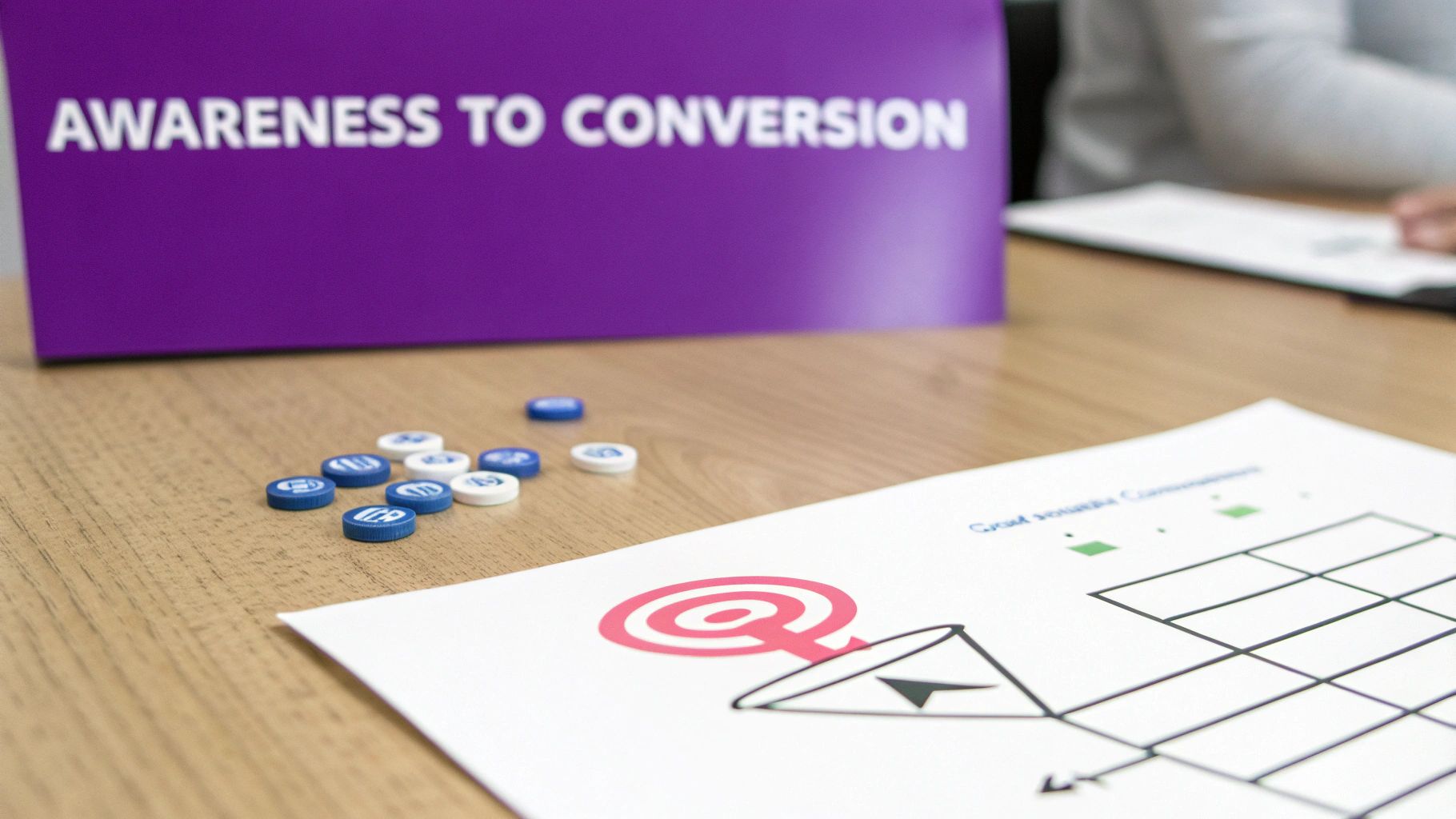
The whole display ads vs. search ads debate isn't about picking a winner. It's about knowing which tool to grab for which job. Thinking of them as competitors is a rookie mistake; they're specialists on the same team, each owning a different stage of the customer journey.
A killer campaign doesn't choose one over the other—it uses both. You assign them to the part of the marketing funnel where they'll make the biggest impact. This way, you’re not just snagging the low-hanging fruit; you're also planting the seeds for future customers.
Top of Funnel (TOFU): Display Ads Are Your Megaphone
At the top of the funnel (or TOFU), your main goal is just getting noticed. People at this stage might not even know your brand exists, or maybe they don't realize they have a problem you can solve. This is where display ads roll out the red carpet.
Display ads are built for creating that initial spark of awareness. By plastering your visually engaging ads across relevant websites, apps, and videos, you’re introducing your brand to a massive—but targeted—audience. The goal isn't an immediate sale. It’s to plant a flag in their brain and build brand recall for later.
Imagine a new eco-friendly cleaning supply company. They could run display ads targeting people browsing home decor blogs or watching Marie Kondo-style organization videos. The ads show off their slick, sustainable packaging, creating a great first impression long before someone actually needs to buy more soap.
Display advertising is the welcome mat for your brand. It’s a proactive "push" that fills the top of your funnel with potential customers who you can warm up over time.
This stage is all about reach and impressions. You're building an audience that will recognize your name down the road, making them way more likely to click when they eventually see one of your search ads.
Middle and Bottom of Funnel (MOFU/BOFU): Search Ads Close the Deal
As people move down the funnel, their mindset shifts completely. They’ve figured out they have a problem and are now actively hunting for a solution. Welcome to the Middle and Bottom of the Funnel (MOFU/BOFU)—this is search ad territory.
Search ads are the ultimate tool for capturing someone who's ready to act. When a user types "best organic all-purpose cleaner" into Google, they're practically waving cash in the air. Your text ad pops up at that exact moment, offering a direct path to what they want.
This is exactly why search ads blow display ads out of the water on direct-response metrics. The numbers don't lie: search ads are miles ahead at driving sales, with conversion rates averaging 3.75% to 4.40% compared to a measly 0.57% to 0.77% for display. That efficiency gap shows up in the cost per acquisition, too—$48.96 for search versus $75.51 for display, simply because search users are already in decision mode. You can dig into more of this data over at amraandelma.com.
- Middle of Funnel (MOFU): Your prospect is comparing options. Search ads targeting keywords like "eco-friendly cleaner reviews" or "plant-based vs chemical cleaners" can position your brand as the obvious choice.
- Bottom of Funnel (BOFU): They're ready to buy, period. Search ads targeting your own brand ("Brand X cleaner") or transactional terms ("buy organic cleaner online") are there to seal the deal.
Retargeting Display Ads: The Bridge That Connects Everything
So what connects the broad awareness you built with display to the sharp conversions you get from search? Retargeting. It’s a genius display ad tactic that acts as the perfect bridge between your funnel stages.
Retargeting lets you show specific display ads to people who’ve already visited your website but didn't buy anything. Maybe they clicked a search ad, browsed a few products, then got distracted. A retargeting ad can follow them around the web, reminding them of the exact items they looked at and nudging them to come back and finish the job.
This strategy works incredibly well because you're targeting a warm audience that's already shown interest. It keeps your business top-of-mind, nurturing those middle-of-the-funnel leads until they're finally ready to pull out their credit card. By combining broad display for awareness, laser-focused search for conversions, and smart retargeting to re-engage, you build a full-funnel machine that drives real, sustainable growth.
Deciding When to Use Search vs. Display Ads
Alright, let's get down to brass tacks. Choosing between search and display isn’t about picking a universal winner—it's about matching the right tool to the job you need done right now. Think of it less like a cage match and more like picking between a hammer and a screwdriver.
The whole decision really boils down to your immediate goal. Are you trying to capture lightning in a bottle and get sales today? Or are you playing the long game, building a brand that people will remember tomorrow? Your answer points you straight to your starting line.
When to Go All-In on Search Ads
Search ads are your closers. They're for capturing demand that already exists, targeting people who are actively raising their hand and saying, "I need a solution."
You should lean heavily on search when:
- Your Budget is Tight: When every penny needs to pull its weight, search is your best friend. You're targeting high-intent users who are ready to act, which often leads to a more efficient Cost Per Acquisition (CPA). Yes, the clicks might cost more, but they're the right clicks.
- You Need Leads, Like, Yesterday: If your sales team is hungry and the pipeline is dry, search is the most direct way to fill it. You’re showing up at the exact moment a potential customer is looking for what you sell. No fluff, just action.
- You Solve an Urgent Problem: Think about it. Nobody is casually browsing for an emergency plumber or a locksmith at 2 AM. They're frantically typing into Google. For these businesses, search advertising isn't just a strategy—it's a lifeline.
When to Unleash Display Ads
Display ads are your brand builders. They’re for creating future demand, making your brand memorable, and planting seeds that will grow into customers down the road. This is top-of-funnel magic.
Unleash display ads when:
- You're Launching Something New: If you've just created a revolutionary new product, guess what? Nobody knows to search for it yet. Display ads get your new idea in front of the right eyeballs, building that crucial initial awareness from scratch.
- Your Sales Cycle is a Marathon, Not a Sprint: For complex B2B services or big-ticket luxury items, decisions take time. Display retargeting is perfect for staying top-of-mind, gently reminding interested prospects that you're still there while they do their research.
- Your Brand is All About the Vibe: If you're a fashion label or a travel company, a plain text ad just won't cut it. You need to sell a dream. The visual canvas of display ads is built for showcasing stunning imagery that creates desire and an emotional connection.
Here's the simplest way to think about it: If your customer knows they have a problem, use search ads to be the solution. If you need to show them they have a problem—or convince them you’re the best solution out there—start with display.
The Real Answer: A Hybrid Strategy
For most businesses, the debate over display ads vs search ads isn't an "either/or" question. The real magic happens when you use them together, strategically.
A brand-new e-commerce store might pour 70% of its budget into search to snag those initial, profitable sales, while dedicating 30% to display for retargeting abandoned carts and building some early brand recognition. As that brand grows, the split might evolve to 50/50 to fuel expansion and reach new audiences.
To build a truly powerful machine, you need to see the bigger picture. Understanding how these channels fit within the broader advertising world, like in a comparison of Google Ads vs. Facebook Ads vs. TV advertising, helps you orchestrate a complete marketing strategy where every part works in harmony to drive real, sustainable growth.
Search vs. Display Ads: Your Burning Questions Answered
Alright, let's cut through the jargon. You've got the basics down, but now you're wondering how this all plays out in the real world. Here are the practical, no-fluff answers to the questions we hear all the time.
Can a Small Business Actually Afford to Run Both?
Yes, and you don’t need a massive war chest to do it. The trick isn't a bigger budget; it's a smarter one.
If you're just starting out, put your money on search ads first. Why? Because you're capturing people who are already looking for what you sell. It's the fastest path to getting a return on your ad spend, which is critical when every dollar counts.
Once you have a steady flow of sales or leads coming in, take a small slice of that profit and reinvest it into display. Start with a simple remarketing campaign. This is the most efficient way to use display—you’re only showing ads to people who have already visited your site, so the audience is warm and the budget goes a lot further. It’s a phased approach that lets you grow without breaking the bank.
How Long Until I See Results? Be Honest.
Search ads are for the impatient. You can literally start seeing clicks, leads, or sales within hours of a campaign going live. The feedback is instant, which means you can see what's working (and what's not) and make changes on the fly.
Display ads play the long game. Since they're mostly about getting your name out there, the payoff isn't as immediate or direct. You won't see a sudden spike in sales the day you launch. Instead, you're building brand recognition that pays dividends weeks or months down the line through more direct website visits and people searching for your brand by name.
Think of it this way: Search ads are like harvesting ripe fruit from a tree—you get an immediate reward. Display ads are like planting seeds for a future harvest. You need both.
Which One Is the King of Retargeting?
This isn't even a contest: display ads win by a landslide.
Sure, you can do retargeting with search ads (they're called RLSAs, or Remarketing Lists for Search Ads), but display is where this tactic really shines.
With display retargeting, you can follow your website visitors around the internet with visually compelling ads. That gentle, persistent reminder keeps your brand top-of-mind and is ridiculously effective at nudging hesitant buyers over the finish line. Let's face it, a slick visual ad showing someone the exact pair of shoes they were just looking at is way more persuasive than a plain text ad they might not even see again.
Ready to stop guessing and start growing? The experts at Rebus have managed over $100 million in ad spend, turning strategy into measurable success. We build integrated campaigns that use the right channels at the right time. Partner with us to supercharge your marketing today.