
Mastering Google Analytics Goals for Growth
Let's be real. In the simplest terms, Google Analytics goals are just the specific user actions you decide are important enough to track. Think of them as finish lines for the stuff that actually matters on your website—someone filling out a contact form, signing up for your newsletter, or, the holy grail, completing a purchase.
Setting these up is the single most critical step you can take to turn a flood of raw traffic data into actual business intelligence.
Why Goals Are Your Most Powerful Analytics Tool

Without goals, your analytics platform is basically a passive observer just counting page views and sessions. You can see how many people showed up to the party, but you have no clue what they did or if it made a difference.
By setting up Google Analytics goals—or "conversions," as they're now called in Google Analytics 4 (GA4)—you’re actively defining what a successful visit actually looks like for your business.
This simple act transforms your analytics from a report card full of vanity metrics into a strategic roadmap. It becomes the language your website uses to tell you what's working and what's falling flat.
From Data Collection to Decision Making
Honestly, setting up conversion tracking is the most important thing any business can do if it wants to grow. This isn't just about watching numbers go up; it's about understanding the behaviors that lead directly to revenue and customer loyalty.
Once you're tracking these key actions, you can finally answer the questions that keep you up at night:
- Which marketing campaigns are actually bringing in qualified leads?
- Are visitors from Facebook more likely to buy than people from a Google search?
- Which of our blog posts are convincing people to sign up for the newsletter?
- Where are people ditching the checkout process?
This kind of insight is make-or-break for businesses of all sizes. The data doesn't lie: the majority of companies using Google Analytics have between 1 and 10 employees, with most pulling in revenues between $1 million and $10 million. This just goes to show how everyone from scrappy startups to established mid-market players rely on this data to make smarter calls. You can dig into more of the numbers on Google Analytics adoption rates over on blobr.io.
By defining and tracking goals, you finally get the intel you need to justify your marketing spend, improve the user experience, and drive real, measurable growth. This is how you stop guessing and start strategizing.
The Critical Shift to GA4 Conversions
It's crucial to understand that the industry has moved on from the old Universal Analytics (UA) platform. While UA used a pretty rigid system of "Goals," the newer Google Analytics 4 runs on a much more powerful, event-based model. In GA4, almost any interaction—a click, a download, a video view—can be tracked as an event.
You then simply tell GA4 which of those events you consider a "conversion." This approach gives you way more flexibility and a much more accurate picture of the modern customer journey, which rarely happens on a single device. Throughout this guide, we'll be focused on this modern, event-based framework to make sure your tracking strategy is built for the future.
From UA Goals to GA4 Conversions: Navigating the Big Shift
The move from Universal Analytics (UA) to Google Analytics 4 (GA4) wasn't just an update. It was a complete rewrite of the analytics rulebook. If you spent years mastering the old system, this shift can feel jarring, like learning a whole new language.
But here’s the secret: understanding the one core difference is the key to unlocking a much smarter, more realistic way of measuring what people actually do on your site.
In short, UA was rigid. It was built around sessions and pageviews, forcing you to cram your business objectives into a handful of predefined goal types. GA4 throws that entire model out the window for something much better.
The Old World: Universal Analytics Goals
In Universal Analytics, goals were a bit like a fill-in-the-blanks form. You had to pick from one of four specific types to track an important action, and it often felt like trying to fit a square peg in a round hole.
- Destination: This was the old workhorse. It triggered a goal when someone landed on a specific page, like your /thank-you page after a form submission or an order confirmation. Simple, but limited.
- Duration: This goal was met when a user's session lasted longer than a set time—say, five minutes. It was a basic proxy for engagement.
- Pages/Screens per session: Similar to duration, this tracked engagement by counting how many pages a user clicked through in a single visit.
- Event: This was the most flexible of the bunch, but it was clunky. It required you to set up specific categories, actions, and labels to track things like a video play or a button click.
This system worked for a simpler time when the customer journey was mostly linear and happened on a desktop computer. But today? Not so much.
Welcome to GA4’s Event-Based World
GA4’s entire philosophy can be summed up in three words: everything is an event.
A page view? That's an event. A scroll down the page? An event. A click, a form submission, a file download—they're all just events. This one change makes GA4 infinitely more flexible and user-centric than its predecessor.
Instead of shoehorning your objectives into those old goal templates, GA4 lets you decide which events matter enough to be called a conversion. You simply track an event—or use one of the many that GA4 tracks automatically—and then flip a switch in the interface to mark it as a conversion.
That small distinction has massive implications. It means you can track a much richer, more nuanced set of interactions across both websites and mobile apps, all in one place.
The industry caught on fast. By mid-2023, data showed that 23% of marketers had fully adopted GA4, while another 50% were in the process of learning it. With over 90% of marketers either aware of or actively using the platform, the market clearly voted for this more flexible approach. You can dig into more stats about GA4's market penetration here.
The takeaway is this: Universal Analytics asked, "Did the user complete one of our predefined goals?" GA4 asks a much better question: "What actually happened during the user's journey, and which of those moments do you consider a win?"
UA Goals vs. GA4 Conversions: A Practical Comparison
Sometimes, the best way to grasp a change is to see it side-by-side. The table below breaks down the fundamental differences between the old way and the new way of thinking about measurement.
| Core Concept | Session-based with rigid goal types (Destination, Duration, etc.). | Event-based model where any user interaction can be an event. |
|---|---|---|
| Tracking a Form | Typically used a "Destination" goal for the 'thank you' page. | A specific form_submit event is created and then marked as a conversion. |
| Flexibility | Limited to 4 goal types and 20 goals total per view. | Highly flexible. You can mark up to 30 different events as conversions per property. |
| Cross-Device | Struggled to unify user journeys across web and app. | Natively designed for cross-platform tracking, giving you a single view of the user. |
| Setup Simplicity | Required navigating through multiple setup screens for each goal type. | Just toggle an existing event to "on" to mark it as a conversion. It's that easy. |
This isn't just a technical upgrade; it's a strategic one. The GA4 model paints a far more accurate picture of the messy, non-linear journey your customers take today. It gives you the clarity to move from just tracking sessions to truly understanding people.
Alright, let's talk about how to get your first GA4 conversions up and running. Now that you've wrapped your head around the big shift from old-school Universal Analytics goals to GA4's event-based world, it's time to get your hands dirty.
The good news? This is less about writing code and more about thinking logically. We'll walk through the process, starting with the easiest wins first.
One of the best things about GA4 is that it’s already doing some of the work for you right out of the box. For any e-commerce store, the most important event is purchase. If your website is set up to send that data, GA4 automatically flags it as a conversion. You literally don't have to do a thing. It just works.
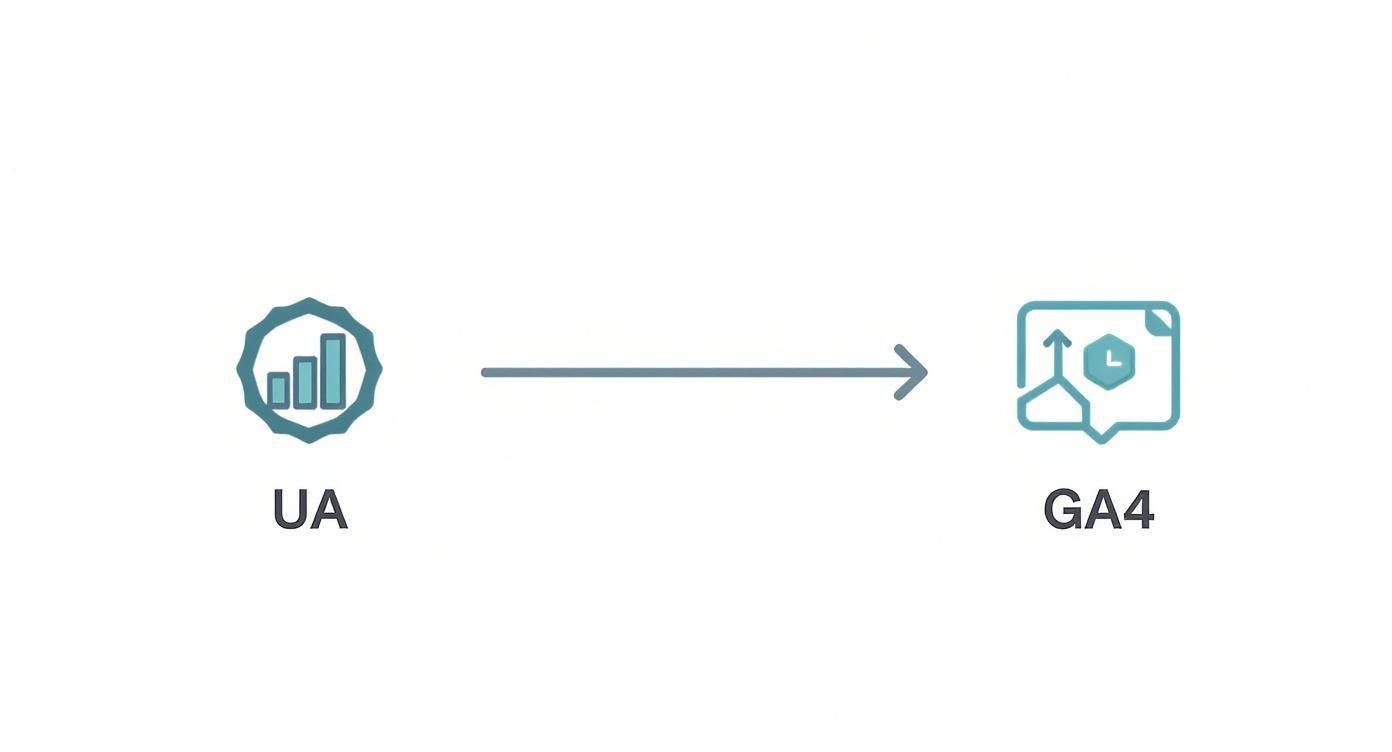
This whole migration is really about moving away from just counting page views on a "thank you" page and toward measuring a whole stream of important user actions. But what about those actions that aren't automatically tracked, like a lead form submission or someone clicking a specific button? For those, we’ll need to create our own events.
Flipping the Switch on Existing Events
The most straightforward way to create a new conversion is to take an event GA4 is already collecting and just tell the system, "Hey, this one's important." Think of it like giving an official promotion to a star employee who's already doing amazing work.
Let’s say you have a PDF brochure or a case study on your site. If you have Enhanced measurement turned on (which it is by default), GA4 is already tracking an event called file_download every time someone clicks on it.
To turn this into a conversion, it’s a simple flick of a switch:
Head over to Admin in the bottom-left corner of GA4.
In the Property column, click on Events.
You'll see a list of every event name your site has collected. Find file_download.
On the far right, you’ll see a toggle under the Mark as conversion column.
Click it on.
Boom. Done. From now on, every file_download event will also be counted as a conversion in your reports. This method is perfect for other actions GA4 tracks automatically, like scroll (when a user scrolls 90% of the way down a page), video_start, or click (for outbound links).
Creating a New Event for a "Thank You" Page
But what if you need to track something more custom, like a user landing on a "thank you" page after filling out your contact form? You can't just mark the standard page_view event as a conversion—that would be a disaster, counting every single page visit as a win.
Instead, we can tell GA4 to create a brand-new event that only fires when a very specific condition is met.
Here’s the scenario: A user fills out your "Request a Quote" form and lands on yourwebsite.com/thank-you-for-your-quote.
Here’s how to track that specific action as a conversion:
Go to Admin > Events and hit the Create event button.
In the Custom event name box, give your new event a clear name. Let's use quote_request_submitted. Pro tip: use underscores, not spaces.
Now, under Matching conditions, we'll set the rules for when this event gets created.
- Set the first condition to: event_name equals page_view.
- Click Add condition and set the second one to: page_location contains /thank-you-for-your-quote.
With these two rules, you're essentially telling GA4: "When you see a normal page_view event, I want you to peek at the URL. If that URL contains /thank-you-for-your-quote, go ahead and create a totally new event called quote_request_submitted for me."
After you save this, give it up to 24 hours for the new quote_request_submitted event to show up in your main Events list. Once you see it there, you just toggle it on as a conversion, exactly like we did with the file_download event.
Pro Tips for Naming and Managing Your Conversions
A clean setup is a useful setup. Trust me, messy naming conventions will come back to bite you when you're trying to pull reports later.
My personal rule of thumb is to follow Google's own snake_case format. Use all lowercase letters and separate words with an underscore (e.g., newsletter_signup, not Newsletter Signup). This keeps everything in your event list looking tidy and consistent with GA4's own events.
And get specific! Instead of a generic form_submit that could mean anything, create distinct events like contact_form_submit and webinar_signup. This lets you see which of your calls-to-action are actually working.
To really dial in your tracking, you should also learn how to use UTM parameters. This will show you which specific marketing campaigns are driving these conversions, giving you a much clearer picture of your ROI.
Essential Conversion Blueprints For Your Business
Theory is great, but let's be real—results come from hitting "publish" and seeing what works. So instead of just talking about what to track, let’s build some practical, road-tested recipes for the google analytics goals that actually move the needle for your specific business.
Sure, every business has its quirks, but most fall into a few common buckets. We’ll break down the essential conversion events for three distinct models, explaining not just what to track, but why each click tells a critical story about your users and what they really want.
Blueprint For E-commerce Websites
For an online store, the path to purchase is a story told through a series of small "yeses" from your customer. Tracking these micro-conversions is just as vital as the final sale, because it shows you exactly where people are hesitating or dropping off.
Your number one priority is the macro-conversion: the purchase event. This is the touchdown, the ultimate goal. Thankfully, GA4 is pretty smart and often tracks this automatically if your e-commerce platform is set up correctly.
But the real gold is in the steps leading up to that sale. You need to be watching:
- view_item: This tells you which products are catching eyeballs and sparking initial interest.
- add_to_cart: A huge signal of purchase intent. If you see tons of add_to_cart events but a low number of actual sales, you've got a problem in your checkout flow or with your pricing. Red flag.
- begin_checkout: This is it, the final hurdle. If users bail here, it’s often a sign of sticker shock from shipping costs or a checkout form that’s just too complicated.
By marking each of these as a conversion, you build a complete funnel in GA4. It lets you pinpoint the friction points and make surgical improvements instead of guessing what’s wrong.
Blueprint For B2B Lead Generation
When your goal is to generate qualified leads, the "purchase" isn't a transaction—it's a conversation. Your website’s entire job is to get that conversation started. This is where defining your google analytics goals is absolutely crucial for keeping marketing and sales on the same page. Tools like the LeadBlaze lead generation platform can also slot into your GA4 strategy here, giving you even richer data on who's knocking at your door.
Your main macro-conversion is usually a direct cry for help or a download of some high-value content.
- form_submission: This is your bread and butter. Get specific with event names like contact_form_submit or demo_request_submit so you can tell the hot leads from the warm ones.
- ebook_download or whitepaper_download: These are powerful micro-conversions. They flag users who are in the research phase—perfect candidates for your email nurturing campaigns.
- phone_number_click: An absolute must-track for mobile visitors. A click on your phone number is a crystal-clear sign of high intent.
Tracking these distinct events gives your sales team invaluable context. Knowing whether a lead came from a demo request versus a whitepaper download helps them tailor their follow-up for much, much better results.
Blueprint For Content Publishers
For blogs, news sites, or any business fueled by an audience, success isn't always a sale. It's about building a loyal, engaged community that you can eventually monetize through ads, affiliate links, or your own products down the line.
Your macro-conversions are the actions that signal a reader is becoming a fan.
- newsletter_signup: This is your primary goal. Turning an anonymous visitor into a known contact is how you build a long-term relationship.
- scroll_depth: Set up a scroll event to fire at 90%. This simple micro-conversion separates the casual skimmers from your truly engaged readers, telling you which articles are actually holding people's attention.
- outbound_link_click: If affiliate revenue is part of your game, tracking clicks on outbound links—especially those tagged with affiliate—is non-negotiable for measuring what's working.
This strategic approach to tracking is the bedrock of modern digital analysis. It's really no surprise that Google Analytics is used by roughly 37.9 million websites across the globe, with over 14.2 million already making the switch to GA4. This isn't just a trend; it's a fundamental shift toward using data to understand users on a deeper level.
By putting these blueprints into action, you’ll turn your analytics from a simple traffic report into a powerful engine for growth. And once you have that data flowing, you can dive into even deeper strategies. You might also want to check out our guide on conversion optimization best practices to take your results to the next level.
Using Conversion Data To Drive Marketing ROI
Getting your Google Analytics goals set up is a massive first step, but honestly, it's only half the battle. The real magic happens when you stop just collecting data and start using it to make smarter, more profitable decisions.
This is the point where your analytics platform shifts from a simple scoreboard to your most valuable marketing advisor.
The data flowing into your conversion reports holds the answers to your most burning questions. It tells the unfiltered story of what your audience actually responds to, not what you think they want. Diving into these reports is how you connect the dots between your marketing sweat and real business growth.
Answering Your Biggest Marketing Questions
Your conversion data is a goldmine for strategic insights, but you need to know where to dig. The key is knowing which reports to pull and what questions to ask.
In GA4, your command center for this is the 'Traffic acquisition' report. This is where you can answer the mission-critical questions:
- Which channels drive the most conversions? Is it your organic search hustle, your paid social campaigns, or that email newsletter you pour your heart into? This shows you where to double down on your budget and where to pull back.
- What's the conversion rate per channel? A channel might drive a ton of traffic but have a garbage conversion rate, signaling low-quality visitors. This insight helps you chase quality over sheer quantity.
- Which specific campaigns are actually performing? Getting this level of detail requires a rock-solid tracking strategy. To accurately track and prove the ROI of every single effort, you need to learn how to use Google Analytics UTM parameters.
By making this data review a regular habit, you shift from a "spray and pray" marketing approach to a data-driven strategy where every single dollar is accountable.
Optimizing Your Website and Landing Pages
Beyond just channel performance, your conversion data is a ridiculously powerful tool for improving your website's user experience. The 'Landing page' report, when you filter it by your key conversion events, reveals which pages are your heavy hitters and which are total duds.
Be on the lookout for pages with high traffic but depressingly low conversion rates. This is a classic sign of a disconnect. Maybe the call-to-action is unclear, the page loads at a snail's pace, or the content doesn't match the promise of the ad that brought them there.
Use this data to form hypotheses you can test. A/B testing different headlines, button colors, or form layouts on underperforming pages can lead to massive uplifts in your conversion rates. This is how you systematically improve your site's effectiveness over time, no guesswork required.
This cycle of analysis and optimization is everything. When you understand not just what happened but why it happened, you finally gain real control over your marketing outcomes.
Fine-Tuning Your Ad Spend and Attribution
Finally, conversion data is non-negotiable for allocating your paid media budget effectively. Once you link your Google Ads account to GA4, you can see post-click conversion data right inside your analytics reports. This gives you a much clearer, more honest picture of your ad performance than you'd ever get from the ad platform alone.
This is where understanding the complete customer journey becomes vital. A user might first discover you through a social media ad, later research you via organic search, and finally convert through a branded search ad.
To properly credit each touchpoint, you need a solid grasp of how different models assign value. Our complete guide explains what attribution modeling is and how to use it to make much smarter budget decisions.
Ultimately, using your Google Analytics goals data isn't a one-time task; it's an ongoing cycle of measurement, analysis, and optimization. It's the engine that powers sustainable business growth, ensuring your marketing efforts are always getting smarter, more efficient, and more profitable.
Common Questions About Goals and Conversions
Once you've got your core tracking in place, the real-world questions always start to pop up. This is your quick-fire FAQ for the most common head-scratchers people run into when wrangling Google Analytics goals and conversions. Getting this stuff straight is the only way you'll ever trust your data.
What Is the Difference Between a UA Goal and a GA4 Conversion?
The biggest difference isn't a feature; it's a philosophy. Universal Analytics (UA) was like ordering from a set menu—you had to force your business objectives into rigid categories like 'Destination' or 'Duration'. It was clunky.
GA4, on the other hand, is a la carte. It treats every single user interaction, from a page view to a button click, as an 'event.' A 'Conversion' in GA4 is simply any event you decide is important enough to flag. This event-based model is way more flexible and gives you a much more realistic picture of what’s happening across your website and apps.
How Many Conversions Can I Set Up in GA4?
A standard Google Analytics 4 property lets you mark up to 30 different events as conversions. At first, that might sound like a low number, but it’s actually a blessing in disguise.
It forces you to be ruthless about what really matters. Instead of tracking every minor action under the sun, you have to focus on the key performance indicators that actually drive your business forward.
This built-in limit is a strategic constraint. It encourages you to prioritize what a ‘win’ actually looks like for your business, leading to cleaner and more actionable reports. For enterprise-level users with Google Analytics 360, this limit is increased to 50 conversions.
Why Are My Conversions Not Showing Up?
Ah, the classic "is this thing on?" problem. It happens to everyone. If your hard-earned conversions are ghosting you in your reports, run through this quick troubleshooting list before you panic.
- Check DebugView first. This is non-negotiable. Use GA4's 'DebugView' in the Admin panel to watch events fire on your site in real-time. If you don't see your event pop up there, the problem is on your website or in your Tag Manager setup, not in GA4.
- Confirm it's toggled on. Okay, so you see the event in DebugView? Great. Now head to Admin > Conversions. Find your event name in the list and make damn sure the toggle next to it is switched on. It's a surprisingly easy step to miss.
- Be patient. This is the hardest part. It can sometimes take 24 to 48 hours for new conversion data to fully process and show up in your standard GA4 reports. So, take a breath and check back tomorrow.
Can I Import My Old Universal Analytics Goals?
Technically, yes, Google offered a 'Goals migration tool' during the big switch. But should you use it? Honestly, I wouldn't.
The tool doesn't do a clean, one-to-one import. It just tries its best to recreate your old UA goals as new conversion events in GA4, and the results can be messy.
My advice? Skip it and start fresh. The structure of UA goals is so fundamentally different from GA4's event-based model that you're far better off rethinking your business objectives from the ground up. Take the time to build clean, native GA4 conversions. You’ll get much higher-quality data from day one and actually understand what you're tracking.
At Rebus, we turn complex data into clear growth strategies. If you're ready to move beyond basic tracking and use analytics to drive real ROI, our team of experts is here to help. Partner with us to supercharge your marketing.