
How Many Keywords SEO: how many keywords seo per page for maximum impact
Everyone wants the magic number. The simple, satisfying answer is to target one primary keyword and a handful of related secondary keywords for each page you create. But honestly, if you're still counting keywords, you're playing yesterday's game.
The real strategy isn't about hitting a quota; it's about covering a topic so completely that you naturally start ranking for hundreds of keyword variations you never even thought of.
The Real Answer to Your Keyword Question

The whole "how many keywords?" question comes from an old-school SEO mindset. Back in the day, it was a numbers game. You'd stuff a page with dozens of keywords, hoping to cast a wide net. Do that today, and you’re practically asking Google to penalize you.
Modern SEO has moved way beyond keyword counting. It’s all about topic coverage now. Think of it this way: instead of trying to be a jack-of-all-trades on a page, your goal is to be the undisputed expert on one specific subject.
Welcome to the World of Semantic Search
Search engines like Google don't just match words anymore; they understand concepts. This is the heart of semantic search. When you write a page about "small business accounting software," Google is smart enough to expect you to talk about related ideas.
It's looking for things like:
- What users actually need: Phrases like “best accounting software for freelancers” or “how to track expenses.”
- Connected concepts: Mentions of invoicing, payroll integration, tax prep, and financial reports.
- Synonyms and variations: Terms like “bookkeeping tools” or “SMB financial software.”
By weaving these related ideas into your content, you're showing you have comprehensive knowledge. You're proving your page is a genuinely valuable resource, not just a thin article repeating the same phrase over and over.
The goal is to prove your expertise. Your content should answer the user's initial query and then anticipate their next five questions, creating a complete and satisfying experience.
For a little guidance, here's a quick cheat sheet for how to think about keyword allocation.
Keyword Targeting Rules of Thumb
This table offers a quick reference for allocating keywords at different levels of your SEO strategy, from a single page to your entire website.
| Per Page | 1 | 3–5+ | Deeply cover a single, specific topic. |
|---|---|---|---|
| Per Blog Post | 1 | 5–10+ | Answer a user's question comprehensively. |
| Per Campaign | 5–10 | 20–50+ | Target a cluster of related topics around a core theme. |
| Site-Wide | Dozens to Hundreds | Thousands | Build authority across your entire business niche. |
Think of this as a starting point, not a rigid set of rules. The real magic happens when you let the user's intent, not a keyword count, guide your content creation.
From Keywords to Topic Clusters
This shift in focus is why the best SEO strategies don't stop at the page level. To truly build an effective plan, it all starts with in-depth keyword research. This process helps you map out the entire ecosystem of terms related to what you sell.
With an estimated 16.4 billion Google searches per day worldwide in 2025, the opportunity is massive, but so is the competition. Properly grouping keywords and mapping them to specific pages prevents your own content from cannibalizing itself. This foundational work ensures every single page you create serves a distinct purpose, building your site's overall authority and making you visible in a very crowded space.
Building Your Site-Wide Keyword Framework

Alright, let's zoom out. Moving from optimizing a single page to an entire website is a whole different ballgame. You need a blueprint. Without one, you’ll inevitably run into a common, self-inflicted wound: keyword cannibalization.
This is when you have multiple pages on your own site accidentally duking it out for the same primary keyword. It’s a mess that confuses search engines and torpedoes your authority.
Think of your website like a house you're building. The homepage is the front door. Your main service or category pages are the big, important rooms—the kitchen, the living room. Your blog posts? Those are the specialized spaces, like a home gym or a cozy reading nook. Each room has a job to do, just like every page needs a unique keyword to target.
You wouldn't build two kitchens side-by-side in one house, right? So why create two pages laser-focused on the exact same high-value keyword? A site-wide framework makes sure every piece of content has a clear purpose and its own turf.
The Power of Keyword Mapping
This is where your architectural blueprint comes in. It’s called a keyword map, and it’s usually just a simple spreadsheet. But don't let its simplicity fool you—this document is the cornerstone of any coherent SEO strategy.
A keyword map assigns a primary keyword and a handful of secondary keywords to every single important URL on your site. The act of creating one forces you to think strategically about your site’s structure and how your content fits together. It gives you a bird's-eye view of your entire SEO footprint, making it dead simple to spot gaps and opportunities.
Your map should track a few key things:
- The URL: Which exact page are we talking about?
- Primary Keyword: The undisputed champion this page is targeting.
- Secondary Keywords: A crew of related terms that support the main keyword.
- Search Intent: What is the user really trying to do? (Learn, compare, or buy?)
- Traffic & Difficulty: The core metrics that help you prioritize what to tackle first.
By meticulously planning which page targets what, you build a logical, organized structure that Google can actually understand. It shows the search engine that you’re an authority on your topic, not just a chaotic collection of random articles.
Putting an End to Keyword Cannibalization
The number one reason to build a keyword map is to stop your pages from wrestling each other for rankings.
Imagine you run an e-commerce store that sells running shoes. Without a map, you might create a killer blog post on the "best running shoes for beginners" and also have a product category page optimized for "best running shoes." Now you've got a problem.
Keyword cannibalization is like sending two of your own salespeople to pitch the same client. They both end up looking weak, they confuse the customer, and you lose the deal. A keyword map is your territory plan—it gives each salesperson (or page) their own exclusive set of leads to chase.
When Google sees this conflict, it gets confused. It might rank the weaker page, or worse, keep swapping which URL it shows in the search results, tanking your visibility.
A keyword map solves this instantly. You’d assign "best running shoes" to the category page (where people buy stuff) and a more informational term like "how to choose running shoes" to the blog post. Each page gets its own lane, and your site's authority on the whole topic gets a massive boost.
Mastering Search Intent and Topic Clusters
Let’s be real. Moving beyond a simple list of keywords is where your SEO strategy goes from sputtering along to hitting the open road. The most important question isn't "how many keywords," but "why is someone typing this into Google?"
That "why" is what we call search intent, and it’s the secret to creating content that people actually want to find.
Think of it like this: understanding search intent is like being a mind reader for your audience. Are they just browsing for information? Are they weighing their options? Or do they have their credit card out, ready to buy? Each of those moments requires a completely different kind of page. Match the page to the intent, and you’re golden.
The Three Flavors of Search Intent
Every single search query falls into one of three main buckets. Nailing these is the first step to making your users happy and showing Google you know what you're talking about. We break this down even further in our complete guide on what is search intent.
- Informational Intent: Your user is in learning mode. They're asking "what is," "how to," or "why does my cat stare at the wall?" These searches demand blog posts, in-depth guides, and step-by-step tutorials. Give them the answers.
- Commercial Intent: Now they're kicking the tires. They're searching for "best," "review," or "X vs. Y." This is your cue to serve up detailed comparisons, product reviews, and "top 10" listicles.
- Transactional Intent: This is it—they're ready to pull the trigger. Searches include brand names, "buy now," or "shipping discount." These queries should lead them straight to a product page, a service page, or a pricing table. No friction.
Building Authority with the Topic Cluster Model
Once you've got a handle on intent, you can start organizing your content with a seriously powerful framework: the topic cluster model.
Imagine you’re building a library about a specific subject. Instead of just randomly stocking shelves with disconnected books, you create a structured, interconnected web of information that makes you the go-to expert.
It all boils down to two key parts:
Pillar Page: This is your magnum opus, the cornerstone of your library. It's a massive, comprehensive guide on a broad topic like "email marketing." It targets a big, juicy, high-level keyword.
Cluster Content: These are the deep-dive articles that explore all the little subtopics related to your pillar. For an "email marketing" pillar, your cluster content might be "email subject line best practices" or "how to build an email list from scratch." Each one targets a more specific, long-tail keyword.
By linking all of your specific cluster pages back to your main pillar page, you create an internal linking powerhouse. This tells search engines that your pillar page is the definitive authority on the subject, giving it the juice to rank for hundreds of related terms.
This hub-and-spoke model is brilliant because it naturally helps you capture traffic from long-tail keywords—those longer, more specific search phrases people use when they know what they want.
And that's a big deal. These super-specific queries make up a whopping 70% of all search traffic and tend to convert at rates 2.5 times higher than broader, more generic terms. As you dig deeper, you'll find even more stats on the importance of long-tail keywords on Exploding Topics. By building out topic clusters, you're not just organizing your site; you're building a net to catch all that high-intent traffic by covering your core subject from every possible angle.
A Practical Guide to Keyword Prioritization
Alright, you've done the brainstorming. You have a monster list of dozens, maybe even hundreds, of keywords that could work. Now what?
Here’s the hard truth: trying to target all of them is a surefire way to get nowhere fast. The secret to actually making progress is ruthless prioritization. You have to focus your limited time and budget on the terms that will genuinely move the needle for your business.
Instead of getting hypnotized by huge search volume numbers, the smart move is to balance three critical factors. Think of it like a three-legged stool—if one leg is wobbly, the whole thing collapses. Real success comes from finding that perfect equilibrium.
Finding Your Keyword Sweet Spot
To build a list that packs a punch, you need to vet every single keyword against these three pillars. This little framework helps you look past vanity metrics and spot the real growth opportunities.
- Relevance: How perfectly does this keyword match what you actually sell? A high-relevance keyword is a direct line to your core business. It’s not a “maybe,” it’s a “hell yes.”
- Authority: What’s your realistic chance of ranking for this term right now? This requires an honest look in the mirror. Check out the competition and your website's current domain authority. Be real with yourself.
- Volume: How many people are actually typing this into a search bar each month? It’s not the only thing that matters, but it represents the total traffic you could potentially capture.
The goal isn't just to find high-volume keywords; it's to find the right-volume keywords for your business that you can realistically rank for. This is where you'll find your quickest wins and build momentum.
This process is all about uncovering that "low-hanging fruit"—those beautiful keywords with a sweet spot of decent search volume and manageable competition. These are the terms that deliver tangible results much faster, building your site's authority and paving the way for you to tackle the big, scary keywords down the road.
A Simple Scoring Technique for Prioritization
Let’s get practical. You can knock this out with a simple scoring system in a spreadsheet to objectively rank your keyword opportunities. It takes the guesswork out of the equation and gives you a clear, data-driven action plan.
Just assign a score from 1 (low) to 5 (high) for each of the three pillars—Relevance, Authority (your chance to rank), and Volume.
This is exactly how you start building topic authority. Highly-focused content pieces act as support beams for a broader pillar page, making the whole structure stronger in Google's eyes.
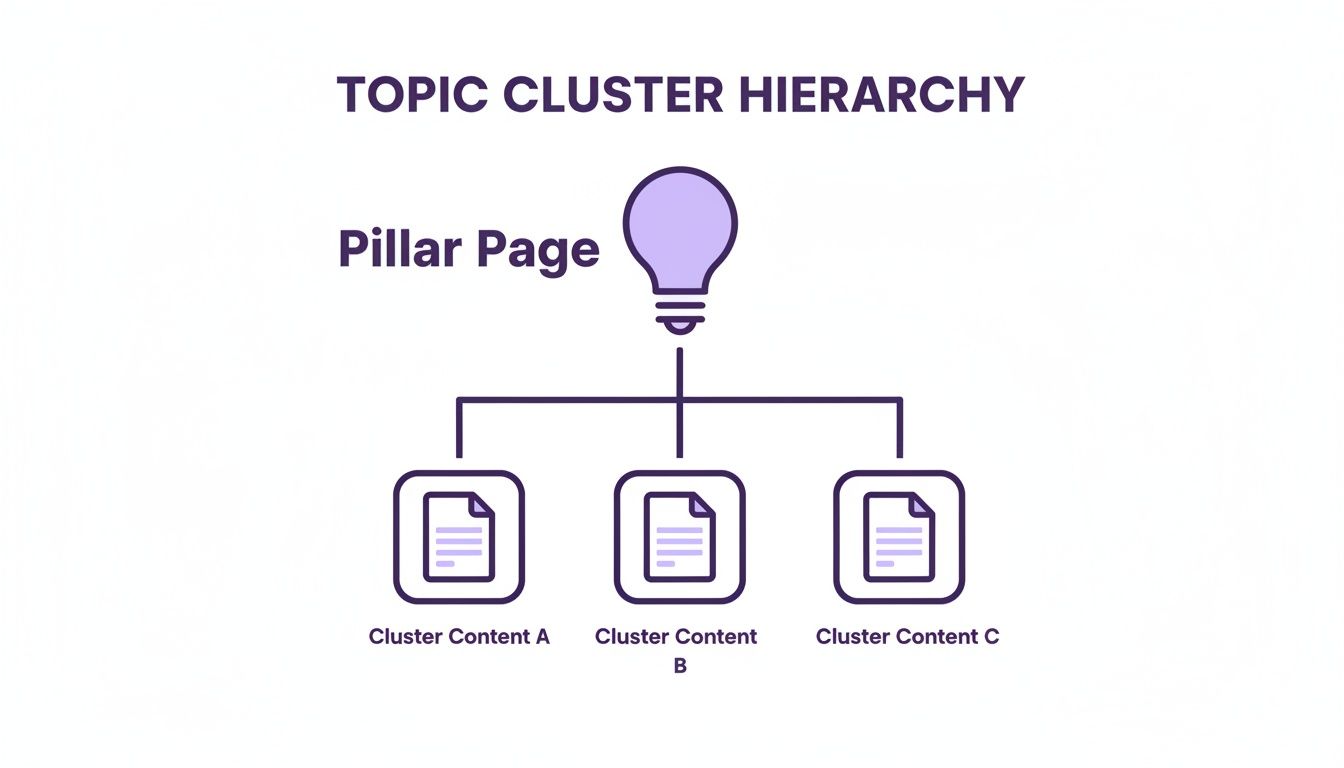
This kind of structure shows why prioritizing keywords for your cluster content is so critical—it directly strengthens the authority of your central pillar page.
Once you have your scores, just add them up. You can quickly sort your list and see which keywords offer the best combo of business value, ranking potential, and traffic opportunity. Start with the highest-scoring terms and work your way down. No more guessing, just winning.
Tools and Techniques for Tracking Keyword Performance
Picking your keywords is only half the battle. Knowing if they’re actually working? That’s how you win the war. A strategy without measurement is just a bunch of expensive guesswork. You have to track your performance to see what’s driving traffic, what’s falling flat, and where your next big opportunity is hiding.
Luckily, you don’t need a massive, expensive suite of tools to get started. The single most powerful (and free) tool at your disposal is Google Search Console (GSC). Think of GSC as a direct hotline to Google, giving you the inside scoop on exactly how it sees your website.
It pulls back the curtain on the real-world queries people are using to find you, your average rank for those terms, and how many people are actually clicking through. This data is pure gold for refining your keyword strategy, page by page, because it shows you what’s already gaining traction.
Essential Metrics to Monitor
Once you’re logged into GSC or another SEO platform, it's easy to get buried in data. Don't. Instead, focus on the metrics that tell a clear story about how your keywords are doing. These are the numbers that translate directly into smart business decisions.
Here’s what you should be watching:
- Keyword Rankings: The position your page holds in the search results for a specific keyword. Seeing this number consistently climb is a fantastic sign.
- Impressions: This is simply how many times your page showed up in search results. It’s your baseline for overall visibility.
- Click-Through Rate (CTR): The percentage of people who saw your page (impressions) and actually clicked on it. A low CTR might mean your title tag or meta description is boring people to tears.
- Traffic: The number of visitors a keyword is actually sending to your site. This is your bottom line—the ultimate measure of success.
From Data to Actionable Insights
Tracking numbers is one thing; turning them into smart moves is another entirely. Your real goal is to spot patterns and trends that tell you what to do next.
For example, if a page is stuck on the second page of Google for a high-value keyword, a little extra optimization could be all it takes to push it to page one and unlock a huge traffic boost.
Don’t just watch your rankings bounce around. You need to ask why. Did a competitor just publish a monster piece of content? Did the search intent for that keyword suddenly change? This is how you shift from passively tracking to actively managing your SEO.
If you notice a page is ranking for a bunch of unexpected keywords, that’s a loud-and-clear signal. It's an opportunity to create new content or update the existing page to better serve that newly discovered intent.
Regularly reviewing these metrics is like giving your site a quick health checkup. For a much deeper dive, a professional website audit can uncover the technical issues and strategic blind spots that are holding you back. This proactive approach ensures your keyword strategy doesn't get stale—it evolves and keeps delivering results.
Answering Your Top Keyword Questions
Alright, let's move from the "what" and "why" of keywords to the nitty-gritty "how." Once you start actually mapping out your strategy, the real questions pop up. How many keywords is too many? Can I target the same term on different pages? Nailing these details is often the difference between a strategy that takes off and one that just sputters on the launchpad.
Think of this as your field guide. We’re tackling the most common questions that come up when you’re deep in the weeds of keyword planning.
Should I Use the Same Keyword on Multiple Pages?
Let's make this simple: no. Almost never.
Targeting the same primary keyword across multiple pages is a classic SEO own-goal called keyword cannibalization. When you do this, you’re forcing your own pages to duke it out for the same spot in the search results. You become your own worst competitor.
This sends confusing signals to Google. The search engine looks at your site and thinks, "Okay, they have two pages about 'dog grooming prices.' Which one is the real authority?" Unsure of the answer, it might rank both of them poorly. You've effectively split your ranking power and diluted your authority.
Every important page on your site needs its own unique primary keyword. End of story.
- Here's what that looks like: Imagine you run a pet grooming business. You wouldn't optimize both your main "Dog Grooming Services" page and a blog post for the exact phrase "dog grooming prices."
- The fix is simple: Assign "dog grooming prices" to your service page, since that matches the user's intent to buy. Then, for your blog, you could target a related but different informational keyword like, "what affects dog grooming costs?" to catch people still in the research phase.
How Often Should I Update My Keyword Strategy?
Your keyword strategy isn’t a stone tablet; it’s a living, breathing document. Search trends change, new competitors show up, and your own business goals will evolve. A "set it and forget it" approach just doesn't work.
As a rule of thumb, plan on doing a full, comprehensive review of your keyword map every 6 to 12 months. This is your chance to make sure your targets are still hitting the mark and haven't gone stale.
But you'll need to do fresh keyword research more often in specific situations, like:
- When you’re launching a new product or service.
- Before you kick off a major content marketing push.
- If you see a sudden, scary drop in organic traffic or rankings for your money pages.
And a pro tip: live in your Google Search Console. Check it at least once a month. It’s the best crystal ball you have for spotting new keyword opportunities and catching pages that are starting to slip before it becomes a five-alarm fire.
Think of your keyword strategy like a garden. It needs regular tending—weeding out underperforming terms, planting new seeds based on emerging trends, and pruning your content to keep it healthy and productive.
What Is the Difference Between Primary and Secondary Keywords?
Getting this distinction right is absolutely fundamental to modern SEO. They're a team, but they have very different jobs when it comes to telling Google what your page is all about.
A primary keyword is the star of the show. It’s the main phrase you want a page to rank for, the one that perfectly sums up its entire purpose. This is usually a term with solid search volume that connects directly to what you sell.
Secondary keywords are the supporting cast. Sometimes called LSI or semantic keywords, these are all the related terms, subtopics, synonyms, and questions that give your content depth and context. They prove to Google that you aren't just stuffing a keyword in; you actually have a comprehensive grasp of the subject. To see how this fits into the bigger picture, you should explore these SEO content writing best practices.
Let's make it tangible with an example for a page about making coffee at home:
- Primary Keyword: "how to make pour over coffee"
- Secondary Keywords: "best coffee grind size," "gooseneck kettle," "coffee bloom," "pour over technique," and "v60 vs chemex."
By weaving in those secondary terms, you're not just chasing one phrase. You’re signaling true expertise on the entire topic, which helps you rank for a whole universe of related searches you might not have even thought of.
At Rebus, we transform these complex SEO questions into clear, actionable strategies that drive real growth. Our expert team builds comprehensive keyword frameworks that eliminate cannibalization, target high-intent users, and build lasting authority for your brand. Partner with us to turn your content into a powerful engine for attracting, engaging, and converting your ideal customers. Learn more about our approach at https://rebusadvertising.com.