How to Generate Leads That Actually Convert a Practical Guide
Generating leads that actually turn into business isn't about some secret hack. It really boils down to two things: attracting the right audience with stuff they actually want to read, and then creating a super clear path for them to raise their hand and say, "I'm interested."
This means you have to nail who you're talking to, solve their problems with your content, and then guide them with compelling calls-to-action on a website that doesn't suck.
Building a Foundation for High-Quality Leads

Before you even think about launching a campaign or writing a single line of ad copy, you have to get your foundation right. So many businesses skip this part. They jump straight into tactics and then wonder why their pipeline is full of tire-kickers and prospects who will never, ever buy.
The truth is, great lead generation isn't about casting the widest net possible. It’s about using the right bait to attract the perfect catch. This upfront work is what separates predictable, scalable growth from expensive, frustrating failures. It makes sure every dollar and hour you spend is aimed squarely at the people who are most likely to become your best customers.
Define Your Ideal Customer Profile
First up: get crystal clear on who you're actually trying to reach. An Ideal Customer Profile (ICP) is just a fancy term for a super-detailed description of the company—not the person—that gets a ton of value from what you sell. Without it, your marketing messages are just noise.
The best way to build your ICP is to look at your current best customers. What do they have in common?
- Industry or Vertical: Are they all SaaS companies? Healthcare clinics? Local construction firms?
- Company Size: Are you crushing it with startups, mid-market businesses, or giant enterprises?
- Geographic Location: Do your best clients all seem to be in a specific city, state, or country?
- Pain Points: What specific, nagging problems did they have that your solution made disappear?
Answering these questions takes you from a fuzzy idea of "our customer" to a concrete profile that will guide every marketing decision you make from here on out.
Map the Buyer’s Journey
Okay, so you know who you're targeting. Now you need to figure out how they buy stuff. The buyer's journey is just the research process someone goes through before making a purchase. It’s rarely a straight line, but it usually moves from realizing they have a problem, to exploring solutions, and finally, to making a decision.
Mapping this journey is a game-changer because it helps you create content that meets people exactly where they are. Someone just realizing they have a problem needs an educational blog post, not a "Buy Now" button shoved in their face. On the other hand, someone deep in the decision-making stage is craving case studies and pricing info.
For a deeper dive into strategies that keep you in front of your audience at every stage, check out these essential demand generation tactics.
Key Takeaway: Think of yourself as a helpful guide. If you provide the right information at the right time, you build trust and make your solution the obvious choice when they're finally ready to pull the trigger.
Set Clear and Measurable Goals
"We want more leads" is not a goal. It's a wish. To actually move the needle, you need specific, measurable, achievable, relevant, and time-bound (SMART) goals. This simple framework turns a vague hope into an actionable plan.
Your goals should connect directly to what the business is trying to achieve. For example:
- Generate 150 marketing-qualified leads (MQLs) per month from organic search by the end of Q3.
- Achieve a cost per lead (CPL) of under $50 for our LinkedIn ad campaigns this quarter.
- Increase our website’s visitor-to-lead conversion rate from 2% to 3.5% within the next six months.
This kind of clarity lets you track what's working and what's not, so you can make adjustments based on real data, not just gut feelings. And getting this right is becoming more important than ever. The global lead generation solutions market was valued at US$3.1 billion in 2021 and is projected to blow past US$15 billion by 2031. It’s a massive signal of just how crucial this is for businesses everywhere.
Using Inbound Marketing to Attract Ready Buyers

Let's flip the script on lead generation. Instead of kicking down doors with ads and cold pitches, what if your ideal customers came knocking on yours? That's the entire premise of inbound marketing.
You stop being a megaphone and start becoming a magnet. It’s the art of being so genuinely helpful that people find you on their own, right when they’re actively hunting for solutions. You’re not interrupting their day; you’re becoming the answer to their late-night Google searches.
The logic is simple: solve their problems first, and you build trust. Trust is the currency that turns a random website visitor into a qualified lead who’s actually excited to talk to you.
Create Content That Solves Real Problems
The engine of any good inbound strategy is content that your Ideal Customer Profile (ICP) is desperate to read. This means you have to stop talking about yourself and start obsessing over your audience's pain points, questions, and goals.
Your blog is ground zero for this mission. Think of every article as a chance to answer a specific question someone is typing into a search bar. If you’re a marketing agency, don't just write another post about your amazing services. Instead, publish an in-depth guide titled, "How to Calculate Your Customer Acquisition Cost." Bam. You've just provided real value and positioned yourself as an expert.
This isn’t just a nice idea—it’s how leads are generated now. Content marketing and company websites are the top sources globally. In fact, content marketing is responsible for a whopping 51.5% of lead acquisition for many businesses, and over 90% of marketers count on their websites to pull in leads. If you want to dive deeper, you can explore detailed lead generation statistics here.
The trick is to have the right content for every step of their journey.
- Awareness Stage: They feel the pain but can't name the problem. Create content like, "5 Signs Your Team is Wasting Time on Manual Tasks."
- Consideration Stage: They've defined the problem and are researching solutions. This is where a guide like "How to Choose the Right Automation Software" shines.
- Decision Stage: They're ready to buy and are comparing vendors. Hit them with case studies, testimonials, and detailed comparison sheets to seal the deal.
Optimize for Discovery With Strategic SEO
Creating killer content is only half the battle. If your masterpiece is buried on page 10 of Google, it might as well not exist. This is where Search Engine Optimization (SEO) comes in, making sure your stuff shows up when and where people are looking.
Good SEO is way more than just cramming keywords into a blog post. It's about getting inside your customer's head and understanding the intent behind their search. When someone types in "best CRM for small business," they aren't just looking for a list. They want a confident recommendation, and your content needs to deliver that clarity.
Pro Tip: Go after long-tail keywords. These are longer, more specific search phrases (think three or more words). They're less competitive and usually signal someone is much closer to making a purchase. For example, ranking for "how to generate real estate leads with no budget" will attract a far more qualified person than just "leads."
And don't sleep on internal linking. It’s a simple but powerful tactic. Whenever you publish a new article, link to it from your other popular, relevant posts. This weaves a web that helps search engines understand your site's structure and passes authority to your new content, helping it rank faster.
To get you started, here's a quick look at some of the most effective inbound channels you should be focusing on.
Core Inbound Lead Generation Channels
| Blog Content & SEO | Answering audience questions, building authority, and driving organic traffic. | Organic traffic, keyword rankings, time on page, leads from content. |
|---|---|---|
| Lead Magnets | Offering high-value resources (ebooks, checklists) in exchange for contact info. | Landing page conversion rate, number of new leads, cost per lead. |
| Social Media | Distributing content, engaging with your community, and building brand personality. | Engagement rate, referral traffic, follower growth, social-driven leads. |
| Email Marketing | Nurturing leads with targeted content and moving them through the sales funnel. | Open rate, click-through rate, conversion rate, unsubscribe rate. |
| Webinars & Events | Providing in-depth education, showcasing expertise, and generating high-intent leads. | Registration rate, attendance rate, post-event lead quality. |
Mastering these channels creates a powerful, interconnected system that consistently brings new prospects into your orbit.
Design Landing Pages That Convert Visitors
Okay, so your content and SEO are bringing in traffic. Fantastic. But traffic doesn't pay the bills—leads do. The conversion from anonymous visitor to known lead happens on a landing page. This is a special, standalone page built for one thing and one thing only: capturing contact information in return for something valuable.
A landing page that actually works has a few non-negotiable parts:
A Killer Offer (Lead Magnet): This is the heart of the transaction. It could be a free ebook, a webinar seat, a handy template, or a cheat sheet. The more irresistible the offer, the more willing people are to trade their email for it.
A Clear, Punchy Headline: Your headline has one job: communicate the value instantly. Something like, "Download Your Free Social Media Content Calendar Template" leaves no room for confusion.
A Super-Short Form: Be ruthless here. Only ask for what you absolutely need. For a first touchpoint, a name and email are usually plenty. Every extra field you add is another reason for them to bail.
A Strong Call-to-Action (CTA): Ditch boring button text like "Submit." Use action-oriented language that reinforces the value, like "Get My Free Guide!" or "Download Now."
A great landing page is a minimalist's dream. It has no navigation menu, no footer, no links to distract them. The visitor has only two choices: fill out the form or leave. By creating that intense focus, you dramatically boost your chances of getting that conversion.
Going on the Offensive With Smart Outbound
While inbound marketing is busy setting the table and waiting for guests to arrive, a smart outbound strategy lets you hand-deliver invitations to the VIPs you really want at the party.
Forget the old spray-and-pray tactics that felt like junk mail. Modern outbound is about being a sniper, not a machine gunner. It's about precision, deep personalization, and offering value before you ever ask for a meeting.
This isn’t about hammering a generic message to a list of 10,000 strangers. It's about surgically targeting the right people at the right companies, armed with insights that prove you’ve done your homework. The goal is to spark a genuine conversation, not just shove a sales pitch down someone's throat. When you get this right, outbound perfectly complements your inbound efforts by proactively starting conversations with prospects who are a dead-ringer for your ideal customer.
Mastering LinkedIn: The B2B Playground
For anyone in B2B, calling LinkedIn a social network is like calling a Swiss Army knife just a knife. It's a strategic goldmine where your future customers are actively talking about their problems and looking for solutions. Your profile isn't just a digital resume; it's a landing page for your personal brand.
A winning LinkedIn game is all about giving, not taking. Ditch the generic connection request followed by an immediate, cringey sales pitch. Try this instead:
- Play in their sandbox first. Find a post they shared and drop a thoughtful comment. This gets you on their radar in a natural, non-creepy way.
- Lead with a helpful resource. When you do reach out, mention a specific article or tool that could help them solve a problem they've been posting about.
- Focus on the chat, not the close. Your first mission is to build rapport and understand their world. The demo can wait.
The data backs this up, big time. Where you play the game matters, and for B2B, LinkedIn is the championship stadium. Some reports show LinkedIn is responsible for a staggering 80% of B2B leads. Other analyses claim it's up to 277% more effective for lead generation than other major platforms.
Writing Cold Emails That Don’t Feel Cold
Cold email gets a bad rap because, frankly, most of it is terrible. But a great cold email isn't really "cold" at all—it's warmed up with sharp personalization and a genuine desire to help. The big mental shift is moving from "What can I get from this person?" to "What can I give them?"
Key Insight: Your first email should feel like the start of a helpful conversation, not an ambush. Offer a specific, actionable insight relevant to their company or role. If they see you've invested time in understanding them, they're far more likely to invest their own time in a reply.
To cut through the noise of a packed inbox, you need a simple, powerful framework:
The Hyper-Personalized Hook. Open with something that proves this isn't a mass blast. Mention a recent company funding announcement, an article they wrote, or even a shared connection.
The "I Get Your Problem" Line. In one or two sentences, state a pain point that's highly relevant to their role. For example, "I saw you're hiring more sales reps, and companies at your stage often struggle with scaling their onboarding process without slowing down."
The Low-Friction Ask. Don't ask for a 30-minute demo. That's a huge commitment. Instead, ask a simple, interest-gauging question like, "Is streamlining sales onboarding on your radar for Q3?"
This approach respects their time and instantly positions you as a helpful expert, not just another salesperson. It turns an unwelcome interruption into a welcome suggestion.
Just as outbound can proactively reach your audience, so can paid advertising. For a deeper look at how to blend these powerful strategies, check out our complete guide to pay-per-click lead generation.
Turning Your Website Into a Lead-Gen Machine
Let's be real: your website can't just be a pretty digital brochure. It needs to be your hardest-working salesperson, clocking in 24/7. The whole game is about turning casual visitors into actual leads, and it happens through a series of small, strategic tweaks that remove friction and gently nudge people toward taking action.
This is the heart of Conversion Rate Optimization (CRO), and it’s how you squeeze more juice out of the traffic you already have. It’s a process of constant improvement, not a one-and-done fix. By obsessing over the user experience—from the punch of your headlines to the color of your buttons—you can systematically get more visitors to raise their hands and say, "Yep, I'm interested."
Craft Calls to Action That Beg to Be Clicked
Your Call-to-Action (CTA) is the make-or-break moment on any page. It’s the tipping point between someone just reading and someone actually engaging. Yet, so many businesses neuter their CTAs with sleepy, vague text like "Submit" or "Learn More." That’s a snoozefest.
A CTA that people can't ignore needs to be specific, action-oriented, and dripping with value. Instead of "Download," try "Get My Free SEO Checklist." See the difference? That simple shift changes the focus from what the user has to do to what they are about to get.
Here’s a quick-and-dirty guide to powerful CTAs:
- Lead with strong verbs: Kick things off with words like "Get," "Reserve," "Download," or "Start."
- Sprinkle in some urgency: Phrases like "Limited-Time Offer" or "Claim Your Spot Now" create a little healthy FOMO that encourages action right away.
- Make it pop: The CTA button should be a color that contrasts with the rest of the page. It needs to draw the eye and be impossible to miss.
Master the Art of the Lean, Mean Lead Capture Form
The lead capture form is where the transaction happens, but it's also where most of your potential leads bail. The secret? Make your forms as painless as humanly possible. Think of it as a value exchange: the less you ask for, the more likely someone is to play ball.
For a top-of-funnel offer like an ebook, a name and an email address are usually all you need. The moment you start asking for a phone number, company size, and job title, you’re creating friction. That feels invasive and will absolutely tank your conversion rates. You can always gather more intel later as you nurture the relationship.
Remember this: every single field you add to a form is another reason for someone to walk away. Be ruthless. Cut out anything that isn't absolutely essential for that first follow-up.
For a deeper dive into optimizing every last element on your site, check out our guide on conversion optimization best practices.
Build Instant Trust with Social Proof
Here’s a universal truth: people trust what other people say about you way more than what you say about yourself. This is the power of social proof, and it's an absolute must-have for turning your site into a conversion powerhouse. Weaving it in builds immediate credibility and reassures visitors they're in the right place.
Here’s how to sprinkle social proof across your site:
- Customer Testimonials: Place short, punchy quotes from happy clients near your CTAs. Adding a headshot and company name makes them 10x more believable.
- Case Studies: Tell detailed stories of how you solved a specific problem for a client. Don't be shy—include real data and results.
- Client Logos: If you've worked with recognizable brands, displaying their logos in a "Trusted By" section is an instant credibility booster.
- Reviews and Ratings: For e-commerce or local services, showing off star ratings from places like Google or Trustpilot can give conversion rates a serious lift.
When you strategically place these trust signals, you’re tackling a visitor's natural skepticism head-on. You're showing, not just telling, them that you can deliver on your promises, making them feel a whole lot better about handing over their contact info.
Nurturing Leads From First Touch to Closed Deal
Generating a lead is like getting a phone number at a party—it’s an exciting first step, but it’s definitely not a commitment. The real work begins now. Lead nurturing is the art and science of guiding a prospect from that initial flicker of interest all the way to becoming a sales-ready opportunity.
It’s about building a relationship, not just blasting them with sales pitches. The goal is to stay top-of-mind by delivering consistent value, so when they’re finally ready to make a decision, you’re the only logical choice. This process is how you turn a cold list of contacts into a predictable pipeline of future customers.
Think of it as a simple but powerful flow: you grab their attention, get them to take an action, and then build enough trust to seal the deal.
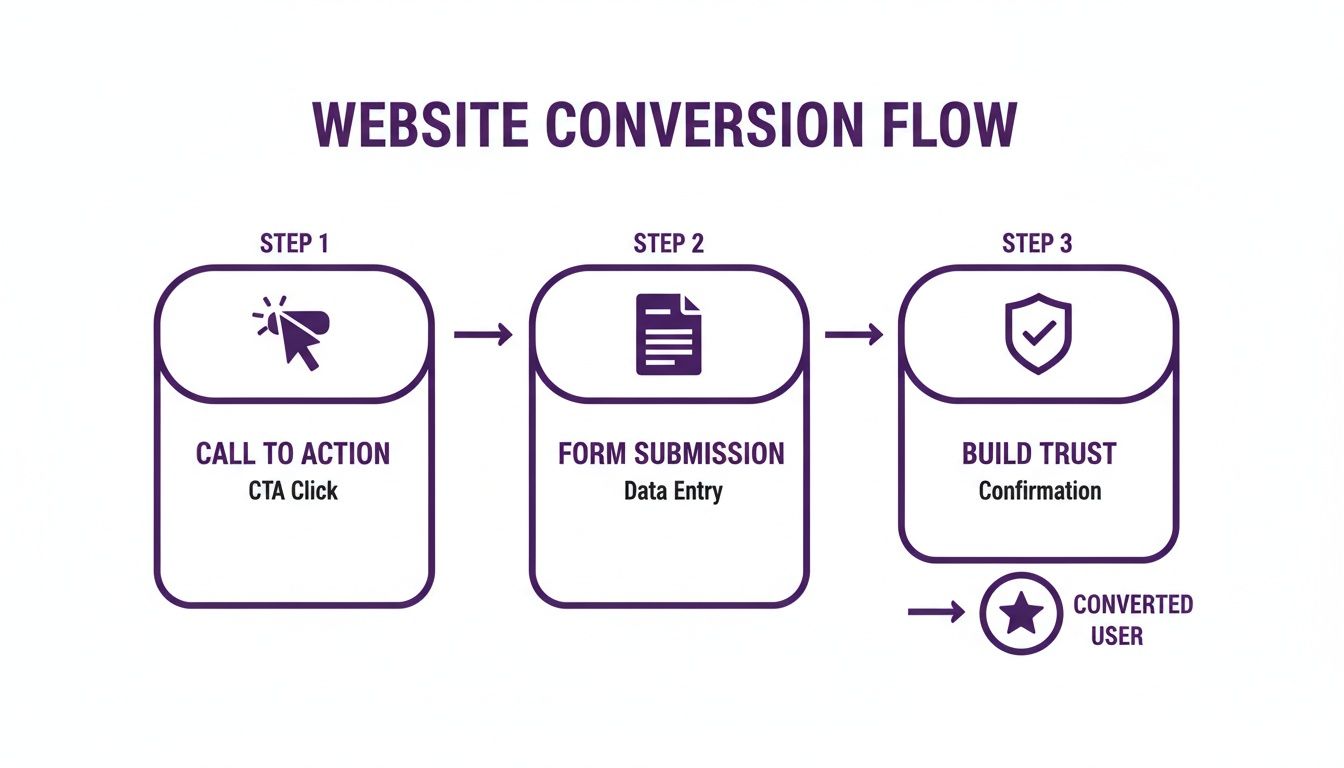
This visual drives home the point that lead gen isn’t a single event. It’s a sequence where every step—from the initial click to the final trust signal—is critical for success.
Building Automated Nurturing Workflows
The heart of modern lead nurturing is automation. Setting up automated email workflows allows you to deliver the right message to the right person at exactly the right time, without lifting a finger. Think of it as putting your relationship-building on autopilot.
A great place to start is with a simple welcome sequence. When someone downloads a lead magnet, they shouldn't just get the PDF and then silence. Fire off a series of three to five emails over the next week or two.
- First, deliver the promised asset and give them a warm welcome.
- Next, offer a related piece of content, like a blog post or a case study, to provide even more value.
- Then, introduce your company’s unique perspective on the problem they're trying to solve.
- Finally, present a soft call-to-action, like an invitation to a webinar or a free tool.
This approach keeps the conversation going and gently moves them deeper into your world. For more advanced strategies, you can explore the nuances of marketing automation best practices to build even more sophisticated and effective workflows.
Key Takeaway: The goal of an automated workflow isn't to sell; it's to educate and build trust. A well-nurtured lead is far more qualified and easier to close when they finally connect with your sales team.
Tracking the Metrics That Matter
You can't improve what you don't measure. Flying blind with your lead generation is a surefire way to waste time and money. To create a predictable system for growth, you need to become obsessed with a few key performance indicators (KPIs).
These numbers tell the true story of your marketing efforts. They show you what's working, what's broken, and where your biggest opportunities are. Focusing on these metrics turns lead generation from a guessing game into a repeatable science.
Essential Lead Generation KPIs and Their Formulas
To make sense of your performance, you need to track the right data. Here are the must-have KPIs that will give you a clear picture of what’s working and what’s not.
| Cost Per Lead (CPL) | The average cost to acquire one new lead from a specific campaign or channel. | Total Campaign Spend / Total New Leads |
|---|---|---|
| Conversion Rate | The percentage of visitors who take a desired action (e.g., fill out a form). | (Number of Conversions / Total Visitors) * 100 |
| Lead-to-Customer Rate | The percentage of leads that ultimately become paying customers. | (New Customers / Total Leads) * 100 |
| Marketing Qualified Lead (MQL) | A lead deemed more likely to become a customer based on their actions and profile. | Varies based on lead scoring rules. |
| Return on Investment (ROI) | The total revenue generated from a campaign compared to its cost. | ((Revenue - Cost) / Cost) * 100 |
By tracking CPL, you can identify your most efficient channels and double down on them. Your Conversion Rate tells you how effective your landing pages and CTAs are. And the Lead-to-Customer Rate is the ultimate bottom-line metric, revealing the true quality of the leads you're generating.
Consistently monitoring these KPIs is non-negotiable. They provide the feedback loop you need to make smart, data-driven decisions that steadily improve your results over time. This transforms your efforts from scattered tactics into a cohesive, powerful engine for business growth.
A Few Common Lead Gen Questions We Hear All the Time
If you're diving into the world of lead generation, you've probably got questions. Good. It means you’re thinking strategically. Let's tackle some of the big ones that pop up again and again—the kind of stuff that can either clarify your path or send you down a rabbit hole.
Getting these fundamentals right saves you from common pitfalls and helps you focus your energy where it actually counts.
Inbound vs. Outbound: What’s the Real Difference?
This is a core concept, and getting it wrong is like trying to play chess without knowing how the pieces move. They’re two completely different philosophies.
Inbound marketing is magnetic. It's about creating valuable stuff that pulls potential customers toward you. Think helpful blog posts, smart SEO, and killer lead magnets that solve a real problem. People find you on their own terms when they're already looking for a solution.
Outbound marketing, on the other hand, is all about the proactive push. You’re directly reaching out to a hand-picked list of potential customers. This is your personalized cold email, your strategic LinkedIn message. While inbound is the long game that builds assets over time, outbound is your go-to for targeting specific, high-value accounts right now.
How Long Until I Actually See Results?
Ah, the million-dollar question. The honest, no-fluff answer is: it completely depends on the channels you choose. There’s no magic timeline for turning on the lead faucet.
- Paid Ads: Something like Google Ads or a targeted LinkedIn Ads campaign can start spitting out leads within a few hours of launch. The catch? The moment you stop paying, the leads stop coming.
- Outbound Outreach: A sharp, personalized email or LinkedIn campaign can get you responses in the first week. Sometimes even the first day if your targeting and messaging are on point.
- SEO & Content Marketing: This is the long game. You’re building a brand asset, not just running a play. It typically takes a solid 6-12 months of consistent work to build enough authority and organic traffic to see a steady stream of inbound leads.
Here’s the reality check: While some tactics give you quick hits, building a predictable, scalable lead generation engine is a marathon, not a sprint. Plan on investing at least a few months to see consistent, meaningful results from a blended strategy.
What Are the Biggest Mistakes I Should Avoid?
So many businesses stumble over the same hurdles. Sidestepping these common blunders will save you a world of pain (and budget).
The single biggest mistake? Not having a crystal-clear Ideal Customer Profile (ICP). If you don’t know exactly who you're talking to, you'll attract a flood of low-quality leads who will never, ever buy. It’s the fastest way to burn out your sales team.
A few other classic missteps include:
- Chasing quantity over quality: A list of 1,000 bad leads is infinitely worse than 10 great ones. Stop celebrating volume and start celebrating fit.
- Forgetting to nurture leads: Getting a lead is just the first step. Most people aren't ready to buy the second they download your ebook. You need a follow-up process.
- Having a leaky website: You can send all the traffic in the world to your site, but if it’s confusing and has no clear calls-to-action, you’re just pouring water into a bucket full of holes.
How Can a Small Business Generate Leads on a Tight Budget?
No cash? No problem. You just have to be willing to trade money for time and effort. The key is to lean into strategies that reward sweat equity.
Content marketing and SEO are your best friends here. Writing genuinely helpful blog posts that answer the exact questions your ideal customers are typing into Google costs you nothing but time. Over the long haul, that effort pays off in free, organic traffic.
Get active on social media where your customers actually hang out—for most B2B, that’s LinkedIn. Don't just post; engage, comment, and build real relationships. Create one high-value lead magnet—like a downloadable checklist or a handy template—and you’ll have a lean, mean, email-capturing machine without a huge financial investment.
At Rebus, we build the strategic campaigns that turn your brand's potential into a pipeline you can count on. If you're ready to stop guessing and start growing with high-quality leads, let's talk. Learn how Rebus can fuel your growth.