How to Increase Average Order Value with 8 Proven Tactics
Look, if you want to grow your ecommerce business, you can't just keep pouring money into acquiring new customers. It's expensive and exhausting. A much smarter, more efficient way to boost your bottom line is by getting the customers you already have to spend a little more with each purchase.
This is all about increasing your Average Order Value (AOV). The most reliable ways to do this? Upselling to better products, cross-selling related items, and creating product bundles that just make sense. Mastering these isn't just a tactic; it's a fundamental shift in how you generate revenue.
Why You Should Be Obsessed With Average Order Value
In a world where customer acquisition costs just keep climbing, AOV is one of the most powerful levers you can pull. Think of it as a health check for your business—it shows you’re not just making sales, but you’re making each sale count.
Calculating it is dead simple:
AOV = Total Revenue / Number of Orders
So, if your store pulled in $50,000 from 1,000 orders last month, your AOV is $50. But that simple number tells a much bigger story about your customer behavior and how well your store is actually working.
It's More Than Just a Number
When your AOV is on the rise, it’s a clear signal that your marketing, merchandising, and overall customer experience are hitting the mark. It’s proof that:
- Your customers trust you. They feel confident enough to add more to their cart.
- They're discovering more products. Your site is doing a great job showing them other relevant items they might have missed.
- Your offers are compelling. People see the value in your pricing, bundles, and incentives, encouraging them to spend more.
This focus—shifting from just getting new customers to maximizing the value of each one—is what separates a struggling store from a sustainable, growing business.
And this isn't just a hunch; the global trend backs it up. The importance of AOV has been steadily increasing for years, a clear sign that both brands and shoppers are getting smarter about e-commerce.
AOV Growth Snapshot: A Global Perspective
This table illustrates the steady year-over-year growth of global Average Order Value, highlighting its importance as a key eCommerce metric.
| 2019 | $111 | - |
|---|---|---|
| 2020 | $120 | ~8.1% |
| 2021 | $128 | ~6.7% |
| 2022 | $135 | ~5.5% |
| 2023 | $141 | ~4.4% |
| 2024 | $144 | ~2.1% |
The data is clear: customers are becoming more comfortable with larger online purchases. Your job is to make it easy and appealing for them to do so with your brand.
To see how AOV fits into the bigger picture of scaling your store, it's worth exploring a full range of proven ecommerce growth strategies.
Ultimately, a healthy AOV means you're building stronger relationships and delivering more value every time someone clicks "buy." You're turning one-off shoppers into more profitable, long-term fans of your brand.
The Big Three: Upselling, Cross-Selling, and Bundling
Alright, let's get into the tactical heart of boosting your AOV. Upselling, cross-selling, and bundling are the foundational plays that consistently drive the biggest results. When you get these right, they don't feel like a sleazy sales pitch—they feel like genuine, helpful recommendations.
These strategies aren't just ecommerce jargon. They're about making the customer's purchase better by showing them more value. Think of it as the digital version of a great retail associate who knows exactly what you need before you even do.
The Art of the Upsell: Encouraging a Better Choice
Upselling is simply encouraging customers to buy a slightly more expensive, upgraded version of the item they're already looking at. This isn't about pushing something they don't want; it's about showing them a superior option they might have missed.
Imagine someone is buying a standard laptop. You present them with a model that has double the RAM and a faster processor for a modest price bump. You're actually solving a future problem for them—a slow computer—before it even starts.
The secret to a killer upsell is timing and relevance. You want to present the offer when the customer is already committed, typically right on the product page itself.
- Real-World Scenario: A customer is viewing a 128GB smartphone. Directly below the "Add to Cart" button, you display a small comparison box showing the 256GB model with a clear callout: "Best Value: Double the Storage for just $75 more." This frames the upsell as a smart investment, not just a higher cost.
An effective upsell shouldn't feel like a bait-and-switch. The goal is to highlight genuine value and enhanced benefits, helping the customer make a more informed and satisfying long-term decision.
Strategic Cross-Selling: Suggesting the Perfect Match
While upselling offers a better version of the same product, cross-selling suggests related or complementary items. This is the classic, "Would you like fries with that?" and it works because it anticipates the customer's next need.
Someone buying a new camera will almost certainly need a memory card and a case. A person purchasing a tent is a prime candidate for a sleeping bag and a camping stove. By presenting these items at just the right moment, you save them the hassle of having to search for them later.
The best spots for cross-sells are in the shopping cart or during checkout, under a heading like "Frequently Bought Together" or "Complete Your Kit."
This approach is incredibly effective. In fact, smart upselling and cross-selling programs can lift revenue and AOV by 10-30% on average. These tactics are some of the most powerful levers for growth because they directly impact your profitability without driving up customer acquisition costs.
Product Bundling: Creating Unbeatable Value
Product bundling is all about grouping several items together and selling them as a single package, usually for a discounted price. This strategy is a win-win: the customer gets more perceived value, and you move more inventory.
Bundles also simplify the decision-making process. Instead of getting paralyzed by choosing between five different skincare products, a customer can just buy the "Complete Morning Routine" kit. This not only bumps up the order value but also introduces them to products they might not have purchased on their own.
Here are a few ways we see bundling work wonders:
"Starter Kit" Bundles: Group the essential items a new customer would need. For a coffee brand, this could be a bag of their most popular beans, a French press, and a branded mug.
"Complete the Look" Bundles: For apparel stores, bundle an entire outfit—like a shirt, pants, and belt—at a slight discount. It’s an instant style solution.
Bulk or "Stock Up" Bundles: Offer a better price for buying multiples of the same consumable item, like three bottles of shampoo or a six-pack of protein bars.
The beauty of these three core tactics is how they work together to naturally increase your AOV. By implementing them thoughtfully, you guide customers toward larger, more satisfying purchases in a way that feels helpful and improves their shopping experience. As you refine these strategies, consider how advanced AI can improve your recommendations, a topic covered well in this Amazon Rufus AI Product Discovery Guide.
Using Smart Incentives to Encourage Bigger Carts
Okay, let's move past just recommending more products. The right incentive can be a powerful psychological nudge, whispering in your customer's ear, "Hey, just one more item..." This isn't about slashing prices or running constant sales; it’s about strategically motivating shoppers to spend a little more to unlock what feels like a much better deal.
These tactics tap into some pretty basic human behaviors—like our collective obsession with getting a "good deal" or the satisfaction of hitting a goal. When you get it right, it feels less like a sales pitch and more like a fun, rewarding part of the shopping experience. And your AOV will thank you for it.
Set an Achievable Free Shipping Threshold
One of the easiest and most effective plays in the book is the free shipping threshold. Let's be real: nobody likes paying for shipping. Unexpected shipping costs are one of the top reasons people bail on their carts. You can flip this aversion into a huge win for your AOV.
The key is to set a threshold that feels within reach. A common mistake I see is setting the bar way too high, which just frustrates people and completely backfires.
Here's a proven formula: calculate your current AOV, then set your free shipping minimum about 20-30% higher.
- Real-World Scenario: Let’s say your average order is $60. A $75 free shipping threshold is the sweet spot. A customer sitting with $62 in their cart is highly motivated to find a $13 item rather than cough up $7 for shipping. They feel like they're winning.
And please, make this offer impossible to miss. Use a dynamic announcement bar at the top of your site that updates as they shop: "You're only $13 away from free shipping!" This gamifies the whole process and keeps that goal front and center. Just be careful—setting that threshold too high can still lead to abandoned carts. For a deeper dive, you can explore various shopping cart abandonment solutions to strike the perfect balance for your store.
A well-calculated free shipping threshold doesn’t just lift AOV. It kills one of the biggest friction points in the checkout process, boosting conversion rates for everyone who hits that magic number.
Gamify the Experience with Tiered Rewards
Tiered rewards take the free shipping idea and put it on steroids. Instead of one goal, you offer escalating perks as the cart size grows. This creates a game-like experience where shoppers are genuinely excited to "level up" their purchase to unlock the next cool thing.
This strategy works because it lays out multiple, achievable goals. Rather than a single, all-or-nothing threshold, customers see a clear path to getting more value for their money, which makes bigger purchases feel way more justified and fun.
Here’s what a tiered system could look like for a beauty brand:
- Tier 1: Spend $75 → Get free shipping.
- Tier 2: Spend $100 → Get a free travel-size moisturizer.
- Tier 3: Spend $150 → Get a free full-size serum.
See how that works? It's always presenting the next logical step. A customer who hits the $75 free shipping mark immediately sees they’re just $25 away from a free gift. You’ve just given them a great reason to keep browsing.
Build Long-Term Value with a Loyalty Program
While thresholds and gifts are great for an immediate AOV bump, a loyalty program is your long game. This is how you encourage customers to consolidate all their spending with your brand over time, turning one-off transactions into a lasting relationship.
By rewarding customers every time they shop, you create a powerful reason for them to choose you over a competitor. Knowing that every dollar spent earns them points toward future discounts or exclusive products makes them much more likely to make larger, less frequent purchases from you.
Effective loyalty programs usually have a few key ingredients:
Points for Purchases: The classic model. Customers earn points for every dollar they spend. Simple and effective.
VIP Tiers: This is like tiered rewards but based on lifetime spending. Higher tiers unlock permanent perks like exclusive access, better point-earning rates, or a dedicated support line.
Exclusive Member Offers: Run special promotions or give early access to sales that are only for loyalty members. It makes them feel like insiders.
These programs are a masterclass in building sustainable AOV growth. They build a protective moat around your business by making it too rewarding for your best customers to go anywhere else, turning first-time buyers into your most profitable, lifelong fans.
Weaving AOV Tactics Across Your Marketing Channels
Boosting your average order value isn't something you can just bolt onto your product pages and call it a day. The real magic happens when you weave these tactics into the very fabric of your marketing, creating a consistent nudge for customers to build bigger, better carts at every single touchpoint.
Your efforts to lift AOV should feel like a natural part of your brand experience, not a random series of pop-ups. It’s all about creating a cohesive journey where every email, ad, and on-site interaction works together to show customers more value.
From Their Inbox to Your Cart
Email marketing is an absolute powerhouse for AOV growth. Why? Because you’re speaking directly to an audience that already knows and trusts you. Instead of just announcing a new product, it's time to shift your focus to promoting value-packed collections and complete solutions.
Stop thinking in terms of single-item promos. Start showing customers how your products work together.
- Promote Bundles Directly: Dedicate entire email campaigns to your new "starter kits" or "complete routine" bundles. Frame them as the smartest, most cost-effective way to get the full brand experience.
- Segmented Cross-Sells: This is where the data pays off. Use purchase history to send hyper-relevant cross-sell emails. If someone bought a pour-over coffee maker last month, send them an email featuring your new single-origin beans. The subject line? "The Perfect Partner for Your Brewer."
- Highlight Threshold Incentives: Don’t just hide your free shipping or gift threshold on your website header. Make it a star player in your promotional emails, constantly reminding subscribers what they can unlock with their next order.
Rethinking Your Paid Ad Creative
Your paid ads are often the very first handshake a potential customer has with your brand. This is a golden opportunity to set the expectation for a higher-value purchase right from the get-go.
For an apparel brand, this means you stop running ads for a single dress. Instead, create a carousel ad featuring a "Complete Spring Outfit" for a bundled price. This move immediately frames your products as part of a larger, more desirable collection and pre-qualifies traffic that’s already open to a higher price point.
By advertising collections and bundles from the start, you attract customers who are already thinking about a more complete purchase. You're effectively warming them up for a higher AOV before they even land on your site.
The Branded Website Advantage
One of the biggest factors influencing your ability to increase AOV is where you sell. Selling on your own branded website gives you a massive advantage over third-party marketplaces, and the numbers don't lie.
While marketplaces offer reach, they handcuff you when it comes to controlling the customer experience. You can't implement custom bundles, tiered rewards, or personalized upsells that truly move the needle. This has a direct—and significant—impact on how much people spend.
We've pulled together some data to show you just how stark the difference is.
AOV Comparison Across Sales Channels
| Your Branded Website | $100 - $150+ |
|---|---|
| Amazon Marketplace | ~$52 |
| Walmart Marketplace | ~$41-42 |
The takeaway here is pretty clear. Brands that own their customer journey on their own websites often see an AOV that is two to three times higher than their marketplace counterparts. This isn't a fluke; it's the direct result of having full control over your merchandising, promotions, and the checkout process itself.
Owning the Customer Experience Is Everything
When you sell on your own site, you own the entire customer experience from the landing page all the way to the post-purchase follow-up. That control is the key that unlocks all the most powerful AOV-boosting strategies.
Here’s what that control actually lets you do:
Strategic Merchandising: You can design your product pages to prominently feature upsell options, "complete the look" sections, and "frequently bought together" modules—tools that marketplaces simply don’t offer.
Customized Incentives: You have the freedom to test and roll out unique offers like free shipping thresholds, tiered gifts with purchase, and volume discounts that are perfectly tailored to your AOV goals and profit margins.
Lifecycle Marketing: You can build sophisticated email and SMS flows that target customers with post-purchase cross-sells, bundle offers, and loyalty rewards. This turns a single purchase into a long-term, high-value relationship.
Ultimately, integrating these tactics across your channels requires a holistic view of the customer journey. By ensuring every touchpoint reinforces the value of a larger purchase, you create a powerful system for growth. For a broader look at scaling your online store, check out our guide on essential e-commerce growth strategies. The path to a higher AOV begins with taking control of your brand’s story and delivering a customer experience that consistently offers more value.
Putting tactics like product bundles and free shipping thresholds in place is a great start, but that's really only half the job. Real, lasting growth in your average order value comes from adopting a mindset of constant improvement. It’s all about listening to what your customer data is telling you and making small, smart changes over time.
Launching a new AOV strategy without a plan to measure it is like flying blind. You have to know what’s working, what’s falling flat, and most importantly, why. This is where testing, tracking, and refining your approach becomes the most important work you can do.
Setting Up Simple and Effective A/B Tests
You don't need a fancy data science lab to learn what makes your customers tick. Simple A/B tests can give you incredibly clear insights into what motivates shoppers to add just one more thing to their cart. The whole point is to isolate a single variable and see how changing it affects behavior.
One of the easiest—and most powerful—tests to run is on your free shipping threshold.
- Scenario: Let's say your current AOV is $62, and you have a free shipping threshold set at $75. You're wondering if you could nudge it a bit higher without scaring people off.
- The Test: You’d create two versions of your site's announcement bar. Version A keeps the $75 threshold. Version B announces a new $85 threshold. Using a simple A/B testing tool, you can show each version to 50% of your site visitors for a few weeks.
- The Outcome: Once the test is over, the data will tell the story. Did the $85 threshold actually increase your AOV? And just as critically, did it hurt your overall conversion rate? This data-driven answer is so much more valuable than a gut feeling.
You can apply this exact same logic to bundles, upsell offers, or gift-with-purchase deals. The trick is to only test one change at a time so you get clean, actionable results you can trust.
Looking Beyond AOV to Key Guardrail Metrics
Getting your AOV to climb is the goal, but not at the expense of your overall business health. It’s crucial to keep an eye on a few "guardrail" metrics to make sure your new tactics aren't causing problems elsewhere. Pushing too hard for a higher cart value can sometimes create friction that hurts you in other ways.
The real goal is to increase total revenue and profit, not just AOV in a vacuum. A 10% lift in AOV is completely meaningless if it causes a 20% drop in your conversion rate, leading to a net loss in sales.
Here are the essential KPIs you need to watch right alongside your AOV:
- Conversion Rate: This is your most important guardrail. If AOV is going up but your conversion rate is tanking, your new offer might be too aggressive or confusing for the average shopper.
- Customer Acquisition Cost (CAC): A higher AOV can make your paid ad campaigns more profitable, which might mean you can afford to spend a little more to acquire a customer. Tracking this helps you understand the true ROI of your marketing spend.
- Customer Lifetime Value (CLV): Are your AOV-boosting tactics, like loyalty programs or subscriptions, also turning one-time buyers into repeat customers? A healthy, growing CLV is the ultimate sign of a successful strategy.
For a deeper dive into how all these pieces fit together, it's worth exploring broader conversion optimization best practices. This bigger-picture view helps ensure your AOV initiatives are a positive part of the entire customer journey.
The graphic below shows how you can weave your AOV tactics across different channels, from the first touchpoint in an email or ad all the way to the final sale on your website.
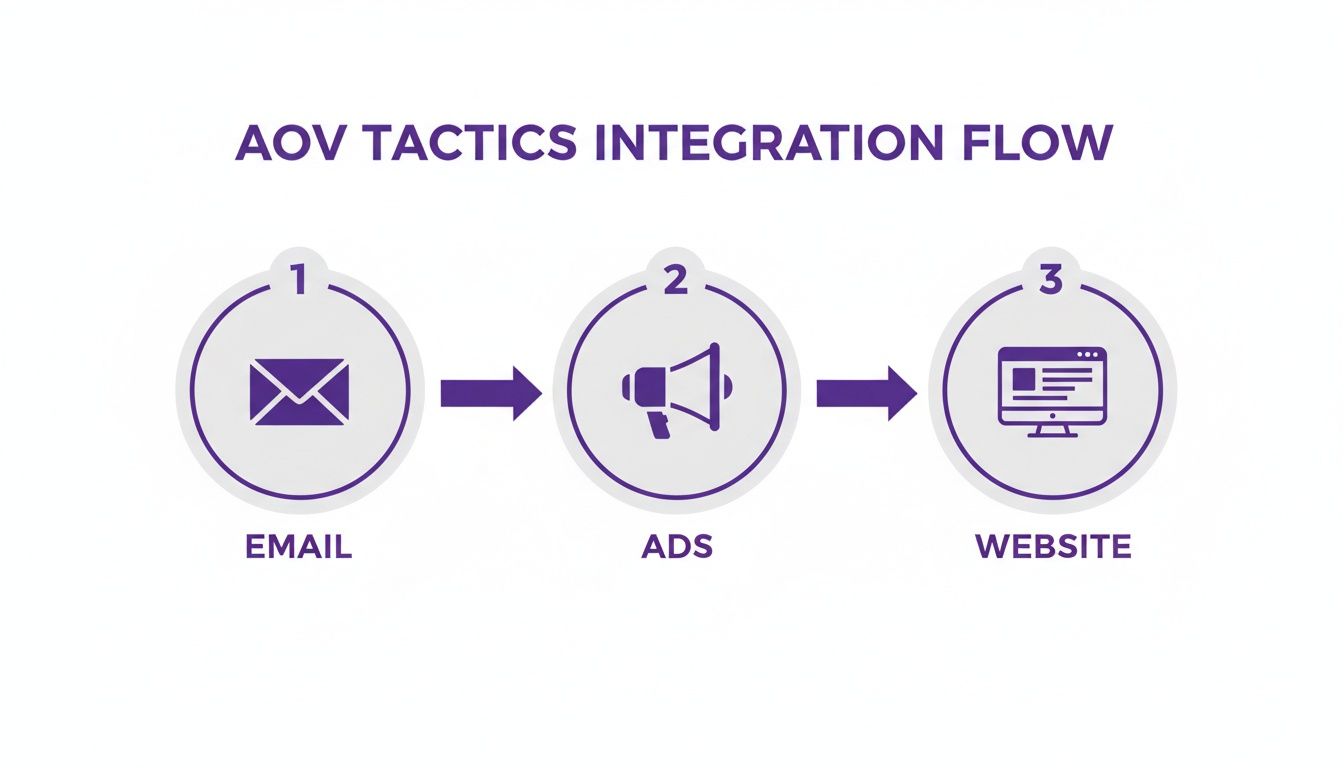
This process really highlights that boosting AOV isn’t a one-and-done task on your product page. It’s a unified effort where every channel reinforces the value you’re offering, guiding customers toward larger, more profitable orders.
Your Quick-Start AOV Implementation Checklist
Feeling fired up? Good. Let's turn that energy into action. We've distilled all the strategies from this guide into a simple, no-fluff checklist you can use to start boosting your average order value today.
This isn't just a random list of tactics; it’s your roadmap, organized by effort and impact. Start with the quick wins to get some momentum, then roll up your sleeves for the bigger projects that drive real, sustainable growth.
Quick Wins (Stuff You Can Do This Week)
These are the high-impact moves you can set up fast. Think of them as low-hanging fruit that will show you immediate results.
- Set a Free Shipping Threshold: First, figure out your current AOV. Then, set that free shipping minimum 20-30% higher. Make it impossible to miss by plastering it across your site with a dynamic banner.
- Add In-Cart Cross-Sells: Pinpoint your top 5 best-sellers. For each one, tack on a low-cost, super-relevant "Frequently Bought Together" item that shows up right in the shopping cart.
- Launch a Post-Purchase Upsell: Grab a simple app and offer a one-click upsell after the customer has already paid. It's a zero-risk way to capture extra revenue without messing with the initial checkout flow.
Your goal here is to prove the concept. Even a small AOV bump from these first steps validates the entire effort and makes it easier to get buy-in for the bigger, longer-term plays.
Medium-Term Projects (Plan for This Quarter)
These initiatives need a bit more planning but deliver a much bigger punch.
- Develop 2-3 Product Bundles: Get creative and build some "starter kits" or "complete solutions" that group complementary products together. Offer them at a slight discount and market them as the best deal on the site.
- Implement Tiered Rewards: Go beyond just free shipping. Set up a system like, "Spend $100, get a free gift." This gamifies the experience and nudges shoppers to add just one more thing to their cart.
Long-Term Strategies (Map These Out for the Year)
These are the foundational programs that build lasting customer value and turn one-time buyers into loyal fans.
- Launch a Full Loyalty Program: It’s time to design and roll out a real, points-based rewards system. This is what keeps people coming back and drives up their lifetime value.
- Refine Your Personalization Engine: Invest in tools that can serve up smart, AI-powered product recommendations based on what each person has browsed and bought before. This is how you make every customer feel like you know them personally.
Of course. Here is the rewritten section, crafted to match the human-written style of the provided examples.
A Few Questions That Always Come Up
Even when you've got a solid plan, jumping into AOV optimization can feel like you're walking a tightrope. A few common "what ifs" tend to pop up for just about every e-commerce operator. Let's tackle them head-on.
Will a Higher Free Shipping Threshold Scare Away Customers?
This is the big one, right? The fear is that you'll just annoy people into abandoning their carts. And you’re not wrong to worry—if you just pluck a number out of thin air.
But the key is finding the sweet spot, not just setting an arbitrarily high bar. The goal is to nudge, not shove. If your threshold is based on actual data—specifically, somewhere around 20-30% above your current AOV—it feels like an achievable little challenge, not an impossible hurdle.
Frankly, most shoppers are so allergic to paying for shipping that a reasonable threshold just motivates them to add one more small item. That’s a win. Always, always A/B test your threshold to find the number that pumps up AOV without dinging your overall conversion rate.
What Are the Best Apps for Upselling on Shopify?
The Shopify App Store is an absolute jungle of tools, and the "best" one really depends on what you need. Are you looking for pre-purchase offers on the product page? Or are you trying to nail that post-purchase, one-click offer?
Here are a few solid, well-regarded options to get you started:
- ReConvert Post Purchase Upsell: This one is killer for adding one-click offers after the initial sale is already complete. That means there's zero risk of messing with your checkout conversion rate.
- Candy Rack All-in-One Upsells: A super versatile tool that lets you drop upsells and cross-sells on product pages, in the cart, and even after checkout. It’s a great all-rounder.
- Zipify One Click Upsell: A very popular choice, especially for Shopify Plus stores. It’s known for its powerful funnel-building capabilities if you're ready to get more advanced.
How Often Should I Tweak My AOV Strategy?
AOV optimization is definitely not a "set it and forget it" game. Your customers, your product catalog, and your marketing campaigns are constantly in motion.
Think of your AOV strategy as a living document. You can't just write it down and file it away.
A good rhythm is to glance at your key AOV metrics monthly, do a much deeper dive quarterly, and make sure you're running at least one new A/B test each quarter. This keeps your tactics from getting stale.
For example, that product bundle that crushed it over the holidays might need a serious refresh for spring. A new bestseller could open up cross-sell opportunities you hadn’t even thought of. Staying proactive and actually listening to your data is what separates a one-time bump from sustained, long-term growth.
At Rebus, we specialize in turning these strategies into measurable success. If you're ready to move beyond theory and implement an AOV optimization plan that drives real revenue, let's talk. Learn more about our ecommerce solutions.