
Law firm website design: Build Trust and Attract Ideal Clients
Your law firm’s website is your single most powerful client-getter. Full stop. It's the digital front door that never closes, a 24/7 rainmaker that combines sharp branding, dead-simple navigation, and clear, confident messaging to turn curious visitors into paying clients.
A strategic design makes sure your site doesn't just look the part—it has to perform flawlessly for the modern client who expects answers, and expects them now.
Your Website Is Your Hardest Working Employee
Stop thinking of your website as a digital brochure. It’s so much more. It's your always-on client intake specialist, your lead-qualifying paralegal, and your firm’s #1 brand ambassador, all rolled into one. In a field built on trust and credibility, your site is the first handshake. It has to instantly scream competence, authority, and "we can solve your urgent problem."
Your website becomes the hub for every single marketing move you make. Whether someone finds you through a Google search, a paid ad, or a word-of-mouth referral, their experience on your site will make or break their decision to call you. Every little detail—from how fast the page loads to how easy it is to find your phone number—directly impacts your bottom line.
The High Cost of an Outdated Website
Letting your firm's primary digital asset gather dust is no longer an option. The data is jarring: while a whopping 94% of law firms have a website, many are dangerously out of date. A concerning 29% of firms haven't touched their site in over two years, and 9% have left theirs untouched for more than five.
This digital neglect is costing them a fortune in lost leads and trashed credibility. And that's not even counting the 6% of firms that still don't have a website at all, completely missing out on what 64.7% of their peers consider their highest ROI marketing channel.
Your website isn’t an expense; it’s an investment in your firm's growth engine. It should be a dynamic, lead-generating machine that consistently delivers qualified prospects and reinforces your professional authority.
Before diving into design, it’s crucial to understand the non-negotiable elements that separate a high-performing site from a digital paperweight. The table below breaks down the core components and why each one is critical for turning visitors into clients.
Core Components of a High-Performing Law Firm Website
| Intuitive Navigation & Structure | A potential client in distress needs answers fast. Your site's layout must be logical, guiding them effortlessly to practice areas, attorney profiles, and contact info without frustration. | Reduces bounce rate and friction, making it easy for leads to find what they need and take the next step. |
|---|---|---|
| Compelling Content & Trust Signals | Detailed case results, client testimonials, and clear attorney bios build confidence. Content must establish both expertise and empathy to connect with someone facing a legal challenge. | Builds credibility and rapport before the first phone call, pre-selling your firm’s value and authority. |
| Mobile-First Performance & Speed | The majority of potential clients will find you on their smartphone. A slow, clunky mobile experience is the fastest way to lose a lead. | A fast, responsive site ensures a seamless experience on any device, capturing leads who are on the go. |
| Clear Calls-to-Action (CTAs) | Don't make visitors guess what to do next. Strategically placed buttons and forms prompting them to "Schedule a Consultation" or "Call Us Now" are non-negotiable. | Directly guides visitors toward conversion, turning passive traffic into active, measurable leads for your firm. |
These pillars aren't just about aesthetics; they're the strategic foundation of a tool designed for one purpose: client acquisition. To get there, the design must seamlessly integrate several key features for law firm websites that all work together to guide visitors from that first click to a signed retainer.
Building Your Strategic Foundation
A high-performing law firm website isn't just about looking slick; it's about building a machine that generates business. It’s constructed on a solid strategic framework. Before you even think about colors or fonts, you have to get inside the heads of your potential clients.
This planning phase is, without a doubt, the most important part of the entire project. It's the difference between a site that's just a digital brochure and one that actively brings in cases.
It all boils down to a simple, yet critical, question: who is your ideal client? Get specific. Are you targeting a startup founder sweating over intellectual property, or a family reeling from a complex personal injury case? Knowing their exact pain points, their biggest fears, and the words they type into Google is everything.
This deep understanding lets you map out their journey. Someone frantically searching for a "car accident lawyer near me" on their phone has a totally different mindset than a business owner methodically researching "contract litigation firms." Your website has to anticipate and cater to both.
Defining Your Ideal Client Profile
To build a site that actually works, you have to ditch the vague generalizations. A generic site built for "everyone" will connect with no one. The goal is to build a detailed persona of your perfect client.
Think about these key attributes:
- Demographics: What's their age, location, and professional background? A young tech entrepreneur has completely different expectations than a retired individual planning their estate.
- Psychographics: What are their immediate legal headaches and emotional triggers? A client facing a DUI is driven by fear and urgency, while someone seeking a patent is motivated by ambition and opportunity.
- Online Behavior: Where do they hang out online? Are they more likely to be swayed by authoritative blog posts, client testimonials, or a straightforward page of case results?
Creating this profile ensures every single element of your site—from the homepage headline to the fields in your contact form—speaks directly to the right person. This focus is the first step toward turning visitors into qualified leads.
Mapping the Client Journey and Site Architecture
Once you know who you're talking to, you can figure out the how—how they'll navigate your site to find the solutions they desperately need. This is where information architecture comes in. It’s the blueprint for your website, making sure content is organized logically for both users and search engines.
A disorganized website is a dead end for potential clients. In fact, one study found that 38% of people will just leave a website if the layout is confusing or unattractive. Your site's structure should feel intuitive, guiding visitors effortlessly toward the information that convinces them you're the right choice.
Your website's navigation isn't just a list of links; it's a guided pathway. A clear, logical structure reduces user frustration, builds trust, and makes it simple for potential clients to take the most important step contacting your firm.
This visual below shows how a well-structured website sits at the very core of your marketing, turning traffic from all over the web into actual revenue.
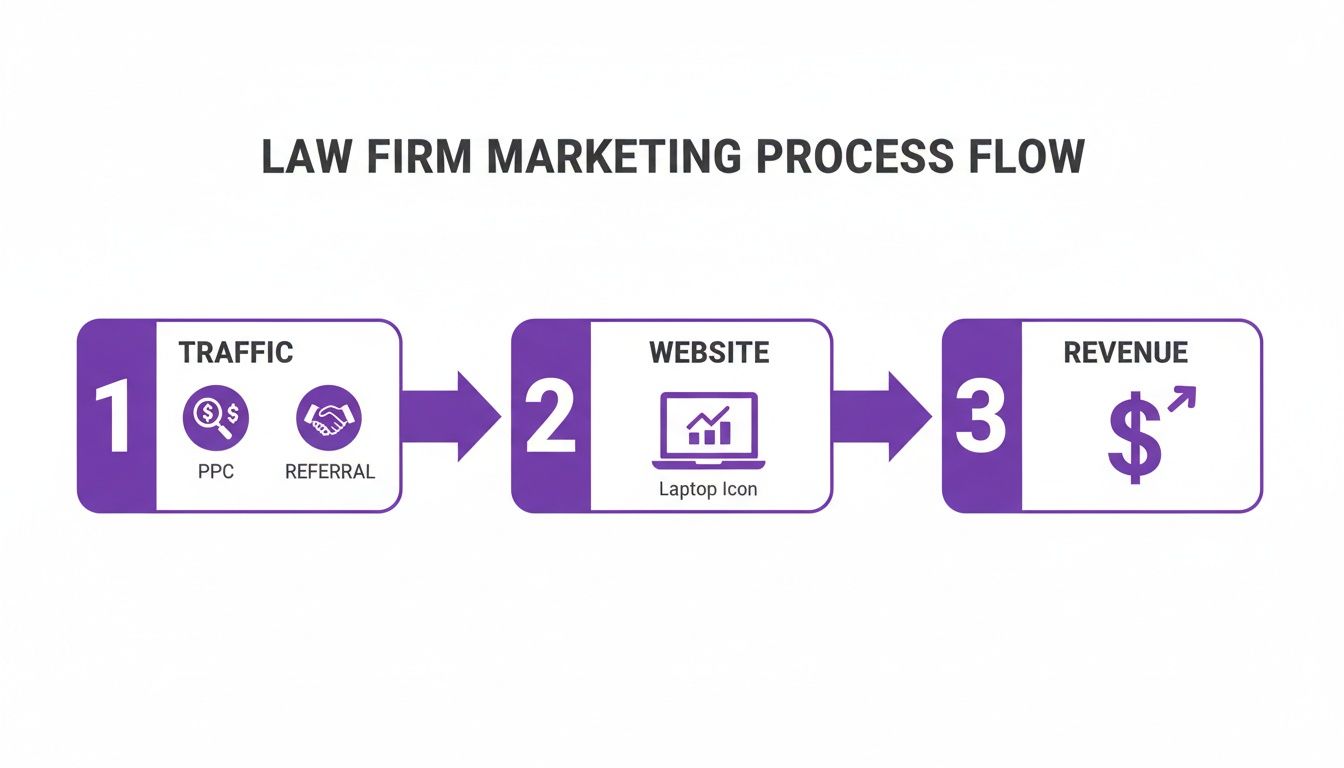
This process makes it clear: whether a visitor comes from a paid ad, a Google search, or a referral, your website is the critical conversion point where interest becomes a real business opportunity.
A logical site structure almost always includes:
- A Clear Homepage: Instantly communicates who you are, what you do, and who you help. No fluff.
- Detailed Practice Area Pages: Each page should be a deep dive into a specific service, addressing client pain points and showcasing your expertise.
- Compelling Attorney Bios: Humanize your firm. Build trust by highlighting the experience and personality of your legal team.
- Proof-Based Pages: Sections for case results, testimonials, and reviews provide the social proof people need before they'll pick up the phone.
- An Accessible Contact Page: Make it incredibly easy for users to get in touch with a clear phone number, a simple contact form, and a map to your office.
This strategic foundation, which aligns with the core principles of digital marketing for professional services, ensures that every visitor has a positive, productive experience—moving them one step closer to becoming your next client.
Designing for Trust and Professional Authority
When a potential client is deciding whether to hire your firm, it all comes down to one thing: trust. Your website is their first handshake, their first impression, and your most powerful tool for establishing credibility right out of the gate. This isn't just about looking good; every font choice, color, and photo sends a signal about your firm's competence.
A polished, professional website tells clients you're meticulous, experienced, and ready to handle their most sensitive legal issues. Let's break down how to use visual design and smart content to build that trust from the very first click.

Cultivating a Professional Visual Identity
Your firm’s visual identity—the colors, fonts, and images you use—creates an instant gut reaction. The goal is to project stability, expertise, and a sense of calm confidence.
Color psychology is a huge part of this. Blues and deep grays are classic for a reason; they communicate professionalism and stability. But that doesn't mean you have to be boring. A modern firm might throw in a bold accent color to show they’re dynamic and forward-thinking. Whatever you choose, the key is to be intentional and consistent.
Typography is just as critical. A classic serif font like Garamond can give headings a feeling of tradition and authority, but for body text, a clean sans-serif font like Open Sans or Roboto is almost always the right call. We've seen it across thousands of legal sites—these fonts are just flat-out easier to read on a screen. Make sure your body text is at least 16px to 18px for accessibility and comfort on any device.
Showcasing Your Attorneys as Your Greatest Asset
Here’s the thing: people hire lawyers, not logos. Your attorney bio pages are probably the single most important trust-building asset on your entire site. This is where a potential client decides if they can see themselves working with you.
A generic, text-heavy bio is a massive missed opportunity. A truly compelling bio needs to do more:
- Feature Professional Headshots: Please, invest in high-quality photography. A warm, confident headshot makes an attorney feel approachable and creates an immediate personal connection. No cropped vacation photos.
- Tell a Story: Don't just list credentials like a resume. Weave a narrative. Why did this attorney choose family law? What drives them to fight for their clients? This is the human element that builds rapport.
- Highlight Specific Accomplishments: Instead of just listing "Bar Admissions," show them what you've done. Mention notable case results, articles you've published, or speaking gigs that prove you're an authority in your field.
This is how you turn a dry CV into a powerful tool that builds confidence long before the first phone call.
Your website’s visual design and content aren't separate tasks. They're a team, working together to answer a visitor’s most urgent question: “Can I trust this firm to solve my problem?” Every choice you make should reinforce a resounding “yes.”
Leveraging Social Proof to Build Confidence
Beyond what you say about yourself, what others say carries incredible weight. Social proof—client testimonials, case results, awards—is non-negotiable for a law firm's website.
Don't bury your best testimonials on some forgotten page. Sprinkle them throughout your site where they’ll have the most impact. A glowing review from a personal injury client hits a lot harder when it's right there on your "Car Accidents" page.
When you share case results, get specific (while always respecting client confidentiality, of course). "Secured a seven-figure settlement for a client" is infinitely more powerful than a vague claim about getting "great results." This is the concrete proof that shows you can deliver. If you really want to kick things up a notch, exploring how interactivity on websites can help you present this proof in a more engaging way.
By weaving together a professional visual identity, compelling human stories, and verifiable proof of your success, your website becomes more than just a digital brochure. It becomes an engine for building trust, showcasing authority, and winning the clients you want.
Mastering Technical SEO and Site Performance
Let's get one thing straight: even the most beautiful, persuasive law firm website is completely worthless if potential clients can't find it. This is where technical SEO and site performance come in. Think of them as the engine under the hood—the raw power that allows your brilliant design and compelling content to actually get in front of the right people at the right time.
Technical SEO is basically the language you use to speak directly to Google. A technically sound website clearly tells search engines what your firm does, who you help, and where you're located. This goes way beyond just stuffing keywords into a page. It’s about building a site that is fast, secure, and dead simple for search crawlers to understand. Get this right, and you'll see higher rankings and more qualified traffic. It’s that simple.
On-Page SEO Essentials for Law Firms
On-page SEO refers to the tweaks and optimizations you make on individual pages to help them rank higher. For a law firm, this is most critical on your practice area pages. Each one needs to be a laser-focused resource targeting a specific legal service.
Here’s how to nail the basics:
- Title Tags: This is that blue, clickable link in a Google search result. It has to be compelling and include your target keyword. "Services" won't cut it. Go for something like, "Austin Personal Injury Lawyer | Car Accident Attorney."
- Meta Descriptions: This is the short text snippet under the title. While it’s not a direct ranking factor, a well-written meta description is your sales pitch to get the click. It should be a concise summary of the page and include a call to action.
- Header Tags (H1, H2, H3): Use headers to give your content a logical structure. Your main page title should always be an H1, with subheadings as H2s and H3s. This is great for user readability and helps search engines understand the page’s hierarchy.
These elements work in tandem to signal relevance, ensuring your pages show up for the exact queries your ideal clients are typing into Google.
The Critical Role of Site Speed
We live in an age of instant gratification, which means site speed is non-negotiable. A slow-loading website is one of the fastest ways to lose a potential client—especially on mobile, where the majority of legal searches now begin. Google knows this, and they use site speed as a significant ranking factor.
A delay of just a few seconds can cause your bounce rate to skyrocket. To prevent this, your agency should be optimizing images, using efficient code, and choosing a high-quality hosting provider from day one. Performance can't be an afterthought.
A fast website isn't just a technical nicety; it's a direct reflection of your firm's professionalism. It shows potential clients that you are efficient, modern, and respect their time—qualities they are absolutely looking for in a legal representative.
A strong technical foundation is essential for converting visitors, and industry benchmarks clearly show what works. Organic SEO, for example, is responsible for landing 3.0% of visitors, demonstrating that search remains the dominant force in client acquisition. The advantage of SEO becomes even clearer when you look at conversion rates: SEO boasts a 7.5% conversion rate, which is over three times higher than PPC's 2.2%. This makes an integrated design and SEO strategy indispensable. It's no surprise that 64.7% of firms view their websites as their top marketing investment, especially as average SEO spending reaches $120,000 annually, delivering significant returns.
Local SEO and Schema Markup
For most law firms, your clients are coming from the local community. This makes local SEO absolutely essential for attracting clients in your specific city or region. A complete and optimized Google Business Profile is the cornerstone of any local strategy, but the signals on your website are just as important.
Make sure your firm’s name, address, and phone number (NAP) are consistent across your entire website—the footer of every page is the perfect spot. If you have multiple offices, you need to create location-specific pages for each one.
To give search engines an even clearer picture, you need to implement schema markup. This is a specific type of code that helps Google understand the context of your content. For a law firm, you can use LegalService schema to define your practice areas and Attorney schema for lawyer profiles. This helps you appear in richer, more detailed search results that make you stand out from the competition. To learn more about building a dominant online presence, check out our guide on SEO for professional services firms.
Turning Website Visitors Into Qualified Leads
A gorgeous law firm website that doesn't make the phone ring is just an expensive digital brochure. Its real job is to be your firm's hardest-working, 24/7 lead generation engine. Every single element, from the layout to the last call-to-action, has to be engineered to turn a curious visitor into a potential client. This is where a good design becomes a great business asset.
But the goal isn't just to get any lead; it's to attract the right kind of lead. Your website needs a crystal-clear understanding of what goes into defining a qualified lead for your firm. It has to act as a filter, separating casual browsers from people with genuine, urgent legal problems you can solve. Get this right, and your intake team will spend their time on conversations that actually convert, not chasing dead ends.

Crafting Compelling Calls to Action
Every page on your website needs to give the visitor one clear job to do. Don't make them guess. A call-to-action (CTA) is the bridge between them passively reading and actively reaching out. It's the button or link that says, "Do this next."
Generic CTAs like "Submit" or "Click Here" are lazy and scream "I don't care." Your CTAs have to be specific, action-oriented, and packed with value. Ditch the vague language and use powerful commands that promise a clear, desirable outcome.
Here are a few examples that work for law firms:
- "Schedule Your Confidential Consultation" (This feels much more professional and secure than a generic "Contact Us.")
- "Download Our Free Car Accident Guide" (Offers immediate value and captures a lead for your email list.)
- "Get a Free Case Evaluation" (A low-commitment offer that encourages someone to share their story.)
Place these CTAs prominently—above the fold and at the end of key content sections. You want to make it ridiculously easy for a visitor to take action the second they feel that spark of motivation.
Essential Lead Capture Mechanisms
To turn visitors into leads, you need tools that make it simple for them to connect. Just having a single contact page is a rookie mistake. A modern law firm site uses a multi-pronged approach to meet potential clients where they are.
The best law firm websites don't just offer one way to get in touch; they provide multiple, frictionless pathways for a potential client to take action. The easier you make it for them, the more leads you will generate.
Smart lead capture is about offering options without creating confusion. Think of this as a foundational part of your website design, not a last-minute add-on.
Choosing the Right Lead Generation Tools
Picking the right tools is crucial for capturing different types of leads effectively. A person with an urgent DUI might prefer to call immediately, while someone researching a business dispute may be more comfortable filling out a form after hours. Here's a quick breakdown of the essentials.
| Contact Forms | Gathers detailed information upfront, letting you qualify leads before the first call. | Practice area pages and dedicated landing pages. | Keep the form short. Only ask for the absolute essentials: name, email, phone, and a brief message. |
|---|---|---|---|
| Click-to-Call | Provides immediate, direct contact—a must-have for mobile users with urgent needs. | The website header, footer, and on pages targeting high-urgency keywords like "DUI lawyer." | Make sure the phone number is a tappable link on mobile. Don't make them copy and paste. |
| Live Chat | Engages visitors in real-time, answers initial questions, and can pre-qualify leads. | The homepage and high-traffic practice area pages where users might have quick, simple questions. | Use a real person if possible. If not, a well-programmed bot that can intelligently route conversations. |
By offering a mix of these tools, you cater to different user preferences and capture leads you might otherwise miss.
Building High-Converting Landing Pages
If you're running paid ad campaigns from Google or Facebook, sending that expensive traffic to your homepage is like pouring water into a leaky bucket. It's a waste of money. You need dedicated landing pages.
A landing page is a standalone page built for a single, focused conversion goal. It's stripped of all distractions, like the main navigation, to keep the visitor locked in on the one action you want them to take.
A successful law firm landing page needs a few key elements to work:
A Compelling Headline: It has to match the ad they clicked on and speak directly to their problem.
Benefit-Oriented Copy: Focus on how you solve their problem, not just on your firm's long history.
Social Proof: A powerful client testimonial or a relevant case result builds instant credibility.
A Single, Clear CTA: The entire page should funnel the visitor toward one action—filling out a form or calling your office.
By creating focused, campaign-specific landing pages, you dramatically increase the chances that your ad spend will deliver what it's supposed to: a steady stream of qualified new clients.
Burning Questions About Law Firm Web Design
When attorneys start thinking about a new website, the same smart, practical questions always come up. It boils down to time, money, and what actually works. Here are the straight-up answers you need to make the right call for your firm's most important marketing asset.
How Much Should a Law Firm Website Cost?
This is always the first question, and the honest answer is: it depends. A professional website for a law firm can run anywhere from a few thousand for a basic template to well over $50,000 for a massive, feature-heavy custom build. The price tag is tied directly to the complexity.
So, what drives the cost?
- Custom vs. Template: A site designed from the ground up costs more than a pre-made template, but the strategic and branding advantages are huge. You're not just buying a look; you're buying a conversion machine built just for you.
- Sheer Size: A 10-page site for a solo practitioner is a different beast than a 100-page site for a firm with multiple offices and dozens of attorneys. More pages mean more design, content, and development time.
- Depth of SEO: A website built on a deep, research-backed SEO foundation requires far more strategic work upfront. This isn't just about keywords; it's about structuring the entire site to dominate search results.
For a small to mid-sized firm that wants a website that actually generates leads, a realistic budget usually lands between $15,000 and $35,000. That range gets you a professional, high-performance site built to grow right alongside your practice.
How Long Does It Take to Build a New Website?
Good things take time. A quality website doesn't get cranked out overnight. You should plan for a timeline of 12 to 20 weeks from the initial kickoff meeting to the day you launch. This buffer is crucial—it allows for a careful, collaborative process that avoids rushed decisions and sloppy work.
The project breaks down into a few key phases: deep-dive strategy, user experience (UX) and wireframing, content writing, visual design, coding, and finally, a ton of testing before launch.
The single biggest thing that slows a project down? Client feedback. The faster a firm can provide things like attorney photos and practice area details or sign off on design concepts, the smoother and quicker the entire process will be.
Think of your website build as a partnership. Your team’s timely communication and decisive feedback are just as critical as the designer's creativity and the developer's code. Collaboration always produces the best results, period.
Should We Use a Template or Go for a Custom Design?
Templates can seem tempting with their lower upfront cost and faster launch time. But for any law firm serious about growth, a custom design is a strategic investment, not an expense. A template gets you online, sure, but it often comes with crippling limitations that will kneecap your marketing down the road.
A custom-built website lets you create something truly unique that stands out from the sea of lookalike competitor sites. It's built specifically around the journey of your ideal client, creating a seamless experience that naturally guides them toward picking up the phone.
But here’s the real kicker: a custom site is built from day one with a scalable SEO architecture. This is a massive advantage. You aren’t trying to shoehorn an SEO strategy into a rigid, pre-built box. The entire site is structured from the ground up to rank in search engines, which is the lifeblood of sustainable lead generation.
What Are the Most Important Pages on a Law Firm Website?
Every law firm needs a killer homepage that immediately communicates who you are and what you do. But beyond that, there are five pages that do the heavy lifting to build trust, establish authority, and turn visitors into clients.
- Detailed Practice Area Pages: These are your money pages. Each one should be an authoritative resource on a specific service you offer, directly addressing client pain points and proving you’re the expert they need.
- Attorney Bios: People hire people, not logos. Your bio pages are where potential clients connect with you on a human level. It’s your chance to build personal trust before you ever meet.
- Case Results or Testimonials: This is your proof. Concrete results and glowing reviews from past clients provide the evidence people need to feel confident they're making the right choice.
- A Can't-Miss-It Contact Page: Make it dead simple to get in touch. Offer multiple ways to connect: a simple form, a clickable phone number, an email address, and an interactive map to your office.
- A Blog or Resources Section: This is your organic traffic engine. Consistently publishing helpful, relevant content establishes you as a thought leader and pulls in potential clients who are just starting their search for answers.
At Rebus, we build custom law firm websites that don’t just look good—they’re engineered to attract your ideal clients and generate a steady flow of qualified leads. If you’re ready to turn your website into your firm's most powerful marketing asset, let's talk about what real results look like. Learn more about our approach at Rebus Advertising.