Grow Your Subscriptions: How to manage email list for Maximum Engagement
Let's be real. Managing an email list is about a lot more than just blasting out a monthly newsletter. It’s about carefully growing your single most valuable business asset. Get this right, and you've built a direct line to your audience—one that drives predictable revenue and forges real customer relationships.
It’s the difference between shouting into a social media void and having a genuine conversation with people who actually want to hear from you.
Why Your Email List Is Your Most Valuable Business Asset

It’s tempting to think of email as old-school, but the numbers tell a completely different story. Unlike that social media account where a mysterious algorithm decides who sees your posts, your email list is yours. You own it. End of story.
That ownership gives you total control over how and when you connect with your audience. It makes your list a stable, reliable engine for growth that you can count on, quarter after quarter.
Think about it this way: every single subscriber is a person who intentionally raised their hand and said, "Yes, I'm interested." That isn't some passive follower you picked up by chance; it's a qualified lead. Smart list management is the art of taking that initial spark of curiosity and nurturing it into long-term loyalty and, ultimately, sales. You stop broadcasting and start building a community.
The Foundation of Sustainable Growth
A healthy, engaged email list is the bedrock for almost every other marketing move you make. Launching a new product? Announcing a flash sale? Sharing a killer piece of content? Your list is always your first—and most receptive—audience.
This direct access gives you instant feedback and helps build the initial momentum that can make or break a campaign on other channels. The scale here is massive. With over 4.6 billion people expected to use email by 2025, the potential is undeniable.
But here’s the catch: you’re fighting for attention. Nearly 17% of emails fail to even reach the inbox. This is precisely why a strategic approach to managing your list isn't just a "nice-to-have." It's essential.
An email list isn't just a database of contacts. It's a curated audience of potential customers and your biggest brand fans. Treating it like an asset means investing in its quality, engagement, and growth every single day.
For any business serious about thriving, especially in a crowded market, mastering this skill is completely non-negotiable. If you want a deep dive into the nuts and bolts, this guide on Shopify Email List Management Done Right is packed with actionable insights.
Proper management ensures your messages get seen, your brand’s reputation stays solid, and your marketing budget actually delivers a powerful return.
Building a Quality List Starts with Trust, Not Tricks
Before you can even think about managing an email list, you have to build one the right way. Too many marketers get obsessed with the subscriber count, chasing a big vanity number. That's a fool's errand. A list of 100,000 people who don't care about you is worthless. A list of 1,000 true fans? That’s gold.
The goal is to attract people who genuinely want to hear from you. This whole process starts with earning their trust from the very first hello. It’s not about tricking someone into a signup; it’s about offering such undeniable value that they want to give you their email address.
When that happens, you’ve started a relationship, not just a transaction.
Create Lead Magnets People Actually Want
A lead magnet is just a fancy term for the valuable thing you offer in exchange for an email. The key word here is valuable. A lazy "sign up for our newsletter" CTA is dead. It doesn't cut through the noise anymore. Your offer has to be specific, relevant, and solve a real headache for your audience.
Let's get practical. Here are a few examples that work:
- For a B2B Software Company: Instead of a generic newsletter, offer a "Free 5-Day Email Course on Advanced Project Management." This immediately filters for professionals actively looking to level up their skills—in other words, highly qualified leads.
- For an E-commerce Skincare Store: A simple 10% discount is fine, but it’s forgettable. A "Personalized Skincare Routine Quiz" that emails tailored product recommendations? That's compelling. It delivers immediate, personal value.
- For a Financial Advisor: Create a downloadable PDF checklist like, "10 Overlooked Tax Deductions for Small Business Owners." This is a practical tool that solves a specific, nagging pain point for their ideal client.
See the pattern? These offers don't just ask for something; they give something genuinely useful first. This simple shift is the foundation of a healthy list. If you want to go deeper on this, our full guide on how to build email lists is packed with more tactical ideas.
Make Consent and Transparency Your North Star
Okay, you’ve got a killer offer. Now you need to make the sign-up process crystal clear and respectful. This isn't just about dodging legal bullets from regulations like GDPR and the CAN-SPAM Act—it's about building long-term trust.
Let’s be blunt: buying email lists is a shortcut to failure. You'll get abysmal engagement, tank your sender reputation, and end up in the spam folder.
A transparent sign-up process tells people exactly what they're getting and how often you'll be in their inbox. Setting those expectations upfront saves everyone a lot of frustration and keeps your unsubscribe rates low.
Think of consent as a strategic advantage, not a legal chore. When subscribers know exactly what they're signing up for, they are far more likely to engage with your emails, leading to higher open rates and better overall campaign performance.
Use a Double Opt-In to Weed Out the Noise
One of the most powerful ways to solidify consent is with a double opt-in. It's simple: after someone fills out your form, they get an automated email asking them to click a link to confirm their subscription.
This extra step is a game-changer for two reasons:
It verifies genuine interest. Only people who truly want your emails will bother to click that confirmation link. Boom—your list is instantly filled with more engaged people.
It keeps your list clean. This process filters out typos, fake email addresses, and spam bots from the get-go, protecting your sender reputation before you've even sent your first campaign.
Sure, it might slightly lower your initial sign-up numbers. But the quality of the subscribers you gain is exponentially higher. This focus on quality over quantity is a core principle of smart email list management. By prioritizing consent, offering real value, and confirming intent, you build an audience that doesn’t just tolerate your emails—they actually look forward to them.
Mastering Email List Hygiene for Better Deliverability
Let's get one thing straight: a bloated, inactive email list isn't a badge of honor. It’s a liability. Every unengaged subscriber, hard bounce, and spam complaint drags down your sender reputation, making it harder for your messages to reach the people who actually want them.
Think of list hygiene not as a chore, but as essential maintenance for one of your most valuable marketing assets. Regularly cleaning your list is single-handedly one of the most effective ways to improve deliverability, boost engagement, and get a better return on your email marketing investment. It’s how you make sure your carefully crafted campaigns don't end up lost in the digital void.
Identifying Problematic Subscribers
The first step in any cleanup is knowing what—and who—you're looking for. Not all "bad" subscribers are created equal. They fall into several distinct categories, and each one requires a specific action to protect the health of your list.
This process is way more than just zapping bounced emails. You need to identify patterns of disengagement and spot potential risks before they cause significant damage to your sender score.
Here’s a breakdown of who to watch out for:
- Hard Bounces: These are permanent delivery failures, usually from an invalid or non-existent email address. They offer zero value and need to be removed immediately. No questions asked.
- Soft Bounces: These are temporary hiccups, like a full inbox or a server being down. One soft bounce isn't a crisis, but an address that repeatedly soft bounces over several campaigns? Treat it like a hard bounce and get it out of there.
- Unengaged Subscribers: These are the ghosts in your machine—the people who signed up but haven't opened or clicked an email in months. Keeping them tells inbox providers like Gmail that your content isn't very interesting, which can tank your overall deliverability.
- Spam Traps: These are the landmines of email marketing. They're email addresses used by inbox providers and blocklist operators to identify spammers. Hitting just one can get your sending domain blacklisted, making proactive list hygiene absolutely critical.
To help you get started, here's a quick-reference guide for handling these common subscriber issues.
Email List Hygiene Action Plan
| Hard Bounce | Permanent delivery failure (invalid address). | Remove immediately after the first bounce. |
|---|---|---|
| Repeated Soft Bounce | Temporary failures that occur over multiple campaigns. | Treat as a hard bounce and remove. |
| Unengaged Subscriber | No opens or clicks in 90-180 days. | Initiate a re-engagement (win-back) campaign. |
| Spam Trap | An email address used to identify spam senders. | Remove immediately. Use a verification service to detect. |
| Complaint Filer | A subscriber who marks your email as spam. | Remove immediately. |
This table should serve as your go-to checklist. By systematically addressing each type, you're not just cleaning your list; you're actively protecting your sender reputation.
The Power of Re-Engagement Campaigns
Before you give up on your unengaged subscribers, give them one last chance to reconnect. This is where a targeted re-engagement campaign, often called a "win-back" campaign, comes in. It's an automated sequence specifically designed to wake up your dormant contacts.
Forget your usual content. This campaign needs to be direct. A common and effective approach is a three-email sequence:
The Gentle Nudge: A friendly email asking, "Hey, do you still want to hear from us?" Often, it's smart to remind them of the value you provide.
The Last Chance Offer: Hit them with an exclusive discount or a super-valuable piece of content as a final incentive to stick around. Make it juicy.
The Goodbye Email: Be upfront. Tell them you'll be removing them from your list to respect their inbox, but give them a final link to re-subscribe if they have a change of heart.
This process is a total win-win. You either bring an old subscriber back into the fold or you cleanly remove someone who wasn't engaging anyway. Either way, your metrics improve across the board.
Maintaining a clean list isn’t just about removing bad contacts; it’s a direct signal to inbox providers that you are a responsible sender who values subscriber engagement. This simple practice is one of the biggest factors in achieving high deliverability rates.
When to Call in the Pros: List Verification Services
Sometimes, your list needs a deeper clean than what your email service provider can offer. This is where third-party email verification services come in. These tools are lifesavers, running your entire list through a gauntlet of checks to identify and flag risky addresses you'd never find on your own.
Consider using a verification service if:
- You're migrating to a new email platform like Klaviyo or Mailchimp.
- You've noticed a sudden, scary spike in bounce rates.
- You inherited an old list with a mysterious, unknown history.
- You honestly can't remember the last time you cleaned your list (it's been over a year).
Investing in a professional cleaning service once or twice a year is a smart move that pays for itself in improved deliverability and higher ROI. Neglecting this has real consequences; on average, a shocking 16.9% of emails never even make it to the inbox due to poor list management. And with the average email reading time being just 10 seconds, you can't afford for your message to go missing before it even gets a chance. You can get more key email statistics and insights to sharpen your strategy.
Using Smart Segmentation to Boost Engagement
Sending the same generic email to your entire list is a one-way ticket to the unsubscribe link. It’s like shouting into a crowded room and hoping the right person happens to hear you.
To really get a handle on your email list, you need to stop broadcasting and start having actual conversations. That's where smart segmentation comes in.
Segmentation is just a fancy word for dividing your email list into smaller, more focused groups based on specific criteria. Instead of a one-size-fits-all message, you can deliver razor-sharp content that speaks directly to a subscriber's needs, interests, and past actions. This is the move that turns a decent email strategy into a serious revenue machine.
When you nail the right message for the right person at the right time, engagement just explodes. Open rates climb, click-throughs get a nice bump, and your subscribers start to feel like you actually get them.
Moving Beyond Basic Demographics
Most people start by segmenting with demographics—things like age, gender, or location. That's not a bad first step, but it barely scratches the surface. Real engagement comes from understanding why someone is on your list and what they've actually done.
This is where behavioral segmentation completely changes the game. It focuses on how subscribers interact with your brand, giving you incredible insight into what they actually care about.
Segmentation isn't just about dividing your audience; it’s about understanding them. When you know who you’re talking to, you can craft messages that hit home on a personal level, turning passive subscribers into your biggest fans.
By digging into what your users do, you can create segments that are way more predictive of what they'll do next. It lets you tailor your emails so they feel incredibly personal and timely.
Actionable Behavioral Segments You Can Create Today
So, how does this actually work? Let's say you run an e-commerce store selling athletic gear. Instead of blasting a generic "New Arrivals" email to everyone, you could build some seriously powerful segments based on what customers have done before.
Here are a few examples of behavioral segments that flat-out work:
- Purchase Frequency: Group customers into buckets like "VIPs" (bought 5+ times), "Recent Buyers" (bought in the last 30 days), and "At-Risk Customers" (haven't bought in 90 days). Each group gets a totally different message—VIPs get exclusive access, recent buyers get product care tips, and the at-risk crowd gets a juicy win-back offer.
- Browsing History: Target subscribers who looked at a specific product category (like "running shoes") but didn’t pull the trigger. Send them a follow-up email with a guide on choosing the right running shoe or some killer customer reviews for the exact items they viewed.
- Email Engagement Level: Create segments for your most engaged subscribers (the ones who open and click everything) and your least engaged. Your superfans might get early access to a sale, while the less engaged folks could get a re-engagement campaign asking what kind of content they'd actually like to see.
If you’re a SaaS company, you might segment users by feature adoption. You could build a segment for users who’ve activated a key feature and send them advanced tips, while users who haven’t could get a friendly tutorial to nudge them along. Getting a grip on these different angles is key to building out your own customer segmentation strategies.
Using Dynamic Content for Hyper-Personalization
Segmentation sets the stage, but dynamic content is what really steals the show. Most modern email platforms let you create "smart" content blocks inside a single email that change depending on who's looking at it.
This means you can design one email campaign but show different images, calls-to-action, or product recommendations to different segments.
Here's a real-world scenario: A travel company sends out its weekly deals email.
- Subscribers in the "Budget Travelers" segment see deals for affordable hostels and backpacking trips.
- Those in the "Luxury Seekers" segment see offers for five-star resorts and all-inclusive packages.
- A "Family Vacation" segment sees promotions for kid-friendly destinations.
The email template itself is the same, but the content inside shifts to be hyper-relevant for each person. For more advanced segmentation and delivering personalized experiences, integrating with dedicated platforms is key. You can explore various CRM SaaS companies that help manage customer data for precisely this kind of targeted email campaign. This level of personalization makes subscribers feel like you’re reading their minds, and it dramatically boosts your chances of making a sale.
Automating Your Nurture and Sales Sequences
If segmentation is the blueprint, automation is the powerhouse that brings it all to life. It's how you manage a growing email list without losing that one-on-one feel. By setting up automated workflows, you build an “always-on” marketing engine that nurtures leads, pulls back lost sales, and builds rock-solid relationships—all while you’re busy running the show.
Think of it as your most reliable team member, the one who always sends the perfect message at the perfect time. This is what transforms your email list from a simple megaphone into a dynamic, responsive machine for growth.
And the numbers don't lie. Automated emails are absolute monsters when it comes to performance, pulling in 42.1% open rates and 5.4% click rates. That blows standard campaigns out of the water. Even better, marketing automation has been shown to pump up qualified leads by a staggering 451%. It's not just a nice-to-have; it's a must-have for guiding people along their journey with you. You can see more data on the impact of email automation to get the full picture.
The Essential Welcome Series
Your welcome sequence is your digital handshake. It’s your first and best shot at making a killer impression. This is way more than a simple "thanks for signing up" email—it’s an onboarding process that sets the tone and delivers value from the word "go."
A great welcome series instantly reassures someone they made the right call. It should do a few key things:
- Deliver the Goods: If you promised them a guide, a discount, or a secret handshake, give it to them in that very first email. No delays.
- Tell Your Story: Who are you? What makes you different? Let them know what they can expect from your emails so they look forward to the next one.
- Show Off Your Greatest Hits: Point new subscribers toward your most popular products, killer blog posts, or game-changing resources.
This is your golden opportunity to turn a casual signup into a raving fan, right from day one.
Recovering Sales with Cart Abandonment Flows
If you sell anything online, you know the sting of an abandoned cart. It's a painful reality, but here's the good news: it's also one of the most profitable problems you can solve with automation. An abandoned cart flow is a short, hyper-focused email sequence sent to people who added items to their cart but bailed before buying.
This one simple automation can claw back a huge chunk of otherwise lost revenue. A battle-tested flow usually looks something like this:
Email 1 (After 1 hour): A gentle, friendly nudge. "Did you forget something?" Slap a picture of the item in there with a direct link right back to their cart. Make it easy.
Email 2 (After 24 hours): Time to build a little urgency or handle common objections. You could showcase some glowing customer reviews, talk up your amazing return policy, or answer a few FAQs.
Email 3 (After 48-72 hours): This is the final push. If it fits your brand, now's the time to offer a small, time-sensitive discount to get them over the finish line.
It’s an incredibly powerful way to re-engage someone who was this close to buying. If you're looking to really dial in this process, our guide on marketing automation best practices has some more advanced strategies.
This whole idea is powered by smart segmentation, which you can see illustrated below. It’s all about combining demographics, behavior, and purchase history to create these hyper-relevant, automated flows.
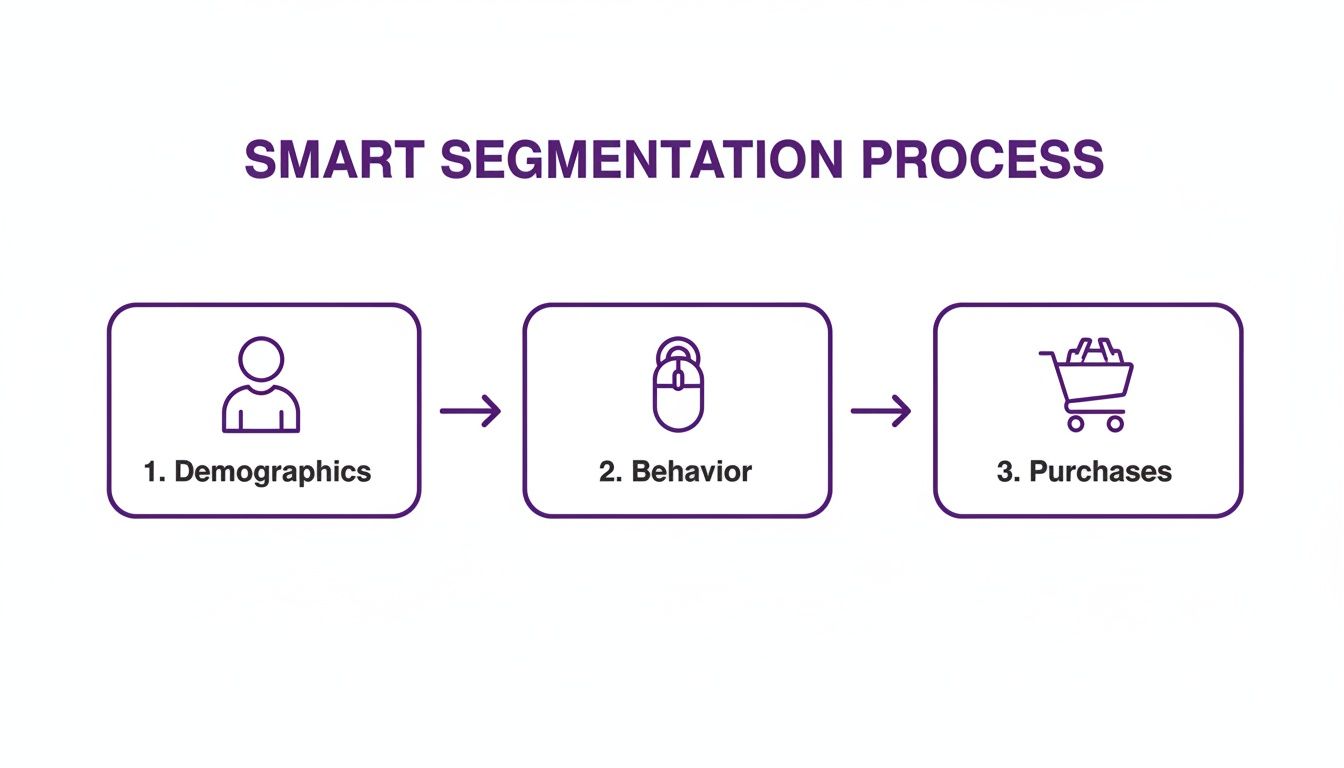
This shows how you create the perfect foundation for personalized, automated conversations by understanding who your customer is and what they’ve done.
Re-Engaging Dormant Subscribers with a Win-Back Campaign
It's natural—over time, some subscribers just fade away. A win-back campaign is your automated effort to pull them back in before they go cold for good. This sequence targets folks who haven't opened or clicked your emails in a while, say 90 or 180 days.
Automation isn't about being robotic; it's about being reliably human. It ensures every subscriber gets a consistent, thoughtful experience, whether they're your first or your ten-thousandth.
The goal here is simple: remind them why they signed up in the first place. You can send an exclusive "we miss you" discount, ask for feedback on what they'd like to see from you, or just highlight some of the incredible value you've shared recently.
And if they still don't bite? This automation can then move them off your active list, which is a good thing. It keeps your list clean and protects your sender reputation.
Measuring Performance and Optimizing for Results
You can't improve what you don't measure. It’s a classic business saying for a reason. Flying blind with your email list is a surefire way to waste time and money. It’s not enough to just send out campaigns; you have to dig into the data to understand what’s working, what’s falling flat, and most importantly, why.
Let's be real: seeing a high open rate feels great, but it doesn't pay the bills. The real goal is to turn your list management into a predictable growth engine. That means getting comfortable with the numbers and making a habit of tweaking your strategy based on cold, hard facts.
Key Performance Indicators That Actually Matter
To get a clear picture of your email marketing health, you need to track the right Key Performance Indicators (KPIs). These are the metrics that connect your email sends directly to business goals, moving beyond vanity metrics and into real impact.
Here are the heavy hitters you should have on your dashboard:
- Conversion Rate Per Email: This is the undisputed champion of email metrics. It tells you the percentage of subscribers who actually did the thing you wanted them to do (like buy a product or sign up for a demo) after clicking through from your email.
- List Growth Rate: A healthy list is a growing list. This metric tracks the rate you’re gaining new subscribers minus the people hitting unsubscribe. A steady, positive number here is a sign your acquisition efforts are on the right track.
- Overall ROI: This is the bottom-line calculation: total revenue generated from your email campaigns divided by what you spent to run them. It’s the ultimate proof that your efforts are profitable.
Focusing on conversion rates and ROI shifts your perspective from "How many people opened my email?" to "How much business did my email generate?" This is the mindset that drives real growth.
When you prioritize these KPIs, you start making data-backed decisions that have a direct, measurable effect on your bottom line.
Key Email Marketing KPIs and Industry Benchmarks
It's one thing to know your numbers, but it's another to know how they stack up. This table gives you a quick look at essential KPIs and what average performance looks like across different industries, so you can see where you stand.
| Open Rate | The percentage of recipients who opened your email. | 15-25% |
|---|---|---|
| Click-Through Rate (CTR) | The percentage of recipients who clicked on one or more links in your email. | 2-5% |
| Conversion Rate | The percentage of recipients who completed a desired action (e.g., purchase, download). | 1-3% |
| Bounce Rate | The percentage of emails that couldn't be delivered. (Aim for low!) | < 2% |
| Unsubscribe Rate | The percentage of recipients who opted out of your list. (Aim for low!) | < 0.5% |
Benchmarks can vary wildly based on industry, audience engagement, and content quality.
Use these numbers as a starting point. If you're crushing these averages, fantastic. If you're falling short, it's a clear signal that it's time to start testing and optimizing.
A Simple Framework for A/B Testing
Data tells you what's happening, but testing tells you why. A/B testing (or split testing) is your secret weapon for understanding your audience. It’s the simple process of sending two slightly different versions of an email to small chunks of your list to see which one performs better.
You can test almost anything, but you'll get the biggest bang for your buck by starting with the elements that have the most impact on your core KPIs.
Here are a few ideas to get you started:
- Subject Line: "Our New Spring Collection Is Here" vs. "5 Fresh Looks for Your Spring Wardrobe." This tells you which style of headline drives more opens.
- Call-to-Action (CTA): "Shop Now" vs. "Explore the Collection." This reveals which phrase gets more clicks.
- Email Content: A long, detailed product description vs. a short, punchy summary with bullet points. This helps you understand your audience's content preferences.
The golden rule? Only test one variable at a time. If you change both the subject line and the CTA button, you’ll have no idea which change actually caused the lift in performance. Be scientific about it. Test consistently, apply what you learn, and you’ll turn every single email send into an opportunity to get smarter.
Your Top Email List Management Questions, Answered
Alright, let's cut through the noise. When you're managing an email list, you run into the same practical, nitty-gritty questions over and over. Here are the straight-up answers to the ones I hear most from marketers and business owners trying to get their email game right.
How Often Should I Actually Email My List?
There’s no magic number here, but if you’re looking for a baseline, start with once a week. This keeps you on their radar without becoming inbox wallpaper. The real answer, though? It comes from paying attention.
An e-commerce brand crushing a holiday sale might send three emails in a single week and see amazing results. On the flip side, a B2B service could win big with a high-value, bi-weekly newsletter. Your audience will tell you what they want. Watch your unsubscribe and open rates like a hawk—they're the ultimate truth-tellers.
The perfect email cadence is a balancing act between staying relevant and respecting your subscribers' time. Don't guess. Start with a consistent schedule, then let your engagement data call the shots.
When Is It Time to Say Goodbye to an Inactive Subscriber?
Hanging onto unengaged subscribers is like carrying dead weight. It kills your sender reputation and hurts your ability to land in the inbox of people who actually want to hear from you.
The rule of thumb is to start the breakup process with anyone who hasn't opened or clicked an email in 90 to 180 days.
But don't just ghost them. First, run them through a final "win-back" or re-engagement campaign. It's an automated Hail Mary—a last-ditch effort to see if there's still a spark. If they still don't bite after that sequence, it's time to let them go. This isn't just a suggestion; regular list cleaning is a non-negotiable part of good hygiene.
Is Buying an Email List Ever a Smart Move?
Let me make this easy for you: No.
Buying an email list is the fastest way to torch your email marketing program. These people never gave you permission to contact them, which is a direct violation of laws like GDPR and the CAN-SPAM Act.
Forget about the legal trouble for a second. Reputable email platforms like Mailchimp or Klaviyo will ban you for using purchased lists. You’re guaranteed to see sky-high bounce rates, a flood of spam complaints, and engagement so low it’ll make you question your career choices. Focus your energy on building a list of people who chose to hear from you. It's slower, but it's the only way to win.
Ready to turn your email marketing into a serious growth engine? The team at Rebus lives and breathes lifecycle marketing, helping businesses like yours build real, valuable relationships with their customers. See how we can help you grow.