Choosing Between marketing agency vs in house: Which Delivers More Value?
The decision to hire a marketing agency vs in house really boils down to one big trade-off. An agency gives you instant access to a team of specialists and resources you can scale on demand, while an in-house team offers unmatched brand knowledge and direct control. The right choice isn't universal; it's entirely dependent on your company's stage, budget, and where you're trying to go.
The Core Decision: Agency Vs In-House Marketing
Figuring out how to run your marketing is one of the biggest moves a growing business can make. This isn't just about filling a seat or signing a contract—it's about building the engine that's going to drive your entire brand forward. Your choice here will echo through your budget, your ability to pivot, your brand's voice, and how fast you can get ideas out the door.
When you build an in-house team, they become part of your company's DNA. They live and breathe your brand, making sure every single message feels authentic. This setup gives you total control and lightning-fast responsiveness, perfect for making quick adjustments and working seamlessly with other departments like sales or product. But let's be real: building that dream team takes a lot of time and a serious investment in salaries, benefits, and keeping their skills sharp.
On the flip side, a marketing agency is your external strike team. They parachute in with a ton of experience from solving problems across different industries. You get immediate access to a full roster of pros—SEO gurus, PPC wizards, content strategists—without the overhead of full-time hires. It's often the faster and more budget-friendly way to tap into a wide range of skills. The catch? There's a learning curve while they get up to speed on your brand, and you won't have the same minute-to-minute oversight.
For businesses weighing their options, understanding the different flavors of outsourcing your marketing—from agencies to fractional CMOs—is a critical first step.
Ultimately, there's no single "right" answer. It all depends on what you value more right now: deep integration and hands-on control (in-house) or broad expertise and speed (agency).
Agency Vs In-House Marketing At a Glance
Feeling stuck? Let's strip away the noise. This table breaks down the core differences between the two models. Use it as a quick cheat sheet to see the major trade-offs at a glance and figure out which column feels more like your business.
| Factor | Marketing Agency | In-House Team |
|---|---|---|
| Cost Structure | Predictable monthly retainer or project fees; lower total cost for a diverse skill set. | Higher fixed costs, including salaries, benefits, training, and software licenses. |
| Expertise & Skills | Immediate access to a broad team of specialists across multiple marketing channels. | Deep, focused knowledge of one brand, one product, and one industry. |
| Speed to Market | Much faster deployment; an experienced team can launch campaigns almost immediately. | Slower ramp-up time; you have to account for hiring, onboarding, and training. |
| Control & Integration | Less direct day-to-day control; they operate as an external partner with their own processes. | Complete control over priorities, messaging, and tight alignment with internal teams. |
| Scalability | Super flexible. You can easily scale services up or down based on your budget or campaign needs. | Scaling is a slow, expensive process that involves recruiting and hiring new people. |
| Brand Knowledge | Needs an initial onboarding period to really "get" your brand voice and company culture. | Inherently deep understanding of brand history, values, and internal politics from day one. |
Seeing it laid out like this makes the choice a little clearer, right? It's not about which option is "better" overall, but which one is the better fit for your specific needs, resources, and goals at this very moment.
A Deep Dive Into Costs And ROI
When you're weighing a marketing agency vs in house team, the conversation almost always lands on money. On the surface, an in-house marketer's salary looks clean and simple next to an agency's monthly retainer. But that’s a dangerously incomplete picture. To really get it right, you have to look way beyond the base salary and figure out the total cost of ownership.

Let's be blunt: an in-house team is loaded with hidden expenses that can absolutely blow up your budget. These aren't just little line items; they are major, recurring investments that are way too easy to ignore.
The Hidden Costs of an In-House Team
Hiring someone is so much more than just their salary. The actual cost of an employee is often 25-40% higher than their base pay once you pile on all the necessary overhead.
Here's where the money really goes:
- Recruitment and Onboarding: Finding great talent is a job in itself. You've got recruiter fees, job board postings, and countless hours of your own team's time spent sifting through resumes and conducting interviews.
- Benefits and Taxes: This is a big one. Health insurance, retirement plans, and payroll taxes are significant recurring costs that are part of any real compensation package.
- Training and Development: Marketing changes at the speed of light. To keep your team from falling behind, you need to budget for ongoing courses, conferences, and certifications. It's a constant investment.
- Software and Tools: A single marketer needs a whole stack of tools for analytics, SEO, social media, and email. These subscriptions can easily run into thousands of dollars per person, per year.
When you do the math, a single marketing manager with an $80,000 salary can realistically cost your business over $110,000 a year. And that’s just for one person, who probably can't be an expert in every single channel you need to be on.
Unpacking Agency Costs And Value
An agency, on the other hand, operates on a much cleaner—and often more efficient—cost model. You're typically looking at a monthly retainer or a fixed project fee that bundles everything: talent, tools, and overhead. It's one clear number.
This structure gives you immediate access to a full squad of specialists—an SEO pro, a PPC manager, a content strategist, a copywriter—for what is often less than the true cost of hiring one senior marketer.
For a comprehensive partnership, digital marketing agencies typically charge anywhere from $50,000 to $150,000 annually. While that might sound like a lot, remember that the average salary for just one digital marketing specialist in the U.S. is $63,000 per year, before you add a single dollar of overhead. For most small to mid-sized businesses, the financial case for an agency is incredibly strong.
A key financial benefit of an agency is cost-efficiency through shared resources. You're not just hiring people; you're gaining access to their enterprise-level software, established processes, and collective expertise without bearing the full cost.
When you're trying to compare apples to apples, it helps to understand a reliable agency labor cost formula.
ROI: The Decisive Factor
Forget the direct costs for a second. The return on investment (ROI) is where the two paths really diverge, especially when it comes to speed.
An experienced agency can get a full-blown marketing campaign off the ground in a matter of weeks. They already have the team, the tools, and the workflows in place. Building an in-house team, however, takes months of recruiting, hiring, and onboarding before anyone is truly firing on all cylinders.
That delay isn't just about time—it's a direct hit to your potential revenue. The market won't wait for you to build your dream team.
This speed-to-market advantage means an agency can start generating leads, driving traffic, and producing a return much, much faster. While you're still interviewing candidates for an in-house role, an agency could already be optimizing your campaigns and delivering results you can take to the bank.
Of course, tracking this is key. To get a better handle on the numbers, check out our guide on https://rebusadvertising.com/blogs/how-to-calculate-return-on-ad-spend/.
Expertise and Strategy: Who Has the Edge?
When you’re weighing a marketing agency vs in house team, the conversation always lands on expertise. But it’s not about who’s “smarter.” It’s about what kind of smarts your business needs right now. Are you looking for broad, battle-tested knowledge from across the market, or deep, undiluted immersion in your own brand?

Think of an agency as a strategic hub. They’re constantly learning from a wild variety of industries, testing strategies across dozens of client accounts, and seeing what actually works in the trenches. This cross-pollination of ideas is their secret weapon.
A tactic that crushed it for an e-commerce brand might unlock a game-changing angle for a B2B software company. An agency team lives at that crossroads, giving them a perspective an internally focused team just can't get.
The Agency Advantage: A Bench of Specialists
Good marketing agencies are built around specialized roles. You don’t just get a “marketing person.” You get a technical SEO nerd who dreams in schema, a PPC manager who lives and breathes Google Ads, a data analyst who finds growth stories in spreadsheets, and a content strategist who understands narrative hooks.
Let's be real: hiring that entire roster of specialists in-house would cost a fortune. An agency lets you tap into all that firepower for a single retainer. It’s like getting a fractional slice of an entire expert-level department. This setup also forces them to stay on top of their game.
Research shows that a staggering 50% of in-house teams struggle to keep up with the breakneck pace of digital trends. For an agency, continuous learning isn't a perk; it's a survival mechanism.
An agency’s value isn't just in the services they provide, but in the strategic foresight they've gained from solving problems you haven't encountered yet. They see patterns across the market that are invisible from inside a single organization.
This outside perspective is fantastic for challenging sacred cows and internal biases. An in-house team might be too close to the product to see its flaws or market position clearly. A great agency partner brings a healthy dose of reality, backed by hard data on what's winning—and what's failing—for everyone else.
The In-House Advantage: Deep Brand Immersion
While agencies bring breadth, in-house teams deliver unmatched depth. An internal marketer is completely submerged in your company’s culture, history, and vision. They’re in the product meetings, they hear the sales calls, and they get the subtle nuances of your brand voice in a way an outsider rarely can.
That deep-seated integration fosters a level of authenticity that’s incredibly hard to fake.
- Effortless Internal Sync: In-house marketers can grab coffee with the sales team or Slack the product developers instantly, making sure marketing campaigns are perfectly aligned with the rest of the business.
- True Brand Voice: They don’t just learn the brand guidelines; they live the brand daily. This leads to more genuine and consistent messaging that resonates with your core audience.
- Accumulated Wisdom: They become the keepers of your brand’s story and marketing history, holding onto valuable lessons from past wins and losses that might disappear when you switch agencies.
This singular focus lets an in-house team become the ultimate subject matter expert on your specific product and customer. They can pivot on a dime in response to internal shifts and champion the brand with a passion that only comes from being part of the family. If you're curious about the nitty-gritty functions these experts handle, our article explaining what SEO companies do is a great place to start.
So, what’s the right call? It boils down to your immediate goals. Are you in a rapid growth phase where you need a diverse set of technical skills to grab market share, fast? An agency is probably your best bet. Or are you refining a complex brand that demands deep institutional knowledge and flawless cultural alignment? Then building your team from within might be the smarter move.
Who's Driving? Control, Agility, and Getting Things Done
Okay, let's get down to the brass tacks. Beyond the spreadsheets and skill charts, the real debate between hiring a marketing agency and building an in-house team often comes down to this: how much control do you need, and how fast do you need to move?
This isn't just about who's in charge. It's about your entire operational rhythm. The choice here is a big one—it pits direct, hands-on oversight against structured, process-driven execution.
An in-house team gives you an incredible amount of direct control. They're your people, plugged into your company's Slack channels, culture, and daily chatter. This means you can change priorities or overhaul a strategy on a moment's notice. Marketing becomes woven into the fabric of your other departments—sales, product, customer service—not just a satellite.
For instance, imagine your sales team uncovers a huge customer pain point in their 9 AM huddle. With an in-house crew, you could brainstorm a solution over coffee and have fresh ad copy and a tweaked landing page live before the end of the day. That kind of responsiveness is a massive advantage in markets that change at the speed of a tweet.
In-House Teams: Your All-Access Pass to Agility
The superpower of an in-house team is its proximity. They live and breathe your brand, sit in on the same all-hands meetings, and pick up institutional knowledge just by being there. This cultural immersion almost always leads to more authentic messaging and lightning-fast turnarounds on internal requests.
It's a model that’s catching on, and for good reason. A recent survey found that a whopping 82% of brands now have some form of in-house agency. The "why" is even more telling: 76% say it’s for increased agility, while 59% point to the benefits of seamless integration and deep brand knowledge. You can dig into the full report on why brands are bringing agencies in-house to see the whole picture.
But this total control can be a double-edged sword. Sometimes, an internal team gets so deep inside the bubble that they develop blind spots. They might miss shifts happening in the broader market or get stuck in an echo chamber of "the way we've always done things."
Agency Partners: The Power of Structure and an Outside Eye
An agency, on the other hand, runs on established processes and structured workflows. No, you can't just stroll over to their desk and demand a new campaign on a whim. But what you get in return is a level of discipline, predictability, and focus that many businesses desperately need. Good agencies bridge the distance with dedicated account managers and transparent project management tools, so you're never in the dark.
This external relationship also brings something crucial to the table: objectivity. An agency isn’t tangled up in your company’s internal politics or held back by historical baggage. Their job is to be the honest friend who tells you your strategy has a flaw. They look at your business from the outside, challenge your assumptions, and bring fresh ideas that have worked for other clients in other industries.
An agency’s external viewpoint is a powerful antidote to strategic stagnation. They can ask the tough questions and poke holes in sacred-cow ideas that an in-house team might be too close to challenge.
This structured approach also acts as a strategic buffer. Instead of reacting to every little fire or shiny new idea from within, an agency helps you stick to the big-picture goals you agreed on from the start. They provide the framework and discipline to execute long-term plans without getting derailed by short-term whims, ensuring every action ties back to a measurable result.
The trade-off is crystal clear: you give up some immediate, knee-jerk agility for a more deliberate, process-driven path to growth.
When To Choose An Agency Or Build A Team
Figuring out whether to hire a marketing agency vs in house team isn't just about the budget. It's a strategic fork in the road, and the right path is completely tied to your company's current stage and where you're trying to go. There’s no single right answer, just the right answer for you, right now.
Let's cut through the generic pros-and-cons lists. The needs of a scrappy startup are worlds apart from those of an established enterprise, and your marketing structure should reflect that reality.
Scenarios Favoring A Marketing Agency
Sometimes, you just need to move. Fast. An agency is your go-to partner when speed, specialized firepower, and breaking into the market are your absolute top priorities. They come with pre-built teams and proven playbooks designed to get you results, yesterday.
You should seriously consider an agency if your business looks like this:
- Early-Stage Startups: You have to make a splash, but you're short on time and cash. An agency lets you skip the months-long hiring and onboarding process, giving you immediate access to a full squad of specialists ready to launch campaigns and get the lead-gen engine humming.
- Businesses Entering New Markets: Trying to expand into a new region or demographic is a minefield of cultural nuances and local quirks. A specialized agency brings that day-one expertise, helping you dodge costly mistakes and stick the landing.
- Companies Needing Highly Technical Skills: If your growth depends on the dark arts of technical SEO, complex paid media funnels, or sophisticated marketing automation, an agency is your cheat code. You get top-tier talent without the six-figure price tags and brutal recruiting battles for full-time hires.
Think of an agency as a strategic accelerator. You're not just hiring people to do tasks; you're plugging into a proven system for rapid growth, built on expertise they've honed across dozens of other companies.
For these types of businesses, tapping into a diverse, seasoned team for less than the cost of one senior marketing hire is a massive competitive edge.
This decision tree breaks down the central trade-off: do you need the deep integration and control of an in-house team, or the agility and specialized skills of an agency?
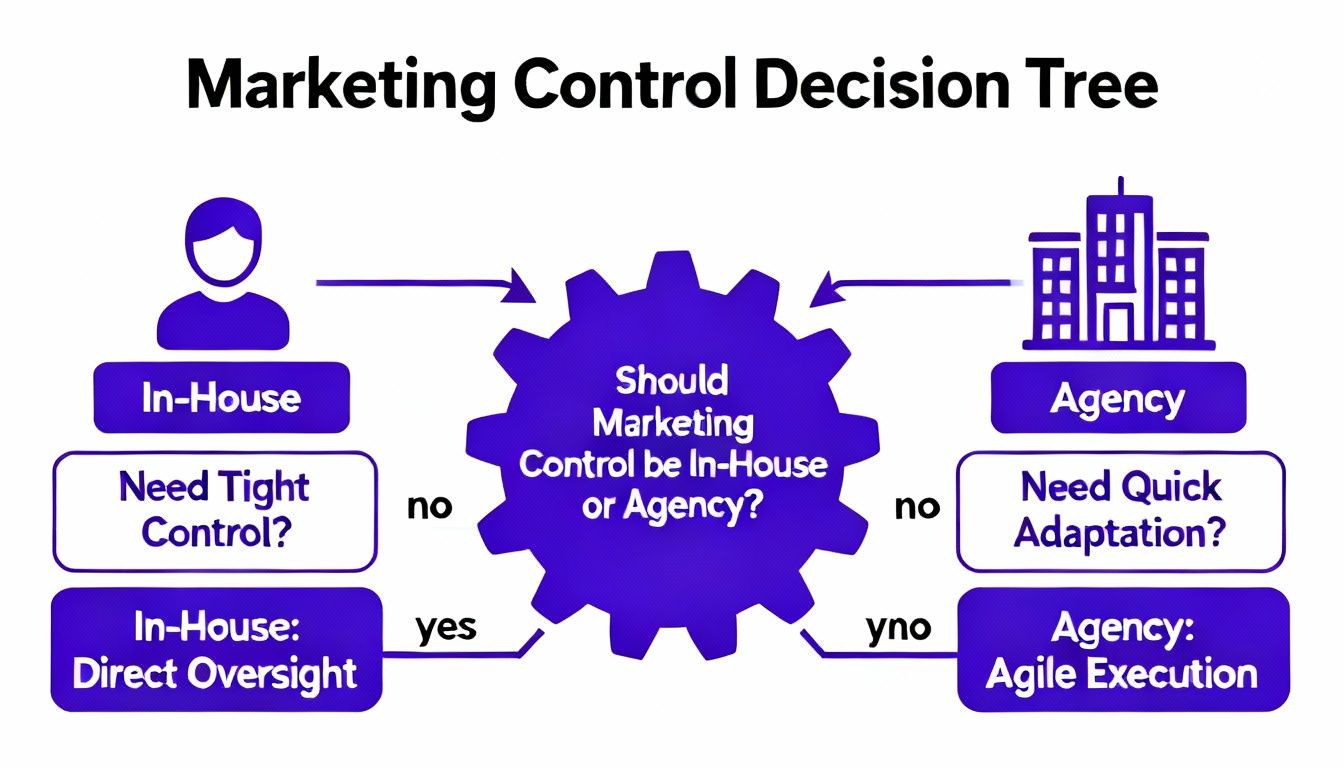
As the visual shows, the choice really boils down to whether your immediate goals demand deep internal alignment or swift, expert-led execution.
Situations Where An In-House Team Shines
Building your own team is a serious commitment of time and money, but the payoff can be enormous—especially when brand immersion and tight integration are non-negotiable. This path makes the most sense once your business has hit a certain level of stability and complexity.
An in-house team is probably the winning move if your company is:
- A Mature Enterprise with a Complex Brand: If you're juggling multiple product lines, sub-brands, or a brand voice with a thousand subtle rules, an in-house team provides unmatched consistency. They live and breathe the brand every day, acting as its ultimate guardians.
- Operating in a Highly Regulated Industry: For businesses in fields like finance or healthcare, having a team that deeply understands compliance is everything. Keeping that expertise in-house minimizes risk and ensures every single marketing asset is properly vetted.
- Focused on a Single, Core Marketing Channel: If your growth is overwhelmingly driven by one specific discipline—like content marketing or community building—it makes perfect sense to invest in building a world-class internal team dedicated to mastering it.
The Best Of Both Worlds The Hybrid Model
The whole marketing agency vs in house debate often misses the smartest play on the board: the hybrid model. This approach is quickly becoming the default for growth-stage companies because it blends the strengths of both options while ditching most of the weaknesses.
Here’s how it works: a lean internal team (think one or two strategic marketers) owns the brand vision and overall strategy. They're the keepers of institutional knowledge. Then, they partner with specialized agencies to execute on the technical stuff—like paid media, advanced SEO, or large-scale content creation.
This setup gives you some serious advantages:
Strategic Control: Your internal leader ensures every agency action is perfectly aligned with your business goals. No more strategic drift.
Specialist Expertise: You still get access to elite agency talent for technical channels without the pain and cost of hiring them full-time.
Knowledge Retention: The internal team absorbs insights and skills from your agency partners, meaning that expertise stays inside your company long-term.
Scalability and Flexibility: Need to ramp up or pull back? Just adjust your agency retainers. You can scale your efforts without the headache of hiring or firing.
For most businesses in the $5 million to $50 million revenue range, the hybrid model hits the sweet spot between control, expertise, and cost. If you're leaning toward bringing on an agency partner to complete your hybrid team, our guide on how to choose a digital marketing agency can help you find the right one.
Decision Matrix Agency Vs In-House Vs Hybrid
To make this even clearer, I've mapped out which model typically works best for different business scenarios. This isn't a rigid set of rules, but it's a solid starting point for figuring out where you fit.
| Business Scenario | Recommended Model | Primary Rationale |
|---|---|---|
| Pre-seed/Seed Stage Startup (Under $1M ARR) | Agency | You need immediate expertise and speed-to-market without the overhead of full-time hires. |
| E-commerce Brand Launching a New Product Line | Agency or Hybrid | Agency handles the launch campaign (PPC, social ads), while the in-house team manages brand. |
| Professional Services Firm ($5M ARR) | Hybrid | An in-house marketer manages strategy and content, while an agency runs technical SEO and ads. |
| SaaS Company Scaling from $10M to $50M ARR | Hybrid | Core strategy is internal; agencies are used for specialized channels or international expansion. |
| Large Enterprise ($100M+ Revenue) | In-House | Brand complexity and the need for deep integration justify the cost of a large internal team. |
| Business in a Highly Regulated Industry (e.g., Finance) | In-House | Compliance and risk management are paramount, requiring tight internal control. |
Ultimately, the best structure is the one that directly supports your growth goals. Use this matrix to gut-check your initial instincts and guide the conversation with your leadership team. The right choice will feel less like a compromise and more like a strategic advantage.
A Practical Checklist for Your Final Decision
The whole marketing agency vs. in-house debate isn't some theoretical business school exercise. It's a real-deal decision with consequences for your budget, your growth trajectory, and even your company culture. To get out of the weeds and into action, use this checklist to cut through the noise.
These questions are designed to force some honest reflection and help you land on a choice you can stand behind.
First, you’ve got to look in the mirror. Your internal reality—from cash flow to who’s actually got the time to manage this stuff—will immediately tell you which option is even on the table.
Evaluating Your Internal Readiness
Before you start interviewing agencies or posting job descriptions, get a brutally honest snapshot of your own organization. Your answers here will quickly show whether you’re ready to build a team from scratch or if bringing in a partner makes more sense right now.
- Financial Reality: Do you have the cash to cover not just a salary, but the extra 25-40% in overhead for benefits, software, and training? Or would a predictable monthly retainer feel a lot safer for your bottom line?
- Growth Timeline: Are your growth goals aggressive and immediate? If you need to see results next quarter, can you really afford the 6-12 months it often takes to hire, onboard, and get an internal team firing on all cylinders?
- Talent and Resources: Do you have anyone internally who can actually manage a marketing function? Even a great agency needs a dedicated point person for at least 10-15 hours a week to keep things aligned and moving forward. Without that, you're just throwing money into a black box.
- Company Culture: Is your company wired for the kind of tight collaboration and rapid communication an in-house team needs to thrive? Or could you benefit from an outside perspective that challenges the way you’ve always done things?
Vetting a Potential Agency Partner
If your gut (and your self-assessment) is pointing toward an agency, the next step is to vet them—hard. Not all agencies are created equal. The right one feels like a true extension of your team; the wrong one will burn through your budget and leave you with vanity metrics and little else.
Use these questions to separate the real partners from the slick-talking vendors.
- Onboarding Process: Ask them, "Can you walk me through your exact 90-day onboarding plan for a client like us?" A great agency won’t wing it. They'll have a structured, transparent process for discovery, strategy, and getting the first campaigns live.
- Reporting and KPIs: Follow up with, "What specific metrics will you report on weekly and monthly, and how do they tie directly to our business goals, like revenue or pipeline growth?" You want a partner obsessed with business outcomes, not just fluffy numbers like traffic or impressions.
- Industry Experience: "Can you share case studies or results from clients in our industry or with a similar business model?" Relevant experience slashes the learning curve and gets you to results much, much faster.
- Team Structure: Get specific: "Who exactly will be working on our account, and what is their level of experience?" Make sure they won’t pass you off to a junior account manager the second the contract is signed.
Watch out for red flags. Things like long-term contracts with no performance clauses, vague promises without a clear strategy, or an unwillingness to let you talk to current clients are all major warning signs. A confident agency will be an open book about their process, their results, and the team you'll actually be working with. You're looking for a partner, not just another line item on your P&L.
Common Questions (And Honest Answers)
Even after weighing the pros and cons, a few lingering questions always pop up when you're on the fence between hiring a marketing agency vs in house. Let's tackle the big ones head-on so you can make your final call with confidence.
Can We Start With an Agency and Build an In-House Team Later?
Absolutely. In fact, it’s one of the smartest ways to scale.
Many companies kick things off with an agency to get to market fast and tap into specialized skills they don't have yet. Once the revenue engine is humming, they bring on an in-house marketing manager. This new hire can spend a few months learning directly from the agency, soaking up all the institutional knowledge before the official handoff.
This approach lets you build your internal capabilities without ever losing momentum. The key is a clean, structured 30-day transition plan. Just make sure you own all your accounts (think ad platforms, social media, analytics) and have full access to the historical data. That'll make the switch painless.
What Does a Good Hybrid Model Actually Look Like?
A killer hybrid model isn't just outsourcing random tasks. It’s about pairing a lean, strategic internal team with an army of external specialists.
Typically, you’ll have one or two in-house marketing strategists who live and breathe the brand, understand your customers inside and out, and own the big-picture goals. They’re the brains of the operation.
This core team then directs agency partners or freelancers who execute on the really technical stuff, like:
- Paid Search (PPC)
- Technical SEO
- Complex marketing automation flows
This setup gives you the best of both worlds: tight strategic control and brand consistency, plus access to elite talent for execution. You get the expertise without the massive overhead of a huge internal department.
A hybrid model lives or dies by the strength of your internal marketing lead. You need someone confident enough to manage agency partners, challenge their assumptions, and ensure every dollar they spend is tightly aligned with your business goals. Without that internal anchor, you’re just outsourcing your strategy—and that’s a recipe for disaster.