Marketing for Professional Services Firms a Complete Guide
Let's be real. Marketing a professional services firm isn't like selling a pair of sneakers. You're not selling a tangible product; you're selling trust. You're selling expertise. You're selling a future outcome that a client can't see or touch.
This is the single biggest reason why cookie-cutter marketing tactics, pulled straight from the consumer playbook, completely bomb for law firms, consultants, and financial advisors. You end up torching your budget with nothing to show for it but a handful of unqualified leads. Success here is built on authority and relationships, not just ad clicks.
Why Your Old Marketing Playbook is Failing You
Think about it. When you're marketing headphones, you can talk about concrete features—battery life, sound quality, how comfy they are. The value is immediate. Obvious.
Now, try marketing legal services or a complex consulting engagement. You’re not selling an item; you’re selling an intangible solution to a high-stakes problem. The decision-making process is worlds apart. It's a considered purchase, often involving a whole committee of stakeholders and a sales cycle that can stretch for months. Clients don't just "add to cart"; they're investing in a long-term partner.
The Expertise and Trust Gap
Most marketing strategies fall flat because they fail to bridge two critical gaps for service firms: proving you're the expert and building genuine trust. A slick ad might turn a head, but it's not going to convince a CFO to hand over their company's finances or a General Counsel to retain your firm for a make-or-break lawsuit.
The real challenge is that expertise is invisible. You can’t point to it on a shelf. A potential client has to feel it or see undeniable proof of it before they’ll even think about hiring you.
This is where a marketing strategy designed specifically for professional services comes in. Instead of just shouting about what you do, you have to systematically make your expertise visible and tangible.
Finding Your North Star Before You Start
Before a single dollar is spent on a campaign, the fastest-growing firms get two foundational things right that traditional marketers often skip over entirely:
- Nailing the Ideal Client Profile (ICP): This is way more than basic demographics. It's about painting a crystal-clear picture of the exact client you serve best. What industry are they in? What keeps them up at night? What are their goals, and what internal politics are they dealing with? A razor-sharp ICP ensures your marketing attracts profitable, long-term partners, not just one-off projects that drain your resources.
- Crafting a Value Proposition That Hits Hard: This isn't a laundry list of your services. It’s a powerful, can't-ignore statement about the transformative results you deliver. It flips the script from talking about yourself to talking about your client's success, hitting on their biggest pain points and wildest aspirations.
Getting these two pieces right is like calibrating your compass before a cross-country trek. It ensures every marketing effort that follows—from the articles you write to the ads you run—is pointed in exactly the right direction. It's how you maximize your impact and finally see a real, measurable return on your marketing investment.
Choosing Your Core Digital-Marketing Channels
Alright, you've got your strategy locked in. You know who you’re talking to and what makes your firm the obvious choice. Think of that as the architectural blueprint for your client-acquisition machine. Now, it's time to pick the right building materials—your marketing channels—to actually construct it.
Let's be clear: in the high-trust world of professional services, not all channels are created equal.
The goal here isn't to plant your flag on every social media platform known to man. That's a surefire way to burn out and get zero results. Instead, we’re going to build an integrated system where a few core channels work in harmony, each one making the others stronger. For most firms, this means mastering three pillars: Search Engine Optimization (SEO), Content Marketing, and surgically-targeted Paid Advertising.
This simple diagram nails the fundamental flow. It all starts with your firm's expertise, connects directly with your ideal client's problems, and delivers undeniable value.
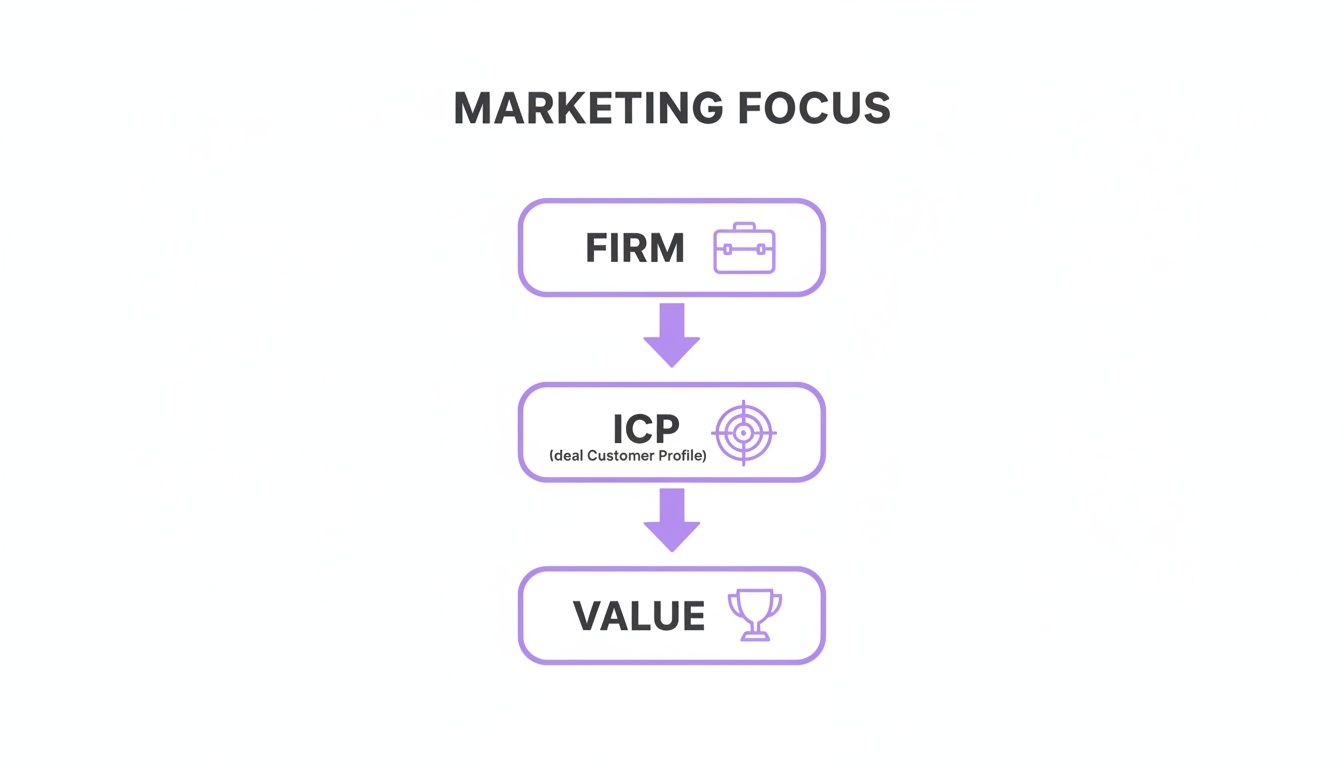
If a marketing activity doesn't fit this flow, it's probably a distraction. Every single effort needs to trace back to solving a real client need.
Attract High-Intent Clients With SEO
Search Engine Optimization is how you make your firm appear the moment a potential client googles the exact problem you solve. It's about becoming the answer they find when they are actively, desperately looking for help. This isn't just about getting website traffic; it's about attracting prospects who are already halfway to buying.
The secret to great https://rebusadvertising.com/blogs/seo-for-professional-services-firms/ is targeting what we call long-tail, high-intent keywords. These are super-specific phrases that signal the searcher knows what they need and is ready to act.
For example, a law firm shouldn't just target "lawyer." That's a waste of time. Instead, they should go after something like "intellectual property lawyer for tech startups." See the difference? That first query is a specific problem from a specific client. They're a much, much warmer lead.
Build Authority With Content Marketing
If SEO gets people to your front door, content marketing is what convinces them you're the expert worth talking to. It’s how you take all that invisible expertise locked in your partners' heads and make it tangible, valuable, and accessible to your audience before they ever sign a contract. This is your chance to prove your authority, not just claim it.
For professional services firms, this usually looks like:
- Insightful Blog Posts: Answering the top 10 questions your ideal clients always ask.
- In-Depth White Papers or E-books: Offering a comprehensive solution to a thorny industry problem.
- Compelling Case Studies: Showing off the real-world results you've delivered for clients just like them.
Think of your content as a digital salesperson that works 24/7. Each article and guide is out there demonstrating your value, building credibility, and gently guiding prospects toward a conversation.
This isn't just a "nice-to-have." The professional services market is expected to jump from $6,091.6 billion in 2024 to $6,370.29 billion in 2025. The firms grabbing the lion's share of that growth are the ones who have mastered digital lead generation.
Reach Decision-Makers With Paid Advertising
SEO and content are your long game—they build assets that pay dividends for years. But paid advertising? That’s all about speed and precision. Platforms like Google Ads and LinkedIn Ads let you put your message directly in front of the exact decision-makers you want to reach. You can target by job title, industry, company size, you name it.
It's basically a digital shortcut to your ideal client's doorstep.
For most B2B service firms, a comprehensive LinkedIn marketing strategy for B2B is non-negotiable. You could run a campaign targeting CFOs in the manufacturing sector with an ad that leads to your white paper on supply chain risk management. Or use Google Ads to show up at the very top of the results for a high-value search query.
The magic happens when you use paid ads to promote the great content you're already creating. It creates a powerful feedback loop: you attract, educate, and engage potential clients all at once.
To make this crystal clear, here’s a quick breakdown of how these channels stack up for different types of professional services firms.
Comparing Core Digital Marketing Channels
| SEO | Attract inbound leads actively searching for solutions. | Law firms, accounting, healthcare, financial advisors—any firm solving known problems. | Organic traffic, keyword rankings, inbound contact form submissions. |
|---|---|---|---|
| Content Marketing | Build trust, demonstrate expertise, and nurture long-term relationships. | Consulting firms, B2B tech services, marketing agencies, complex advisory roles. | Time on page, downloads (e-books/white papers), newsletter sign-ups. |
| Paid Ads (Search & Social) | Generate leads quickly and target specific decision-makers with precision. | High-growth firms, niche B2B services, firms promoting events or specific offers. | Cost Per Lead (CPL), Click-Through Rate (CTR), Conversion Rate. |
| Email Marketing | Nurture leads, stay top-of-mind, and drive repeat business from existing clients. | All professional services firms with an established client list or lead database. | Open rate, click-through rate, unsubscribe rate. |
Each channel has its strengths, but they are most powerful when used together. SEO brings in the traffic, content proves your value, and paid ads amplify your message to the right people at the right time.
Turning Leads into Long-Term Client Relationships

Getting a lead is the starting gun, not the finish line. In the professional services world, trust is everything, and the real work begins long after that first form submission or white paper download. This is exactly where so many firms drop the ball, letting a promising prospect go cold because of sloppy, inconsistent follow-up.
The goal isn't just to land one project; it's to build a relationship that lasts for years. The journey from a curious browser to a loyal, long-term client is paved with steady, valuable communication that proves your expertise at every single turn. This means moving beyond manual, one-off emails and building a real system that nurtures that fragile trust over weeks or even months.
Of course, to nurture leads, you first have to get them. For a deep dive into filling the top of your funnel, you can find 12 practical lead generation ideas to get you started.
Automating Trust with Email Nurture Sequences
Imagine a potential client downloads your guide on "Navigating Complex Mergers." A generic "thanks for your download" email isn't just boring—it's a massive missed opportunity. That download should be the trigger for a carefully designed email sequence that keeps the conversation going and cements your firm as the obvious expert.
This automated series of emails delivers value over time, keeping you top-of-mind without ever feeling pushy or desperate. Think of each email as a small deposit into the "trust bank." When that prospect is finally ready to hire someone, your account will be full.
A simple (but killer) nurture sequence could look like this:
- Email 1 (Immediately): Deliver the guide they asked for, but also include a link to a related case study. You’re not just giving them information; you're showing them results.
- Email 2 (3 days later): Share a short video or a blog post that answers a common follow-up question. You’re anticipating their needs and proving you understand their world.
- Email 3 (1 week later): Invite them to an upcoming webinar on a similar topic or offer a no-strings-attached consultation to talk through their specific challenges.
This approach turns a single, fleeting interaction into a sustained, value-driven dialogue. You stop selling and start educating—and that’s how you build credibility.
Systematizing Your Referral Engine
Referrals are the lifeblood of most professional services firms. We all know this. Yet, for some reason, most firms just sit back and hope they happen. That’s a passive strategy that leaves a mountain of high-value opportunities on the table.
Instead, you need to build a repeatable process that actively encourages and captures these golden leads. This isn't about awkward, salesy requests. It's about making it dead simple for your happiest clients to spread the word.
The secret is timing. You have to ask for a referral at the absolute peak of client satisfaction—right after a major project milestone or when you've just delivered a huge, game-changing result. The value you provided is fresh in their mind, making them eager to advocate for you.
You can systematize this with a few key moves:
Pinpoint the Trigger: Define the exact moment in your client's journey when you'll make the ask.
Make It Effortless: Give them a pre-written email template or a simple online form they can use to make an introduction. Remove all the friction.
Show Your Gratitude: Whether it’s a handwritten thank-you note, a small gift, or a donation to their favorite charity, always acknowledge a successful referral. This reinforces the behavior and makes them want to do it again.
By putting these strategies into play, you're doing more than just generating leads. You're building a well-oiled machine that turns prospects into clients and clients into your most passionate advocates. And that's how you create a truly sustainable cycle of growth. For more on this, our guide on lead generation for professional services offers even more ways to build a healthy pipeline.
One Size Fits None: Marketing Playbooks for Your Industry
Trying to use a generic marketing strategy for a professional services firm is like wearing a one-size-fits-all suit. Sure, it technically covers you, but it doesn’t look good on anyone. The pitch that lands a cautious legal client who craves discretion will completely miss the mark with a healthcare practice that needs to build local patient trust.
The context, the client's mindset, and the jungle of regulations in each field demand a completely different playbook.
This is where high-growth firms separate themselves from the pack. They aren't just winging it; they're executing a strategy fine-tuned for their specific arena. It’s all about knowing your ideal client's journey inside and out and showing up exactly where they are, speaking their language.
The Marketing Playbook for Law Firms
For law firms, it all boils down to three things: authority, discretion, and ethical compliance. Your potential clients are often navigating stressful, high-stakes situations. They don't want a flashy sales pitch; they want an expert they can trust without a shadow of a doubt. Your marketing has to scream competence and rock-solid reliability.
- Become the Authority with Real Legal Insights: Forget those fluffy, 500-word blog posts. You need to go deep. Develop in-depth articles, white papers, or webinars that tackle niche legal topics your ideal clients are actually wrestling with. A corporate law firm, for instance, could publish the definitive guide to navigating Series A funding for tech startups. That’s real value.
- Laser-Focused Advertising: Use platforms like LinkedIn and Google Ads to target with surgical precision. A family law practice can aim ads based on life events, while a commercial litigation firm targets C-suite executives in specific industries. No more spraying and praying.
- Acquire Clients Ethically (or Else): Every single marketing move has to play by the bar association's strict rules. This means your content should educate, not sell aggressively. Client testimonials and case studies (with permission and anonymized, of course) are your best friends here—they let your track record do the talking.
The Marketing Playbook for Management Consultants
Consulting firms sell brains and big outcomes. The sales cycle is long, the deals are huge, and clients are looking for a true strategic partner, not just a vendor. Your marketing has to be built on a foundation of thought leadership and executive-level engagement. The goal isn't just to be seen—it's to become the indispensable resource that industry leaders can't ignore.
The heart of consulting marketing isn't just proving you're an expert. It's about being the firm that starts the next big conversation in your industry. You’re not just solving today’s problems; you're showing clients the problems they’ll have tomorrow.
Here’s how you do it:
- Publish Your Own Research and Data: Don't just comment on trends—create them. Conduct original research and publish it as an industry report. A supply chain consultancy could release an annual report on logistics efficiency, creating a killer asset that pulls in media attention and high-quality backlinks for years.
- Host Webinars for the C-Suite: Run exclusive online events for senior decision-makers. Focus on strategic, forward-looking topics, not tactical fluff. This positions your firm as a peer and a trusted advisor, not just another service provider.
- Use LinkedIn for More Than Just Updates: Get in the trenches on LinkedIn. Don't just post company news. Engage in real conversations, drop valuable insights on executive posts, and use smart, targeted outreach to connect with the key players in your target accounts.
The Marketing Playbook for Healthcare Providers
For doctors, dentists, and other healthcare providers, marketing is a delicate dance. You have to build patient trust, guard privacy like a hawk, and own your local turf. Patients are making deeply personal choices, so your marketing must be empathetic, educational, and above all, reassuring. And it absolutely must be HIPAA-compliant.
A data-driven approach is no longer optional here. The top-performing firms are using analytics to segment patients and predict needs, giving them a massive edge. For example, a 2025 study showed that high-growth consulting firms grew at a median 41.7% CAGR—that's 4.4 times the industry average—mostly because their digital lead generation was lightyears ahead of their competitors. You can find more insights about professional services marketing trends and see how this is driving growth even as 49% of B2B tech firms are hitting the brakes on hiring.
Here are the must-do strategies for healthcare:
- Create Content That Educates Patients: Develop clear, easy-to-understand content that answers the common questions patients have about conditions, treatments, and procedures. This isn't just good marketing; it builds immense trust and positions your practice as a caring, authoritative place to go for help.
- Dominate Local SEO: You need to own the search results when someone types "cardiologist near me." This means meticulously managing your Google Business Profile, actively gathering patient reviews, and building out location-specific service pages.
- Keep Your Digital House in Order (HIPAA-Style): Every digital tool you use—from your website's contact form to your patient portal and email marketing platform—has to be fully HIPAA-compliant. There are no shortcuts here. Protecting patient privacy is non-negotiable for maintaining your legal and ethical standing.
How to Measure Marketing Success and ROI
Let’s be real: marketing without measurement is just expensive guesswork. For professional services firms—where trust is the product and sales cycles can drag on for months—you simply can't afford to fly blind. You need to know, without a doubt, if your marketing budget is a cost center or a predictable engine for growth.
The trick is to cut through the noise. Things like social media likes and page views are often called "vanity metrics" for a reason. They feel good, but they don't tell you if you're actually landing high-value clients. True success is measured by Key Performance Indicators (KPIs) that connect directly to your firm's bottom line.
Moving Beyond Vanity Metrics
At the end of the day, your marketing must answer one critical question: Are we generating profitable growth?
To get to the truth, you have to focus on the metrics that track the entire client journey, from the first time they hear your firm's name to the day the contract is signed.
Here are the essential KPIs that actually matter for professional services firms:
- Client Acquisition Cost (CAC): This is your all-in cost for sales and marketing, divided by the number of new clients you won in a given period. It tells you exactly how much you're spending to bring a new client through the door.
- Client Lifetime Value (CLV): This is an estimate of the total revenue you can expect from a single client over the entire relationship. When you compare your CLV to your CAC, you see the real profitability of your marketing efforts.
- Lead-to-Client Conversion Rate: Of all the qualified leads your marketing generates, what percentage actually become paying clients? A low number here might signal a disconnect between your marketing message and your sales process.
Tracking these numbers turns an abstract budget into a tangible business investment. It gives you a clear, defensible return. For a deeper dive, check out our guide on measuring marketing campaign effectiveness, which lays out more detailed frameworks.
Building Your Marketing Dashboard
Think of a marketing dashboard as your command center. It’s a simple, visual way to keep your most important KPIs in one place, letting you spot trends, make decisions backed by data, and create a feedback loop for getting better over time. You don't need fancy, expensive software to get started—a simple spreadsheet can work wonders.
A good dashboard gives you an at-a-glance view of your marketing funnel's health. It helps you shift from reacting to problems to proactively optimizing performance, making sure every dollar you spend is working as hard as possible.
Tracking performance isn't just about proving value; it's about finding opportunities. Data shows you what's working so you can double down on it, and what's failing so you can fix it or cut it loose.
The urgent need for efficient, high-ROI strategies is especially pronounced for marketing leaders at law practices, healthcare providers, and consultancies. Adopting Professional Services Automation (PSA) tools is becoming a key differentiator, with firms that use them reporting 11% higher resource utilization and a substantial 25% greater profit margin. Discover more insights about these professional services trends and their impact on profitability.
By focusing on the right metrics, you transform marketing from an unpredictable expense into a reliable driver of revenue. This data-driven approach is the foundation of scalable growth for any professional services firm.
Your First 90 Days: A Practical Marketing Plan

Theory is great, but execution is everything. A winning strategy for professional services firms needs focused, deliberate action. This 90-day plan is designed to cut through the overwhelm, build real momentum, and deliver results you can actually see. We'll break it down into three manageable sprints.
Think of this as your roadmap from a blank page to tangible progress. The goal isn't to boil the ocean in three months. It's to build a rock-solid foundation, test your ideas with real-world data, and create a system for growth you can use again and again.
Month 1 (Days 1-30): Laying the Groundwork
The first 30 days are all about sharpening your tools before you start building. Rushing this stage is a classic mistake, and it almost always leads to wasted ad spend and content that completely misses the mark. Your entire focus here is on clarity and preparation.
Here's what success looks like in this first phase:
Finalize Your Ideal Client Profile (ICP): Go way beyond basic demographics. Actually interview your best current clients. Talk to your sales team. Build a crystal-clear picture of who you serve, what keeps them up at night, and what their biggest goals are.
Sharpen Your Value Proposition: Using that new ICP, refine your core messaging. It has to answer one simple question: "Why should this specific client choose us over anyone else?"
Set Up Analytics: Get Google Analytics and any conversion tracking installed correctly on your website. You can't improve what you don't measure, period.
Month 2 (Days 31-60): Execution and Engagement
With a solid foundation poured, it's time to go live. This month is about activating your strategy with two high-impact moves. The key is to start small with a focused pilot campaign, not a massive, multi-channel launch that spreads you too thin.
This sprint is your first real test. The goal here is to gather data, not to achieve perfection. Launching a targeted pilot campaign lets you learn quickly from a smaller, controlled investment before you scale up.
Your action items for this period are straightforward:
- Launch Your First Pillar Content Piece: Publish one comprehensive blog post, white paper, or guide that solves a major pain point for your ideal client.
- Run a Pilot Paid Campaign: Use LinkedIn Ads or Google Ads to drive targeted traffic directly to that new piece of content. Focus on a small, super-relevant audience segment.
Month 3 (Days 61-90): Analysis and Iteration
This final sprint is all about learning and planning your next move. You now have actual performance data from your pilot campaign, which means you can make informed decisions instead of just guessing. It's time to dig into the numbers, figure out what they mean, and refine your approach for the next quarter.
This phase is where you create a feedback loop for continuous improvement. Analyze what worked, what didn't, and—most importantly—why. With these insights in hand, you can confidently plan your next marketing initiatives, ensuring every campaign from here on out is smarter and more effective than the last.
Got Questions? We’ve Got Answers.
When it comes to marketing for professional services, the details can get tricky. Let's tackle some of the most common questions we hear from firms just like yours.
How Much Should We Actually Budget for Marketing?
There’s no magic number, but a solid rule of thumb is to set aside 5% to 15% of your firm's annual revenue.
If you're a newer firm or in a high-growth phase, you’ll want to aim for the higher end of that range. You need to build momentum and carve out your space in the market. More established firms can often lean closer to the 5% mark, focusing more on nurturing their existing client base and staying top-of-mind.
The biggest mindset shift? Stop thinking of it as an expense and start treating it as an investment in a predictable growth engine.
For a Small Firm, What Are the Most Important Metrics to Track?
With limited resources, you can't afford to get distracted by vanity metrics. You need to focus on the numbers that directly tell you if your marketing is making you money.
Forget about chasing likes or follows. The three KPIs that truly matter are Client Acquisition Cost (CAC), Client Lifetime Value (CLV), and your Lead-to-Client Conversion Rate. These tell the real story of whether your marketing is profitable and sustainable.
Everything else is just noise.
What's the Best Way to Market a New Service Offering?
Launching something new is all about focused, multi-channel education. You have to teach your audience why they need this new service.
Start by creating a big, foundational piece of content—think of it as a "pillar." This could be an in-depth guide, a live webinar, or a detailed whitepaper that breaks down the exact problem your new service solves for your ideal client.
Once you have that, promote it to a hyper-targeted audience. Use channels like LinkedIn Ads to reach new prospects or run a dedicated email campaign for your existing clients. The goal is to spark initial interest and get some early feedback before you go all-in on a broader campaign.
How Long Does It Really Take to See Results from SEO and Content?
Patience is the name of the game here. Unlike paid ads that offer instant (but temporary) visibility, SEO and content marketing are long-term plays. They're about building a valuable asset for your firm over time.
You can usually expect to see some initial traction—like better keyword rankings or a small bump in organic traffic—within 3 to 6 months.
But the significant, lead-generating results? That often takes a solid 6 to 12 months of consistent, high-quality work. Think of it like planting a tree. There's a lot of foundational work upfront, but the real growth compounds over time as you build authority with both search engines and your audience.
Ready to turn your marketing from a cost center into your firm's most predictable revenue driver? The expert team at Rebus builds strategic campaigns that deliver high-quality leads and fuel sustainable growth. Let's build your growth engine together.