Outline Marketing Plan: A Quick Growth Guide
Think of an outline marketing plan as your business's GPS. It's the step-by-step roadmap that gets you from where you are today to where you want to be tomorrow. Without one, you're just driving in the dark, hoping you'll end up somewhere good. A solid plan turns vague ambitions into an actionable strategy, making sure every dollar and every minute you spend is deliberate, measurable, and pushing your core business goals forward.
Building Your Strategic Foundation

Before you even think about running an ad or scheduling a social media post, you have to build a rock-solid foundation. This is where you connect your marketing activities directly to real business outcomes. It’s all about swapping wishful thinking for strategic pillars that can actually support your entire effort.
Honestly, skipping this step is one of the biggest reasons marketing plans fail. It’s the difference between randomly throwing darts at a board and aiming for a specific, well-defined target. This initial work is what keeps you from wasting time and money on activities that feel busy but don't actually move the needle.
From Vague Hopes to Concrete Goals
So many businesses start with fuzzy goals like "increase sales" or "get more brand awareness." While the sentiment is right, these goals are impossible to measure and even harder to act on. The very first thing you need to do is sharpen those ambitions into SMART goals—that’s Specific, Measurable, Achievable, Relevant, and Time-bound.
Here’s how you can transform a generic goal into something you can actually work with:
- Vague Goal: "We need more leads this year."
- SMART Goal: "Increase Marketing Qualified Leads (MQLs) from our website by 20% in Q3 by launching a targeted content marketing campaign."
See the difference? Now the team knows exactly what the target is (20% MQL increase), the deadline (Q3), and the game plan (content marketing). This kind of clarity creates focus and holds everyone accountable. As you start setting these goals, getting a handle on what is lead generation in marketing is fundamental to attracting and converting the right people.
Understanding Who You Are Really Talking To
You can't create marketing that resonates if you don't know who you're talking to. This is where detailed buyer personas come in. A persona isn't just a list of demographics; it's a semi-fictional deep-dive into your ideal customer, built from market research and real data on your existing clients.
A good persona feels like a real person. It should capture their motivations, their daily headaches, and what they're trying to achieve.
A great buyer persona tells you more than just what your customer needs; it tells you why they need it and how they look for solutions. This insight is the key to creating marketing that truly connects.
Your persona needs to answer the tough questions:
- What are their biggest challenges at work? What keeps them up at night?
- Where do they hang out online to get information? Are they on LinkedIn, reading specific blogs, or active in niche forums?
- What are the specific pain points that your product or service is uniquely positioned to solve?
Crafting Your Unique Value Proposition
The final piece of your foundation is a clear, compelling Unique Value Proposition (UVP). Your UVP is a short, punchy statement that tells a potential customer exactly why they should pick you over the competition. It's not a fluffy slogan; it's the promise of value you deliver.
A powerful UVP should instantly answer three questions for your ideal customer:
How do you solve my problem or make my life better?
What specific benefits will I get?
Why you? What makes you different from everyone else?
For example, a cloud storage company could go from a generic "Store your files online" to a knockout UVP: "The only cloud storage with end-to-end encryption and a 100% data privacy guarantee, so your most sensitive documents stay secure and confidential."
Nailing down your goals, audience, and value is a crucial part of the entire planning effort. You can dive deeper into this framework in our complete guide to the strategic marketing planning process.
Picking Your High-Impact Marketing Channels

Alright, you’ve got your goals and you know who you’re talking to. Now for the fun part: deciding where you’re actually going to show up. This is where your outline marketing plan gets real, fast.
It’s tempting to want to be on every platform, but that’s a classic rookie mistake. Spreading yourself too thin across a dozen channels is a guaranteed recipe for burnout and getting absolutely nowhere. The goal here isn’t to be everywhere; it's to be where it counts.
Think of it like fishing. You don’t just toss a net into the middle of the ocean and hope for the best. You go to the specific spots where you know the fish are biting.
Let Your Audience Lead the Way
Remember those buyer personas you built? They’re your treasure map now. Every single decision about which channels to use should trace directly back to where those people actually spend their time online. Stop guessing and start knowing.
- For a B2B Software Company: Your ideal customer, let’s call her "Project Manager Priya," isn't scrolling TikTok for a new workflow solution. She’s deep in LinkedIn, reading industry blogs, and Googling software comparisons. That tells you to focus your firepower on SEO, in-depth content marketing, and targeted LinkedIn ads.
- For an eCommerce Brand: If you're selling sustainable activewear to "Eco-Conscious Eric," his discovery process is all about visuals and community. He's on Instagram and Pinterest, following eco-influencers and getting inspired. That’s your battleground.
When you match your channels to your personas, your message lands in the right place, at the right time. It feels less like an ad and more like a helpful solution.
The Magic of an Integrated Strategy
Here’s where a lot of marketers drop the ball. Picking channels is one thing, but making them work together is the secret sauce. A standalone email blast is okay. An email blast that retargets people who visited your blog from a specific social post? That's when things get powerful.
It's shocking, but a staggering 70% of marketing teams still operate without a truly integrated strategy. That’s a massive missed opportunity. Companies that get this right see their campaign efficiency jump by up to 31% and pull in a 50% higher return on investment. You can dig into more of this data and other great marketing statistics on Optimizely.com.
An integrated strategy means every channel reinforces the others. Your social media drives people to your blog. Your blog captures their email. Your email marketing nurtures them toward a sale. It’s a flywheel, not a bunch of disconnected wheels spinning in the mud.
Breaking Down Your Key Channel Options
Let's get practical. Here are some of the heavy hitters and where they typically shine. Nailing this is a critical step in building a marketing plan outline that actually works.
SEO and Content Marketing
- Best for: Businesses with longer sales cycles, B2B services, and anyone looking to build long-term authority. Think of it as building a valuable asset that pays dividends in organic traffic for years to come.
- The Catch: SEO is a marathon, not a sprint. You need patience and a commitment to creating genuinely helpful content. Don't expect to see game-changing results in month one.
Paid Media (PPC and Social Ads)
- Best for: Getting immediate traffic and leads. It's perfect for testing new offers, launching a product, or reaching super-specific audiences with laser precision.
- The Catch: It’s strictly pay-to-play. The second you turn off the spend, the traffic dries up. This requires constant monitoring and a sharp eye on your budget to make sure you’re getting a positive ROI.
Email Marketing
- Best for: Building real relationships with your audience. It's your direct line for nurturing leads, creating loyal customers, and driving repeat sales from people who’ve already said they want to hear from you.
- The Catch: Your success lives and dies by the quality of your list and the value you provide. If all you do is send sales pitches, get ready for a flood of unsubscribes.
By zeroing in on a handful of high-impact channels that fit your audience—and making them work in harmony—you’ll build a marketing machine that drives real, sustainable growth.
Allocating Your Budget for Maximum Returns
Let's talk about the money. An ambitious marketing plan is just a pretty document until you put a smart budget behind it. This is where your strategy gets real—transforming big goals into a financial roadmap that dictates what you can actually pull off. It's all about making every single dollar sweat.
A lot of businesses just take a flat percentage of their revenue and call it a day, but that's leaving money on the table. A much sharper approach is goal-driven budgeting. You tie every dollar to a specific, measurable outcome you're trying to hit. This completely changes the conversation from "How much can we spend?" to "What will it take to win?"
Honestly, this is where a ton of marketers get stuck. In 2025, the average marketing budget is hovering around 7.7% of company revenue, pretty much the same as last year. But here’s the kicker: a wild 84% of Chief Marketing Officers admit they have a hard time actually developing and executing their plans. That's a massive gap between a nice-looking strategy and getting things done.
Breaking Down Your Budget Categories
A solid marketing budget is way more than just your ad spend. You've got to account for the whole machine that makes your marketing run. I like to think of it in three main buckets.
- Channel & Ad Spend: This is the most obvious part. It’s the cash you're putting directly into paid media channels like Google Ads, social media advertising, and sponsored content. This is where you fuel the high-impact channels you picked out earlier.
- Content & Creative: Great marketing needs great creative. Period. This bucket covers everything from graphic design and video production to copywriting and photography. Never, ever skimp here—awful creative can sink even the most perfectly targeted ad.
- Tools & Technology: This is the engine room. Your marketing stack—your CRM, email platform like Mailchimp, analytics software, and social media schedulers—keeps everything humming. These tools are non-negotiable for efficiency and, just as important, for measuring what's working.
Your budget isn't just a spreadsheet of expenses; it's a strategic document that shows what you truly care about. If your number one goal is to own organic search, then your budget better show a serious investment in content creation and SEO tools. It's that simple.
Prioritizing Your Spend for High Impact
Okay, you’ve got your categories. Now for the hard part: prioritizing. Not all marketing activities deliver the same bang for your buck, and your budget needs to reflect that reality.
Start by funneling a bigger slice of the pie to the channels and tactics that have the highest potential ROI for your specific business.
For an eCommerce brand, that probably means doubling down on performance marketing—think Google Shopping and Instagram ads that drive direct sales. But a B2B services firm? They're better off putting their money into LinkedIn campaigns and high-value content like whitepapers or webinars. Getting this right is critical, and you can find some great marketing budget allocation best practices to help you fine-tune your own mix.
Sample Budget Allocation
To make this feel less abstract, let's look at a sample breakdown for a small business with a $10,000 monthly marketing budget. This is a good example of a balanced approach.
Here’s a sample budget table that illustrates how a small business might allocate a $10,000 monthly marketing spend. This provides a balanced mix, ensuring investment in both immediate lead generation and long-term brand building.
Sample Marketing Budget Allocation
| Paid Search (PPC) | 35% | $3,500 | Capturing high-intent leads and driving direct sales |
|---|---|---|---|
| Content & SEO | 25% | $2,500 | Building long-term organic traffic and authority |
| Paid Social Media | 20% | $2,000 | Brand awareness and top-of-funnel engagement |
| Email Marketing | 10% | $1,000 | Nurturing leads and driving customer retention |
| Tools & Analytics | 10% | $1,000 | Supporting operations and measuring performance |
See how this works? This model gives you a blend of short-term wins from your paid channels while also investing in the long-term, sustainable growth that comes from organic efforts like SEO and content.
When you allocate your funds with this kind of intention, your marketing plan stops being a document and starts being a powerful engine for real business growth.
Setting Milestones and Measuring What Matters
A brilliant strategy is just a collection of good ideas until you define how you’ll measure progress. This is where your high-level goals get real—transforming from a vision into a concrete, actionable roadmap.
Think of this step as building the nervous system for your marketing plan. It’s what keeps your team on track, proves marketing’s immense value to the rest of the business, and turns your annual vision into daily, weekly, and monthly wins.
From Big Goals to Specific KPIs
Every single channel you use needs its own set of Key Performance Indicators (KPIs) to track success. It's absolutely crucial to move beyond "vanity metrics"—like social media followers or page views—and focus on numbers that reflect genuine business impact. These are the metrics that tell a story about growth, not just activity.
The trick is to link every KPI directly back to one of your big-picture business goals.
- Goal: Increase qualified leads by 20%.
- SEO KPI: Number of organic keyword rankings on page one for high-intent terms.
- PPC KPI: Cost Per Lead (CPL) for targeted ad campaigns.
- Content KPI: Conversion rate on gated content downloads (like ebooks or webinars).
- Goal: Improve customer retention by 15%.
- Email KPI: Click-through rate on customer-exclusive newsletters.
- Lifecycle KPI: Repeat purchase rate within a 90-day window.
This direct connection ensures every team member knows exactly how their work is moving the needle. No more siloed efforts; just a clear line from their tasks to the company’s bottom line.
The most powerful KPIs are those that measure profitability and efficiency, not just volume. Get obsessed with metrics like Customer Acquisition Cost (CAC) and Customer Lifetime Value (LTV) to understand the true financial impact of your marketing.
Creating a Timeline That Actually Works
With your KPIs locked in, it’s time to build a timeline. Let's be honest, an annual plan can feel overwhelming. A year is a long time, and staring at a 12-month GANTT chart is enough to make anyone want to take a nap. The key is to break it down into manageable chunks, creating a rhythm of execution and review.
Most successful marketing teams I’ve worked with operate on a quarterly "sprint" system. This gives you a 90-day window to zero in on specific initiatives—long enough to see real results, but short enough to stay agile.
Here's how that looks in practice:
Annual Goals: Define your big-picture objectives for the year. (e.g., achieve $2M in marketing-sourced revenue).
Quarterly Rocks: Break that annual goal into four major milestones. (e.g., Q1: Launch new website to improve conversion rates).
Monthly Tasks: Detail the specific projects needed to hit the quarterly rock. (e.g., January: Finalize website design; February: Develop all new content).
Weekly Sprints: Assign individual tasks and deadlines to team members. (e.g., Week 1: Wireframe homepage and key landing pages).
Suddenly, that massive annual plan feels far less intimidating and a whole lot easier to manage.
The Right Tools for the Job
You don’t need some ridiculously complex or expensive system to manage your timeline. In fact, simple project management tools are often the most effective for keeping everyone aligned and on schedule.
Platforms like Trello, Asana, or even a well-organized shared spreadsheet can work wonders. The goal isn’t fancy software; it’s creating a single source of truth where everyone can see:
- What tasks are on their plate.
- When each task is due.
- How their work plugs into the bigger quarterly goal.
This kind of transparency is the secret sauce for accountability and smooth execution. If you want to see how these concepts fit together in one place, our comprehensive marketing campaign planning template provides a structured framework to get you started.
By setting clear milestones, tracking what really matters, and building a realistic timeline, your marketing plan evolves from a static document into a dynamic guide that powers your daily decisions and guarantees you’re always moving forward.
See How a Marketing Plan Works in Practice
Theory is great, but let's be real—seeing a plan in action is where the magic happens. A solid marketing plan isn't some dusty document you write once and forget. It's a living, breathing guide that steers your day-to-day decisions.
To pull this out of the abstract and into the real world, we’re going to walk through three completely different scenarios. You'll see exactly how the strategic pieces we've talked about—goals, audience, channels—snap together for different kinds of businesses.
This image sums up the core pillars of any plan worth its salt: what you measure (KPIs), how long it'll take (timelines), and the results you're driving (impact).
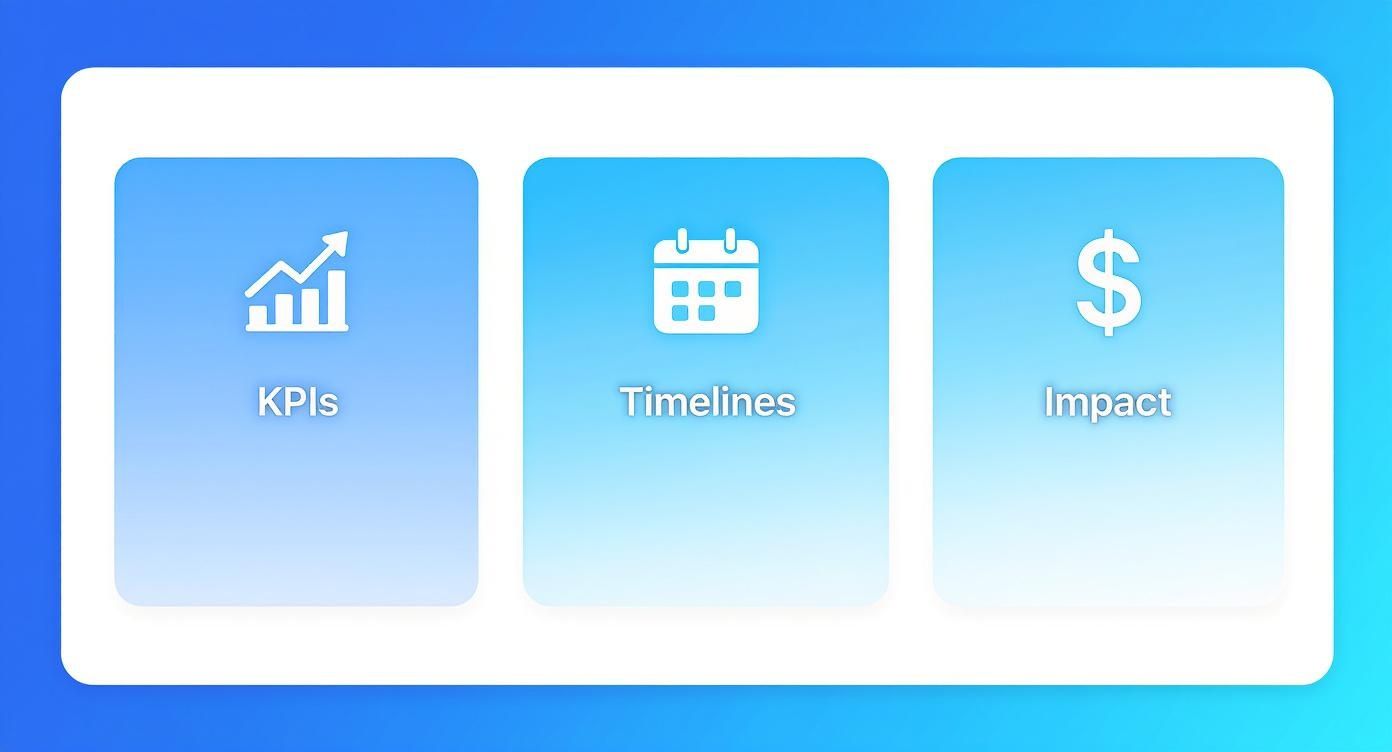
Think of it as your reality check. A good plan always connects your daily grind to measurable, bottom-line results.
Example 1: The Local Coffee Shop
Let’s start small. Imagine "The Morning Grind," an independent coffee shop trying to survive in a neighborhood with a big-name chain just a few blocks away. Their marketing has to be scrappy, hyper-local, and all about community.
The Core Goal Their main objective is to increase foot traffic by 15% on weekdays over the next three months. A secondary goal? Build a base of regulars who come for the vibe, not just the caffeine.
Target Audience They’ve zeroed in on two key people:
- "Freelancer Fiona": A 28-year-old remote worker living nearby. She's looking for a "third place" to work, loves great coffee, and practically lives on Instagram.
- "Commuter Carl": A 45-year-old professional who drives past every morning. He needs fast, friendly service and a perfect latte without the long wait.
Channel Strategy The Morning Grind can't afford a massive ad spend, so they get smart with local channels:
Local SEO: They're all-in on their Google Business Profile. Daily updates, gorgeous photos of latte art, and actively asking for reviews to dominate "coffee near me" searches.
Instagram Marketing: This is Fiona's world. Daily stories with behind-the-scenes glimpses, new pastry features, and reposting customer photos are their bread and butter.
Email Marketing: A simple clipboard by the register is their secret weapon. They’re building a list for a weekly newsletter with deals and updates on local events they're hosting.
For a local business, the marketing plan's strength is its intimacy. It’s not about shouting the loudest; it’s about becoming an indispensable part of the neighborhood's daily rhythm.
Key Performance Indicators (KPIs) To see if it's working, they'll track:
- Weekly in-store sales numbers.
- Views and direction requests from their Google Business Profile.
- Instagram post engagement and story views.
- Sign-ups for their new loyalty program.
Example 2: The eCommerce Brand
Next, meet "TerraTrek," a direct-to-consumer brand selling sustainable outdoor gear. They're growing fast but are up against giants like REI. Their marketing plan has to build a powerful brand and drive profitable sales.
The Core Goal They're aiming to increase online sales by 25% in the next six months while keeping their Customer Acquisition Cost (CAC) under $50.
Target Audience Their ideal customer is "Eco-Adventurer Alex." At 32, Alex is passionate about hiking and conservation, researches gear obsessively, and trusts reviews from real people and niche influencers. You'll find Alex on Instagram and outdoor adventure blogs.
Channel Strategy TerraTrek’s plan is all digital and content-heavy:
- Content Marketing & SEO: They create killer blog posts like "Top 10 Eco-Friendly Hiking Trails," targeting long-tail keywords that Alex is actively searching for.
- Paid Social (Instagram & Facebook): They run slick ad campaigns featuring user-generated photos and partner with micro-influencers who are genuinely out there using their gear.
- Email & Lifecycle Marketing: Automated emails are their workhorse, hitting customers who abandon carts and following up post-purchase to build loyalty and get that crucial second sale.
Example 3: The B2B Software Company
Finally, let's look at "ProFlow," a SaaS company selling project management software to creative agencies. Their sales cycle is long and involves multiple decision-makers. Their plan is all about building trust and generating high-quality leads.
The Core Goal ProFlow needs to generate 200 new Marketing Qualified Leads (MQLs) per month in Q4. It's a specific, high-stakes number.
Target Audience They're talking to "Agency Owner Anna." She's 40, runs a 30-person design agency, and is tearing her hair out over messy workflows. She's on LinkedIn and reads industry publications to find solutions.
Channel Strategy Their strategy is built on expertise and value, not a hard sell:
LinkedIn Marketing: This is their playground. They publish insightful articles, run targeted ads for a free trial, and Anna’s CEO is active in agency-owner groups.
Content Marketing (Gated Assets): They created a beast of an eBook, "The Agency Guide to Profitability." To get it, you have to give your email—turning a curious visitor into a lead.
Webinars: Once a month, they host a webinar with an industry expert on a topic like "How to Scale Your Agency." It's a lead-gen machine.
Key Performance Indicators (KPIs) ProFlow lives and dies by these numbers:
- Number of eBook downloads (Leads).
- Cost Per MQL from their LinkedIn ads.
- Website-to-trial conversion rate.
- Webinar registrants and, more importantly, attendee numbers.
As you can see, a powerful plan is never one-size-fits-all. If you want to dive even deeper, this collection of marketing plan strategy samples is a fantastic resource for more inspiration. By tailoring your goals, audience, and channels, you create a focused roadmap that drives results that actually matter to your business.
Got Questions About Your Marketing Plan? We’ve Got Answers.
Even with the perfect template, putting a marketing plan together in the real world can feel a bit messy. Questions always pop up. It’s a beast of a process, and honestly, asking for clarity is smart.
Let's dig into some of the most common questions we hear from teams on the ground. These aren't just hypotheticals—they're the practical hurdles that can turn a killer plan into a dusty document in a desk drawer.
How Often Should I Actually Update My Marketing Plan?
Think of your marketing plan as a living, breathing thing, not something you carve into a stone tablet and worship for a year. Yes, you absolutely need a deep, comprehensive review annually. That’s when you zoom out, look at major market shifts, and set the big, ambitious direction for the next 12 months.
But in the trenches? You have to be way more nimble.
We’re huge believers in quarterly check-ins. This is your chance to get real about what’s working and what’s not. Markets pivot, competitors drop surprise campaigns, and golden opportunities appear out of nowhere. These regular reviews keep your plan sharp and relevant, giving you the flex to adjust on the fly.
Your annual plan is the destination you plug into your GPS. Your quarterly reviews are for checking traffic, avoiding roadblocks, and maybe even finding a better, faster route.
What’s the Real Difference Between a Plan and a Strategy?
This one trips up a lot of people, and it's a fantastic question because the distinction is critical.
Your marketing strategy is your high-level "why" and "what." It's the big-picture thinking—the story you want to tell, the position you want to own in the market. It answers the foundational questions: "Who is our ideal customer?" and "What makes us their only logical choice?" It's your North Star.
Your marketing plan, on the other hand, is the boots-on-the-ground "how." It’s the nitty-gritty, step-by-step roadmap. The plan details the specific channels, campaigns, budgets, and timelines you’ll use to bring that grand strategy to life.
Put simply: the strategy is the grand vision for winning the war; the plan is the detailed battle map for winning each fight along the way.
How Can a Small Business with a Tiny Budget Even Create a Good Plan?
For a small business, the name of the game isn't doing more; it's doing less, but better. A great marketing plan on a shoestring budget is all about ruthless prioritization. You can't be everywhere, so you have to be somewhere that really matters.
Focus with laser-like intensity on one or two channels where you know your ideal customers live and breathe. From there, prioritize tactics that give you the most bang for your buck (or your time).
- Go All-In on Local SEO: Optimizing your Google Business Profile is free, and for many local businesses, it’s the single most powerful tool for getting in front of ready-to-buy customers.
- Create Hyper-Specific Content: Don't just blog. Write a definitive guide that solves one painful, specific problem for your niche. This builds authority and pulls in organic traffic for years to come.
- Build an Email List Like Your Business Depends On It: Because it does. An email list is a direct line to your audience that you own. It's a low-cost, high-return channel for nurturing leads and driving repeat sales.
Start small, track everything, and find that one thing that moves the needle. Once you do, pour every spare dollar and minute back into scaling what’s proven to work. A solid plan ensures every precious bit of your budget is an investment, not an expense.
Ready to build a plan that actually drives results? The team at Rebus has spent over a decade in the trenches, crafting and executing winning marketing strategies for businesses just like yours. Let's build your growth engine together.