Paid Search vs Organic Search A Complete ROI Analysis
Here's the deal with the whole paid search vs organic search showdown: one gets you on the map right now, and the other builds you a landmark that stands the test of time. Think of it like this: paid search is renting a billboard on the busiest highway in town. As long as you pay the rent, the traffic is yours. Organic search is building your own flagship store on that same highway—it takes a while, but once it's built, it generates its own buzz.
Defining the Core Search Channels
Before we get into the nitty-gritty strategy, let's make sure we're on the same page. Both of these channels pop up on a Google search results page, but they couldn’t be more different in how they operate, how much they cost, and how fast they work. Getting this wrong is a surefire way to burn cash and miss out on massive growth.
Paid search, which you’ll hear called pay-per-click (PPC), is exactly what it sounds like. You bid on keywords to place your ads at the very top of the search results. Someone clicks, you pay. It’s direct, it’s fast, and it gives you a ton of control, making it perfect for targeted campaigns with immediate goals.
On the flip side, organic search is all about earning your spot in the non-paid results. This is the art and science of search engine optimization (SEO)—crafting killer content, making your site technically sound, and building its authority so Google sees you as the best answer. It’s a marathon, not a sprint, but the payoff is sustainable, long-term traffic.
Paid Search vs Organic Search At a Glance
To cut to the chase, here’s a quick-and-dirty comparison of the two. This table breaks down the core differences at a high level.
| Speed to Results | Immediate (within hours) | Long-term (months to years) |
|---|---|---|
| Cost Structure | Direct cost per click (CPC) | Indirect (content, tools, expertise) |
| Placement on SERP | Top of the page (marked "Sponsored") | Below paid ads |
| User Trust Level | Generally lower | Generally higher |
| Longevity | Stops when you stop paying | Compounding and durable |
| Targeting | Highly specific (demographics, location) | Broader (based on user queries) |
See the pattern? One gives you instant gratification, while the other builds an asset that pays dividends for years to come.
The core distinction is simple: Paid search is about renting an audience, while organic search is about building one. Your strategy should account for both the immediate need for leads and the long-term goal of creating a sustainable digital asset.
Understanding this dynamic is the first step toward a search marketing strategy that actually works. You can use paid search to get revenue in the door and collect crucial market data from day one. Then, you can pour those insights (and profits) back into the foundational work of SEO. One provides the sprint, the other provides the endurance for the marathon.
This guide will show you how to find that perfect balance, turning a simple "vs." into a powerful partnership that helps your business dominate the search results.
Speed vs. Credibility: Picking Your Lane
The whole paid vs. organic debate often comes down to one simple question: how fast do you need to see results? Your answer will shape not only your starting strategy but also how people see your brand and the kind of traffic you pull in over the long haul. These two channels are on completely different clocks and build entirely different kinds of digital street cred.

Paid search is built for speed. Simple as that. Once a campaign is set up and funded, your ads can rocket to the top of the search results page (SERP) within hours. This kind of instant visibility is a game-changer for anything time-sensitive.
Think about it: if you're launching a new product or running a flash sale, you can use PPC to get in front of a targeted audience that's already looking for what you've got. It’s a fast feedback loop, too, letting you test out messaging and offers in almost real-time.
The Trade-Off: Instant Gratification vs. Hard-Earned Trust
On the flip side, organic search is a long-term play—an investment in building a digital asset that pays dividends over time. Getting to the top of the rankings with SEO is a marathon, not a sprint, often taking six months to a year of solid, consistent work. We're talking high-quality content, a technically sound website, and building authority through backlinks.
The reward for all that patience? Trust. And lots of it. People tend to view organic results as more credible and authoritative because they know you can't just buy your way to the top. A high organic ranking is like a silent endorsement from Google, signaling that you’re a legit and trustworthy resource.
This difference in perception totally changes how people behave. Someone researching a complex problem is way more likely to click on and trust a detailed organic blog post. But a user who's ready to buy a specific widget right now? They'll probably click the first ad they see.
How Traffic Volume and Quality Shake Out
That credibility gap has a massive impact on where the clicks go. The latest data is pretty clear: organic search is the undisputed king, driving over 53.3% of all website traffic. And when it comes to clicks on Google, the difference is staggering—an overwhelming 94% of clicks go to organic results, leaving a mere 6% for paid ads. You can dig into these search statistics to see the full breakdown for yourself.
This means that while paid search can deliver sharp, targeted bursts of traffic, organic search builds a much larger, more sustainable river of visitors. The type of traffic is different, too:
- Paid Traffic: This is often your "ready-to-buy" crowd. They have high commercial intent, they're deep in the sales funnel, and they’re looking to make a move.
- Organic Traffic: This is a much broader audience. You'll catch people at every stage of their journey, from the "just browsing" phase to the "I'm ready to pull the trigger" moment.
In the end, it’s not just about speed. It’s about strategic alignment. Paid search is your go-to for immediate, sales-focused campaigns. Organic search is how you build a rock-solid foundation of trust and authority that brings in a steady, high-volume flow of diverse traffic for years to come. The smartest strategies don't pick one—they use both to hit specific business goals.
Analyzing Cost, ROI, and Long-Term Value
When you get down to the brass tacks of paid vs. organic search, the conversation always lands on money. But just comparing dollar for dollar is like asking whether it's cheaper to rent an apartment or buy a house—it completely misses the point. The real difference is in their financial DNA and how they build value over time.
One gives you instant, predictable results. The other builds a compounding asset that can define your business for years to come.

Paid search is a straightforward pay-to-play model. The costs are crystal clear: you pay for clicks, and the second you turn off your budget, you disappear. It’s the marketing equivalent of renting prime real estate on page one.
This model makes it dead simple to calculate your short-term return on investment (ROI). You can see almost immediately if the cash coming in from a campaign is more than the cash going out. That direct line between spend and results is gold for testing a new offer, launching a product, or hitting a quarterly sales goal.
The Paid Search Cost Equation
With PPC, your profitability hinges on just a few core metrics. Nail these, and you can manage your budget with surgical precision.
- Cost Per Click (CPC): This is the raw price you pay every time someone clicks your ad.
- Conversion Rate: The percentage of those clickers who actually do what you want them to (buy something, fill out a form, etc.).
- Return on Ad Spend (ROAS): The big one. This tells you exactly how much revenue you're generating for every single dollar you spend. We break it all down in our guide on how to calculate return on ad spend.
To get the full picture, a solid grasp of your customer acquisition cost calculation is non-negotiable. It puts your ad spend into the much bigger context of a customer's total lifetime value.
Organic Search as a Digital Asset
Organic search completely flips the script. You're not paying a fee for every click, but it demands a serious upfront and ongoing investment in things like killer content, technical wizardry, link building, and a whole lot of expertise. This isn't renting; it's buying the land and building the skyscraper yourself.
In the beginning, the ROI is slow and honestly, a pain to measure day-to-day. But here's the magic: a single, well-ranking article can pull in traffic for months—or even years—generating leads and sales long after you paid for it. This creates an insane compounding effect, where every new piece of content adds another brick to a fortress of sustainable, free traffic.
This isn't just about different metrics; it's a fundamental difference in how you build business value. Over time, the ROI from organic search can blow everything else out of the water, which is why a whopping 49% of marketers say it delivers the best return of any channel they use.
Paid search offers predictable, linear returns tied directly to your budget. Organic search, on the other hand, provides the potential for exponential returns as your authority grows, turning your website into a self-sustaining lead generation machine.
Ultimately, the cost debate isn't about which one is "cheaper." It's about asset creation versus expenditure. Paid search is a tactical expense you deploy for immediate impact. Organic search is a strategic investment in building a durable, high-value digital asset that pays dividends forever.
Evaluating Targeting Capabilities and User Intent
In the showdown between paid search and organic search, the real endgame is reaching the right person at the exact moment they need you. The crucial difference isn't just about speed or cost—it’s about how each channel targets users and matches up with what they're actually trying to do.
One gives you a scalpel for immediate action; the other builds a long-term relationship across the entire customer journey.
Paid search campaigns come loaded with powerful, granular targeting options that organic search just can't touch. You get to define your audience with almost scary accuracy.
- Demographic Targeting: Zero in on users by age, gender, parental status, and even household income.
- Geographic Targeting: Pinpoint customers down to a specific city, zip code, or a tight radius around your shop.
- Behavioral Targeting (Remarketing): Re-engage people who’ve already visited your site, abandoned a cart, or watched one of your videos.
This level of control makes paid search ridiculously effective for connecting with users who have high commercial intent. They know what they want, and their credit card is practically already out.
Aligning Strategy with What Users Really Want
Organic search, on the other hand, casts a much wider net. It's brilliant at capturing people at every stage of their journey, from "I'm just curious" to "Okay, I'm ready to buy." This is where knowing what a user is truly looking for becomes mission-critical. We break this down piece by piece in our guide on what is search intent.
Think about it this way: someone searching for "how to fix a leaky faucet" is still in research mode (informational intent). They aren't ready to call a plumber just yet. A helpful organic blog post or a quick how-to video is the perfect way to grab their attention, build some trust, and position your brand as the expert.
Later, when that same person searches "plumbers near me" (commercial intent), their goal has totally shifted. This is the moment a precisely targeted paid ad can swoop in and seal the deal, appearing right at the top of the page with a clear "Book a Plumber Now" button.
Here's the core difference: Paid search targets the person, using data about who they are and what they've done. Organic search targets the problem by providing the best answer to a user's question, no matter who's asking.
While organic search brings in the lion's share of total web traffic, paid search has a killer advantage for high-stakes commercial keywords. In fact, a staggering 65% of clicks on keywords with high commercial intent go to sponsored results. That means for users actively looking to buy something, paid ads capture most of their attention—a vital insight for any e-commerce or service business fighting in a crowded market. You can dig into more numbers by checking out these PPC vs SEO statistics.
Ultimately, a winning strategy doesn't choose one over the other; it blends them. Use the broad reach of organic to build your audience and become an authority by answering their early questions. Then, deploy the surgical precision of paid search to convert that audience the second their intent flips from learning to buying.
How to Build a Hybrid Search Strategy
Let’s get one thing straight: the whole “paid search vs. organic search” debate is a trap. Pitting these two against each other is like asking if your car needs an engine or wheels. It’s a rookie mistake. The real pros know the goal isn’t to pick a side—it’s to create synergy.
Think of it as a powerful feedback loop. You want each channel’s strengths to patch up the other’s weaknesses, creating a growth engine that basically runs itself. This isn't about coexistence; it's about active collaboration to completely dominate the search results page from top to bottom.
Use PPC Data to Fuel SEO Success
Here’s one of the smartest plays in the book: use your paid search data to de-risk and supercharge your SEO content strategy. SEO is a long game, right? Burning months (and money) on content that completely misses the mark is a painful, expensive lesson. Paid search is your cheat code.
PPC campaigns give you immediate, granular data on what keywords actually convert. No more guessing. You can see, clear as day, which search terms drive not just clicks, but real leads and sales. This isn't theory; it's battlefield intel you can use to map out your entire content calendar.
- Pinpoint Money-Making Keywords: Find the exact phrases people type right before they pull out their credit card.
- Test-Drive Your Messaging: Figure out which headlines and ad copy make people click before you commit to a 2,000-word blog post.
- Validate Your Big Ideas: Got a hunch for a massive pillar page? Run a small PPC campaign first to see if anyone actually cares.
This approach turns your SEO from an educated guess into a data-backed investment. You're putting your resources where the ROI is already proven.
Dominate the SERP for Maximum Impact
Owning both the top paid ad spot and the number one organic result for a critical keyword? That’s a power move. It’s the digital marketing equivalent of putting a hotel on both Boardwalk and Park Place.
This "SERP takeover" does more than just double your odds of getting a click. It screams authority. When a user sees your brand listed in both the paid and organic sections, it sends a powerful signal: you're the undisputed leader. It creates this psychological effect that you are the answer to their problem. Studies have shown this one-two punch can massively boost your total click-through rate because the two listings reinforce each other.
The real magic happens when paid and organic search work in a coordinated effort. PPC can capture high-intent users now, while SEO builds the foundational trust that nurtures future customers. Together, they create a competitive moat that is difficult for rivals to penetrate.
Create a Cohesive User Journey
Finally, a true hybrid strategy connects the dots for the user. For instance, you can use paid remarketing to bring back valuable visitors who first found you through an organic search. Someone reads your incredibly detailed blog post but leaves without converting? No problem. A targeted ad can follow them around the web, gently reminding them of your solution and pulling them right back into your funnel.
As you think about weaving these strategies together, getting a deeper understanding of how PPC and SEO can work together to boost ROI will give you a serious edge.
Practical Budget Scenarios for Your Business
Figuring out how to split your marketing dollars between paid and organic search isn't just some theoretical exercise—it’s a brass-tacks decision that directly fuels your growth. There’s no magic one-size-fits-all formula here. The right budget split depends entirely on your business model, where you are on your growth journey, and what you need to accomplish right now.
To put theory into practice, you need to know what you expect every dollar to do. Are you hunting for immediate leads and sales, or are you playing the long game to build a sustainable digital asset? Your answer is what determines whether you lean hard into paid search for quick wins or invest in organic for foundational strength.
Startups and New Product Launches
When you're a new business or launching a fresh product, speed is everything. You have to validate your market, get those first crucial sales, and gather customer data as fast as humanly possible. In this scenario, paid search isn't just an option; it's your MVP.
An aggressive spend on paid search lets you jump the long queue of SEO and get your brand in front of potential customers from day one. This approach delivers immediate market feedback and drives that all-important early revenue, which you can then smartly reinvest into your long-term organic strategy.
- Suggested Split: 70-80% Paid Search, 20-30% Organic Search
- Primary Rationale: The mission is immediate market penetration, lead generation, and data collection. Paid search gives you the speed and laser-focused targeting you need, while a smaller SEO budget starts laying the groundwork for future growth.
Established B2B Service Firms
For businesses in fields like law, healthcare, or consulting, trust and authority are the currency of client acquisition. While paid search can definitely snag high-intent leads, the real, lasting value comes from cementing your firm as the go-to expert. This is where organic search absolutely shines.
Investing heavily in high-quality, authoritative content—think in-depth articles, detailed case studies, and insightful whitepapers—builds a powerful digital moat that attracts and nurtures clients over the long haul. The sales cycle is often longer here, making the sustained credibility from SEO far more valuable than the fleeting immediacy of PPC.
In high-trust industries, a strong organic presence acts as a powerful, silent endorsement. It signals to potential clients that you are a credible and authoritative voice, which is something that paid ads alone cannot achieve.
E-commerce and Retail Businesses
The e-commerce world is a dog-eat-dog arena that demands a balanced and nimble approach. To win, you need both immediate sales and long-term brand visibility. This makes a more balanced budget split between paid and organic not just a good idea, but essential for survival.
Paid search, especially Google Shopping ads, is non-negotiable for driving product-level sales and grabbing users ready to buy. At the same time, a muscular SEO strategy focused on category and product pages builds a sustainable river of "free" traffic, cutting your long-term ad dependency and fattening your profit margins. A smart hybrid strategy is the only way to play.
The decision tree below gives you a great visual for how PPC data can directly inform and beef up your SEO strategy, creating a feedback loop that leads to total SERP domination.
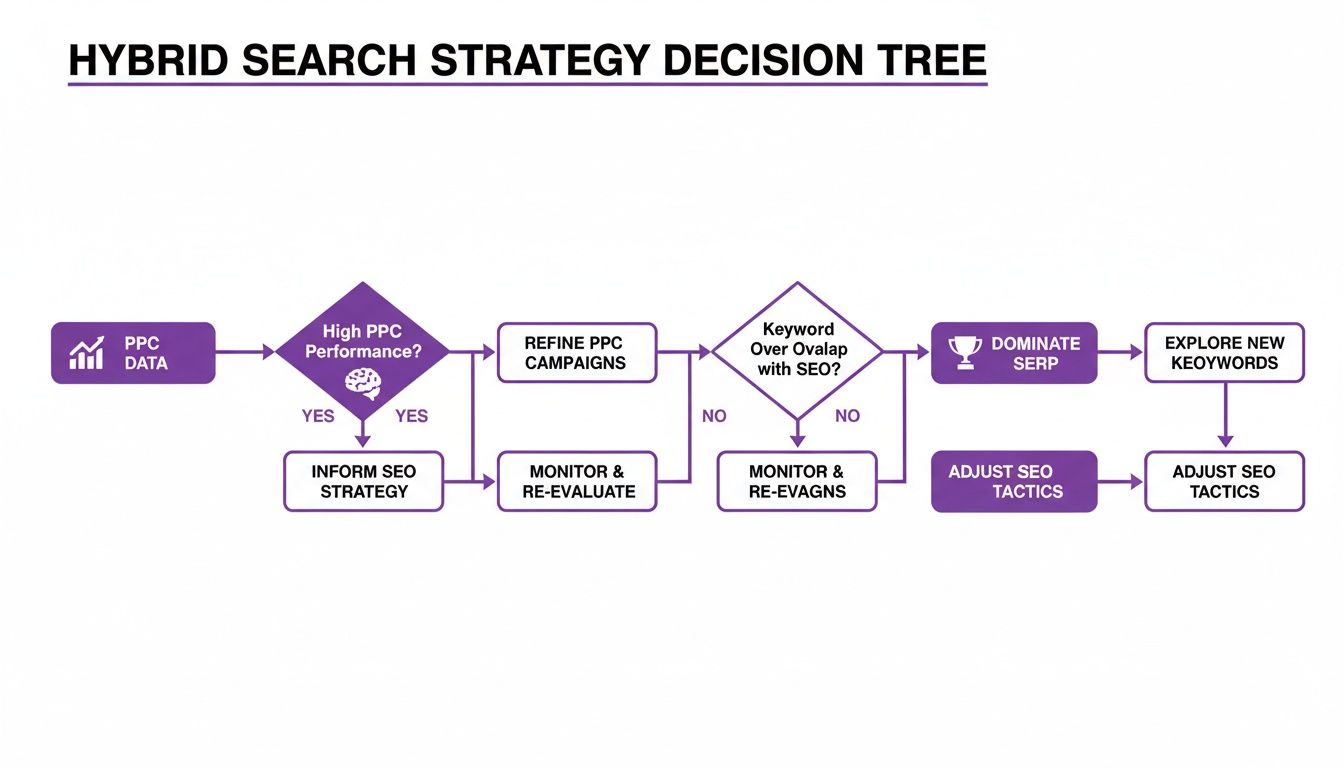
This flowchart maps out a clear path from using paid search for quick data to building a dominant, long-term organic presence.
Nailing down the right budget takes more than just looking at industry benchmarks; it demands a real-world understanding of your specific costs and potential returns. To get a precise estimate of what you might spend and what you could get back, you need a specialized tool.
Get a head start by trying our Google Ads calculator to model different scenarios for your business. It will help you make a data-driven decision that aligns your financial commitment with your strategic goals, ensuring every single dollar is put to its most effective use.
Got Questions? We've Got Answers.
Jumping into the world of paid and organic search can feel like you're staring at a fork in the road. Which path do you take? Let's clear up a few of the most common questions we hear from clients, so you can move forward with confidence.
My Website Is Brand New. Should I Go with Paid or Organic Search?
For a fresh-out-of-the-box website, our answer is almost always the same: do both, but lead with paid. Think of paid search (PPC) as your launchpad. It gets you immediate traffic, lets you test your product-market fit, and—most importantly—starts collecting hard data on which keywords actually convert from day one.
While that’s happening, you kickstart your organic search (SEO) efforts. The beauty here is that you're not guessing. The insights from your PPC campaigns become your roadmap for SEO, telling you exactly which keywords and topics are worth building content around. This two-pronged attack delivers instant feedback while you build a powerful, long-term asset.
Once I Hit the Top Ranks, Can I Stop Doing SEO?
Absolutely not. Hitting the brakes on SEO once you rank high is one of the most common—and costly—mistakes a business can make. It's like winning a race and then deciding to sell your car.
SEO isn't a "set it and forget it" task. It's an ongoing race. Search engine algorithms change constantly, your competitors are always trying to knock you off the top spot, and your own content can go stale.
To protect your hard-won rankings, you have to keep your foot on the gas. That means continuous content creation, keeping your site's technical health in check, and consistently building your authority.
How Fast Will I See a Return on Investment from SEO vs. PPC?
The timeline for ROI is where these two channels really show their differences. It’s one of the starkest contrasts in the paid vs. organic showdown.
With PPC, the return can be almost immediate. We're talking days or weeks after a well-built campaign goes live. You put money in, and you can track the resulting leads or sales right away. It's direct, it's measurable, and it’s fast.
SEO, on the other hand, is a long game. You're building an asset, not just buying an ad. Typically, it takes a solid 6 to 12 months of consistent, quality work before you see a significant positive return. That’s the time it takes to earn the trust, authority, and relevance needed to climb the ranks for keywords that actually matter.
Ready to stop debating and start dominating? The team at Rebus has spent over a decade building powerful hybrid strategies that deliver both immediate wins and lasting growth. Let's build a search strategy that actually drives results.