PPC for Small Business A Practical Guide to Profitable Campaigns
For small businesses, pay-per-click (PPC) advertising is one of the fastest ways to get in front of customers who are actively looking for what you sell. Forget waiting months for SEO to kick in. With PPC, you can show up at the very top of Google, putting your business directly in the path of people ready to buy.
Setting a Foundation for PPC Success
Jumping into paid ads without a clear plan is the quickest way to burn through your cash with nothing to show for it. Before you spend a single dollar, you need a solid foundation built on two things: clear goals and a realistic budget. This isn't about some complicated marketing theory; it's about building a practical framework that turns your ad spend into a predictable growth engine.
Everything flows from this simple process. Get these first two steps right, and your strategy will practically write itself.
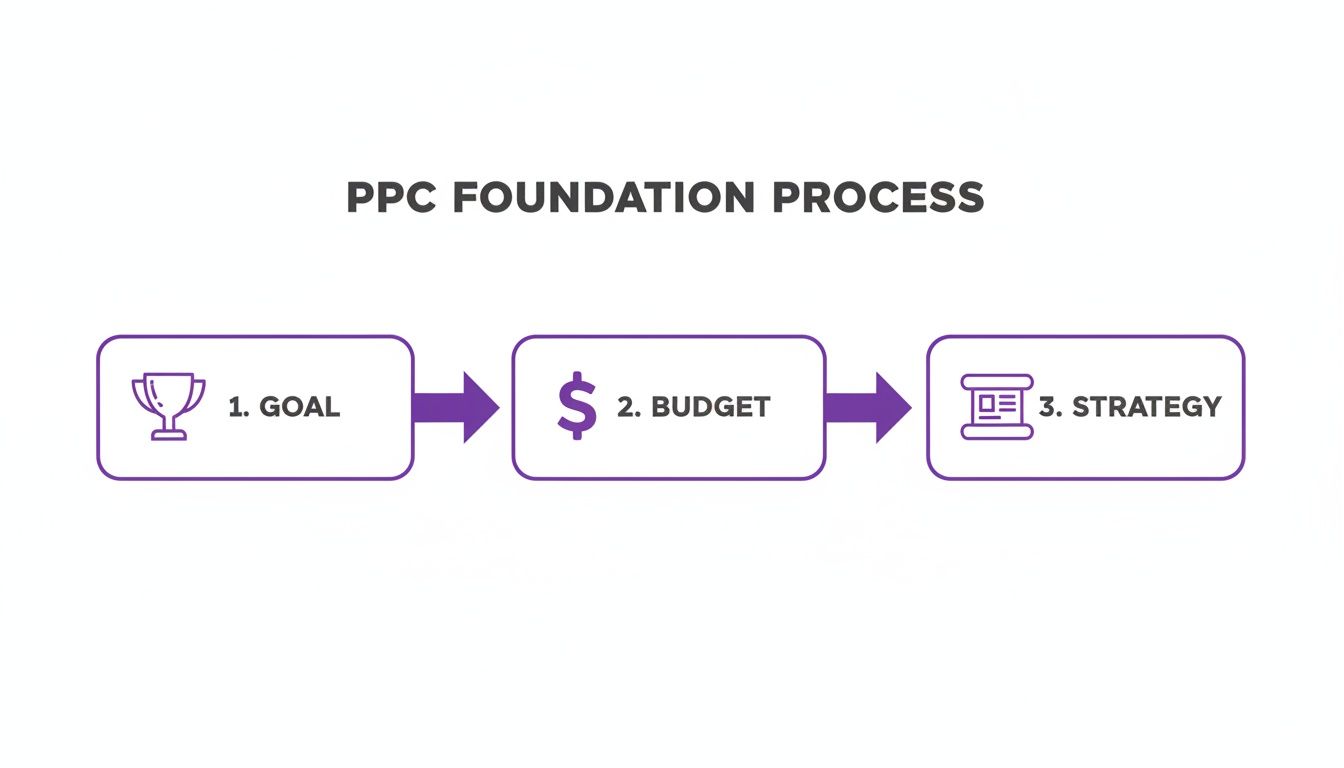
See how strategy comes after goals and budget? That’s the key. It ensures every decision you make is intentional and moves you closer to your target.
Define Your Business Goals First
Your ad goals need to be a direct extension of your business goals. The most important question you can answer is: what do I want someone to do after they click my ad? Vague ambitions like "get more traffic" won't cut it. That’s a recipe for wasted spend.
You need specific, measurable outcomes that actually make a difference to your bottom line.
- Lead Generation: This is the go-to for most service businesses, from plumbers to lawyers. The goal is simple: make the phone ring or get a potential client to fill out your contact form.
- E-commerce Sales: If you run an online store, this one’s a no-brainer. The objective is to drive purchases, and success is measured by sales volume and, most importantly, Return On Ad Spend (ROAS).
- Brand Awareness: This is a bit trickier to measure but can be a smart move for new businesses in a crowded market. The goal is to get your name in front of as many relevant people as possible.
Think of it this way: a local bakery wouldn't just say they "want more customers." They'd set a specific goal, like getting 20 online cake orders per month from their PPC ads. This gives them a clear benchmark to hit and makes it easy to see if the campaigns are actually working.
Pro Tip: Start with one—and only one—primary goal. Trying to get leads, drive sales, and build awareness all at the same time will spread your budget too thin and make it impossible to know what's working. Nail one objective, then expand.
How to Set a Realistic Starting Budget
The "how much should I spend?" question is the biggest hurdle I see when talking about PPC for small business. There's no magic number, but the secret is to invest just enough to get meaningful data without betting the farm.
Think of your initial budget as an investment in learning. For most local businesses, a starting budget between $500 and $1,500 per month is a solid place to begin. It's enough to test a few key offers, bid on high-intent keywords, and figure out what your audience actually responds to.
The biggest mistake you can make is spreading a small budget across too many campaigns. Focus all your firepower on one or two of your most profitable products or services. This lets you maximize the data you get from every single click.
To make this even clearer, here’s a simple framework to help you connect your budget to a realistic starting goal.
PPC Budget and Goal Framework for Small Businesses
This table gives you a quick reference to help align a starting monthly budget with achievable PPC goals for different business types.
| $500 - $1,000 | Local Lead Generation | Geo-targeted search ads, click-to-call, lead form extensions | Plumber, Electrician, HVAC |
|---|---|---|---|
| $1,000 - $2,500 | E-commerce Sales (Niche) | Google Shopping for top products, branded search, remarketing | Boutique clothing store, custom jewelry maker |
| $1,500 - $3,000 | High-Value Leads | High-intent keywords, landing page optimization, call tracking | Law firm, B2B software, financial advisor |
| $2,500+ | Scale & ROAS Focus | Performance Max campaigns, audience expansion, competitor targeting | Growing e-commerce brand, national service provider |
Use this as a starting point. As you gather data and see what works, you can adjust your budget and goals accordingly. The key is to start smart and focused.
Building Your Campaign Structure the Right Way
A messy Google Ads account is a money pit. Seriously. When your campaigns, ad groups, and keywords are all jumbled together, you completely lose control. Your budget gets torched, your ads become irrelevant, and your costs go through the roof.
The secret to profitable PPC for small business isn't some crazy growth hack. It's building a logical, scalable structure from day one.
Think of your campaign structure as the digital blueprint for your business. It should basically mirror how your website is organized, with each campaign representing a distinct product category or service you offer. Getting this clean separation right is the foundation for everything else you'll do.
Starting with a logical structure makes managing your advertising efforts straightforward and efficient, which is how you prevent those costly rookie mistakes.
Campaigns: The Top-Level Organizers
Campaigns are the big buckets—the highest-level folders in your account. Each one gets its own dedicated budget and specific settings, like where you want your ads to show up (location targeting) and when (ad scheduling).
A classic mistake I see all the time is small businesses lumping unrelated services into a single, massive campaign. This forces you to use one budget for everything, which is a terrible idea.
For example, a local plumber should never have one giant "Plumbing Services" campaign. Instead, they should create separate campaigns for their most profitable services:
- Campaign 1: Emergency Plumbing Repairs
- Campaign 2: Drain Cleaning Services
- Campaign 3: Water Heater Installation
This separation gives you surgical control. You can pump more budget into "Emergency Plumbing Repairs" during peak hours or on weekends, while running "Water Heater Installation" ads only during business hours. That level of control is flat-out impossible with a disorganized account. You can also gain deeper insights by comparing different approaches, like we cover in our guide detailing the differences between display ads vs. search ads.
Ad Groups: Get Specific and Relevant
Inside each campaign, you have ad groups. This is where the real magic of relevance happens. An ad group is a container for a small, tightly-themed cluster of keywords and the specific ads that will show for those keywords.
The golden rule here is to keep your ad groups hyper-focused. The keywords inside a single ad group should be so similar that the exact same ad would be a perfect fit for every single one. If your keywords are too different, your ad becomes generic, and performance tanks.
Let's stick with our plumber and break down their "Emergency Plumbing Repairs" campaign:
- Ad Group A Keywords:
- "24 hour plumber near me"
- "emergency plumber boulder"
- "leaking pipe repair now"
- Ad Group A Ad Copy:
- Headline: 24/7 Emergency Plumber | Fast Response
- Description: Leaking Pipe? Burst Hose? Get an Expert Plumber to Your Door in Under 60 Mins. Call Now!
- Ad Group B Keywords:
- "clogged toilet repair"
- "fix overflowing toilet"
- "emergency toilet unclogging"
- Ad Group B Ad Copy:
- Headline: Clogged Toilet Repair Experts
- Description: Fast & Affordable Unclogging Service. We Fix Overflowing Toilets. Available Now.
See how specific that is? Someone frantically searching for a clogged toilet sees an ad that speaks directly to their problem, not some generic "plumbing" ad. This relevance is exactly what Google wants to see.
A well-structured account with highly relevant ad groups leads to a higher Quality Score. Google rewards ads with high Quality Scores by giving them better ad positions at a lower cost-per-click—a massive advantage for any small business.
Why This Structure Matters So Much
Look, this methodical approach isn’t just for neatness; it directly impacts your bottom line.
A logical structure makes your account way easier to manage. You can quickly see what’s working and what isn’t. You can pause an underperforming ad group without accidentally kneecapping your top performers.
It also makes optimization a breeze. When you want to test new ad copy, you know exactly which ad group to jump into. When you need to adjust bids for a specific service, you can do it at the ad group level without messing up the entire campaign. This organized framework is the key to scaling your PPC efforts profitably instead of just throwing more money at the wall.
Alright, your campaign structure is in place. Now for the fun part: finding the actual people who are going to give you money. This is all about filling those shiny new campaigns with the right keywords and audiences.
Think of it this way: you’re setting up shop right at the intersection where a customer’s problem meets your solution. It’s about being there, ready and waiting, the exact moment they type their pain into that little search box.
But solid PPC for a small business isn't about casting a wide net with a few obvious keywords. It’s about getting inside your customer’s head. What are they really looking for? How can you find them without lighting your budget on fire?
Digging for Keyword Gold
Every great search campaign is built on a killer keyword list. Your mission is to find the phrases that scream, “I’m ready to buy,” not, “I’m just browsing.”
The real treasure is usually buried in the long-tail. These are longer, super-specific phrases (think three or more words) that might not get a ton of search volume but convert like crazy. While your bigger competitors are slugging it out over a broad term like "landscaping," you can swoop in and win with phrases like "drought tolerant front yard design" or "monthly lawn care service denver."
More specific means less competition. Less competition means a cheaper, more qualified click for you. It's that simple.
Get a Grip on Your Match Types
Just dumping keywords into an ad group is like throwing spaghetti at the wall. You have to tell Google how picky you want to be. This is where keyword match types come in, and mastering them is non-negotiable for protecting your ad spend.
- Exact Match: [organic dog food] - Your ad shows for this exact phrase or something ridiculously close. This gives you maximum control and usually delivers the highest conversion rates.
- Phrase Match: "organic dog food" - Your ad can show up if the search includes your phrase in order, even with words before or after it (like "best organic dog food for puppies"). It’s a nice middle ground.
- Broad Match: organic dog food - Google gets creative here. Your ad can appear for searches related to your keyword, even if the exact words aren't there. Use this one with extreme caution. It can be a budget incinerator if you're not careful.
For small businesses, I almost always recommend starting with a healthy mix of Exact and Phrase match. It’s the safest way to make sure you’re attracting the right crowd from day one.
My Two Cents: Start tight with Phrase and Exact match. Once you have some real data rolling in, you can strategically test Broad Match, but only if you pair it with an aggressive negative keyword strategy to weed out all the junk traffic.
Speaking of which, negative keywords are just as important as the ones you’re targeting. These are the terms you don't want to show up for. For instance, a company selling premium dog food would immediately add words like "free," "cheap," and "jobs" to their negative list. To get this right, check out our deep dive on building and managing effective negative keyword lists.
It's Not Just What They Search, It's Who They Are
Modern PPC is a two-pronged attack. It’s not just about what people are typing; it’s about who is doing the typing. Layering audience targeting on top of your keyword strategy is how you go from getting clicks to getting high-value customers.
This is especially critical when you're working with a tight budget. As of 2025, the average cost per click (CPC) on Google Ads is hovering around $5.26, but that number can swing wildly depending on your industry. Most small businesses we see start with a budget between $1,000 and $3,000 a month. That’s more than enough to target great keywords and test offers, but in cutthroat industries like legal services, a single click for a term like 'injury attorney' can easily top $8–$9. Precise targeting isn't a luxury; it's a necessity.
The Two Audiences Every Small Business Should Use
Ready to get started? Here are the two absolute must-use audience types to layer into your campaigns today:
Remarketing Lists: This is your lowest-hanging fruit, period. A remarketing list is simply a collection of people who have already visited your website. You can serve up specific, tailored ads to this warm audience, reminding them to come back and finish that purchase or fill out your contact form.
In-Market Audiences: Google is pretty smart. It creates these lists by analyzing search and browsing behavior to identify people who are actively researching and about to buy something specific. Targeting users who are "in-market" for "Home Renovation Services" is infinitely more powerful than just targeting a broad demographic.
When you combine sharp keyword research with smart audience layers, you create a hyper-efficient machine. You’re no longer just bidding on search terms; you’re bidding on the valuable potential customers behind them.
Writing Ads and Landing Pages That Actually Convert
Getting the click feels good, but let's be real—it’s just the starting line. The real test in any PPC for small business campaign is turning that click into a phone call, a form fill, or a sale. I’ve seen it a hundred times: a brilliant ad that funnels traffic to a confusing landing page is just a very creative way to burn cash.
Success comes down to creating a totally seamless journey, from the moment a user sees your ad to the second they hit "submit" on your landing page. This isn't magic. It's about nailing two things: writing ad copy that grabs them by the collar and making sure your landing page delivers exactly what the ad promised.
Crafting Ad Copy That Gets the Click
Your ad copy has one simple job: convince a searcher that you have the best, fastest, or most reliable solution to their problem right now. You don’t need to be a literary genius; you just need to follow a proven formula.
- Mirror Their Search: Your headline should feel like a direct answer to what they just typed. If they searched for "emergency roof leak repair," your headline better have those exact words. It's an instant signal that says, "Hey, you're in the right place."
- Sell the Benefit, Not Just the Service: Don't just list what you do. Tell them why it matters. "We Fix Roofs" is forgettable. "Fast Roof Leak Repair | Stop Damage Now" is an urgent solution.
- Give a Clear Command: Tell people exactly what you want them to do next. Be direct and action-oriented. Use phrases like "Get a Free Quote," "Shop Our Sale," or "Call for a Consultation."
Once you've got the basic ad locked in, it's time to take up more space on the search results page with ad extensions. Think of these as free upgrades for your ad—snippets like your phone number, location, or direct links to specific service pages. They make your ad bigger, more helpful, and can seriously boost your click-through rate without costing an extra dime.
The Make-or-Break Post-Click Experience
The moment a user clicks your ad, a new clock starts ticking. You have just a few seconds to prove they made the right choice. This is where your landing page does all the heavy lifting, and the single most important concept to master is message match.
Message Match: This is simple but so often overlooked. It just means the promise you made in your ad is immediately and obviously fulfilled on your landing page. If your ad screams "50% Off Spring Lawn Care," the landing page headline better shout the exact same thing, front and center.
Any disconnect creates friction. It makes people pause, question, and ultimately, hit the back button. A smooth, consistent experience, on the other hand, builds instant trust and guides them straight to your goal.
Anatomy of a High-Converting Landing Page
First things first: your landing page is not your website's homepage. It's a specialized, standalone page built with one single conversion goal in mind. Anything that distracts from that goal—like a navigation bar with a dozen different links—needs to go.
Here are the non-negotiable components:
A Compelling Headline: Reiterate the exact promise from your ad. Reinforce that message match.
Clear, Scannable Copy: Use bullet points and short sentences. Focus on the benefits and how you solve the user's problem. No walls of text.
Powerful Social Proof: This is your trust-building toolkit. Sprinkle in testimonials, customer reviews, star ratings, or logos of companies you've worked with.
A Big, Obvious CTA: Your call-to-action button should pop off the page. Use action-oriented text like "Get My Free Quote Now."
A Dead-Simple Form: Only ask for what you absolutely need. For a lead, a name, email, and phone number is often plenty. Every extra field you add will lower your conversion rate.
And if you're looking to branch out, understanding the fine points of creating video ads that convert can give you a huge edge by adding a dynamic visual layer to your message.
Ultimately, this synergy between your ad and landing page is what separates the profitable campaigns from the money pits. This is powerful stuff because paid traffic is, by its nature, high-intent traffic. In fact, PPC traffic can convert 50% better than organic traffic, and search ads are known to lift brand awareness by a massive 80%. It’s a key reason why businesses plan to earn an average of $2 for every $1 they spend on PPC. By making your post-click experience flawless, you capitalize on that intent and squeeze every last drop of value from your ad spend.
How to Measure and Optimize Your Campaigns for Growth
Launching your PPC campaign is just popping the champagne. The real work—and the real money—comes from what you do next. It's a constant, data-backed cycle of measuring, tweaking, and improving. If you’re not tracking what’s working, you’re just gambling with your ad spend.
This is the part where you stop spending and start investing. The goal is to turn all that campaign data into a clear map that leads straight to profitable growth. It’s all about making smart decisions that drive your costs down and your leads or sales up.
Nail Down Your Measurement Foundation
Before you can optimize a single thing, you have to track everything that matters. The absolute first step is setting up conversion tracking. This is non-negotiable. A conversion is any valuable action someone takes after clicking your ad, like buying a product, filling out a form, or calling your business.
Without it, you can see clicks, but you have no clue which ones are actually making you money. It’s like running a retail store with a broken cash register.
Here’s what you absolutely need to be tracking from day one:
- Form Submissions: Every single time a user hits "submit" on your "Contact Us" or "Request a Quote" form.
- Phone Calls: Use call tracking to see exactly which campaigns, ads, and keywords are making your phone ring.
- Purchases: For e-commerce shops, tracking the revenue from each sale is the only way to calculate true profitability.
Getting this set up correctly in Google Ads is what empowers you to make intelligent, data-backed decisions instead of emotional ones.
Focus on the Metrics That Actually Pay the Bills
It’s way too easy to get lost in a sea of data. Clicks and impressions might look good on a report, but they don't pay your bills. We call those "vanity metrics." For a small business, you have to zero in on the numbers that connect directly to your bottom line.
- Cost Per Acquisition (CPA): This is the total you spend to get one new customer or lead. If your product has a $200 profit margin and your CPA is $50, you're crushing it. If your CPA is $250, you’ve got a big problem to solve.
- Return On Ad Spend (ROAS): This is the ultimate gut check for profitability. It tells you exactly how much revenue you’re generating for every dollar you put into ads. A ROAS of 4:1 means you’re making $4 for every $1 spent.
Imagine doubling your money with every dollar you put in—that's the power of a well-optimized campaign. Many businesses see an average return of $2 for every $1 spent on PPC. With search ad conversion rates hitting an average of 4.40%, focusing on these KPIs is what separates a successful campaign from a costly experiment.
Understanding your ROI is critical for sustainable growth. For a deeper dive, check out this excellent guide on measuring your marketing ROI.
A Simple Framework for Optimization
Once your tracking is solid and you know which metrics to watch, optimization becomes a straightforward, repeatable process. Think of it as a continuous loop: analyze the data, then take action.
Key Takeaway: Your campaign data is a goldmine of feedback straight from your target market. It tells you exactly what they want and what they ignore. Your job is to listen and adapt.
Here’s how to turn that feedback into profit:
Cut the Waste: The first place to look is your search terms report. This shows you the actual search queries that triggered your ads. If you spot irrelevant searches eating up your budget, add them to your negative keyword list immediately. This is the fastest way to stop bleeding cash and improve performance.
Double Down on Winners: Find the keywords, ads, and ad groups with the best CPA or ROAS. These are your all-stars. Funnel more of your budget toward them to scale what’s already proven to work.
Always Be Testing: Never assume your best ad is as good as it can get. Constantly run A/B tests on your ad copy. Try a new headline that hits on a different pain point. Test a different call-to-action. Small tweaks can lead to massive lifts in click-through and conversion rates.
By focusing on these core principles, you build a system for continuous improvement. If you're laser-focused on profitability, we also have a detailed breakdown on how to calculate Return On Ad Spend that you'll find useful. This isn't about making massive, risky changes; it's about making small, informed adjustments that compound into major growth over time.
Common PPC Questions from Small Business Owners
Jumping into pay-per-click advertising can feel like you’re trying to learn a whole new language overnight. It’s completely normal to have a ton of questions. We’ve been there, and we’ve heard them all from small business owners just like you.
So, we’ve rounded up the most common questions we get and laid out some clear, no-fluff answers to help you get started with confidence.
Think of this as your go-to FAQ for making paid ads actually work.
How Much Should I Spend on PPC?
This is the big one, isn't it? The million-dollar question every small business owner asks. And the honest-to-goodness answer is: it depends. Your industry, your goals, and where you're located all play a huge part.
But you need a number to start with. For most local service businesses or niche e-commerce shops, a solid starting point is somewhere between $500 to $2,500 per month.
That range isn’t just pulled out of a hat. It’s the sweet spot for gathering enough meaningful data to see which keywords, ads, and audiences are actually working. If you try to run a campaign on a shoestring budget below that, you’ll likely struggle to get enough clicks to make smart, data-backed decisions.
Remember, your first budget is really an investment in learning. The goal isn’t to hit a home run on day one; it's to figure out your cost per lead and what it really takes to win a customer profitably.
How Long Does It Take to See Results?
One of the best things about PPC for small business is the speed. Compared to SEO, it’s lightning fast. You can start seeing traffic and data rolling in within hours of launching your first campaign. But "results"—as in profitable leads or sales—take a little more time to dial in.
Here’s a realistic timeline:
- Week 1: You'll see initial data pop up—clicks, impressions, and click-through rates. This is when you get your first clues about which ads are catching people’s attention.
- Month 1: By now, you should have enough conversion data to spot the early winners and losers. The first round of real optimization begins: pausing keywords that are wasting money and shifting your budget to the top performers.
- Months 2-3: This is typically when a well-managed campaign starts to find its groove. You’ll see more consistency and, if things are on the right track, real profitability.
A classic mistake is yanking the plug too soon. PPC needs a bit of patience. You have to give your campaigns at least 90 days of consistent tweaking and optimizing before you can truly judge if they're working.
Can I Do PPC Myself or Should I Hire Someone?
You can absolutely manage PPC yourself, especially now that platforms like Google Ads are becoming more intuitive. If you’re working with a tiny budget and have more time than money, learning the ropes can be an incredibly valuable skill.
But let’s be real: the learning curve is steep. One or two rookie mistakes—like using broad match keywords without a strategy or forgetting to add negative keywords—can drain your budget in a flash with zero to show for it.
You should seriously consider hiring an agency or a freelancer if:
- You don't have at least 3-5 hours a week to dedicate to managing, analyzing, and optimizing your account.
- You're in a super competitive industry where every click costs a fortune.
- You want to scale up faster and sidestep all the costly beginner traps.
Is PPC Better Than SEO?
This isn’t an "either/or" fight; it’s a "both/and" partnership. PPC and SEO are two sides of the same digital marketing coin, and they are powerhouse when they work together.
PPC gives you that instant visibility. It’s perfect for testing new offers, pushing specific promotions, and generating leads right now. SEO, on the other hand, is the long game. It’s about building organic traffic and brand authority over time, eventually delivering those coveted "free" clicks once you start ranking.
The smartest play? Use PPC to get immediate results while your SEO foundation is being built. The keyword data you collect from your paid campaigns is pure gold—it can actually inform and speed up your SEO strategy by showing you which terms have the highest buying intent.
Ultimately, a truly dominant marketing plan uses both to own the search results page.
Ready to stop guessing and start growing? The expert team at Rebus has managed over $100 million in ad spend, turning clicks into customers for businesses just like yours. Let us build and optimize a powerful PPC strategy that delivers real, measurable results. Partner with us today and see the difference professional management makes.