PPC for Small Businesses: Master Advertising with ppc for small businesses Tips
If you've ever felt like your small business is shouting into the void, you're not alone. The world of digital marketing can feel like a long, slow climb, especially when you're up against bigger players with deeper pockets.
But what if you could jump the line?
That's where Pay-Per-Click (PPC) advertising comes in. Think of it as your fast pass to the front page of the internet. Instead of waiting months for your SEO efforts to kick in, PPC puts you right in front of customers the moment they’re searching for what you sell. It’s a direct, powerful way to drive traffic and make sales from day one.
Why PPC Is Your Small Business Growth Engine

As a small business owner, you’re painfully aware of every dollar and minute spent. Marketing often feels like a long-term bet, but PPC flips that script entirely. It isn’t just another line item on your budget; it's a controllable, data-driven machine that can start generating results almost immediately.
Imagine you run a local bakery. With a smart PPC campaign, your shop can pop up at the very top of Google Ads the instant someone searches "custom birthday cakes near me." This isn't about outspending the national chains—it’s about outsmarting them with laser-focused precision.
The Power of Immediate and Targeted Visibility
The biggest win with PPC for small businesses is speed. Let's be real: search engine optimization (SEO) is a marathon, not a sprint, and it can take months before you see any real traction. PPC, on the other hand, gets your business in front of potential customers instantly.
This immediate feedback is priceless. You can quickly test offers, figure out what customers are actually looking for, and start bringing in revenue right away.
It's a strategy that's catching on fast. A whopping 65% of small to mid-sized businesses are now running PPC campaigns, a clear signal of its power to drive growth. These smaller companies are also investing more heavily in paid search than organic efforts, showing a major shift in where they see the best returns. You can dig into more of these trends over at Insivia.com.
A Measurable Return on Investment
Unlike throwing money at a billboard and hoping for the best, PPC gives you crystal-clear data on your performance. You know exactly how many people clicked your ad, what they did on your website, and precisely how much it cost to land each new lead or sale.
This level of transparency is a game-changer. It allows you to:
- Put Your Budget Where It Counts: Funnel money into the campaigns and keywords that are actually making you money, and cut the ones that aren't.
- Sharpen Your Targeting: Use real data to understand your audience better and make your ads more relevant over time.
- Justify Your Marketing Spend: Show anyone—your partners, your accountant, yourself—exactly how much value PPC is bringing to the business.
For a small business, knowing what's working and what isn't is a superpower. PPC delivers that clarity, turning your marketing from a guessing game into a predictable investment that fuels your most important goals—whether that’s booking more appointments, selling more products, or just getting your name out there.
Build Your PPC Foundation Before Spending a Cent
Let's get one thing straight: jumping into paid ads without a solid plan is the fastest way to set your marketing budget on fire. Success in PPC for small businesses isn’t about outspending the big guys; it’s about out-thinking them before you spend a single cent.
This prep work is what separates campaigns that print money from those that feel like a costly trip to the casino. It’s about being deliberate. Every keyword, every ad, every dollar has a purpose.
Define Sharp, Measurable Objectives
"I want more website traffic." Cool story. But traffic doesn't pay the bills. Vague goals get you vague, useless results. You need objectives that are specific, measurable, and tied directly to the health of your business.
A local plumbing business, for instance, shouldn't chase traffic. They need leads. A razor-sharp objective would be: "Generate 20 qualified leads for emergency leak repairs this month through Google Ads." That’s a goal you can take to the bank—it's specific, you can count it, and it targets a high-value service.
Or maybe you run an e-commerce shop selling handmade leather goods. Your goal could be: "Achieve a 3:1 return on ad spend (ROAS) for our new wallet collection within the first 60 days." This forces your entire campaign to focus on pure profitability, not just clicks.
Before you even open an ad account, write down one or two crystal-clear objectives. This single step will guide every decision you make, from keyword selection to ad copy, ensuring your efforts are laser-focused on what actually moves the needle.
Uncover Keywords with Buying Intent
Keywords are the literal language your customers use when they need you. Your mission is to find the exact phrases they type when they're ready to open their wallets. This is where keyword research becomes your superpower.
Think beyond the obvious. A search for "shoes" is a black hole of competition and vague intent. But a search for "women's waterproof hiking boots size 8"? That person knows exactly what they want and is probably moments away from buying. These beautiful, specific phrases are called long-tail keywords.
You don't need a fancy, expensive tool to get started. Google's Keyword Planner is free and gives you more than enough to build a solid list. The trick is to get inside your customer's head.
- For a service business: A local accountant might start with "accountant near me," but the real gold is in phrases like "small business tax preparation services" or "help with quarterly payroll filing."
- For an e-commerce store: A coffee subscription box should be targeting "best whole bean coffee subscription" or "monthly coffee delivery for espresso." See the difference?
Build a Simple Customer Persona
Who are you really talking to? If you try to sell to everyone, you’ll sell to no one. You need a simple customer persona—a quick sketch of your ideal buyer—to write ads that actually connect with a real human being.
Don't overcomplicate this. Just jot down the answers to a few questions:
- Demographics: What's their rough age, location, and job?
- Pain Points: What problem are they trying to solve that you fix?
- Goals: What's the dream outcome they're looking for?
- Where They Hang Out: Are they frantically searching on Google, scrolling Instagram for inspiration, or seeking professional advice on LinkedIn?
This little profile immediately tells you where to spend your money. If your ideal customer is a homeowner in a panic searching for a roofer after a storm, Google Ads is your playground. If you sell visually stunning custom jewelry, you'll probably find your people on Meta (Facebook and Instagram).
Shield Your Budget with Negative Keywords
Knowing what you don't want is just as important as knowing what you do. Negative keywords are your budget's best friend. These are terms you tell the ad platform to ignore, preventing your ads from showing up for irrelevant searches.
Think about it. You're a high-end kitchen remodeler. You want your ad to show for "kitchen renovation contractor." But you absolutely do not want to waste a click on someone searching "DIY kitchen renovation" or "cheap kitchen cabinet repair."
By adding "DIY" and "cheap" as negative keywords, you instantly stop bleeding cash on clicks from people who were never going to hire you anyway. This simple tactic ensures every dollar is spent reaching your actual potential customers.
Set a Realistic Budget and Smart Bidding Strategy
Alright, let's get down to brass tacks: the money. Figuring out your PPC budget can feel like throwing darts in the dark, but it doesn't have to be a guessing game. A smart budget isn't just a number you pull out of thin air; it’s a strategic decision that flows directly from your business goals.
The first question to ask isn't "how much should I spend?" but rather, "what am I actually trying to achieve?" Are you gunning for a specific number of new leads each month? Or are you trying to hit a certain sales target for your e-commerce shop? Your answer is the true starting line.
Calculating Your Initial PPC Budget
Instead of picking a spending number and hoping for the best, let's work backward from your desired result. This simple flip turns your budget from a blind expense into a predictable investment.
Here’s how this plays out in the real world for, say, a local HVAC company.
Their main goal is to land 20 new installation jobs per month. From experience, they know they close 1 out of every 4 leads that come in. A little quick math tells them they need 80 total leads to hit their target. If they're comfortable paying up to $50 per qualified lead (their target Cost Per Acquisition, or CPA), the budget practically sets itself.
- The Math: 80 leads x $50 CPA = $4,000 monthly budget
Suddenly, you have a data-driven number that’s easy to defend. It’s grounded in business reality, not just marketing fluff.
Key Takeaway: Build your PPC budget from the ground up, starting with your lead or sales goals. Work backward from your target Cost Per Acquisition (CPA), and you’ll land on a realistic number that’s tied to actual growth.
Now, let's put that into perspective. The average cost per click on Google Ads search can hover anywhere from $1.16 to $2.69, but that's just an average—some industries are way more expensive. For small businesses, monthly PPC spend can be a few hundred bucks or tens of thousands. The goal-based approach we just walked through ensures your spend is always purposeful. For some more context, you can dig into other PPC advertising statistics here.
To help visualize this, here’s a simplified breakdown for a local service business trying to set its first budget.
Sample PPC Budget Calculation For A Local Service Business
| Monthly Lead Goal | 10 | The number of new customers you want this month. |
|---|---|---|
| Lead-to-Close Rate | 25% | You close 1 out of every 4 qualified leads. |
| Total Leads Needed | 40 | Lead Goal (10) / Close Rate (0.25) |
| Target Cost Per Lead (CPA) | $75 | The maximum you're willing to pay for one lead. |
| Starting Monthly Budget | $3,000 | Total Leads Needed (40) x Target CPA ($75) |
This simple table shows how your business goals directly translate into a concrete, actionable budget. It’s a powerful starting point.
Choosing a Smart Bidding Strategy
Once you’ve set your budget, you have to tell the ad platforms how to spend it. This is where bidding strategies come into play. If you're just starting out, my advice is to keep it simple. Focus on either having total control or letting smart automation do the heavy lifting.
Here are two of the best strategies to start with:
Manual CPC (Cost-Per-Click): This puts you in the driver's seat. You set the absolute maximum price you’re willing to pay for a single click. It's perfect for beginners who want to learn the ropes and avoid accidentally blowing their budget while they gather that crucial first batch of data.
Maximize Conversions: This is a fully automated strategy. You basically tell Google, "Here’s my daily budget, go get me the most leads you can." The platform’s machine learning gets to work finding users who are most likely to fill out your form or make a call. This is a fantastic option once you have reliable conversion tracking in place.
So, which one is for you? It really comes down to your comfort level. Manual CPC is like driving a stick shift—you have total control, but it demands your attention. Maximize Conversions is like an automatic—it handles the details for you, but you need to trust the system.
As you start gathering real performance data, you'll get much better at forecasting your results. For a deeper dive, check out our guide on how to calculate return on ad spend and prove your campaigns are actually making money.
Craft Ads and Landing Pages That Actually Convert
Getting someone to click your ad is only half the battle. If the experience after the click is a letdown, you've just paid for a bounce, not a customer. This is where the real magic happens—in crafting ads that demand attention and landing pages that smoothly guide that attention toward a sale.
The journey from a user's search to your "thank you" page needs to be seamless. Every single piece, from the ad headline to the button on your contact form, has to work in perfect harmony. This is the core of effective PPC for small businesses: making every single click count.
Writing Ad Copy That Demands a Click
Think of your ad as a digital billboard on a very crowded highway. You have just a few characters to make someone slam on the brakes. Your goal isn't just to be seen; it's to be so compelling that you earn the click over three or four other competitors right next to you.
A classic framework that just plain works is AIDA. It’s old-school because it taps into fundamental human psychology.
Let's break it down with a real-world example for a local business:
- Attention: Start with a headline that mirrors exactly what the user is looking for. If they searched for "emergency plumber dallas," your headline better be something like "24/7 Emergency Plumber in Dallas." No creativity needed here, just pure relevance.
- Interest: Use the description to solve their immediate problem or highlight a key benefit. Think "Fast, Reliable Service" or "Clogged Drains Cleared Today." You're showing them you get it.
- Desire: Now, make them want your solution. Drop in an incentive like "Free Service Call Estimate" or flash some social proof like "50+ 5-Star Google Reviews." This is your trust-builder.
- Action: End with a crystal-clear, direct command. Forget passive language. Use strong calls-to-action (CTAs) like "Get a Free Quote Now" or "Book Your Appointment Online."
This structure is effective because it guides a potential customer from awareness to action in just a few lines of text. It's a psychological funnel in miniature.
The Non-Negotiable Elements of a High-Converting Landing Page
So, you earned the click. Congrats. Now the landing page has to take the baton and finish the race. A landing page isn't just another page on your website—it’s a purpose-built conversion machine with one single, focused goal.
Your landing page has one job: to convert the visitor who just clicked your ad. If it's confusing, slow, or disconnected from the ad's promise, you're essentially setting your ad spend on fire. Message-matching is everything.
To build a page that actually converts traffic into business, you need a few critical ingredients. Nail these, and you're already ahead of most of your competition.
Here are the absolute must-haves:
A Headline That Mirrors Your Ad: The very first thing a visitor sees should be a headline that directly echoes the ad they just clicked. If the ad promised "Custom Wedding Invitations," the landing page headline needs to say something almost identical. This instantly tells them, "Yep, you're in the right place." It's a simple step that kills confusion.
Persuasive, Benefit-Driven Copy: Ditch the long, dense paragraphs. No one reads them. Use short, scannable copy, bullet points, and clear subheadings to explain how your product or service makes the customer's life better. Always focus on outcomes, not just a list of features.
A Frictionless Form or Obvious CTA: If you're after leads, keep your form brutally simple. Ask only for what you absolutely need (e.g., name, email, phone). Every extra field you add will cost you conversions. If you want sales, make the "Add to Cart" or "Buy Now" button big, bold, and impossible to miss.
Trust-Building Social Proof: Nothing builds confidence like seeing that other real people have had a great experience with you. Sprinkle in customer testimonials, reviews, star ratings, case study snippets, or logos of well-known clients. This is how you reduce doubt and make people feel safe handing over their information or money.
By locking in these components, you create a cohesive journey that feels natural and builds trust. The path from ad to action becomes logical, not jarring. For a much deeper look, there are some fantastic guides on conversion rate optimization best practices that can help you squeeze every last drop of performance out of your pages.
And for e-commerce businesses, a standard product page often isn't enough to convert paid traffic effectively. To see what pages designed specifically to turn ad clicks into sales look like, check out this guide on High-Converting Ecommerce Landing Pages That Drive Profit. It's full of practical advice for stopping wasted ad spend.
Launch, Measure, and Optimize Your Campaigns
Hitting the "launch" button isn't the finish line. It's the starting gun. This is where the real work of turning a good campaign into a great one actually begins, fueled by data and a little bit of detective work. Successful PPC for small businesses isn't about a perfect launch; it’s about a relentless commitment to making things a little bit better, every single day.
First things first, and I can't stress this enough: make sure your conversion tracking is working flawlessly. If it isn't, you're essentially flying blind, burning cash with no idea what's actually working. You absolutely have to be able to measure the actions that matter to your bottom line—a form submission, a phone call, a product sale. This data is the bedrock of every smart decision you'll make from here on out.
Finding Your Way Around the Ad Dashboard
When you first log into your ad dashboard, the sheer volume of numbers and charts can feel like you've just stepped into the cockpit of a 747. It's overwhelming. Don't get lost in the noise. For a small business, only a handful of metrics really tell the story.
To start, just focus on these three core metrics:
- Click-Through Rate (CTR): This is simple. Of all the people who saw your ad, what percentage clicked on it? A low CTR is a huge red flag that your ad copy isn't hitting the mark or your keywords are way off base.
- Conversion Rate: Of the people who clicked, what percentage actually did the thing you wanted them to do (buy something, fill out a form)? A high CTR with a rock-bottom conversion rate often means there's a major disconnect between what your ad promised and what your landing page delivered.
- Cost Per Acquisition (CPA): This is your bottom-line metric, the one that really matters. How much are you paying for each new lead or customer? The goal is to drive this number as far below the lifetime value of that customer as possible.
Think of it as a simple journey. Every potential customer has to navigate these three steps.
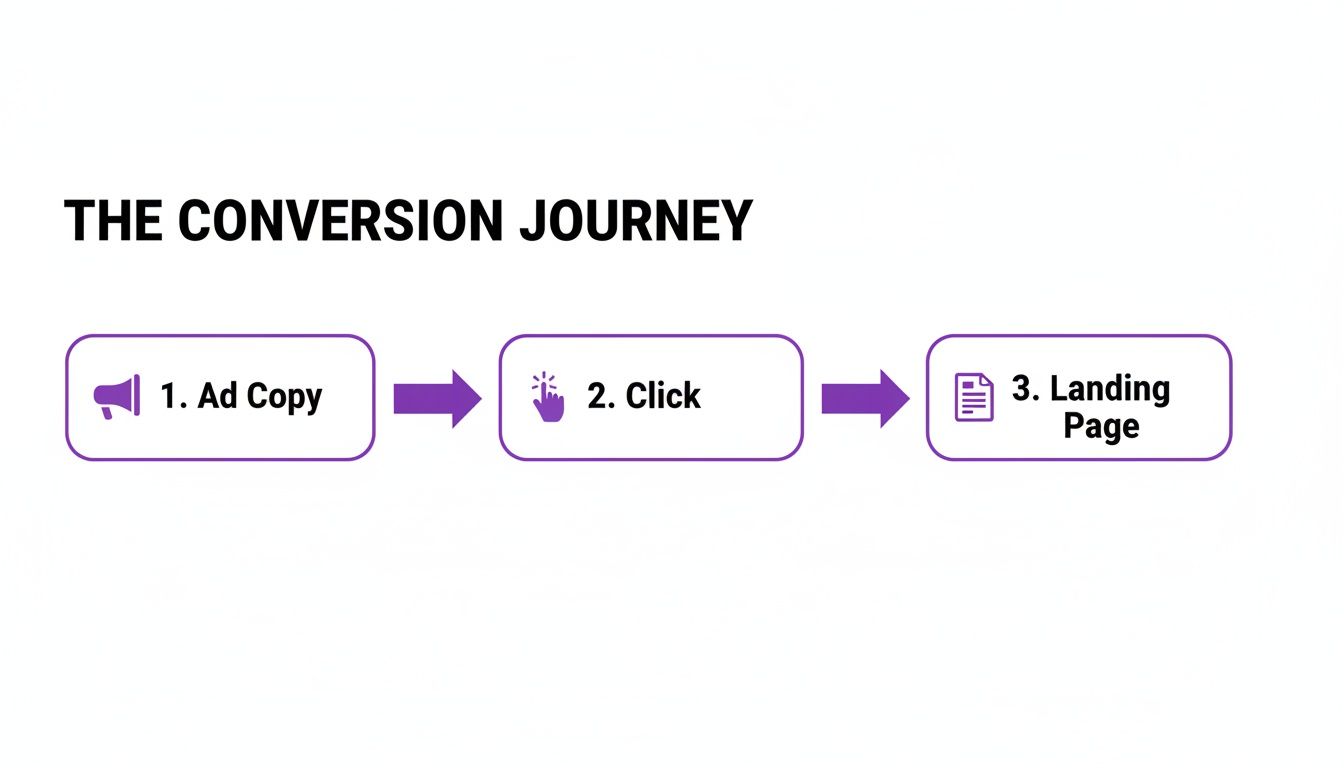
Each step is a place where you can lose someone, so making that experience smooth and consistent—from the ad's promise to the landing page's payoff—is everything.
Your Simple Optimization Checklist
Optimization isn't some massive, one-time project. It's a rhythm. By setting aside a little time each week and month to poke around and make small tweaks, you create a powerful feedback loop that stops you from wasting money and helps you double down on what works.
A weekly check-in should be quick and dirty. Look at your key metrics. See any ads with a shockingly low CTR? Pause 'em. Got keywords burning through your budget without a single conversion? Pause those, too. This is just about trimming the fat and reacting to what the data is screaming at you.
The goal of ongoing optimization is to make small, consistent adjustments. Over time, these tiny tweaks compound into massive improvements in efficiency and profitability, turning your PPC efforts into a predictable growth engine.
Your monthly review is where you get a bit more strategic. This is when you zoom out, look for trends, and make bigger adjustments to steer the ship. What’s working, and more importantly, why is it working?
Digging for Gold in Your Search Term Report
One of the most powerful—and underused—tools in your arsenal is the search term report. This report shows you the exact phrases people typed into the search bar right before they clicked your ad. This isn't just data; it's pure gold.
Checking this report regularly helps you do two critical things:
Find New Keyword Opportunities: You’ll often stumble upon valuable long-tail keywords you never would have thought of. If you see a specific search term that's converting well, add it as an exact match keyword to its own ad group so you can bid on it directly and control it.
Stop Wasting Money: Even more importantly, you’ll uncover all the irrelevant junk searches that are eating your budget. If you're a pet groomer and see clicks coming from "free dog grooming videos," adding "free" and "videos" to your negative keyword list is a no-brainer. This single move can save you a surprising amount of cash.
Building out a solid negative keyword list is one of the fastest ways to improve your ROI. For a deeper dive, our guide on building and using negative keyword lists shows you how to protect your ad spend like a pro.
A/B Testing: Never Settle for "Good Enough"
Never, ever assume your first ad is your best ad. A/B testing, or split testing, is just the simple process of running two slightly different versions of an ad to see which one performs better. It's a dead-simple concept with a massive impact.
Start by duplicating your current best-performing ad. Now, change just one thing. Test a new headline that focuses on a different customer benefit. Or try a different call-to-action—maybe "Get Your Free Quote" works better than "Schedule a Consultation." Let both ads run until you have enough data to declare a winner, then pause the loser and test something new against your reigning champ.
The same exact principle applies to your landing pages. You can test different headlines, hero images, button colors, or even the number of fields in your form to see what convinces more visitors to take action. This methodical process—test, learn, iterate, repeat—is the secret sauce to unlocking real, sustainable growth with PPC.
Time to Scale: Advanced Tactics to Turn Good PPC into Great PPC
Got your campaigns humming along and bringing in steady results? Nice. It's tempting to set it and forget it, but coasting is where growth goes to die. The real magic in PPC for small businesses happens when you move beyond the basics and start playing chess, not checkers.
It's time to add a couple of smarter plays to your book. These aren't complicated, brain-melting strategies; they’re just more efficient ways to spend your money. By layering in things like remarketing and hyper-local targeting, you can transform a decent campaign into a predictable, high-octane engine for leads and sales.
Bring ‘Em Back with Remarketing
Think about all the people who land on your website, click around, maybe even add something to their cart... and then vanish. Ghosted. But they're not lost causes. In fact, they’re your hottest audience. Remarketing (or retargeting, if you prefer) is how you get back in front of those exact people after they’ve left your site.
These aren't strangers anymore; they’ve already raised their hand and shown interest. A well-timed, gentle reminder is often all it takes to bring them back to seal the deal.
You can set up dead-simple (but crazy powerful) remarketing campaigns on both Google and Meta.
- Google Remarketing: This lets you show display ads to your past website visitors while they’re browsing other sites or watching YouTube videos. A local yoga studio, for instance, could show a "Your First Class is Free!" banner to anyone who checked out their class schedule but didn’t book.
- Meta Remarketing: This is all about targeting past website visitors with ads right in their Facebook and Instagram feeds. Imagine an online shop selling custom pet portraits. They could run a carousel ad showcasing adorable customer photos to people who added a portrait to their cart but never checked out. It's a perfect little nudge.
Go Hyper-Local and Hyper-Timed
Not every click is worth the same. A click from someone searching for your service at 2 AM on a Tuesday is probably less valuable than one from someone searching during your business hours. And a customer who’s a five-minute drive away is infinitely more valuable than one on the other side of the state.
This is where getting surgical with your targeting gives you a massive edge.
Stop wasting your budget running ads 24/7 to everyone in a 50-mile radius. Use geo-targeting and ad scheduling to focus your spend exactly where and when it counts. This one refinement saves a ton of cash and dramatically improves the quality of your leads.
Geo-targeting lets you draw a virtual fence around your business. Show ads only to people within a specific radius, a set of zip codes, or a single city. If you run a local bakery, this means you’re not paying to advertise to people who are never, ever going to stop by for a croissant.
Ad scheduling puts you in control of the clock. You decide which days and times your ads run. Let's say your HVAC company is the go-to for after-hours emergencies. You can create a specific campaign with ad copy like "24/7 Emergency Repairs" that only runs in the evenings and on weekends. You’re catching high-intent customers at the exact moment they need you.
The numbers don't lie. Geo-targeted ads can pull in 15% higher click-through rates, and some studies show remarketing can boost conversions by a wild 115%. These aren't just minor tweaks; they’re game-changers that give small businesses a serious fighting chance. You can dig deeper into how these tactics are reshaping local advertising by checking out these critical PPC changes for home service companies.
Own E-Commerce with Google Shopping
If you’re selling physical products online, Google Shopping campaigns are not optional. You know them—they're the product ads with images, prices, and store names that sit right at the top of the search results. They’re visual, they’re immediate, and they grab the attention of shoppers who have their wallets out.
Setting up a Shopping campaign involves creating a product feed in Google Merchant Center and linking it to your Google Ads account. Yes, it’s a bit more work upfront than a simple text ad, but the payoff is huge. You’re putting your products on a brightly lit stage, competing on visual appeal and price before the user even has to click.
Ready to put these strategies to work and really move the needle for your business? The team at Rebus has managed over $100 million in ad spend, helping businesses just like yours turn clicks into customers. Partner with us to supercharge your marketing.