Search Engine Optimization Cost for Google Explained
Figuring out the search engine optimization cost for Google isn't about finding a single price tag. It's an investment, and like any investment, it can range from a modest $1,000 to over $10,000 per month. What you’ll actually spend is tied directly to your business goals, how tough your industry is, and the sheer amount of work needed to get real results.
Defining Your Google SEO Budget
Thinking about SEO costs is a lot like planning to build a house. You wouldn't walk up to a builder and ask, "How much for a house?" without any details. The real question is, are you building a cozy starter home or a sprawling custom estate? The materials, the timeline, and the complexity all shape the final budget.
SEO works the same way. It isn't a one-size-fits-all product you grab off a shelf. It’s a strategic service crafted for your specific needs. A local bakery trying to pull in more foot traffic will have a completely different strategy—and budget—than a national e-commerce brand trying to compete with Amazon. Your investment is a direct reflection of your ambition.
Key Factors Influencing Your SEO Cost
To get past the vague "it depends" answer, you need to understand the core components that actually drive the price. Think of these as the building blocks of any solid SEO campaign, each requiring its own level of investment.
Before you can nail down a number, you have to get clear on the moving parts. Here’s a quick rundown of the big ones:
Quick Guide to SEO Cost Factors
Here's a breakdown of the primary elements that determine what your SEO campaign for Google will actually cost you.
| Business Goals | Are you aiming for local foot traffic, national lead generation, or a boost in e-commerce sales? Your end goal dictates the intensity of the strategy. | High Impact. Ambitious goals like national dominance require a much larger investment than ranking in a single city. |
|---|---|---|
| Competitive Landscape | How crowded is your market? Ranking for "best pizza in Omaha" is a different ballgame than ranking for "best auto insurance rates." | High Impact. The more players fighting for the top spots, the more resources (time, content, links) are needed to stand out. |
| Scope of Work | Does your campaign need basic on-page fixes and local listings, or a full-blown strategy with technical audits, massive content creation, and aggressive link building? | Medium to High Impact. A comprehensive, multi-faceted campaign will naturally cost more than a focused, smaller-scale project. |
| Your Starting Point | Is your website brand new with zero authority, or is it an established site that just needs a tune-up? | Medium Impact. Starting from scratch requires a heavier upfront investment to build momentum and authority that older sites might already have. |
Each of these factors plays a huge role in shaping your final SEO budget. Being honest about where you stand and what you want to achieve is the first step toward building a realistic financial plan.
The growing importance of SEO is clearly reflected in how businesses are spending their money. As one of the marketing channels with the highest ROI, the global SEO services market is on track to hit $127.5 billion in 2025, with over 64% of marketing teams making it a top priority. You can learn more about how businesses are spending in this deep dive into SEO market trends.
Ultimately, understanding the search engine optimization cost for Google is less about finding a magic number and more about matching your budget to tangible business outcomes. By getting a handle on these variables, you can start building a smart financial plan for your organic growth. For a closer look at what a winning strategy involves, check out our comprehensive guide to SEO services.
The Four Pillars Driving Your SEO Investment
So, what exactly are you paying for when you invest in SEO? It’s a fair question. SEO isn’t some single, magical button you push. It’s a mix of interconnected strategies that build on each other to create momentum.
Think of it like building a high-performance race car. You can't win with just a powerful engine. You also need premium fuel, a stellar reputation on the track, and a local pit crew that knows the terrain. Miss one piece, and you’re not finishing the race, let alone winning it.
Your total SEO investment is directly tied to the work needed across these four essential pillars: Technical SEO, Content Strategy, Link Building, and Local SEO.
This flowchart breaks down how your business goals, the scope of the project, and the level of competition all feed into the final cost.
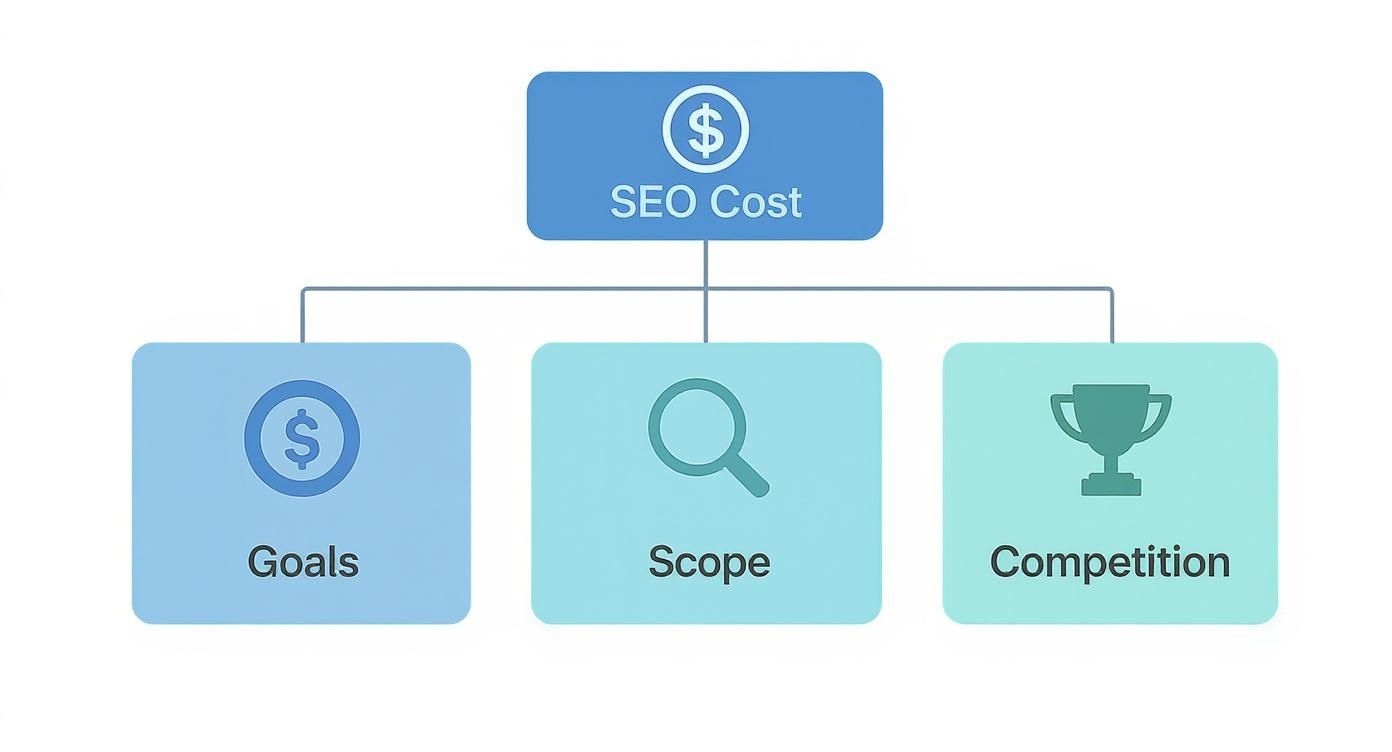
As you can see, if you’ve got ambitious goals or you’re jumping into a crowded market, you’ll naturally need a bigger investment to make a real dent.
Technical SEO: The Engine of Your Website
Technical SEO is all the behind-the-scenes work that makes sure search engines can find, crawl, and actually understand your website. If your site is a technical mess, it doesn't matter how amazing your content is—it won't rank.
It’s like owning a beautiful storefront but keeping the door permanently locked. No one's getting in.
The cost-driving activities here often include:
- Site Speed Optimization: Making your pages load lightning-fast to improve user experience. Google absolutely rewards this.
- Mobile-Friendliness: Ensuring your site works perfectly on phones and tablets, where over 70% of Google searches now happen.
- XML Sitemap and Robots.txt Management: This is like giving Google's crawlers a clear map of your site and telling them which areas are off-limits.
- Fixing Crawl Errors: Hunting down and fixing things like broken links (404 errors) that kill the user experience and signal a poorly maintained site.
These aren't optional tweaks; they're foundational. Fixing them requires specialized know-how, which directly factors into your overall cost.
Content Strategy: The Fuel for Your Rankings
Content is how you answer your audience’s questions and prove to Google that you know your stuff. High-quality, relevant content is the fuel that powers your entire SEO engine. Without it, your campaign is going nowhere fast.
A well-crafted content strategy does more than just attract visitors; it builds trust. By the time a customer reaches out, they're often 60-90% of the way through their decision-making process, largely thanks to the helpful content they found online.
This pillar is where a significant chunk of the investment in time and skill goes. Key activities include:
- In-Depth Keyword Research: Figuring out the exact words and phrases your ideal customers are typing into Google.
- Competitor Content Analysis: Sizing up what’s already ranking to find gaps and opportunities to create something ten times better.
- Creating High-Value Blog Posts: Writing genuinely helpful articles that solve problems for your audience.
- Developing Service and Product Pages: Crafting copy that’s optimized for search engines but written for humans to convert.
Creating expert-level content is a primary driver of the monthly search engine optimization cost for Google.
Link Building and Authority: The Votes of Confidence
In Google's world, backlinks—links from other websites pointing to yours—are like votes of confidence. When a reputable site links to your content, it’s a powerful signal that your website is a trustworthy authority.
Building a strong backlink profile is absolutely essential for competing at the top of the search results.
This process is often one of the most resource-intensive parts of any SEO campaign. It’s not about just slapping links anywhere; it’s about strategic outreach and building real relationships. This includes guest posting on industry blogs, digital PR, and creating "link-worthy" assets like original research or cool interactive tools that people want to share.
Local SEO: Winning Your Geographic Market
For any business with a physical location or a defined service area, local SEO is a non-negotiable. This pillar is all about making you pop up for customers searching for products or services "near me."
The goal is to get you featured in Google Maps and the coveted "Local Pack"—that box of three businesses that gets prime real estate on the search results page.
Key cost drivers for local SEO are:
- Google Business Profile (GBP) Optimization: Creating and constantly managing your GBP listing with accurate info, photos, and updates.
- Local Citation Building: Making sure your business name, address, and phone number (NAP) are consistent across dozens of online directories.
- Managing Online Reviews: Actively encouraging and responding to customer reviews to build social proof and trust.
Each of these pillars requires its own budget for time, tools, and expertise. Together, they form the complete picture of your SEO investment.
Exploring Common SEO Pricing Models
So, you’re ready to invest in SEO. But how do you actually pay for it? Just like you can lease a car, finance it, or buy it outright, there are a few different ways to hire an SEO pro. Getting a handle on how they bill for their services is the first step to finding a partner that fits your budget and, more importantly, your goals.
Each payment structure has its own vibe—its own pros and cons. Knowing the difference will help you cut through the jargon in proposals and choose the right path for your business. Let's break down the four most common pricing models you’ll run into out in the wild.
Monthly Retainers For Ongoing Growth
This is the big one. The monthly retainer is the most common model you’ll see, and for good reason. Think of it as putting an SEO expert or an entire agency on your team. You pay a fixed fee every month, and they deliver a consistent, ongoing strategy designed for long-term, sustainable growth.
This model is perfect for businesses that are serious about winning on Google. SEO isn't a one-and-done task; it’s a marathon of creating content, tweaking technical details, and building authority. A retainer ensures you never lose momentum.
What’s great about a monthly retainer?
- Predictable Budgeting: You know exactly what your search engine optimization cost for Google will be each month. No surprises, just clean financial planning.
- A True Partnership: Over time, your SEO provider gets to know your business, your industry, and your customers inside and out.
- The Whole Enchilada: Retainers usually cover everything—technical audits, content creation, link building—making sure no stone is left unturned.
Bottom line: If you see SEO as a core part of your marketing machine, a retainer is almost always the way to go.
Project-Based Pricing For Specific Goals
Sometimes, you don’t need the whole ongoing shebang. You just need one specific job done, and done right. That’s where project-based pricing shines. You pay a single flat fee for a clearly defined task with a clear start and end date.
This is the perfect fit for one-off needs like:
- A deep-dive technical SEO audit to figure out what’s holding your site back.
- A keyword research and content strategy package to kickstart your efforts.
- Getting your local SEO dialed in for a brand-new storefront.
- A nerve-wracking website migration to a new domain.
The biggest win here is clarity. You know exactly what you’re getting and exactly what it’ll cost before a single minute of work begins. The only catch is that once the project’s over, any new work needs a new contract.
Hourly Consulting For Expert Advice
Imagine you need a lawyer's brain for an hour, but you don't need to keep them on retainer. Hourly SEO consulting works the same way. You’re buying direct access to a specialist's expertise at a set hourly rate.
This is a fantastic option if you already have an in-house marketing team but need some high-level strategic guidance, training, or help untangling a really specific, tricky problem. You pay only for the time you use. Simple.
Expert Insight: Hourly consulting is a sniper rifle, not a shotgun. It's best for targeted questions and specific tasks. For executing a broad, long-term strategy, you're better off with a retainer.
Pricing for these models can be all over the map. Hourly rates can swing from $50 to over $300, while a solid monthly retainer usually lands somewhere between $1,500 and $5,000. And generally, you can expect agencies to charge about 30% more than freelancers for similar work, which reflects their larger teams and resources. You can dig into more current SEO pricing benchmarks on seoprofy.com to get a better feel for the landscape.
Performance-Based SEO: A Word of Caution
And then there's performance-based SEO. On the surface, it sounds like a dream deal. The pitch is simple: you only pay when you get results, like hitting a certain ranking or traffic milestone.
While it sounds totally risk-free, this model is often a minefield. To get those "guaranteed" results quickly, some providers cut corners and use sketchy "black-hat" tactics that Google hates. These shady methods can get you slapped with a severe penalty—or even get your website booted from search results entirely.
Because of the massive risk and the focus on short-term gains over long-term site health, most reputable SEOs steer clear of this model. If someone offers you a "pay for results" deal, proceed with extreme caution and vet them thoroughly.
Comparing SEO Pricing Models
Feeling a little overwhelmed by the options? Don't be. Most businesses will find their perfect fit in one of the first three models. To make it even clearer, here’s a quick-glance table breaking it all down.
| Monthly Retainer | Businesses committed to long-term, sustainable SEO growth and wanting a strategic partner. | $1,500 – $5,000+ /mo | Predictable budget, deep partnership, comprehensive strategy, consistent momentum. | Higher long-term cost, requires commitment to see full ROI. |
|---|---|---|---|---|
| Project-Based | Businesses with specific, one-time needs like a website audit, migration, or initial setup. | $1,000 – $25,000+ /project | Clear scope and cost, defined timeline, great for isolated tasks. | No ongoing support, requires a new contract for additional work. |
| Hourly Consulting | Companies with in-house teams that need expert guidance, training, or troubleshooting. | $50 – $300+ /hr | Flexible, pay only for what you need, direct access to expertise. | Can be costly for large tasks, not ideal for strategy execution. |
| Performance-Based | Generally not recommended | Varies widely | Pay only for results (in theory). | High risk of harmful "black-hat" tactics, can lead to Google penalties. |
Ultimately, the best model depends on your business's maturity, in-house resources, and how central SEO is to your overall growth strategy. Choosing the right one sets the foundation for a successful and profitable partnership.
How to Budget for SEO Based on Your Business Size
Figuring out your search engine optimization cost for Google isn't about pulling a number out of a hat. The right budget is completely tied to your company’s size, your goals, and just how crowded your industry is. What a local bakery needs to win over the neighborhood is worlds apart from the strategy a national e-commerce brand needs to dominate its market.
So, to give you a realistic starting point, let’s break down what a typical SEO investment looks like based on business size. This will help you see what kind of services you can expect at different price points and match your spending to your ambitions.

Small Businesses And Local Companies
For small or local businesses—think dentists, plumbers, or that cool new boutique shop downtown—the game is all about owning your specific geographic area. You’re not trying to compete with national chains; you’re focused on snagging all those "near me" searches and building an unbeatable local reputation.
- Typical Monthly Budget: $1,000 – $2,500
At this level, your SEO strategy is foundational and laser-focused. The main goal is to make sure you’re the obvious choice for anyone in your service area looking for what you offer.
A sharp local campaign ensures that when someone searches for your services nearby, you don't just show up—you stand out. This is make-or-break, considering that 90% of wedding planning, for instance, now happens online, with couples hitting Google to find their local vendors.
Here’s what you should expect for this kind of budget:
- Google Business Profile (GBP) Optimization: Keeping your listing fresh, responding to reviews, and making sure every detail is accurate.
- Local On-Page SEO: Tweaking your website’s service pages and homepage with keywords that scream "we're local."
- Basic Content Creation: Pushing out one or two blog posts a month that answer local customer questions or highlight community topics.
- Citation Management: Making sure your business name, address, and phone number (NAP) are consistent and correct across all the important online directories.
Mid-Sized Businesses And Regional Players
Mid-sized companies are usually in a tougher fight, often competing across several cities or an entire region. They need more than just a pin on the map; they need a strategy that builds real brand authority and keeps a steady flow of qualified leads coming in the door.
- Typical Monthly Budget: $2,500 – $7,500
This budget opens the door for a much more comprehensive and aggressive game plan. The objective shifts from just ranking locally to establishing yourself as an authority on key topics in your industry, effectively boxing out regional competitors for those high-value keywords.
Services at this tier expand quite a bit and usually include:
- Advanced Content Strategy: Creating deep-dive guides, pillar pages, and a steady stream of high-quality blog content that positions you as the expert.
- Technical SEO Audits: Routinely digging into your site to find and fix health issues like slow page speeds or crawl errors that hold you back.
- Initial Link Building: Actively reaching out to earn valuable backlinks from other relevant websites, which is a huge signal to Google that you're legit.
- Conversion Rate Optimization (CRO): Analyzing how people use your site to improve its layout and calls-to-action, turning more of those visitors into actual customers.
To get the most bang for your buck, it’s always smart to keep an eye on your spending. Exploring different strategies for cutting business costs effectively, including marketing expenses, can help you free up more budget to invest where it counts.
Large Enterprises And National Brands
For the big players—large enterprises and national brands—SEO is a high-stakes war for the top spots on a massive scale. The competition is relentless, and the only goal is to capture and hold market leadership for the most competitive, high-volume keywords out there.
- Typical Monthly Budget: $7,500 – $25,000+
At the enterprise level, the search engine optimization cost for Google reflects a full-funnel, all-out assault. It’s a deeply integrated effort that blends technical wizardry, huge-scale content production, and sophisticated authority-building campaigns to completely own the search landscape.
The scope of work is massive and almost always includes:
- Large-Scale Content Marketing: Running a powerful editorial calendar that includes diverse formats like white papers, original research, case studies, and video series.
- Digital PR and Advanced Link Building: Launching major campaigns designed to earn media mentions and high-authority backlinks from top-tier publications.
- Advanced Technical SEO: Juggling complex site structures, international SEO for different countries, and advanced schema markup to gain every possible edge.
- Comprehensive Analytics and Reporting: Deep data analysis to meticulously track ROI, attribute revenue back to organic search, and make sharp, data-backed strategic decisions.
Choosing Between an SEO Agency and a Freelancer
Deciding who’s going to steer your SEO ship is a huge moment, one that directly impacts your results and your budget. This isn't just about picking the cheapest option; it's about finding the right partner for your business's DNA.
You're basically choosing between a full pit crew (the agency) or a master mechanic who specializes in one thing (the freelancer). Both can get you to the finish line, but the ride is completely different. Let's break down how to pick the right one for you.
The Case for an SEO Agency
Hiring an SEO agency is like bringing in a whole team of specialists at once. You don’t just get one person—you get a technical SEO guru, a content strategist, a link-building pro, and an analytics wizard, all working together. It's a one-stop shop for growth.
This setup is perfect for businesses that need a big, comprehensive strategy and would rather be hands-off. Agencies have battle-tested processes, expensive software, and the bandwidth to juggle complex, large-scale campaigns that would make a single person’s head spin.
But all that firepower comes with a bigger price tag. The overhead for a full team means agencies almost always have a higher search engine optimization cost for Google than a freelancer. Communication can also feel a bit more corporate, often routed through an account manager instead of going straight to the person doing the work. To make sure you find a team that clicks with your own, it’s worth checking out a solid guide on how to choose a digital marketing agency.
The Case for an SEO Freelancer
Going with an SEO freelancer is a much more personal, specialized experience. You're not hiring a company; you're hiring an expert. That direct line of communication is a massive plus—you talk to the person actually doing the work, which means faster decisions and a more nimble strategy.
Freelancers often bring incredibly deep, niche expertise to the table. You might find someone who only does e-commerce SEO for Shopify stores or technical SEO for SaaS companies. If you have a super specific need, that kind of focused skill is gold.
Freelancers are all about flexibility and direct partnership. If you value a close working relationship and have a clear, defined scope of work, a specialized freelancer can deliver incredible value and a killer return on investment.
The biggest wins you get with a freelancer are usually:
- Lower Costs: With almost no overhead, freelancers are almost always more affordable than agencies.
- Direct Communication: You have one point of contact, which makes collaboration a breeze.
- Greater Flexibility: Freelancers can pivot on a dime when strategies need to change.
When you're looking at your options, don't forget that hiring remote SEO experts can also give you a major competitive edge in both cost and specialized talent. The main trade-off? One person has limited bandwidth and can't be an expert in everything the way a full agency team can.
How to Measure and Justify Your SEO Investment
Throwing money at SEO without a way to measure success is like driving a race car with the windows blacked out. Sure, you’re moving fast, but you have no clue if you’re even on the track, let alone heading for the finish line.
To really get a grip on the value of your search engine optimization cost for Google, you have to look past the flashy, feel-good numbers. I’m talking about things like rankings and traffic. Instead, you need to zero in on what actually grows your business.

This final piece of the puzzle is all about connecting your SEO spend to real-world outcomes. It’s about building a clear, data-backed case showing that your investment isn't just another line item on the expense sheet—it's a powerful engine for revenue.
Moving Beyond Surface-Level Metrics
Look, it feels fantastic to see your website hit that #1 spot on Google. But rankings alone don't pay the bills. The same goes for traffic. A huge spike in visitors is exciting, but if those visitors aren't your ideal customers, it’s just noise.
To justify your investment, you absolutely must track the metrics that directly impact your bottom line. These are the numbers that tell the real story of your SEO success.
Key business-focused metrics include:
- Qualified Leads: How many potential customers are coming from organic search and filling out your contact forms, calling you, or signing up for a demo?
- Conversion Rate: What percentage of your organic visitors are taking the action you want them to take? This tells you if you're attracting the right kind of traffic.
- Organic Revenue Growth: For e-commerce businesses, this is the gold standard. How much actual sales revenue is coming directly from your SEO efforts?
Focusing on these outcomes transforms the entire conversation. It shifts from "How much are we spending?" to "How much are we earning?"
Calculating Your SEO Return on Investment
Calculating your Return on Investment (ROI) is hands down the most powerful way to justify what you're spending on SEO. It puts a clear dollar value on your efforts, making it dead simple for stakeholders to see the direct financial benefit.
While the exact formula can get tweaked, the core concept is straightforward.
SEO ROI = (Gain from Investment - Cost of Investment) / Cost of Investment
To nail this calculation, you need two key pieces of information: the total cost of your SEO campaign and the total revenue it generated. This means you need solid tracking systems in place, like Google Analytics with goal tracking, to attribute leads and sales back to organic search.
Sometimes, seeing what's possible for other businesses provides great context. You can explore a variety of real-world SEO case studies to get a sense of potential outcomes.
Setting Realistic Timelines and Expectations
One of the biggest hurdles in justifying SEO cost is managing expectations. Let’s be blunt: SEO is a long game, not an overnight fix. You're building a valuable business asset, and like any good construction project, it takes time to pour the foundation before you see the structure take shape.
Generally, it can take anywhere from 6 to 12 months to see significant, measurable results from a new SEO campaign. That timeline depends heavily on how competitive your industry is, your website's starting point, and how aggressively you pursue your strategy.
Communicating this reality upfront is critical for keeping everyone on board. Instead of just waiting for the big payoff, focus on reporting the small wins along the way—things like steady improvements in keyword rankings, consistent traffic growth, and an increasing number of organic leads. This shows progress and builds confidence over time.
Common Questions About What SEO Actually Costs
Alright, so even with a budget in mind, you’ve probably got some lingering questions about what to expect when you're paying for Google SEO. Let's tackle the big ones we hear all the time.
How Long Until I Actually See Results?
This is the million-dollar question, isn't it? SEO is a marathon, not a sprint. While you might see some small wins in the first couple of months, you should plan on it taking 6 to 12 months to see the kind of results that really move the needle—like a real jump in qualified leads and revenue from organic search.
The honest timeline depends on how competitive your industry is, where you're starting from, and the kind of budget you're working with.
Think of it like planting a tree. You don't get shade and fruit the day after you stick it in the ground. It needs consistent attention and time before it’s strong enough to produce anything valuable.
Can't I Just Do SEO Myself to Save Cash?
It’s tempting, for sure, and you can absolutely learn the basics. The problem is, professional SEO goes deep—it requires serious expertise in technical audits, content strategy, and link building, not to mention access to pricey software that agencies pay thousands for.
While you save money upfront with a DIY approach, it often leads to painfully slow progress or, worse, costly mistakes that a pro would have dodged. It really comes down to a trade-off: what's more valuable, your time or your money?
Are There Hidden Costs I Should Brace Myself For?
Yep, sometimes. Your main SEO fee might not cover everything. It's smart to ask about other potential expenses right out of the gate. These often include:
- Premium Tools: Subscriptions for specialized analytics or keyword research software.
- Content Creation: Costs for professional writers, photographers, or video producers if that's not bundled in.
- Website Development: Fees for a developer to jump in and implement the technical fixes your SEO team recommends.
Getting clarity on these potential add-ons from the start keeps the entire investment transparent and predictable. No nasty surprises.
Ready to turn your SEO budget into actual, measurable growth? The team at Rebus builds strategic campaigns that deliver results you can see. Partner with us to drive sustainable revenue and finally get noticed in a crowded market.