
Search Engine Optimization Costs Google Ranking And Your Budget
So, what's the real cost of SEO? Let's cut to the chase: most small businesses should expect to invest somewhere between $750 and $2,000 per month to make a real dent in Google's rankings. That number, of course, goes up depending on how big your business is, how tough your competition is, and exactly what kind of work you need done.
Unpacking The True Cost To Rank On Google
Figuring out how much to budget for SEO is a lot like planning a home renovation. There’s no single price tag. The final cost depends entirely on the current state of your "house" (your website) and what you’re trying to build. A simple cosmetic update is worlds cheaper than a full structural overhaul, and the same logic applies here.
Your investment is shaped by your unique situation. A local bakery competing with a few other shops in town has a wildly different budget than a national e-commerce brand that's battling it out with major retailers. The health of your website right now, the level of competition in your industry, and your own growth goals are what really drive the monthly spend.
A Starting Point For Your SEO Budget
While every campaign is different, we can definitely set some realistic starting points based on business size. Industry data shows a clear line connecting company size and how much they typically set aside for SEO. Smaller businesses usually start with the essentials, while bigger companies need more complex, multi-channel strategies just to hold their ground.
When you're looking at what to invest, it's crucial to understand how costs vary. Small businesses typically land in the $750 to $2,000 per month range for foundational SEO services. Medium-sized companies can expect to invest at least $2,000 monthly for more in-depth strategies, and large businesses often put $5,000 or more per month toward advanced SEO and GSO (Generative Search Optimization). You can get a deeper dive into these costs over at TheHOTH.com.
This chart gives you a quick visual of how monthly SEO spending stacks up across different business sizes.
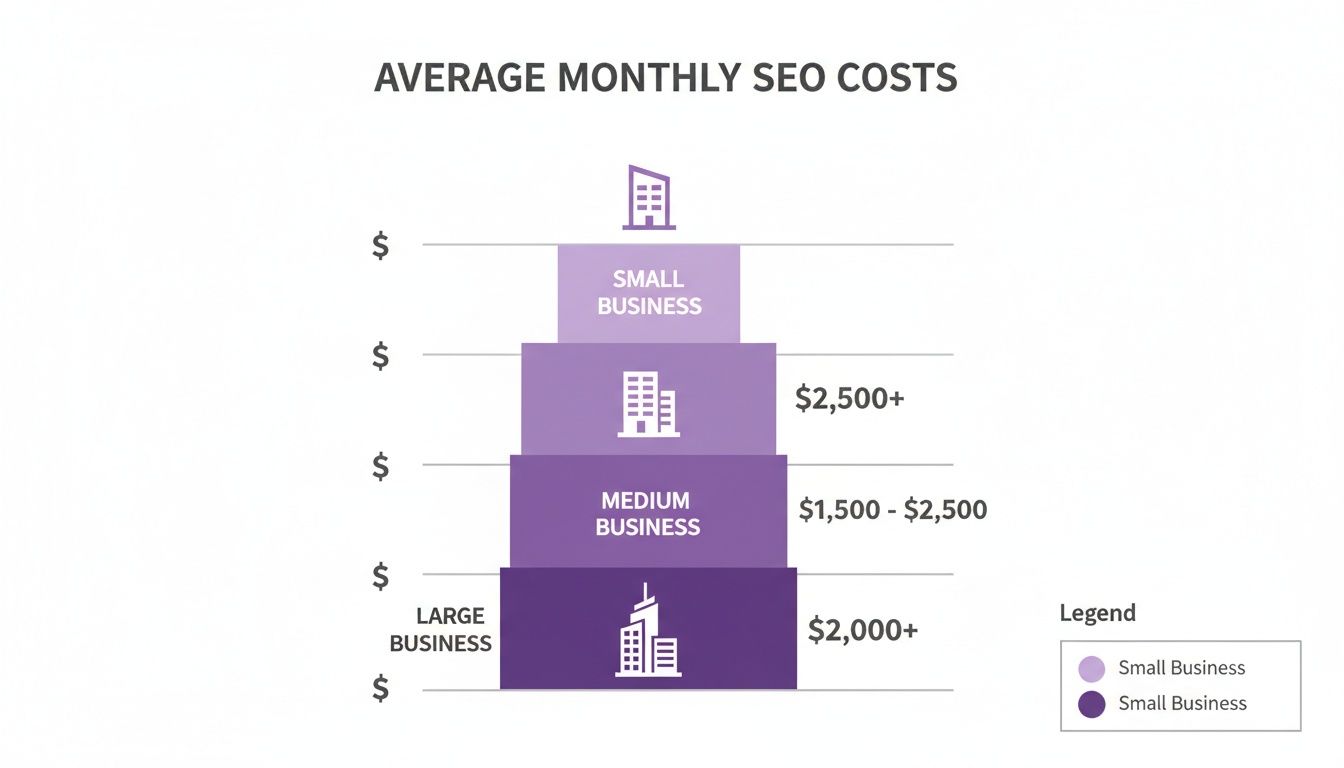
As you can see, the investment ramps up quickly as businesses get bigger. That's a direct reflection of the increased complexity and resources needed to win in more crowded markets.
To make this even clearer, here's a quick reference table.
Estimated Monthly SEO Investment By Business Size
| Small Business | $750 - $2,000 | Local businesses, startups, or those in low-competition niches needing foundational growth. |
|---|---|---|
| Medium Business | $2,000 - $5,000 | Companies in competitive markets or expanding regionally, requiring aggressive content and link building. |
| Large Business | $5,000+ | National/e-commerce brands needing comprehensive, multi-faceted strategies to dominate search results. |
Think of these ranges as a starting point. The right budget for you will ultimately depend on your specific goals and timeline.
Key Takeaway: Stop thinking of SEO as a fixed cost. It's a flexible investment that should adapt to your ambition. Your budget is the fuel for your digital growth engine—more fuel means you can go faster and cover more ground.
In the next sections, we'll break down the specific pricing models, the factors that drive costs up or down, and what you should really expect to get back for your investment. This will give you the clarity you need to build a budget that actually delivers results.
Decoding The Different SEO Pricing Models
When you start digging into search engine optimization costs google will throw a dizzying array of numbers at you. But what's really behind those price tags? The first step to finding a partner that actually fits your goals—and your wallet—is understanding how agencies bill for their work. It’s not about finding the absolute cheapest option; it’s about matching the payment structure to the results you need.
Most agencies lean on one of three common pricing models. Each has its own rhythm and is built for different business needs. Think of it like hiring a personal trainer for your website: you need to pick the approach that matches your site's current fitness level and where you want it to be in a year.

Monthly Retainer: The Subscription Model
The monthly retainer is far and away the most common setup. This is basically a subscription service for your website's health and continuous growth. You pay a set fee every month, and in exchange, the agency delivers ongoing SEO services. This model is perfect for any business that’s serious about long-term, sustainable growth.
A retainer allows the agency to really sink its teeth into your business, becoming a true partner who understands your market and adapts the strategy as things change. Here’s what’s usually baked in:
- Ongoing keyword tracking and deep dives into performance data.
- Regular content creation, like blog posts that actually attract customers.
- Consistent link-building to grow your site's authority and trust signals.
- Monthly reporting that cuts through the fluff to show what’s working.
The stability of a retainer means your SEO partner can be proactive, building a long-term game plan instead of just reacting to fires. If you see SEO as a core marketing function—not a one-time chore—this is your model.
Project-Based Pricing: The One-Time Fix
Next up is project-based pricing. This is like hiring a contractor for a specific job, like renovating your kitchen. You get a clearly defined scope of work, a fixed timeline, and a single price for the whole shebang. It’s ideal for businesses with a specific, isolated SEO problem to solve.
For example, you might bring in an agency for a one-off technical SEO audit to clean up all the junk under the hood. Or maybe you just need a foundational local SEO setup to get your Google Business Profile humming and build some initial citations. These projects have a clear start and finish line.
Key Insight: Project-based pricing gives you predictability. You know exactly what you’re getting and how much it will cost upfront, which is a lifesaver for businesses with tight budgets or those just dipping a toe into the SEO waters.
The big catch, however, is that SEO is rarely a "set it and forget it" activity. Once the project wraps up, the work stops. Without continued effort, any ground you gained can be quickly lost to competitors who are playing the long game.
Hourly Consulting: The Specialist On Call
Finally, you’ve got the hourly rate model. This is like calling in a specialist—a plumber or an electrician—for their focused expertise. You pay for the precise number of hours they spend on a specific task. In the SEO world, hourly rates can swing wildly from $100 to $300+, all depending on the consultant's experience and what they specialize in.
This approach works best for:
- Specific, targeted tasks: Like training your in-house team on a new SEO tool.
- Strategic gut-checks: You want an expert to review your current strategy and point out the holes.
- Emergency troubleshooting: Your rankings just tanked, and you need a pro to figure out why—fast.
While it’s flexible, this model can get expensive and unpredictable if the scope isn’t nailed down. It's generally a bad fit for a comprehensive, ongoing SEO campaign, as the costs can easily spiral out of control without the structure of a retainer.
Curious about what's included in these packages? For a closer look at the range of services agencies offer, check out our guide on what SEO companies do. Picking the right model really boils down to your immediate needs, your budget, and your vision for the future.
The Key Factors That Shape Your SEO Costs
Ever gotten two SEO quotes and wondered why one was double the other? It’s a classic head-scratcher. But here’s the thing: trying to understand search engine optimization costs Google offers isn't about finding a single price tag. SEO is a custom service, not an off-the-shelf product.
Think of it like hiring a personal trainer. One person might just need a basic workout plan to stay in shape. Another might be training for a marathon and need intensive, daily coaching, a nutrition plan, and specialized gear. The goal dictates the effort, and the effort dictates the cost. SEO works the exact same way.
A one-size-fits-all price just doesn't exist because every business has a unique starting line and a different finish line in mind. Four core drivers will ultimately determine the scale of your investment.
The Competitive Landscape
This is the big one. The single biggest factor influencing your SEO cost is how crowded your industry is online. Getting a local bakery in a small town to show up on Google is a completely different ballgame than ranking a national insurance company. The more sharks in the water, the more resources it takes to get noticed.
Imagine you're trying to get a table at a restaurant. A quiet local spot on a Tuesday night? Easy. But trying to get a prime-time reservation at the hottest restaurant in a major city on a Saturday? That requires more planning, more effort, and probably a bigger budget.
- Low Competition: A niche local business (like a "mobile dog groomer in Peoria") is up against fewer direct competitors online. This makes it faster and less expensive to gain visibility.
- High Competition: A global software company targeting a term like "CRM software" is fighting against industry giants with massive marketing budgets. That requires a significant and sustained investment to even make a dent.
Your Website's Current Foundation
Your website’s existing health is the second critical factor. Some sites are built on a solid technical foundation, ready to hit the ground running. Others are like a house with a leaky roof and cracked foundation—you have to fix the structural issues before you can even think about decorating.
A thorough technical SEO audit is the first thing any reputable agency will do. This process uncovers the gremlins holding you back, like slow page speed, mobile usability problems, or indexing errors that make it hard for Google to even see your content. A site needing extensive repairs will naturally require a larger upfront investment to build a stable platform for growth.
A strong technical foundation is non-negotiable. Without it, any investment in content or link building is like pouring water into a leaky bucket—wasteful and ineffective.
The Scale of Content Required
Content is the fuel for your SEO engine. To rank on Google, you have to create genuinely helpful, relevant, and authoritative content that answers the questions your potential customers are asking. The amount of content needed depends entirely on your goals and how far behind the competition you are.
If your top competitors each have hundreds of in-depth blog posts, guides, and resource pages, publishing a handful of articles simply won't be enough to move the needle. A real content strategy involves research, writing, editing, and optimization—all of which contribute to the overall cost.
The Intensity of Link Building
Backlinks—links from other reputable websites to yours—are a massive signal to Google that your site is trustworthy and authoritative. Earning these high-quality backlinks is often one of the most resource-intensive parts of any SEO campaign.
Think of each backlink as a vote of confidence. A mention from a small, unknown blog is a nice nod. A link from a major industry publication or news site? That’s a powerful endorsement that significantly boosts your credibility. To manage your budget effectively, it's crucial to weigh the investment in different tools and platforms; understanding the best AI SEO tools available and comparing their features is a key factor in shaping your overall SEO costs.
The more competitive your industry, the more aggressive your link-building efforts will need to be. This process, often called digital PR or outreach, requires serious time and expertise. You can dive deeper by reading about how backlinks work and why they are crucial for success.
Ultimately, these four factors work together to create a unique "fingerprint" for your SEO needs, directly shaping the investment required to get you where you want to go.
SEO Costs For Local And E-Commerce Businesses
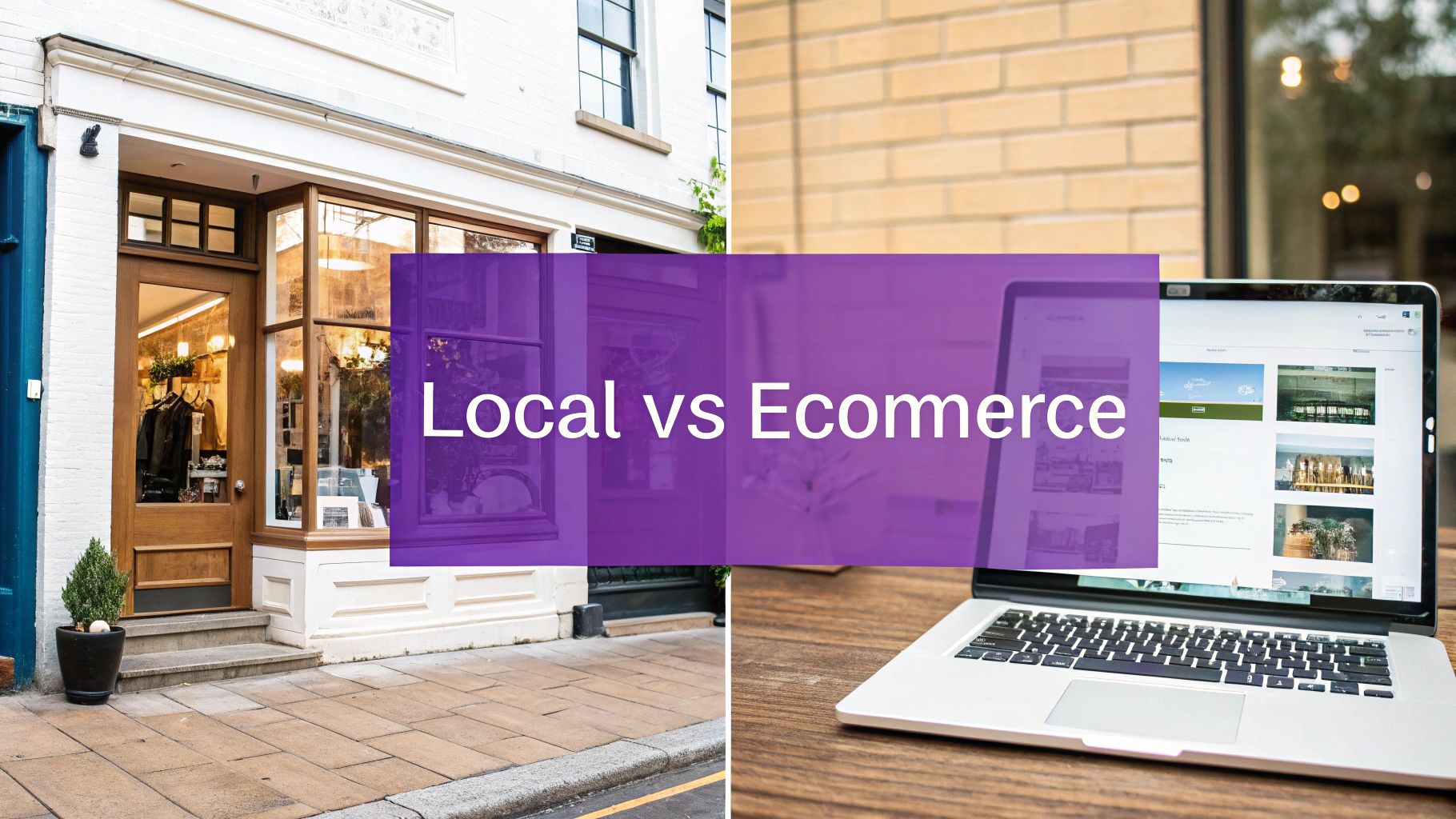
Let’s get one thing straight: SEO isn't a one-size-fits-all product you pull off a shelf. The game plan—and the price tag—for a neighborhood dental clinic is a world away from what a national online shoe retailer needs. The search engine optimization costs Google shows you can be wildly different because the work itself is fundamentally different. Your business model is the single biggest factor driving your final investment.
So, let's break down what this actually means for two of the most common business types out there: local service providers and e-commerce stores. Each one has a unique set of needs that directly shapes what an SEO budget looks like.

Cost Breakdown For Local Businesses
If you're a local business—think plumbers, lawyers, or restaurants—your entire world is about owning the "map pack" and local search results. Success means proving your relevance and proximity to Google. You're not trying to rank for broad, global keywords; you're fighting for hyperlocal dominance.
This laser-focused approach requires a specific set of services that directly influence your monthly bill.
- Google Business Profile (GBP) Optimization: This is your digital storefront, period. A huge chunk of a local SEO budget goes into constantly feeding your GBP with new photos, updated services, fresh posts, and quick responses to Q&As. This signals to Google that you're active and open for business.
- Local Citation Management: Think of citations as digital breadcrumbs. They’re mentions of your business's name, address, and phone number (NAP) across the web on sites like Yelp or niche industry directories. Making sure this info is identical everywhere is a tedious but critical job for building local trust.
- Review Generation and Management: Positive reviews are pure gold for local rankings. A smart local SEO strategy includes systems to nudge happy customers for reviews and processes for responding to all feedback. This takes consistent effort and resources.
The heart of local SEO is building trust and visibility within a tight geographic bubble. Your budget is funding the detailed, consistent work needed to convince Google that you're the best, most reputable choice for customers right around the corner.
This specialized work leads to a pretty distinct pricing structure. Local SEO services typically fall between $500 to over $2,000 per month. Most expert providers really start their pricing around $1,600 monthly for a single location.
But if you have multiple storefronts, you get economies of scale. The cost can drop to as low as $175 per month per location for enterprises with 51-100 locations, showing a clear advantage to a multi-location strategy. You can dig deeper into these numbers in a detailed local SEO pricing guide on seoprofy.com.
Cost Breakdown For E-Commerce Businesses
E-commerce SEO is a completely different beast. Your "storefront" isn't a single address; it's a massive digital warehouse with potentially thousands of products. The challenge isn't just about one location—it’s about making every single product and category pop for a national or even global audience.
That kind of scale introduces several expensive factors that local businesses just don't have to worry about.
Product & Category Page Optimization: Every product page is a potential front door for a customer. Optimizing thousands of these pages with unique descriptions, sharp images, and the right keywords is a massive undertaking that scales directly with the size of your inventory.
Advanced Technical SEO: E-commerce sites are notoriously complex. A bigger slice of the budget has to go toward technical health—things like improving site speed, implementing structured data (schema) so Google understands product details like price and availability, and taming faceted navigation to avoid crippling duplicate content issues.
Content for the Entire Funnel: Just having product pages isn't enough. E-commerce success demands buying guides, comparison articles, and blog posts that grab shoppers at every stage of their journey, from "I'm just browsing" to "take my money."
The sheer volume of pages and the technical heavy lifting mean e-commerce SEO investments are almost always higher. A small online shop might start in a similar price range as a local business, but a large retailer with tens of thousands of products could easily be investing $10,000 to $25,000+ per month to stay competitive. The bigger the catalog, the more intensive the work, and the higher the cost.
Measuring The Real Return On Your SEO Investment
Spending money on SEO is the easy part. The real challenge—and what separates a cost from a genuine investment—is proving its value to your bottom line.
Sure, seeing your site climb the ranks is exciting, but rankings alone don’t pay the bills. Real success is measured in tangible business growth, not just vanity metrics. This is where a lot of businesses get sidetracked, focusing on keyword positions while totally overlooking the stuff that actually matters: organic traffic growth, lead quality, conversion rates, and ultimately, revenue.
To really get a handle on what your SEO is doing for your wallet, you need to know how to calculate marketing ROI properly. It’s the only way to speak a language every stakeholder understands: money.
SEO As An Asset, Not An Expense
Think of your search engine optimization costs Google ranking as an investment in digital property. When you pay for Google Ads, you’re basically just renting visibility. The second you stop paying, your presence vanishes into thin air. SEO, on the other hand, is like buying and developing that property.
Every blog post you publish and every backlink you earn builds equity. This digital asset grows in value over time, generating a steady stream of "foot traffic" (organic visitors) that keeps paying dividends long after the initial work is done. It’s this long-term value that makes SEO one of the most powerful marketing channels out there.
SEO is the process of building a valuable, long-term business asset. Unlike paid ads, which are a temporary rental, a strong organic presence generates leads and sales for years, delivering a compounding return on your initial investment.
This means shifting your mindset from short-term spending to long-term wealth creation.
Realistic ROI Benchmarks By Industry
The return you get from SEO isn't the same for everyone. It swings wildly based on competition, sales cycles, and how much a customer is worth to you. Knowing these benchmarks helps you set realistic financial goals and hold your SEO partner accountable for real results. If you want to dive deeper, check out our guide on measuring SEO performance.
For instance, industries with high-ticket clients often see absolutely staggering returns. Financial services can hit a massive 1,031% ROI within nine months. Meanwhile, construction and HVAC services can pull in impressive returns of 681% and 678% in just five to six months.
Even in a dog-eat-dog market like e-commerce, businesses can still see a 317% ROI over nine months, making SEO a no-brainer for online retailers.
Here’s a quick look at what different industries can typically expect, showing both the potential return and how long it usually takes to get there.
Typical SEO ROI Benchmarks By Industry
| Financial Services | 1,031% | 9 |
|---|---|---|
| Construction | 681% | 5 |
| HVAC Services | 678% | 6 |
| E-Commerce | 317% | 9 |
| Healthcare | 250% | 8 |
These numbers make it pretty clear: while SEO demands patience, the financial upside is enormous. By tracking the right metrics and understanding your industry's potential, you can confidently measure the powerful return on your investment.
Common Questions About SEO Costs And Value
Alright, we’ve talked models, drivers, and dollars. But you probably still have a few practical questions buzzing in your head. The world of search engine optimization costs can feel murky, so let’s clear the air and tackle the big ones head-on.
Think of this as the final gut-check—direct answers to bust some myths and help you make a smart, confident call on where your SEO budget is going.
Why Is SEO So Expensive Compared to Other Marketing?
This one comes up a lot. SEO often feels pricey upfront because you’re not just renting attention for a month—you’re building a long-term digital asset. Think of it like buying a house versus renting an apartment. With paid ads, the moment you stop paying, your visibility vanishes. Poof. Gone.
With SEO, you’re building lasting authority and a traffic-generating machine that can pay dividends for years. The cost reflects the deep, specialized expertise needed to actually win. A killer SEO campaign isn't a one-person show; it requires a whole crew of specialists—technical wizards, content strategists, link-building pros—all working together to outsmart your competitors on Google.
And here’s the kicker: when you zoom out and look at the cost-per-acquisition over a year or two, SEO almost always turns out to be one of the most cost-effective channels out there, delivering a compounding return that ads just can't touch.
How Long Until I Actually See a Return on My SEO Investment?
Let’s be real: SEO is a marathon, not a sprint. Anyone who tells you otherwise is selling something you don’t want. You might see some early green shoots within 3-4 months, like ranking for a few less-competitive keywords or a small uptick in organic traffic.
But for the kind of results that really move the needle—meaningful traffic, qualified leads, and actual sales—you should typically plan for a 6 to 12-month runway. This timeline can stretch or shrink based on your website's history, how brutal your industry’s competition is, and the firepower of your SEO strategy.
It's like planting an orchard. It takes consistent work and a bit of patience before you're harvesting fruit. A good agency will set this expectation from day one and give you transparent reports showing clear progress markers, so you’re never left wondering if anything is happening.
Can I Just Do SEO Myself to Save Money?
Look, learning the basics of SEO is totally doable. But executing a winning strategy? That’s a full-time job, and then some. The game is constantly changing. Google rolls out algorithm updates that can flip the board overnight, and keeping up requires non-stop learning.
For a business owner, every hour you spend trying to DIY your SEO is an hour you’re not spending on running your actual business. That opportunity cost is huge and often gets ignored.
A professional agency brings years of battle-tested experience, a whole toolbox of advanced software that would cost a fortune for a single business, and a dedicated team. That combination of resources lets them get results way more efficiently. For most businesses, the growth you miss out on by trying to go it alone far outweighs the cost of hiring experts to do it right the first time.
Key Insight: If an agency ever promises you "guaranteed #1 rankings," run. Don't walk, run. No one can legitimately guarantee that, because Google is the one in control, and its algorithm is a closely guarded, constantly changing secret.
What Are the Red Flags of a Bad SEO Agency?
Knowing what to run from is just as crucial as knowing what to look for. When you’re vetting potential partners, keep your radar up for these giant red flags that scream "trouble ahead."
Here are a few of the most critical warning signs:
- Guaranteed Rankings: We just said it, but it bears repeating. Anyone promising a #1 spot is selling you a fantasy. Real SEO pros know rankings are earned through hard work, not guaranteed.
- Dirt-Cheap Prices: An unusually low price tag is almost always a sign that corners are being cut. This could mean they’re using outdated tactics, or worse, "black-hat" strategies that can get your site penalized by Google and cause years of damage.
- Zero Transparency: A good partner is an open book. If an agency is cagey about their process, won’t explain their strategies, or provides vague, fluffy reports, it’s a huge red flag. You should always know what they're doing and why.
- Focus on Vanity Metrics: Be wary if all they talk about are rankings and impressions. A great partner ties their work directly to your business goals. They report on the stuff that matters: organic traffic growth, lead conversions, and, most importantly, revenue.
A trustworthy agency will be excited to share case studies, offer client references, and act like a true strategic partner invested in your growth—not just your keyword positions.
Ready to invest in an SEO strategy that delivers real, measurable results without the red flags? The team at Rebus has over 14 years of experience crafting custom SEO campaigns that drive sustainable growth. We build digital assets, not temporary fixes. Start your journey with us today and see how a true partnership can transform your online presence.