Tech Growth SEO: seo for technology companies that drive leads
For tech companies, SEO isn't just another marketing channel to check off the list. It’s a core business strategy, laser-focused on getting your website in front of high-intent buyers neck-deep in research. We're talking about optimizing everything—your product pages, your docs, your thought leadership—to grab and hold the attention of leads with long, complicated sales cycles.
For a tech brand, strong SEO isn't just about traffic—it's about building unshakeable authority and creating a sustainable pipeline of truly qualified leads.
Why SEO Is Your Tech Company's Growth Engine
In the cutthroat world of technology, nobody makes an impulse buy. Your customers are researching, comparing features, digging through documentation, and hunting for expert validation long before they'll ever dream of talking to a salesperson. And that entire self-guided journey almost always kicks off on Google.
Think of SEO less like a marketing expense and more like building your digital headquarters on the most valuable real estate online: page one. A solid SEO foundation connects your solutions directly to the problems your ideal customers are trying to solve, capturing them in that critical moment of need. Before we jump into the deep end, it’s worth getting a handle on the fundamentals of What is Search Engine Optimization (SEO).
In a market defined by careful consideration and technical evaluation, organic search becomes your number one source for high-intent leads. Simple as that.
The Power of Organic Visibility
Unlike paid ads that vanish the second you turn off the budget, SEO builds compounding value. Every optimized blog post, every technical fix, and every hard-won backlink strengthens your digital footprint. You're not renting attention; you're building a durable business asset.
This is especially true for SaaS, enterprise software, and other B2B tech firms. Organic traffic is the undisputed powerhouse for sustainable growth, projected to drive a massive 46.98% of all website traffic by 2025. Snagging that top spot in the search results? That gets you a 39.8% click-through rate. The second position gets less than half of that, at just 18.7%. With 91% of online adults heading to search engines first, you can't afford to be invisible.
For a tech company, ranking on page one for a critical keyword is like having your best salesperson available 24/7, ready to answer questions and guide prospects toward a solution. It’s an always-on engine for lead generation.
Connecting SEO to Business Goals
A killer SEO strategy doesn't just exist in a marketing silo; it directly fuels the goals that your CEO and board actually care about. It’s not about attracting random visitors. It’s about attracting the right visitors and pulling them through your sales funnel.
Here’s how smart SEO translates into real business wins:
- Generates Marketing Qualified Leads (MQLs) by pulling in users who are actively researching solutions just like yours.
- Establishes Brand Authority by positioning your company as the go-to expert through high-value, problem-solving content.
- Reduces Customer Acquisition Costs (CAC) by creating a dependable, long-term source of inbound leads that you don't have to pay for per click.
- Supports Product-Led Growth (PLG) by making your docs and tutorials easily discoverable for the developers and end-users who are trying to get hands-on.
At the end of the day, a well-oiled SEO machine ensures your innovative products are found by the people who desperately need them, turning search queries into revenue.
Mastering Your Audience and Keyword Strategy
Let’s get one thing straight: effective SEO for a tech company isn’t about targeting keywords. It’s about targeting people—very specific people trying to solve very complex problems.
Think of it like learning a new dialect. Your customers, whether they’re developers, project managers, or CTOs, speak a unique language packed with technical jargon, specific pain points, and solution-focused phrases. Guessing at keywords is like trying to join their conversation without having a clue what they're talking about. You'll get ignored.
Success means ditching the basic keyword tools and diving deep into your audience's mindset. You have to map search behavior across the entire B2B buying journey, which is notoriously long and almost always involves multiple stakeholders. It all starts with building out detailed user personas that go way beyond simple demographics.
This is how SEO becomes the engine that turns search visibility into actual, measurable business growth.
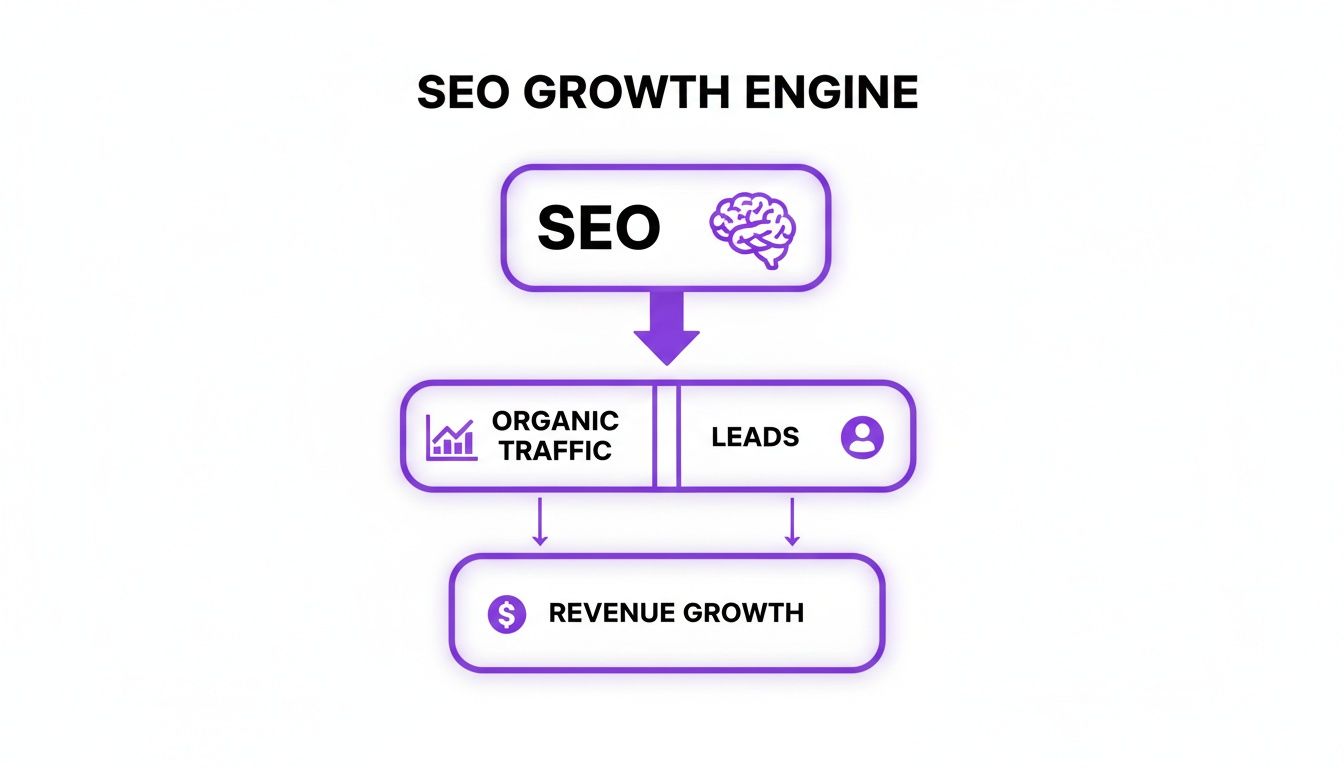
As you can see, strategic SEO efforts directly pump up your organic traffic, which then feeds your pipeline with qualified leads—the lifeblood of any tech company.
Differentiating Buyer and Developer Personas
In the tech world, you're usually marketing to two fundamentally different audiences at the same time: the economic buyer and the technical user. Each has different goals, speaks a different language, and looks for information in their own unique way. A one-size-fits-all keyword strategy will just fall flat, failing to connect with either of them.
- The Buyer Persona (think CTO or VP of Engineering): This person is all about business outcomes. They care about ROI, security, scalability, and how your solution integrates with their existing tech stack. Their searches are almost always commercial in nature.
- The Developer Persona (the Software Engineer in the trenches): This user is focused on one thing: implementation. They need to know if your product will fix a technical headache, how the API works, and whether your documentation is any good. Their searches are highly specific and informational.
For a deeper dive into this process, check out our complete guide on how to create buyer personas for your business.
To really nail this, you have to align different keyword types and content formats with each persona. Here’s a quick breakdown of what that looks like in practice.
Mapping Keyword Strategy to Tech Buyer Personas
| The Buyer (CTO, Manager) | Commercial & Strategic: Focused on ROI, business impact, and vendor comparison. | "enterprise cloud security solutions", "salesforce vs hubspot for tech", "best project management tools for dev teams" | Whitepapers, Case Studies, Comparison Guides, Product Pages |
|---|---|---|---|
| The Developer (Engineer) | Informational & Technical: Focused on implementation, troubleshooting, and code. | "api documentation for oauth 2.0", "how to fix database latency", "python library for data visualization" | Technical Docs, Tutorials, How-To Guides, Code Snippets |
This table makes it crystal clear: you can’t just create one piece of content and hope it works for everyone. You need a dedicated strategy for each persona to meet them exactly where they are.
Mapping Keywords to the B2B Buying Journey
Once you’ve got your personas locked in, the next move is to align your keywords with each stage of their decision-making process. This ensures you’re creating content that meets their needs at the perfect moment, gently guiding them from initial awareness to the final purchase.
1. Awareness Stage (Problem-Focused)
At this stage, your audience knows they have a problem, but they might not even know a solution like yours exists. Your job is to educate them.
- Persona: Developer
- Query Type: Informational (How-to, what-is)
- Example Keywords: "how to integrate payment gateways," "what is serverless architecture," "troubleshooting database latency issues."
2. Consideration Stage (Solution-Focused)
Now they're actively researching and comparing different solutions, tools, and platforms. Your content needs to position your product as a top-tier option.
- Persona: CTO / Project Manager
- Query Type: Commercial Investigation (Best, comparison)
- Example Keywords: "best CRM for small tech startups," "Mailchimp vs SendGrid," "open-source data visualization tools."
3. Decision Stage (Brand-Focused)
Finally, they're ready to make a choice and are evaluating specific providers. Content at this stage has to build trust and scream your unique value from the rooftops.
- Persona: Both Buyer & Developer
- Query Type: Transactional / Navigational
- Example Keywords: "[Your Brand] pricing," "[Competitor] alternatives," "[Your Brand] API docs," "demo of [Your Product]."
When you categorize keywords this way, you create an incredibly powerful framework. Every single piece of content—from a high-level blog post to your most detailed API documentation—has a clear purpose and speaks directly to a specific user's need. This is how you transform your SEO from a simple traffic-driving tactic into a strategic, lead-generating machine.
Getting Technical: SEO for Complex Tech Websites and Documentation

Tech company websites are rarely simple beasts. They’re intricate ecosystems weaving together slick product pages, marketing content, and deep, labyrinthine technical documentation. If you're not careful, this combo can seriously confuse search engine crawlers.
Mastering technical SEO here isn’t about quick fixes. It's about drawing a clear, logical blueprint that Google can actually follow.
Think of your website's architecture as the foundation of a skyscraper. If that foundation is a mess, everything you build on top is at risk. A clean structure ensures crawlers (and users!) can get from your homepage to a specific API endpoint in your docs without getting lost. This logical flow is how you distribute authority and show Google how all your content pieces relate to each other.
Architecting for Crawlability and Indexing
First things first: can search engines even find your pages? A messy or illogical site structure leads to "crawl budget" waste. That’s a fancy way of saying Google’s bots get tired of wandering through your junk pages and leave before they ever find your high-value content.
A streamlined site architecture is one of the most fundamental web development best practices for SEO. To nail it, focus on creating a shallow, logical hierarchy. Your most important pages should never be more than three or four clicks from the homepage. Period.
Here’s your checklist:
- Clean URL Structure: Use simple, descriptive URLs. Think /products/data-visualization-tool/, not /p_id=4821&cat=dvt. One is for humans, the other is for robots from 1998.
- Comprehensive XML Sitemaps: Keep an up-to-date sitemap that lists all your important URLs. This is like handing Google a map to your treasure.
- Logical Internal Linking: Strategically link between related pages. This passes authority and helps both users and crawlers connect the dots.
This isn't just about appeasing bots. A clean architecture makes for a killer user experience, which is a massive ranking factor in itself.
Leveraging Advanced Schema Markup
Schema markup is basically a secret language you speak to search engines. It’s structured data you add to your code to give them deeper context about your content. For tech companies, this is a golden opportunity to make your search results pop with rich snippets, which can send your click-through rates soaring.
Instead of a boring blue link, schema can add interactive elements, ratings, and specific product details right there in the search results.
By giving Google explicit clues about what your page means, you move beyond just matching keywords. You’re handing it the context it needs to feature your software, articles, and documentation in much more compelling ways.
Common schema types for tech businesses that you should be using yesterday:
- SoftwareApplication: Slap this on product pages to show off pricing, ratings, and OS compatibility.
- TechArticle: Use this on your blog posts and guides to signal their technical nature.
- FAQPage: This markup helps your FAQs appear as slick, interactive dropdowns in search results, answering queries on the spot.
Turning Documentation into an SEO Powerhouse
Your technical documentation is probably one of the most overlooked goldmines in your entire SEO strategy. Developers and engineers aren’t just looking for products; they're constantly searching for solutions to hyper-specific technical problems.
Your docs can—and should—be the answer.
Optimize your documentation to capture all those long-tail, problem-solving queries. Treat each doc page like a standalone landing page, fully optimized for a specific technical question or keyword. Use clear headings, include code snippets, and write for humans, not just machines.
For example, a page optimized for a query like "how to authenticate REST API key" can pull developers directly into your world. This simple shift in mindset turns your docs from a cost center into a powerful, top-of-funnel lead generation machine.
This kind of technical groundwork pays off, big time. We’ve seen focused tech optimization projects deliver a 54% organic visibility boost in just 90 days, just from fixing crawl issues. And with mobile users now spending over five hours a day on their devices, a technically flawless, mobile-first approach is non-negotiable.
Building Your Content and Authority Engine

Getting your technical SEO right puts you on the map. But it’s your content that convinces people to actually show up and stay awhile. In the world of SEO for technology companies, think of content as the fuel for your growth engine. Authority—earned through genuine trust and industry endorsements—is the horsepower that leaves competitors in the dust.
A killer content strategy does more than just rack up page views. It’s a systematic way to build trust with a naturally skeptical audience, educate prospects who are trying to solve complex problems, and, ultimately, earn the kind of backlinks that tell Google you’re the real deal.
Crafting Content That Converts and Commands Respect
Your content strategy can't be a one-trick pony. It needs to be a multi-pronged attack that meets users exactly where they are, whether they’re just browsing or ready to pull out the company card. This means moving beyond a simple blog and creating a portfolio of assets, each designed for a specific job.
First, nail your product and feature pages. These are your digital storefronts, and they need to do more than just list specs. They have to answer the tough questions buyers have, show off tangible benefits, and target those high-stakes, commercial-intent keywords that capture people ready to make a move.
Next, it’s time to plant your flag as an industry leader with thought leadership. This isn't just about sharing your opinions on LinkedIn. It’s about delivering unique insights, data-backed analysis, and sharp commentary on where your industry is headed. For a full blueprint on how to organize this, check out this actionable content marketing strategy template.
Finally, create those deep, evergreen guides that become the definitive resource on a topic. These cornerstone pieces solve big, hairy problems and act as magnets for organic traffic and natural backlinks for years to come.
Rethinking Link Building as Authority Building
For way too long, link building has had a shady, back-alley reputation. It's time to change that narrative. For a tech company, every single backlink should be viewed as a credible industry endorsement—a vote of confidence from a respected peer.
This mindset immediately shifts your focus from quantity to quality. A single link from a major tech journal or a top-tier industry blog is worth a hundred links from low-quality directories. It’s not even close.
The goal isn’t just to collect links. It's to build a network of authoritative relationships that validates your company's expertise. This is how you create a durable competitive advantage that’s almost impossible for others to copy.
To really power up your domain authority and drive qualified leads, you need to understand what link building strategies for SaaS growth actually look like. It’s about moving past simple link acquisition and turning it into a strategic function that fuels real business growth.
Creating Irresistible Linkable Assets
The absolute best way to earn high-authority backlinks is to create something so good that people can't help but link to it. This means producing "linkable assets"—high-value content that other websites want to share with their audience. This is the art of passive link building.
Instead of constantly knocking on doors, you build a magnet that pulls the best links right to you.
Here are a few powerful ideas for linkable assets that crush it for tech companies:
- Original Data Studies: Run your own surveys or analyze proprietary data to uncover trends no one else is talking about. When you publish original research, you instantly become the primary source everyone else has to cite.
- Free Tools and Calculators: Build a simple, genuinely useful tool that solves a common pain point for your audience. Think free ROI calculators or project management templates. These can quickly become industry-standard resources.
- Proprietary Research and Whitepapers: Go incredibly deep on a complex topic and publish the most comprehensive report out there. This is the kind of stuff journalists, analysts, and other bloggers love to reference.
- In-Depth Guides and Tutorials: Create the most thorough, practical, and well-structured guide on a technical topic. For developers and practitioners, a great tutorial is worth its weight in gold.
By investing in these assets, you're not just making content; you're building pillars of authority. Every link earned signals to Google that your brand is a trusted voice, boosting your entire domain and helping all your pages rank higher. This turns your content from a simple marketing tactic into a powerful, self-sustaining engine for growth.
Adapting Your Strategy for AI in Search
The ground is shifting beneath our feet. Google is no longer just a list of links; it’s rapidly becoming a direct answer engine, powered by AI Overviews and conversational search. For tech companies, this isn't some far-off disruption—it's happening right now, and it's a massive opportunity.
Think of your old SEO strategy as a paper map. It was reliable, sure, but it was static. Adapting to AI in search is like upgrading to a real-time GPS. It gives your audience smarter, more direct routes to the answers they need—answers your brand should be providing.
This evolution demands a new playbook: Answer Engine Optimization (AEO). The goal is no longer just to rank at the top of a list. The new goal is to be the answer—the definitive source AI models quote directly in their responses.
Thriving in the Age of AI Overviews
AI Overviews, those summarized answers popping up at the top of search results, are fundamentally changing user behavior. To win here, your content has to be the go-to source for these summaries. This is where amplifying your E-E-A-T (Experience, Expertise, Authoritativeness, and Trustworthiness) signals becomes absolutely non-negotiable.
Google's AI is designed to surface reliable, expert-backed information. If you want to get featured, you have to prove you’re the real deal.
- Show, Don't Just Tell: Add author bios with real-world credentials and link to their social profiles. Let people see the experts behind the content.
- Bring the Receipts: Back up every claim with original research, hard data, or specific statistics.
- Write for Clarity: Use simple, declarative sentences. Make it incredibly easy for an AI to parse your content and pull a direct quote.
The impact of this shift is already massive. AI is supercharging SEO for technology companies, with nearly 70% of businesses reporting higher ROI after integrating it into their strategies. Google's AI Overviews now reach 2 billion monthly users, and get this—AI referral visitors are worth 4.4x more from a conversion standpoint and have a 27% lower bounce rate. You can dig into more of these AI SEO statistics on semrush.com.
Ethically Using AI as Your Copilot
While you're busy optimizing for AI, you can also put it to work in your own corner. The trick is to treat AI as a strategic partner, not a replacement for your own expertise and authentic voice. It’s about working smarter, not cutting corners.
AI should augment your strategic thinking, not automate it. Use it to find patterns and speed up analysis, but always apply your human expertise and brand voice as the final, critical layer.
Here are a few practical ways to use AI tools without sacrificing quality:
Advanced Keyword Clustering: AI can tear through thousands of keywords and group them into tight, topically relevant clusters based on search intent—a task that would take a human analyst days to complete.
Content Ideation and Outlining: Use AI to brainstorm fresh angles, spot content gaps your competitors missed, and structure comprehensive outlines. The creative direction and the final words, however, must be human.
Technical SEO Analysis: AI-powered tools like Ahrefs or Semrush can audit your site for complex technical issues in minutes, flagging patterns in crawl data or log files that might otherwise go unnoticed.
Measuring What Matters in the New Landscape
Your old dashboards need an upgrade. While traditional metrics like organic traffic and keyword rankings still have their place, new KPIs are emerging to track your success in this AI-driven world.
The most critical new metric to obsess over is your AI Presence Rate. This tells you how often your domain is cited as a source within AI-generated Overviews for your target keywords. A high presence rate is the new benchmark for visibility. It’s a clear signal that Google’s AI trusts your content, and it's a powerful leading indicator of future organic success.
An SEO strategy without a way to measure it is just throwing money into the wind. For tech companies, it’s absolutely critical to connect every ounce of SEO effort to real business results. We need to move way beyond vanity metrics like raw traffic.
The real story isn't just about how many people land on your site; it’s about what they do once they get there. Did that deep-dive technical tutorial actually lead to more free trial sign-ups? Did our big-brain thought leadership piece get demo requests from enterprise-level CTOs? That’s where the gold is.
Building a Dashboard That Actually Tells a Story
A good performance dashboard should spell out your return on investment in plain English. It’s not a data dump; it's a narrative connecting your actions to tangible outcomes.
Here's what it absolutely must include:
- Lead Quality Metrics: You need to be tracking MQLs and SQLs coming straight from organic search. No excuses.
- Conversion Rates: Are people signing up for demos, starting free trials, or hitting that "contact us" button? Monitor these key actions from your organic visitors.
- Pipeline Influence: Use a solid attribution model to see how many times organic search touched a lead before they became a closed deal. You'll be surprised.
- Cost Per Acquisition (CPA): How does the cost of landing a customer through SEO stack up against your paid channels? This is the number that makes CFOs smile.
Tracking at this level proves that smart SEO for technology companies isn't a cost center. It’s a powerful, predictable revenue engine.
Choosing the Right SEO Partner (and Not Getting Burned)
Finding the right agency is a strategic move, not just a line item in your budget. It’s a big deal.
Globally, a whopping 89% of marketers say SEO is successful, but that doesn't mean it's easy. Budget issues are a constant hurdle. The data is clear: businesses that spend at least $500 a month on SEO are 75% less likely to be unhappy with their results. Investing properly from the start makes all the difference. You can review the full breakdown of SEO statistics on seo.com to see the numbers for yourself.
When you're vetting a potential partner, you need to ask the tough questions to see if they really get it.
Technical Chops: "Walk me through an example of how you diagnosed and fixed a gnarly indexation issue for a tech client with a complex site."
Strategic Mindset: "How would your content strategy differ for our developer persona versus our CTO persona? Be specific."
Proven Performance: "Show me a case study—for a B2B tech company—where you measurably grew qualified organic leads, not just vanity traffic."
Reporting and Communication: "What KPIs will you show us every week and every month, and how do you tie them directly back to our revenue goals?"
A great partner is more than a vendor; they're an extension of your team. They bring the technical skill, sure, but they also provide the strategic guidance that delivers real, sustainable growth.
Got Questions About Tech SEO? We've Got Answers.
Diving into SEO for a tech company always kicks up a few tricky questions. We get it. Below, we’re tackling the most common ones we hear from B2B tech marketers, with straight answers to help you sharpen your strategy.
How Long Does SEO Take To Work For A Tech Company?
Let’s get this one out of the way: SEO is a long game, not a lottery ticket. For a competitive tech niche, you’ll likely see the first positive rumblings—think better rankings and a traffic uptick—within 3 to 6 months. But for the kind of results that make your CEO smile? That usually takes a solid 9 to 12 months of consistent work.
Think of it like building a reputation in the industry. It doesn’t happen after one great blog post; it happens by showing up with high-quality contributions, month after month.
Of course, that timeline can swing based on a few things:
- Your starting line: A brand-new website is climbing a much steeper hill than an established domain with some authority already built up.
- The competition: Trying to rank for "enterprise cybersecurity solutions" is a bare-knuckle brawl compared to a niche developer tool.
- Your investment: The speed and quality of your content, technical fixes, and link-building efforts will directly fuel how fast you see results.
Is Technical SEO More Important Than Content For Tech Brands?
This question is a classic, but it’s a false choice. It's like asking if a race car needs a powerful engine or a skilled driver. You need both, period. Technical SEO and content are two sides of the same coin; one is useless without the other. You could have the most mind-blowing technical docs on the planet, but if your site is a maze of crawl errors, nobody will ever find them.
Technical SEO builds the superhighway that lets search engines get to your content. Content is the high-value cargo that travels on that highway. You need both to make a delivery.
For tech companies, a technically flawless website is just table stakes. Your product pages and documentation are complex, and skipping the technical foundation makes even the most brilliant content completely invisible.
Should We Gate Our High-Value Content For Lead Generation?
Ah, the eternal debate. Gating content like a whitepaper or original research report can absolutely pack your CRM with leads, but it comes with a massive SEO trade-off. When your best stuff is hidden behind a form, search engines can’t crawl or index it. That means it contributes zero direct SEO value. You miss out on all the potential rankings, organic traffic, and backlinks it could have earned.
So what's the move? A hybrid approach usually crushes it:
- Create Ungated "Hub" Content: Write a comprehensive, search-optimized blog post or guide that hits all the key findings from your research. This is your SEO powerhouse.
- Offer a Gated "Upgrade": Inside that ungated post, offer a more detailed PDF, a ready-to-use template, or the full dataset as a downloadable "content upgrade" in exchange for an email.
This way, you get the best of both worlds—you capture organic traffic and visibility while still generating a stream of high-intent leads.
At Rebus, we build SEO strategies that connect complex tech solutions with the people who need them. We blend deep technical expertise with content that actually resonates to drive real, measurable growth. Ready to supercharge your marketing? Let's start the journey.