
SEO Keywords How Many Should You Target for Real Results
When you’re staring at a massive list of keywords, it’s easy to get overwhelmed. How many is the right amount?
The short answer: a single page should zero in on one primary keyword and 3-5 secondary keywords. A full campaign, on the other hand, can target hundreds, all neatly organized by topic.
Defining Your Keyword Targeting Scope
Asking "how many keywords should I target?" is a lot like asking a chef how much salt to use. The answer isn't a single number; it depends entirely on what you're cooking. Are you seasoning a single dish, an entire course, or planning the menu for a week-long event?
That’s the core idea behind a smart SEO strategy. Instead of chasing a random number, you need a framework that scales with your goals. You wouldn't try to cram every spice in the pantry into one dish, and you shouldn't try to stuff dozens of unrelated keywords onto a single page.
The goal isn't to maximize the sheer number of keywords on a page. It's to achieve killer relevance for a specific user intent. Focus and quality will always crush disorganized quantity.
To make this real, let’s break down the different levels of keyword targeting. Each one has its own rules and benchmarks for success.
- Page Level: This is the most granular view—a single blog post, product page, or service page. The keyword count here is small and hyper-focused.
- Topic Cluster Level: Here, you zoom out to a group of related pages that cover a broad subject from multiple angles. The total number of keywords grows as you target a family of related search queries.
- Campaign Level: This is the 30,000-foot view of your entire SEO strategy. It’s the mothership, containing all your topic clusters and potentially involving hundreds or even thousands of keywords working together.
Getting a handle on these distinct levels is the first step toward building an SEO plan that actually works and doesn't drive you crazy.
To give you a practical starting point, here’s a quick-reference table outlining how many keywords to aim for at each scope.
Keyword Targeting Benchmarks at a Glance
Think of this table as your cheat sheet. Use it as a guide to structure your content and SEO efforts so you're not just throwing keywords at a wall and hoping something sticks.
| Single Page | 1 | 3-5 | 4-6 |
|---|---|---|---|
| Topic Cluster | 1 (Pillar Page) | 15-30+ (Across Cluster Pages) | 16-31+ |
| SEO Campaign | 5-10+ (Across Clusters) | 100-1000+ | 105-1010+ |
These numbers aren't magic, but they provide a solid foundation. They force you to be strategic, ensuring every page has a clear purpose and every campaign is built on a strong, organized keyword architecture.
From a Single Page to a Full Campaign: How to Scope Your Keyword Targeting
Figuring out "how many keywords" to target is a bit like looking at a map. You can zoom way in to a single street, pull back to see the whole neighborhood, or zoom all the way out to view the entire city. Each perspective gives you a different kind of clarity.
The same goes for your SEO strategy. We’ll start on the ground floor with a single page, then zoom out to the neighborhood view of a topic cluster, and finally take the 30,000-foot view with a full-blown campaign.
Think of it as a pyramid. Your big-picture campaign sits at the top, supported by strong topic clusters, which are built on a foundation of laser-focused individual pages.
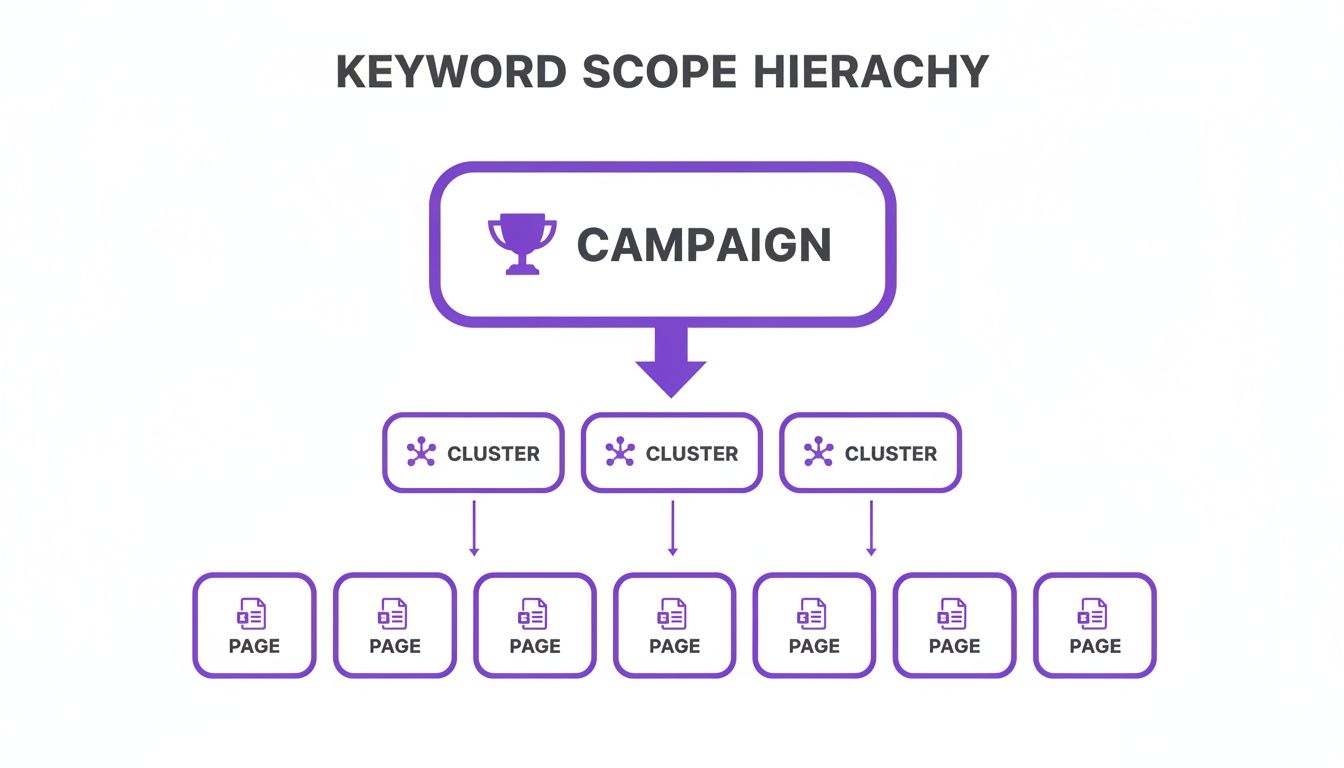
This structure is key. A winning campaign is just a collection of well-executed clusters, and each cluster is only as strong as the individual pages that hold it up.
The Single Page Focus: One Page, One Job
At the most detailed level—a blog post, a product page, a service description—the rule is dead simple: one primary keyword. This is your North Star. It’s the single phrase that perfectly sums up what the page is about and what the user is looking for.
If you try to stuff multiple, unrelated primary keywords onto one page, you just confuse Google and your visitors. It’s a classic mistake called keyword cannibalization, and it kills your rankings.
To back up your primary keyword, you’ll want to sprinkle in 3 to 5 secondary keywords. These aren't just random phrases; they’re your backup singers, providing harmony and context. They typically fall into three buckets:
- Synonyms: Just different ways of saying the same thing (e.g., "small business SEO services" vs. "SEO for small companies").
- Long-tail variations: More specific, multi-word phrases related to your main term. If your primary is "content marketing," a long-tail could be "content marketing strategy for e-commerce."
- LSI keywords: These are terms that are conceptually related. For a page about "car repair," LSI keywords would be things like "mechanic," "oil change," or "brake pads." They help Google understand the topic’s context.
This tight focus ensures every single page you publish becomes an authority on its specific little corner of the universe.
The Topic Cluster Structure: Owning the Conversation
Zooming out a bit, we get to the topic cluster. This is where you group related pages together to prove you're an expert on a broader subject. A cluster has a main "pillar page" covering a big topic, which is then supported by a handful of "cluster pages" that dive deep into specific subtopics.
A topic cluster is your strategy for owning an entire conversation. You're not just trying to rank for one term; you're aiming to become the go-to resource for a whole subject area.
A solid topic cluster usually has 5 to 15 (or more) cluster pages, and each one targets its own unique primary keyword. The main pillar page goes after the broad, high-volume "head term," while the smaller cluster pages pick off the more specific long-tail keywords. This creates a powerful web of internal links that screams "topical authority" to search engines.
The Full Campaign View: The Master Plan
Finally, we’re at the campaign level—the master blueprint for your entire SEO operation. A campaign isn’t measured by a specific number of keywords; it’s driven by your business goals. It can pull together multiple topic clusters to hit different customer needs all along their buying journey.
A small business might kick things off with one or two topic clusters, targeting a few dozen keywords in total. On the other end of the spectrum, a huge e-commerce site might have a campaign targeting thousands of keywords, all neatly organized into clusters for different product categories. And for businesses with brick-and-mortar locations, mastering your approach to SEO for multiple locations becomes another crucial layer in the campaign.
By scaling your focus from a single page all the way up to a full campaign, you build a structured, powerful, and totally manageable SEO machine that’s built for consistent growth.
How to Prioritize Your Keywords for Maximum Impact
Knowing how many keywords to target is a solid first step, but the real magic happens when you pick the right ones.
Think of yourself as a venture capitalist for your SEO strategy. You have a finite amount of resources—time, budget, and creative energy—and you need to invest them in the keywords with the highest potential for a killer return.
You can't afford to back every idea that comes across your desk. Instead, you have to be ruthless, evaluating each keyword against a strict set of criteria before you commit. This methodical approach is what separates the campaigns that hit their goals from the ones that just spin their wheels chasing vanity metrics. It ensures every piece of content you create is a calculated investment, not just a shot in the dark.
The Four Pillars of Keyword Prioritization
To build a powerful keyword portfolio, you need to run every potential term through four critical filters. A keyword has to pass the test on all four fronts to be considered a top-tier investment for your content.
Search Intent: This is all about the why behind the search. Is the person looking to learn something (informational), find a specific website (navigational), compare their options before pulling out their wallet (commercial), or make a purchase right now (transactional)? Matching your content to the user's goal is completely non-negotiable if you want to rank. We break this down even further in our complete guide to understanding search intent.
Search Volume: This classic metric tells you how many times a keyword gets typed into a search bar each month. It's tempting to go after the big, shiny numbers, but those high-volume terms are often fiercely competitive. A smarter, more balanced strategy often involves targeting mid-volume keywords where you have a realistic shot at winning.
Competition: This is your reality check on how hard it'll be to crack the first page of Google. SEO tools can give you a "keyword difficulty" score, but you absolutely have to do a manual spot-check. Go look at the search results yourself. Are the top spots dominated by huge household names with massive authority, or are smaller blogs and businesses making a showing?
Commercial Value: This is the bottom-line question: how likely is a person searching this term to become a paying customer? A keyword like "free marketing templates" has high informational intent but pretty low commercial value. On the flip side, something like "book a marketing consultation" screams high commercial value.
Balancing Volume with Real-World Value
It’s so easy to get fixated on search volume, but traffic alone doesn't pay the bills. This is where long-tail keywords—those super-specific, multi-word phrases—become your secret weapon.
Sure, they might have lower individual search volumes, but they often pack a much bigger punch in commercial intent and face way less competition.
Don't just chase traffic; chase the right traffic. A page that attracts 50 highly qualified visitors who are ready to buy is infinitely more valuable than a page that attracts 5,000 casual browsers with no commercial intent.
For example, long-tail keywords are known to deliver approximately 2.5 times higher conversion rates than their short-tail cousins. This makes them an incredibly efficient tool for any business focused on actually generating leads and sales, not just racking up page views.
By zeroing in on keywords with clear commercial value and user intent, you make sure your SEO efforts are directly fueling your business's growth.
Why Targeting More Niche Keywords Is a Modern SEO Superpower
It’s tempting. You see those big, shiny keywords with massive search volumes and think, "That's the trophy." But the reality of modern SEO is way more subtle. Real dominance isn’t found fighting over a few popular terms; it’s discovered in the vast, less-traveled territory of the long tail.

You have to shift your perspective because the keyword world is incredibly fragmented. The huge majority of searches aren't broad, one-word queries. They’re hyper-specific, multi-word questions and phrases that reveal exactly what a user needs.
This is where you find your edge. While your bigger competitors are dumping resources into high-competition head terms, you can strategically capture pockets of highly motivated traffic they almost always ignore.
Embrace the Power of Specificity
Think about it like this: trying to rank for a term like "shoes" is like shouting in a packed stadium and hoping someone hears you.
But targeting a niche keyword like "waterproof trail running shoes for wide feet" is like having a direct, meaningful conversation with a customer who knows exactly what they want and is ready to buy.
This isn’t just a gut feeling; it’s backed by hard data. A staggering 94.74% of all keywords get 10 or fewer monthly searches. Meanwhile, a tiny 0.0008% of keywords are the titans breaking the 100,000 monthly search mark.
The takeaway is crystal clear: the real action is hidden in the long tail. If you ignore these low-volume, high-intent keywords, you’re basically leaving most of your potential customers on the table.
It’s all about adopting a "quantity of targeted quality" mindset. Instead of one page trying to answer a massive, broad question, you create many pages that each solve a very specific problem. This is how you build true topical authority and run circles around the big players.
Turning Niche Searches into Business Growth
When you zero in on niche, long-tail keywords, you unlock some seriously powerful benefits that hit your bottom line directly.
- Higher Conversion Rates: Someone searching for a super-specific phrase is usually much further down the buying funnel. They're not just browsing; they're ready to act.
- Lower Competition: Let's be real, it’s way easier and faster to rank for "how to fix a leaky faucet under sink" than it is for a beast like "plumbing."
- Building Authority: Every time you answer a specific question, you’re not just getting traffic—you’re building your reputation as the go-to expert in your field.
This strategy changes how you think about the whole "how many keywords" question. The goal is to build a huge portfolio of super-specific keyword targets, where each piece of content is a precision tool for a niche audience. If you really want to get good at this, digging into resources on mastering long-tail keyword research will give you a massive competitive advantage.
Measuring the True Success of Your Keyword Strategy
Let's be real: a keyword strategy without measurement is just a bunch of expensive guesswork. It feels amazing to watch your page climb the search rankings, but hitting that number one spot is ultimately a vanity metric. True success is measured by the actual impact your keywords have on your bottom line.
It's time to move beyond rankings and start tracking the key performance indicators (KPIs) that actually matter to your business.

This means shifting your focus to metrics that show real engagement and, more importantly, real revenue. Tools like Google Search Console and Google Analytics are your best friends here. They'll help you build a data-driven feedback loop that proves your SEO work is paying off.
Key Metrics That Signal Real Growth
Instead of just celebrating a top ranking, you need to dig deeper. These are the indicators that tell the real story of what’s working and what's falling flat.
- Keyword Visibility: Think of this as your "share of voice" for the topics that matter most. It measures how often your site shows up in search results for a specific set of keywords, giving you a clear picture of your presence in the market.
- Organic Traffic Growth: Are your keyword efforts actually bringing more people to your site? You need to monitor traffic increases and, crucially, segment them by keyword groups to see which topics are driving the most eyeballs.
- Click-Through Rate (CTR): A high ranking is useless if nobody clicks on it. Your CTR tells you how compelling your page title and meta description are in the wild. A low CTR on a high-ranking page is a massive red flag that your SERP appearance needs a facelift.
The ultimate goal isn't just to rank, but to connect with an audience that will actually do something. Measuring success means tracking the entire journey from a search query to a valuable business action, proving your keyword choices are driving tangible outcomes.
Connecting Keywords to Bottom-Line Results
This is where the rubber meets the road. Traffic is great, but conversions pay the bills. The real test of your keyword strategy is its ability to generate leads and sales.
To measure this properly, you need to be tracking Conversions and Goal Completions in Google Analytics. Set up goals for the actions you care about, like form submissions, phone calls, or product purchases. This lets you see exactly which organic keywords are leading to those valuable outcomes.
Getting a handle on what attribution modeling is is also a game-changer. It helps you accurately assign credit to the keywords that influence a customer's journey, even if they aren't the very last click before a sale.
In a world where Google sees 16.4 billion searches every single day, every keyword you choose is a shot at capturing a piece of that massive audience. To make the most of it, you have to make sure every piece of your content is searchable. A great example is how podcast transcription for SEO can unlock the hidden potential of your audio content and pull in a whole new segment of your audience.
Got Questions About Keyword Targeting? We've Got Answers.
Even the best-laid keyword plans hit a few bumps in the road. Once you start getting your hands dirty, the real, nitty-gritty questions pop up. Let's tackle some of the most common head-scratchers that trip up marketers and SEOs alike.
Think of this as your field guide for those tricky situations. These answers will help you sidestep common mistakes and keep your keyword targeting sharp, effective, and actually working for you.
Can I Target the Same Primary Keyword on Multiple Pages?
Nope. This is one of the classic SEO blunders, a little problem we call keyword cannibalization. When you aim the same primary keyword at more than one page, you’re basically telling Google, "Hey, I have two kids, and I need you to pick your favorite."
Search engines get confused. They don't know which page is the real authority for that query. The result? They might rank both pages poorly, or worse, keep swapping them in and out of the search results, killing your visibility and driving you crazy.
Every single page on your website needs a unique job to do. Giving each page its own primary keyword ensures it has a clear, distinct purpose. This prevents your content from fighting itself and actually builds your site's authority.
If you've got two pages that feel like twins, it’s a sign to do one of two things:
Consolidate them: Cherry-pick the best parts from both pages and merge them into one powerhouse piece of content.
Differentiate them: Tweak the angle of each page. Have them target slightly different long-tail variations of the main keyword, zeroing in on distinct user intents.
How Often Should I Update My Keyword Strategy?
Your keyword strategy isn't a tattoo—it's not permanent. Think of it more like a haircut; it needs a refresh every so often to stay sharp. A good rule of thumb is to give your entire keyword map a comprehensive review and update at least once or twice per year.
That said, some events should trigger an immediate "all hands on deck" review. If there's a major Google algorithm update, a big shift in your industry, or you’re launching a new product or service, it’s time to revisit your keywords right away.
What if My Primary Keyword Has Zero Search Volume?
It happens all the time. You find the perfect, hyper-specific long-tail keyword, but tools like Ahrefs or Semrush swear it gets zero monthly searches. Don't toss it in the trash just yet.
Those tools often underestimate (or can't even register) the volume for super-niche queries. Targeting these "zero-volume" keywords can be a brilliant move. Here's why:
- The purchase intent is usually off the charts.
- Competition? What competition? It’s virtually nonexistent.
- You're using the exact language your most qualified, ready-to-buy customers are typing into Google.
If a keyword perfectly describes a problem your product solves, creating content for it is a low-risk, high-reward bet. Sure, you might only pull in a handful of visitors, but they could be the most valuable people to land on your site all month.
How Do I Know if I'm Using Too Many Keywords?
The biggest red flag is when your writing starts to sound like a malfunctioning robot. This is keyword stuffing, and it’s a one-way ticket to the bottom of the search results. If you find yourself awkwardly shoehorning phrases into sentences just to hit some imaginary number, you've gone way too far.
Here’s the simplest test in the world: read your content out loud. Does it sound clunky, forced, or weirdly repetitive? If it sounds unnatural to a human ear, you can bet it looks like spam to a search engine. Your first priority should always be clear, helpful communication for your reader—not appeasing some keyword density myth.
Ready to build a keyword strategy that drives real business growth? The expert team at Rebus crafts data-driven SEO campaigns that captivate, engage, and convert your target audience. Partner with us to transform your brand potential into measurable success.