What do seo companies do? A Quick Guide to Their Services
So, what do SEO companies actually do? In a nutshell, they’re the architects and city planners for your business’s online presence. Their job is to make sure your website gets found by the right people at the exact moment they’re searching for what you sell.
Simply put, they bring you qualified, organic traffic.
Your Business On Digital Main Street
Imagine your website is a brand-new brick-and-mortar store. Without SEO, it’s like building that shop on some unmarked backroad with no signs—completely hidden from anyone who might want to stop by. An SEO company’s mission is to move your business onto a bustling digital main street, making it impossible for your ideal customers to miss.
They pull this off by focusing on three core pillars that work together to build your visibility and earn trust with search engines like Google.

The Pillars Of SEO Success
A truly effective SEO strategy isn’t just one thing; it’s a coordinated attack on multiple fronts. Here’s a quick peek at what that looks like:
- Building a Solid Technical Foundation: This is all about making sure your website is built in a way that search engines can easily crawl, understand, and index. Think of it as ensuring the roads leading to your store are paved and totally clear of obstacles.
- Creating High-Value Content: A good agency develops content—from blog posts to service pages—that directly answers the questions your target audience is asking Google. This content acts like a magnet, pulling in potential customers who are actively searching for solutions you provide.
- Establishing Authority and Trust: Through things like link building and online PR, they build up your website's reputation across the web. This is like getting rave reviews and shoutouts from other respected businesses, which tells search engines you’re a credible and trustworthy source.
The sheer scale of this opportunity is mind-boggling. SEO companies help businesses compete for a slice of the pie in a world where Google is projected to process 16.4 billion searches per day by 2025. That staggering volume makes it crystal clear why you need a pro to help you navigate the chaos.
This strategic, multi-pronged approach is what turns a website from a static online brochure into a powerful engine for business growth. By cranking up your online visibility, a great SEO partner connects you with a steady stream of new customers, ultimately driving real results like leads, sales, and revenue.
If you want to dive deeper into the nuts and bolts of these strategies, you can explore our detailed guide on search engine optimization.
For a quick summary, this table breaks down the core functions of an SEO agency and why each one matters for your bottom line.
Core SEO Services at a Glance
| Technical SEO | Ensure your site is fast, secure, and easily crawlable by search engines. | A smooth, error-free site gets indexed faster and ranks better. |
|---|---|---|
| On-Page & Content | Create and optimize content that answers user questions and targets keywords. | Attracts the right audience and shows Google your expertise. |
| Link Building | Earn high-quality backlinks from other reputable websites to yours. | Builds your site's authority and signals trustworthiness to Google. |
| Local SEO | Optimize your online presence to attract customers in your geographic area. | Puts you at the top of local "near me" searches and map results. |
| Analytics & Reporting | Track key metrics, analyze performance, and adjust the strategy. | Provides clear data on what's working and what's not, proving ROI. |
Each of these services is a critical piece of the puzzle, working together to transform your website into a reliable customer acquisition machine.
The Six Pillars of a Modern SEO Strategy
So, what do SEO companies actually do? The best way to get it is to break their work down into six distinct, yet totally connected, pillars.
Think of it like building a high-performance race car. Each pillar is a critical system—the engine, the chassis, the aerodynamics. One part can’t win the race alone; they all have to work in perfect harmony to get you across the finish line first. And in the race for customer attention, that finish line is page one of Google.
This isn’t some niche corner of the marketing world, either. The global SEO services market was valued at a whopping $82.3 billion in 2023 and is expected to blast off to $143.9 billion by 2030. Why the explosion? Because businesses know organic search isn’t just a channel; it’s the channel, driving 53.3% of all website traffic. For 61% of B2B marketers, it delivers more leads than anything else. If you want more stats that make the case, check out this detailed statistical report.
Let's pop the hood and look at the six pillars that make it all work.
Pillar 1: Technical SEO — The Foundation
Technical SEO is the bedrock. It’s all the behind-the-scenes work that makes sure search engines can find, crawl, and understand your website without hitting any roadblocks.
Imagine you’ve built a beautiful new retail store, but the front door is locked, the hallways are a confusing maze, and half the lights are out. It doesn't matter how great your products are if people can't get in and find them. Technical SEO is about unlocking the doors, hanging clear signs, and turning on all the lights for search engine bots.
A pro SEO company will get their hands dirty with tasks like:
- Boosting Site Speed: Making sure your pages load in a snap. A slow site is a ranking killer because frustrated users will just leave.
- Fixing Crawl Errors: Hunting down and repairing broken links or "404 not found" pages that annoy both users and Google's crawlers.
- Implementing Schema Markup: Adding special code (structured data) that helps Google understand your content's context. This is how you get those fancy "rich snippets" in search results, like star ratings or event times.
- Optimizing for Mobile: Ensuring your site works flawlessly on a phone. With most searches happening on mobile now, this is non-negotiable.
Pillar 2: On-Page SEO — The Signage
If technical SEO is the foundation, on-page SEO is the clear, helpful signage inside your store. It’s all about optimizing individual pages so they rank higher and pull in the right kind of traffic. This is where an agency fine-tunes your content so both humans and search engines instantly know what each page is about.
An SEO expert will strategically polish elements right on your pages, including:
- Keyword Optimization: Weaving target keywords naturally into your titles, headings, and paragraphs—no awkward keyword-stuffing allowed.
- Title Tags & Meta Descriptions: Writing the punchy, clickable headlines and summaries that show up in Google search results and make people want to click your link over the competition.
- Internal Linking: Building a logical web of links between your own pages. This helps spread authority (or "link juice") around your site and guides users to other relevant content.
A well-executed on-page strategy is like pointing at your page and telling Google, "This right here? This is the absolute best answer for someone searching this topic." It cuts through the noise and connects a customer's problem directly to your solution.
Pillar 3: Content Strategy — The Magnet
Content is the magnet that pulls your ideal customers to you. A modern SEO agency doesn't just churn out generic blog posts. They build a smart content strategy designed to attract, engage, and convert your target audience, no matter where they are in their buying journey.
This pillar is about becoming a trusted authority, not just a salesperson. The aim is to create content so genuinely helpful that it naturally earns attention and links.
This often involves creating a mix of assets:
Blog Posts: Answering your customers' most pressing questions and solving their problems.
Service and Product Pages: Writing clear, persuasive copy that shows off what you sell.
Guides and Ebooks: Creating in-depth resources that prove you're an expert in your field.
Case Studies: Showcasing real-world success stories to build trust and show you can deliver.
Pillar 4: Link Building — The Reputation
Link building, often called off-page SEO, is purely about building your website's reputation across the internet. In Google’s world, a link from another credible website to yours is basically a vote of confidence. It's a signal that your stuff is legit.
Think of it like getting a glowing recommendation from a well-respected expert in your industry. The more high-quality recommendations you get, the more trustworthy you appear. An SEO agency uses ethical, creative strategies to earn these valuable links.
Effective link-building tactics include:
- Digital PR: Creating newsworthy content—like original research or data—that journalists and bloggers actually want to write about and link to.
- Guest Posting: Writing helpful articles for other relevant websites in your industry.
- Broken Link Building: Finding broken links on other sites and politely suggesting your awesome content as a replacement.
Pillar 5: Local SEO — The Neighborhood Expert
For any business with a physical storefront or a local service area, local SEO isn't just important—it's everything. This pillar is all about making your business impossible to miss for customers searching for products or services "near me."
The goal here is to dominate the local search results, especially the coveted Google Map Pack (that box with three businesses at the top of the page). An SEO company will optimize your digital footprint to capture this high-intent local traffic.
Key local SEO moves involve:
- Google Business Profile (GBP) Optimization: Creating and obsessively managing your GBP listing with up-to-date hours, photos, services, and posts.
- Citation Management: Making sure your business name, address, and phone number (NAP) are 100% consistent across all online directories.
- Review Generation: Putting a system in place to encourage happy customers to leave those all-important positive reviews.
Pillar 6: Analytics and Reporting — The Growth Blueprint
Finally, none of this matters if you can't measure what’s working. This pillar is the growth blueprint, where an SEO company uses data to track performance, prove ROI, and tweak the strategy for even better results.
They won't just dump a confusing spreadsheet in your inbox. A good agency translates raw data into actionable insights, showing you exactly how their work is moving the needle on your business goals. And in today's world, a holistic strategy often looks at how organic search plays with other efforts, like ecommerce marketing automation, to create a seamless customer journey.
A solid reporting process always tracks the metrics that matter:
- Organic Traffic Growth
- Keyword Ranking Improvements
- Click-Through Rate (CTR)
- Conversion Rate from Organic Traffic
- Leads and Sales Generated
This constant cycle of doing, measuring, and refining is what separates professional SEO from just throwing things at the wall and hoping something sticks. It’s how you build real, sustainable growth.
Your Journey with an SEO Partner from Start to Finish
So you've decided to team up with an SEO company. Smart move. But this isn't like dropping your car off at the shop and hoping for the best. A great SEO partnership is a structured journey, a methodical process with clear phases. Knowing what to expect demystifies the whole thing and helps you understand exactly what your investment is buying.
Think of it like hiring an architect to build your dream house. They don't just start laying bricks. First, they survey the land, draw up detailed blueprints, and then, and only then, does the construction begin.
Phase 1: The Discovery and Audit
First things first: diagnosis. Before a single keyword is changed or a line of code is touched, a real pro will put your entire digital presence under the microscope. This isn't a quick once-over; it's a full-blown forensic investigation.
They’re digging into a few key areas:
- Technical Health Check: Is your site a Ferrari with a flat tire? They’re looking for backend problems like sluggish page speed, broken links, or a clunky mobile experience that's frustrating users and telling Google to look elsewhere. A proper website audit is non-negotiable—it's the foundation for everything.
- Competitive Analysis: Who are you up against? The agency sizes up your top competitors, figuring out what they’re doing right, where their blind spots are, and where you can swoop in and steal their lunch money.
- Initial Keyword Research: This is a baseline look at the exact words and phrases your ideal customers are typing into Google when they need what you sell.
Phase 2: Strategy and Roadmap Development
With the audit results in hand, it's time to build the game plan. The agency takes all those findings and translates them into a concrete, actionable SEO strategy that’s built around your business goals. If an agency tries to sell you a "one-size-fits-all" package, run. Your strategy should be as unique as your business.
This roadmap is your blueprint for success and will outline the critical pieces:
- Goal Setting: What does winning actually look like for you? Is it getting the phone to ring off the hook? Flooding your inbox with qualified leads? Driving more e-commerce sales?
- Content Plan: They'll map out a calendar of what needs to be created—from hard-hitting blog posts that solve customer problems to service pages that actually convert.
- KPI Selection: How will you measure success? The agency will define the key performance indicators (KPIs) you'll both track, like organic traffic, keyword rankings, and the big one: conversions.
This is where all the core pillars of SEO come together, as shown in the infographic below. A solid strategy has to balance all these elements to work.
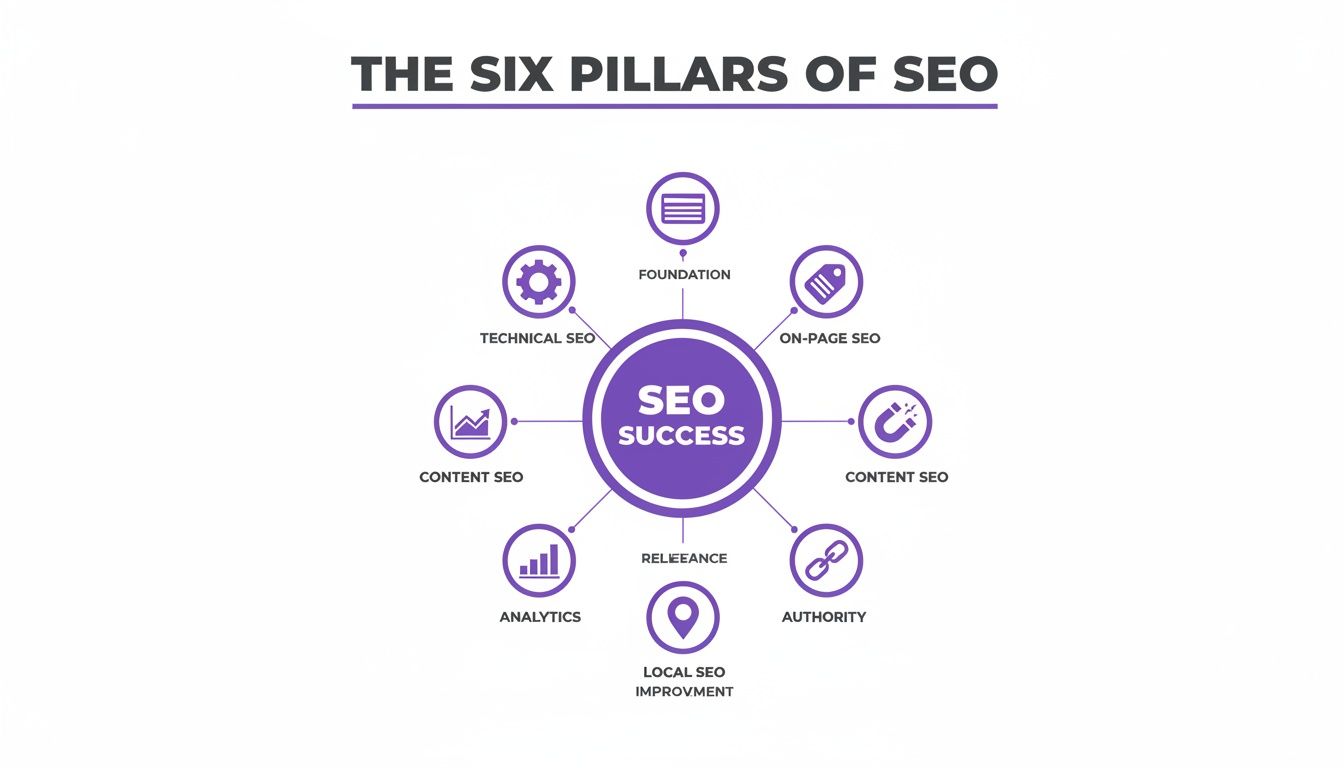
As you can see, a winning program isn't just about one thing. It's the interplay between the technical stuff, the content you create, and the authority you build online.
Phase 3: Execution and Implementation
Alright, plan's in place. Now it’s time to get to work. This is the "doing" phase where the strategy gets put into action. Your SEO partner starts methodically checking off the items on the roadmap, often with multiple tasks happening at the same time.
An SEO campaign is not a one-and-done project. It's an ongoing cycle of execution, measurement, and refinement. The best partnerships see consistent effort and adaptation over several months, not just a quick burst of activity.
During this phase, you'll start to see things happen:
Technical Fixes Rolled Out: The agency will get to work cleaning up the messes found in the audit, either with their own team or by coordinating with your developers.
New Content Creation: The content machine fires up. Blog posts, articles, and new pages start getting written and published, all aligned with the strategy.
Authority Building: This is where the link-building happens. They'll start outreach campaigns to earn high-quality backlinks and mentions from other reputable websites, which is like getting a vote of confidence in Google's eyes.
Phase 4: Measurement, Reporting, and Optimization
Finally, the journey comes full circle. A top-notch SEO partner won't just send you a spreadsheet full of confusing data. They provide clear, transparent reports that tie their work directly back to your business goals. They’ll tell you what the numbers mean and how they impact your bottom line.
This phase is really a perpetual loop. Based on the data, the agency figures out what’s working and doubles down on it. They also spot new opportunities or areas that need a little tweaking. It’s this constant process of refinement that drives real, long-term growth and makes sure your SEO investment is paying for itself over and over again.
Measuring the Real ROI of Your SEO Investment
So you're investing in SEO. Great move. But every business owner, at some point, will ask the only question that really matters: "What am I getting back for this?"
It's thrilling to watch your site climb the Google ranks, but any good SEO partner knows that rankings are just a stepping stone. The real win isn't about being #1; it's about what that #1 spot does for your business.
We need to ditch the vanity metrics—like raw traffic numbers—and get serious about the Key Performance Indicators (KPIs) that actually show up on your balance sheet.
For instance, a pro SEO agency will help you zero in on what’s truly moving the needle:
- Lead Quality Improvement: Are the phone calls and form fills you're getting from search actually turning into paying customers?
- Lower Customer Acquisition Cost (CAC): How much cheaper is it to win a customer through SEO versus, say, pricey Google Ads?
- Increased Customer Lifetime Value (CLV): Do the customers who find you organically tend to stick around longer and spend more money over time?
The goal isn't just more visitors. It's attracting the right visitors—the ones ready to pull out their wallets.
What Does Success Look Like for You?
Success in SEO is not a one-size-fits-all trophy. What works for an e-commerce giant would be a total waste of time for a local law firm. So, what do SEO companies do to get this right? They tailor the entire game plan to your specific business goals.
A law firm, for example, couldn’t care less about a million website visits. Their victory is measured in the number of qualified case inquiries they get through their contact form. One high-value lead from the right search query is a massive win.
Meanwhile, an e-commerce store is completely obsessed with organic revenue growth. They need to see a straight line connecting their ranking for "men's running shoes" to the sales piling up in their shopping cart. Their ROI is counted in dollars and cents, plain and simple.
True SEO ROI isn't just about traffic—it's about measuring the specific actions that generate revenue for your unique business. Whether it's booked appointments, downloaded resources, or completed purchases, the right KPIs tell the full story.
When it clicks, the returns can be massive. For many businesses, organic traffic powers over 40% of all revenue. We've seen some wild numbers across different sectors, like a 702% ROI for B2B SaaS companies and a mind-boggling 1,389% in real estate. You can dig into more of these impressive SEO performance statistics on SEO.com.
Setting a Realistic Timeline (Because Good Things Take Time)
One of the most important chats you'll have with any potential SEO partner is about timelines. Let's be blunt: SEO is not a light switch. It's more like planting a tree. It takes consistent care and patience before you can enjoy the shade. You're building a long-term asset, not just running a quick ad campaign.
Generally, you can expect to see real, sustainable results within a 6 to 12-month timeframe. Here's a rough idea of what that journey looks like:
Months 1-3: This is the foundation-laying phase. We're talking technical fixes, deep-diving into strategy, and rolling out the first wave of content. You might see a few small glimmers of hope here.
Months 4-6: The content and link-building engine starts to pick up steam. You should see noticeable jumps in keyword rankings and a healthy uptick in organic traffic.
Months 7-12+: Now the magic happens. The momentum from the first six months starts to compound, leading to significant growth in leads, sales, and a clear, positive return on your investment.
Getting a handle on this timeline, and the factors that influence your search engine optimization cost for Google, will set you up for a healthy, goal-oriented partnership with an agency. It ensures everyone is on the same page, gunning for long-term success.
How to Choose the Right SEO Partner for Your Business

Choosing an SEO partner can feel like navigating a minefield. The industry is packed with agencies making bold claims, so how do you separate the real experts from the ones just selling snake oil?
The key is knowing what to look for—and which red flags should send you running for the hills.
Making the right choice is about more than just dodging a bad investment. A bad SEO partner can actively damage your website's reputation with search engines, setting you back years. A great one, however, becomes a true engine for sustainable growth.
Red Flags to Watch Out For
Spotting a questionable SEO company early can save you a world of time, money, and headaches. Be wary of any agency that trots out these classic warning signs.
These red flags often signal a focus on short-term tricks over long-term strategy, which almost never ends well.
- Guarantees of #1 Rankings: This is the oldest trick in the book. No one can guarantee a specific ranking on Google because the algorithm is a complex beast that’s always changing. Legitimate pros talk about growth, visibility, and measurable business outcomes—not impossible promises.
- A Fixation on Vanity Metrics: If an agency only talks about traffic, impressions, or keyword rankings without tying them to your actual leads or sales, be careful. Those numbers look great on a chart but mean nothing if they don't impact your bottom line.
- A Lack of Transparency: A trustworthy partner should be an open book. If they’re secretive about their methods, refuse to explain their strategy, or hide behind confusing jargon to deflect questions, it's a massive red flag.
Green Flags of a Great SEO Partner
On the flip side, the best SEO companies share common traits that signal their expertise and commitment to your success. These are the green flags that tell you you're talking to a real pro.
A great SEO partner doesn't just work for you; they work with you. They should feel like an extension of your marketing team, deeply invested in understanding and achieving your business goals.
Keep an eye out for these positive signs during your conversations:
- A Focus on Your Business Goals: The first conversation should be about your revenue targets, customer acquisition costs, and market position—not just keywords. They want to understand your business so they can build a strategy that drives real-world results.
- A Data-Driven Approach: Top-tier agencies live and breathe data. They should be talking about performing a thorough technical audit, analyzing your competitors, and using analytics to guide every single decision they make.
- A Portfolio of Case Studies: They should be eager to show off their past work. Look for case studies with tangible results, like "increased organic leads by 75%" or "grew e-commerce revenue by $200K," not just "improved rankings."
- A Clear Communication Process: They should clearly outline how and when they'll report on progress. Expect regular meetings, easy-to-understand reports, and a dedicated point of contact who actually responds to your questions.
Vetting Your Next SEO Partner: Key Questions to Ask
To make an informed decision, you need to ask the right questions. This checklist will help you vet potential partners, cut through the sales pitch, and truly understand their approach. When you're evaluating agencies, it's also smart to understand their pricing structures; you can compare pricing models for web optimization services to get a better sense of industry standards.
Bring this list to your next meeting and listen carefully to the answers.
| Strategy & Onboarding | What's your process for understanding our business and customers? | "We start with a deep dive into your goals, ideal customer profile, and competitive landscape. We'll conduct stakeholder interviews and analyze your current analytics to build a baseline." |
|---|---|---|
| Proof of Performance | Can you share a few case studies from clients in a similar industry? | "Absolutely. Here are two examples where we helped B2B SaaS clients increase demo requests by over 50%. We can walk you through the specific strategy we used for them." |
| Measurement & KPIs | How do you measure success, and what KPIs will you report on? | "We focus on business metrics like organic leads, conversion rates, and pipeline value. We'll also track leading indicators like keyword visibility and backlink authority, but always tie them back to revenue." |
| Adaptability | How do you adapt when Google releases a major algorithm update? | "We monitor industry news daily. When an update hits, we analyze its impact on our clients, communicate our findings, and adjust our strategy accordingly. We don't panic; we adapt." |
| Tactics & Execution | What's your approach to link building and content creation? | "Our link building is outreach-based, focusing on earning high-quality, relevant links. For content, we build topic clusters around your core services, targeting every stage of the buyer's journey." |
| Communication | Who will be my main point of contact, and what does your communication look like? | "You'll have a dedicated account manager. We hold bi-weekly calls to review progress and provide a monthly performance report. You can also reach us anytime via Slack/email for quick questions." |
Armed with this knowledge, you can confidently cut through the noise, evaluate what different SEO companies really do, and choose a partner who will help you achieve lasting success.
The Big Questions: What to Expect When Hiring an SEO Company
Making the call to bring in an SEO company is a big deal. It’s a real investment of money, trust, and time. Before you sign on the dotted line, you’re bound to have some practical, bottom-line questions swirling in your head.
Let's cut through the noise and tackle the questions pretty much every business owner asks. No jargon, just straight talk on budget, timing, and what this all really involves.
How Much Do SEO Services Cost Anyway?
This is always question number one, and the honest-to-goodness answer is: it really depends. The price tag for SEO is tied to how competitive your industry is, the current shape of your website, and what you’re trying to achieve. A local HVAC company and a national e-commerce store are playing in two totally different ballparks.
That said, most pro SEO agencies structure their pricing in a few common ways:
- Monthly Retainer: This is the go-to model for a reason. You pay a set fee each month for all the ongoing work—strategy, execution, check-ins, the whole shebang. Most retainers fall somewhere in the $1,500 to $5,000+ per month range, based on how much horsepower you need.
- Project-Based Pricing: Got a specific, one-off job? Maybe you need a deep-dive website audit to figure out why traffic tanked, or you're launching a massive new content hub. You'll pay a flat fee for that defined project.
- Hourly Consulting: If you just need a seasoned pro to look over your shoulder, offer strategic advice, or tackle a super-specialized task, you can hire them by the hour. Rates typically run between $100 and $300 per hour.
A quick word of warning: if you see someone hawking SEO for a few hundred bucks a month, run. One industry analysis put it perfectly—at typical agency rates, that budget gets you maybe a couple of hours of work. That’s barely enough time to log in, let alone run a real audit or execute a strategy that moves the needle. Real SEO takes expertise, time, and resources. Rock-bottom prices can't deliver that.
How Long Does It Take to See SEO Results?
Patience, grasshopper. SEO is a marathon, not a sprint. This isn't like flipping a switch on a paid ad and watching the clicks roll in. Think of it as building a valuable asset for your business—something that grows stronger and more profitable over time.
Here’s a realistic timeline of what the journey usually looks like:
- Months 1-3: This is the "get our house in order" phase. The agency is digging through your site, fixing technical gremlins, mapping out the strategy, and getting the first pieces of content rolling. You might see some small flickers of life, like ranking for a few less-competitive keywords.
- Months 4-6: Now we’re cooking. With consistent content going live and link-building efforts gaining steam, you should start seeing a real, noticeable lift in your rankings and organic traffic. The needle is officially moving.
- Months 7-12+: This is where the magic happens. The compounding effect of all the previous work starts to pay off in a big way. You'll see significant growth in qualified leads, sales, and revenue—the stuff that actually matters to your bottom line.
Patience is the secret weapon in SEO. The upfront investment of time and money builds a powerful growth engine that keeps paying you back for years, long after the ad campaigns have been turned off.
Can I Just Do SEO Myself Instead of Hiring Someone?
The short answer? Yep, you absolutely can. The better question is, should you? To figure that out, you need to get brutally honest about three things: your time, your expertise, and your tools.
Going the DIY route gives you total control and a deep, intuitive feel for your brand. But don't underestimate the learning curve—it's a vertical climb. SEO is a full-time job, and the goalposts are always moving thanks to algorithm updates and new tactics.
Let’s break down the trade-offs:
| Time | Get ready to burn the midnight oil. You'll need a serious time commitment—often 10-20+ hours a week—just for learning, doing, and analyzing. | You get your time back. You and your team can focus on running the business while the experts handle the entire SEO workload. |
|---|---|---|
| Expertise | You’re the one-person band. You have to become a master of everything from technical site architecture to creative content and data science. | You get an entire team of specialists. You tap into deep knowledge across every facet of SEO without having to learn it all yourself. |
| Tools | The pro-level tools of the trade (like Ahrefs or Semrush) are powerful, but they’re not cheap. Expect to pay hundreds of dollars every month. | Agencies already have the full arsenal of premium tools. That cost is baked right into your retainer, saving you a fortune in software subscriptions. |
At the end of the day, it's a simple calculation. Doing it yourself saves you cash upfront but costs you an enormous amount of time. Hiring an agency costs more money but saves you time and gives you instant access to expertise, which almost always gets you better results, faster.
Ready to stop guessing and start growing? The expert team at Rebus builds data-driven SEO strategies that deliver real business results. We combine 14 years of experience with a relentless focus on your goals to turn your website into a powerful customer acquisition engine. Let's talk about your growth potential.