What Is a Good Click Through Rate and How to Improve Yours
Everyone wants the simple answer. They ask, "What's a good click-through rate?" and hope for a magic number.
The honest answer? A good click-through rate (CTR) is anything better than what you're getting right now. It depends entirely on where you're advertising and who you're trying to reach. A "good" CTR for a Google Search Ad might hover around 3-5%, but a solid email campaign could—and should—be aiming for 20-30%.
There’s no universal scoreboard here.
So, What Is a Good Click Through Rate, Really?
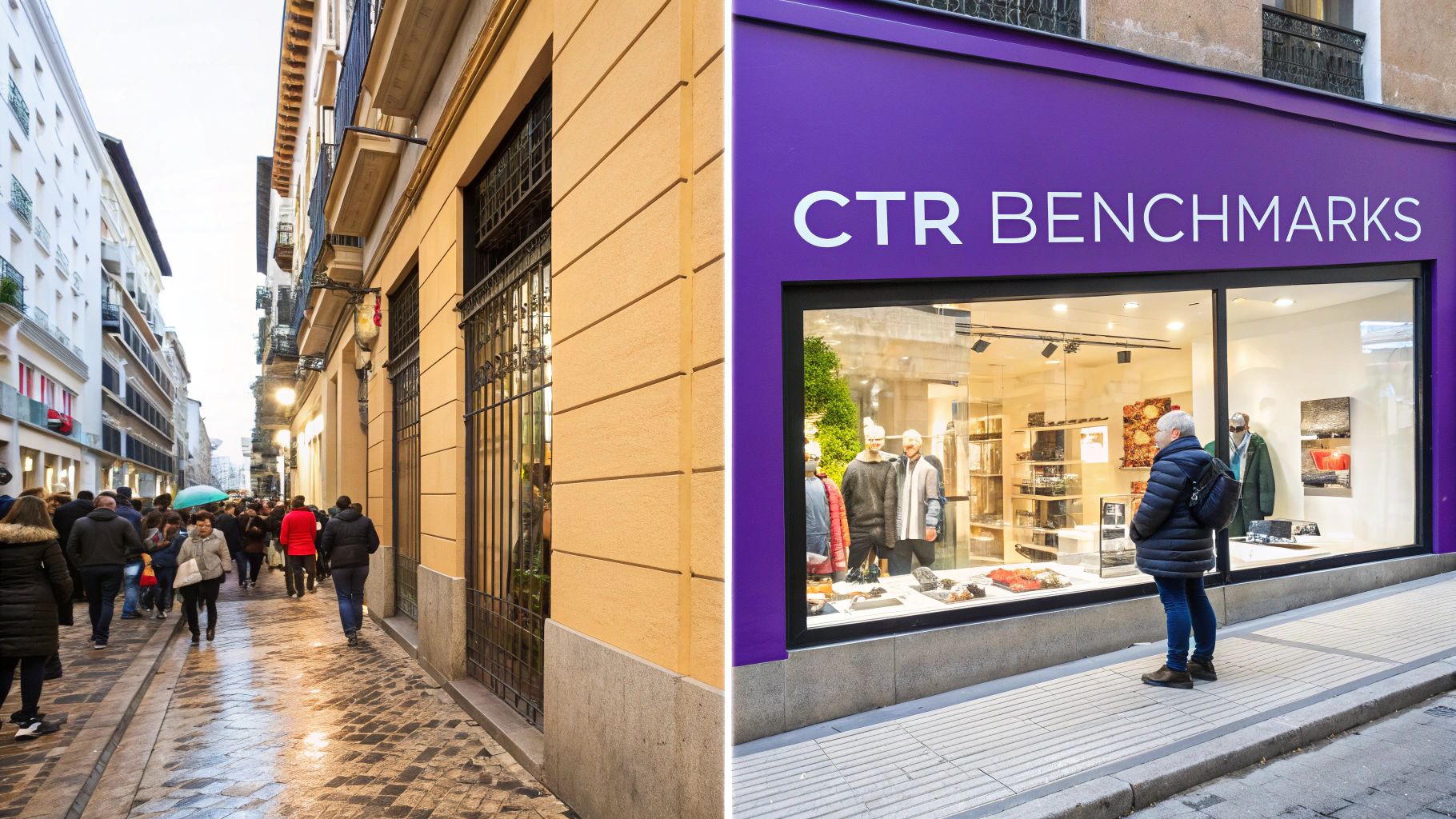
Think of CTR like foot traffic for a storefront. If you have a killer window display on a super busy street, you'll get a ton of people walking in. But that same display on a quiet side street? Not so much.
Your CTR is just a measure of how compelling your "window display" is—whether that’s an ad, a search result, or an email subject line. It's a direct signal of how well your message is resonating with the people who see it.
Asking for a single "good" CTR is like asking, "What's a good price for a vehicle?" without saying if you're buying a beat-up scooter or a brand-new truck. The answer always, always depends on the context. To give you a better feel for it, let's look at some real-world averages.
Why Benchmarks Change From Channel to Channel
Different marketing channels have wildly different rules of engagement. Someone typing a problem into Google is in a completely different headspace than someone doomscrolling through their social feed. That difference in intent dramatically changes what a "good" CTR looks like.
Let’s quickly break down the big three:
- Google Search Ads: These ads pop up when someone is actively hunting for a solution. The user has high intent, which is why these ads generally see strong engagement.
- Social Media Ads: Here, users are in discovery or entertainment mode. They aren't necessarily looking to buy, so you have to work a lot harder to grab their attention, leading to lower CTRs.
- Email Marketing: You're talking to a warm audience—people who already know you and opted in. Because of that trust, email often boasts the highest CTRs of all.
To give you some at-a-glance numbers, here's how these channels typically stack up.
| Google Search Ads | ~3.17% | 5%+ |
|---|---|---|
| Google Display Ads | ~0.46% | 1%+ |
| Social Media Ads | ~1.3% | 2%+ |
| Email Marketing | ~10-20% | 25%+ |
Note: These are broad industry averages. Your mileage will absolutely vary.
As you can see, the platform and the user's mindset are everything.
The core principle is simple: The better you match your message to the user's intent and the platform's context, the higher your CTR will climb.
Recent industry data really drives this home. The average CTR for Google Search Ads sits around 3.17% across all industries. But dig a little deeper, and you'll see huge variations. High-intent categories like dating and personals can hit averages of 6.05%, while something like travel and hospitality is closer to 4.68%.
If you're curious about where your own industry lands, you can explore more detailed advertising benchmarks to get a clearer picture.
Deconstructing the Click-Through Rate Metric
Before you start chasing a "good" click-through rate, you need to get under the hood and understand what this metric is actually telling you. At its core, CTR is a simple but mighty measure of engagement. It answers one critical question: out of every single person who saw my message, what percentage was intrigued enough to take the next step?
The math is dead simple:
Clicks ÷ Impressions = Click-Through Rate (CTR)
Think of it like a billboard on a busy highway. The total number of cars that drive past is your impressions. The drivers who actually look up, read your sign, and decide to take the advertised exit? Those are your clicks. Your CTR is just the percentage of drivers who took action.
This basic formula is the same everywhere you look, from Google search results to your email inbox. It’s the very first handshake in your digital marketing funnel.
What Counts as an Impression or a Click?
While the concept is universal, what a platform considers an "impression" or a "click" can have some slight variations. Getting these nuances right is key to actually understanding what your data means.
- Impressions: Generally, an impression gets logged any time your ad, search result, or email is displayed on a user's screen. For a Google Ad, that means it showed up on the search results page. For a Facebook post, it means it appeared in someone's feed. Simple enough.
- Clicks: A click is registered when someone actively interacts with your link. This could be tapping the headline of an ad, an image in your social post, or a big, shiny call-to-action button in an email. Being able to track these actions accurately is everything, which is why learning how to use UTM parameters is non-negotiable for serious campaign analysis.
Why CTR is More Than Just a Number
A high CTR isn’t just a vanity metric to brag about in a meeting; it's a direct signal of relevance and connection.
It tells you that your ad copy hit the mark, your keywords are properly targeted, and your visuals are resonating with the right people. A strong CTR means you’ve successfully captured someone's initial interest—you’ve gotten them to your digital doorstep. Now, the real work begins.
To see how CTR fits into the bigger picture of ad performance, it's also worth digging into the differences between key ad metrics like CPC, CPM, and CPA. Each one tells a different part of the story, but CTR is often the first place you’ll look to figure out if your campaigns are healthy or in need of a tune-up.
What's a Good Click-Through Rate, Anyway? A Look at Benchmarks Across Different Battlegrounds
Trying to nail down a single “good” click-through rate is like asking for the perfect temperature—it feels completely different depending on where you are and what you’re doing. A CTR that’s killing it on one marketing channel could be a total dud on another. It all comes down to context: user intent, the platform itself, and who you’re competing against.
Think about it like this: someone typing a search into Google is on a mission. They have a problem and are actively looking for a solution, so they’re primed to click. On the other hand, a person scrolling through their social media feed is just chilling, in a passive discovery mode. Grabbing their attention takes a whole different kind of hook.
This fundamental difference in user mindset is exactly why CTR benchmarks swing so wildly from one channel to the next.
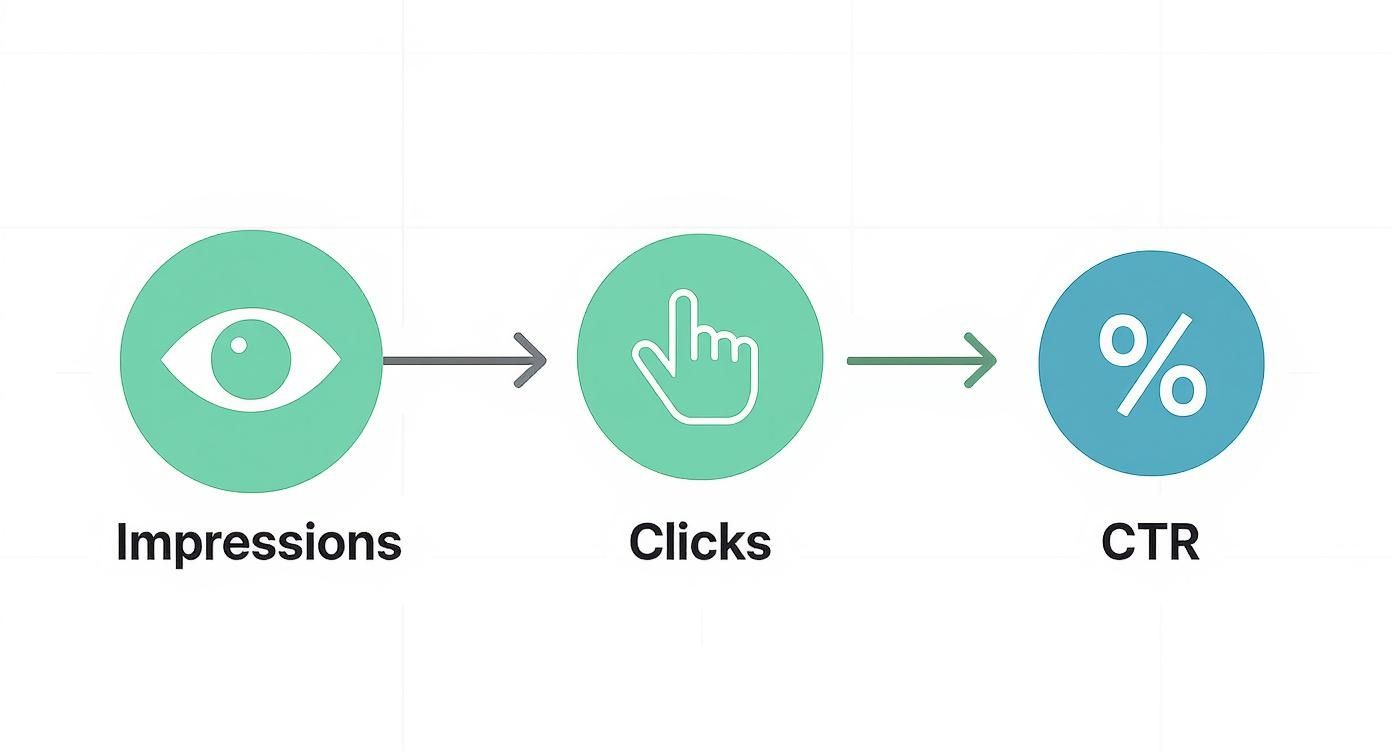
The journey from seeing your ad (impression) to actually clicking on it is simple on paper, but the why behind that click changes everything.
CTR in the World of Search Marketing
When it comes to search, not all clicks are created equal. You’ve got a massive performance gap between the results that show up naturally (organic) and the ones people pay for (paid ads), mostly because users see them in a different light. Getting your head around organic search vs paid search is step one for setting goals that actually make sense.
If you look at the data for Google's organic search results, the story is crystal clear. The #1 organic result is king, pulling in an insane average CTR of 39.8%. This just hammers home how valuable top-tier SEO is. In fact, the top three organic spots collectively gobble up about 68.7% of all clicks for any given search.
Paid ads, even though they sit right at the top, tell a different story. The top paid ad spot usually lands a CTR of around 2.1%. That might seem tiny next to its organic big brother, but it’s still incredibly valuable traffic from people with serious buying intent. You can dig into more stats on search engine click rates to see just how much ranking position matters.
Benchmarks for Social, Display, and Email
Once you step away from the search bar, CTR expectations shift again as the user’s intent gets a lot less direct.
- Social Media Ads: Platforms like Facebook and Instagram are made for browsing, not for specific searches. A solid CTR here is usually in the ballpark of 1.3% to 2%, since you’re essentially interrupting someone’s feed to get your message across.
- Google Display Ads: These are the visual ads you see on websites all over the internet. They have the lowest average CTR, typically hovering around 0.46%. Their main job is often just getting your brand name out there, not driving immediate action.
- Email Marketing: This is your home turf. You're talking to an audience that already knows you and opted in. That relationship leads to way higher engagement, with average CTRs often landing somewhere between 10% and 20%.
A "good" CTR is always relative. It’s less about hitting some magic universal number and more about beating your own past performance and outdoing your direct competitors on that specific channel.
To tie this all together, let’s see how different industries stack up across these platforms. It’s only natural that a B2B service will see different engagement than a retail brand, which is why industry-specific benchmarks are so crucial for knowing if you’re actually doing well.
Industry CTR Benchmarks Across Marketing Channels
This table gives you a snapshot of how average click-through rates can vary not just by channel, but by the industry you're in. Notice how B2B might struggle on Facebook compared to retail, while email remains a strong performer for almost everyone.
| Retail & E-commerce | 6.19% | 1.59% | 15.22% |
|---|---|---|---|
| B2B Services | 4.21% | 0.78% | 20.13% |
| Healthcare | 6.11% | 0.83% | 20.69% |
These numbers aren't set in stone, but they give you a much better starting point than a generic, one-size-fits-all benchmark. Use them to gauge where you stand and identify where your biggest opportunities for improvement might be.
What Actually Makes People Click?
Knowing your click-through rate benchmarks is a good start. But understanding why someone decides to click? That’s where the magic happens. A CTR isn't just a number that pops out of a spreadsheet; it’s the end result of a dozen tiny, controllable factors that either grab a user's attention or get scrolled past into oblivion.
Think of it as a split-second audition. A user is skimming a search results page or their social feed, and your content gets a brief moment to make its case. Several key elements have to work together perfectly to earn that click instead of losing it to the next guy.
Relevance and Laser-Focused Targeting
The single most important factor driving a good CTR is relevance. Your ad, your search result, your social post—it absolutely must speak directly to what the user needs or wants in that exact moment. If someone searches for "best running shoes for flat feet," an ad for generic sneakers is dead on arrival. But one that screams "Support for Flat Feet"? That’s getting the click.
This all comes down to targeting. You have to make sure your message isn’t just shouted into the void, but delivered to an audience that actually gives a damn. A perfectly crafted ad shown to the wrong people will always, always have a lousy CTR.
Killer Ad Copy and Stop-the-Scroll Visuals
Your ad copy and visuals are your digital storefront. They have to be compelling enough to stop someone mid-scroll and make them pay attention.
- Headlines and Copy: The words you choose should be sharp, persuasive, and hit a specific pain point or desire. Your copy needs to promise a solution or a benefit that makes clicking feel like the most logical next step.
- Visuals: In the visual battlegrounds of social media and display advertising, the creative is everything. A high-quality, eye-popping image or a snappy video can do more heavy lifting than a wall of text ever could. The visual has to back up the message and trigger the right feeling.
A great ad doesn’t just describe a product; it sells a solution. The copy and visuals must work in perfect harmony to answer the user’s unspoken question: "What's in it for me?"
The Underrated Power of a Clear Call to Action
You have to tell people exactly what you want them to do next. A vague or missing call to action (CTA) is like a dead-end street—it creates confusion and kills all momentum. Simple, direct phrases like "Shop Now," "Learn More," "Download Free Guide," or "Get a Quote" are your best friends.
A strong CTA greases the wheels, making the decision to click feel effortless. It sets a clear expectation of what’s on the other side of that click, which builds trust and nudges people into action.
Ad Position and Format Upgrades
Finally, where and how your content shows up is a massive deal. In organic search, the results on the first page gobble up over 90% of all clicks, with the top few spots getting the feast. It's the same story with paid ads—the ones at the top of the page consistently crush those buried at the bottom.
But you can do more than just fight for position. You can make your listings bigger, better, and more informative with enhancements.
- Ad Extensions (PPC): These are little upgrades that let you bolt on extra info like your phone number, direct links to specific pages (sitelinks), or customer ratings. They make your ad take up more space and look more credible.
- Rich Snippets (SEO): Think of these as search result bling. Features like star ratings, FAQs, and product prices show up right in the search results, making your listing impossible to ignore.
These enhancements don't just add information; they take up more precious screen real estate, giving users more reasons to pick your result over everyone else's.
How AI and Modern Search Features Are Reshaping CTR
The old playbook for getting clicks is officially being rewritten. Thanks to the rise of AI-powered search features like Google’s AI Overviews, the way people find information is changing right under our noses—and your click-through rate is caught in the crossfire.
Think about it: these slick new features are designed to give users the answer directly on the search results page. An AI summary can neatly pull key info from your killer blog post, hand it to the searcher on a silver platter, and poof—they never even have to visit your site.
This means you might still snag an impression, but the all-important click never materializes. For simple, fact-based questions, this "zero-click" trend is becoming a massive headache, making it tougher than ever to drive traffic even when you rank at the top.
The Impact on Organic Clicks
The data is already telling a pretty stark story. Recent studies are showing a nosedive in organic CTR whenever those AI Overviews show up.
For searches featuring AI-generated summaries, the average organic CTR has plummeted from 1.41% down to just 0.64%. Even searches without AI summaries have seen a 41% reduction in clicks, suggesting a broader change in user behavior.
This isn’t just a small dip; it's a major challenge for anyone who relies on search traffic. As AI gets more woven into the search experience, you can learn more about how these changes are impacting Google CTR and what it means for the road ahead.
Adapting Your Strategy for an AI-Driven World
So, what’s a marketer to do? Throw in the towel? Not a chance. The key is to zig where the AI zags. Stop chasing simple questions that a robot can answer in a heartbeat. Instead, focus on creating the kind of deep, valuable content that an AI summary just can't do justice to.
Here’s where to aim your efforts:
- Complex, Nuanced Topics: Go deep. Create content that explores topics with multiple layers, expert opinions, and detailed analysis that can't be squished into a tidy little paragraph. Make your content the main course, not an appetizer.
- High-Intent Keywords: Target keywords that signal someone is ready to make a move. Think terms related to comparisons, solutions, or purchase decisions. These users aren't just browsing; they're looking for an expert to guide them.
- Building Brand Authority: It's time to double down on being a brand people know, like, and trust. When users see your name pop up in the search results, the goal is for them to skip the AI summary and click on you because they know you deliver the goods.
Proven Strategies to Improve Your Click Through Rate

Knowing your CTR benchmarks is one thing, but actually moving the needle is where the real work begins. Boosting your click-through rate isn't about throwing spaghetti at the wall to see what sticks—it's about making smart, data-backed tweaks that make your content irresistible to the right people.
Time to move from theory to action. Let’s get tactical.
The single biggest lever you can pull is your title and meta description. This is your one shot to stand out on a crowded, noisy search results page. Your headline has to grab eyeballs, and your meta description needs to be a killer mini-pitch that promises a solution to whatever problem the searcher is trying to solve.
You can get a much deeper dive on how to write meta descriptions that turn searchers into visitors, but the core idea is simple: be clear, be relevant, and give them a damn good reason to click your link instead of the nine others on the page.
A/B Test Your Headlines and Copy
Never, ever assume your first idea is the best one. A/B testing, or split testing, is your secret weapon for finding out what actually resonates with your audience, not just what you think will.
It’s simple. You create two versions of a headline or ad copy, show them to different segments of your audience, and let the data tell you which one wins.
For instance, you could test:
- A benefit-driven headline: "Lower Your Energy Bills with Our Smart Thermostat"
- A question-based headline: "Tired of High Energy Bills? A Smart Thermostat Can Help"
Let the test run until you have enough data to call a statistically significant winner. This process of constant, small optimizations is how you incrementally—but powerfully—improve your CTR over time.
Refine Your Ad Targeting with Negative Keywords
For any paid search campaign, wasted impressions are the mortal enemy of a good CTR. Your best defense? Negative keywords. Think of them as a bouncer for your ads, keeping the irrelevant searchers out.
These are simply terms you add to your campaign to prevent your ads from showing for searches you don't want, ensuring you only pay for impressions that actually matter.
Imagine you sell premium "leather shoes." Without negative keywords, your ad might pop up for searches like "free leather shoes" or "how to repair leather shoes." By adding "free" and "repair" as negative keywords, you instantly filter out unqualified clicks and stop burning your budget.
This one simple tactic sharpens your targeting, makes your ads more relevant, and gives your CTR a direct boost by focusing only on people with high intent to buy.
And this thinking extends beyond just search ads. For example, digging into email newsletter best practices for higher engagement will show you specialized ways to apply the same principle of relevance and targeting to that specific channel.
Your Burning Questions About CTR, Answered
Once you start pulling the thread on click-through rates, a few key questions always pop up. Let's tackle the big ones head-on so you can get back to optimizing with confidence.
Is a High CTR Always a Good Thing?
Not necessarily. Think of a high CTR as a killer opening line at a party—it gets people to turn their heads, but it doesn't guarantee a meaningful conversation. It's a measure of attraction, not satisfaction.
If all those clicks lead to a landing page where people immediately bounce, you've got a problem. You might be attracting the wrong crowd or making a promise your content can't keep. The real magic happens when you pair a high CTR with a solid conversion rate. That's how you know you're not just getting clicks, you're getting the right clicks.
How Long Should I Wait Before I Judge My CTR?
Patience, my friend. Making big decisions based on a tiny trickle of data is like trying to predict the weather from a single cloud. You need to let your campaign run long enough to gather a statistically significant amount of data.
What does that mean in practice? For a brand new campaign, give it at least a few days, maybe even a full week, to breathe. A great rule of thumb is to wait until you have at least 100 clicks before you start digging in and drawing any real conclusions. This helps smooth out the random noise and shows you what's actually happening.
A low CTR isn’t a failing grade—it’s a diagnostic tool. It’s your audience giving you a crystal-clear signal that your message, offer, or targeting needs a second look.
Can a Low CTR Actually Hurt My SEO or Ad Quality Score?
Yes, absolutely. This is one of those metrics that has a ripple effect.
In the world of paid ads, platforms like Google Ads see a low CTR as a major red flag. It tells them your ad isn't relevant to the people seeing it, which directly tanks your Quality Score. A lower score means you'll pay more for worse ad placements. Ouch.
For organic search, the hit is a bit more indirect but just as real. If your page consistently shows up in search results but nobody clicks on it, you're signaling to search engines that you're not the best answer for that query. Over time, Google and others will start favoring the results that users are clicking on, which can slowly but surely push your rankings down.
Ready to turn these insights into a higher-performing campaign? The crew at Rebus lives and breathes this stuff, building data-driven campaigns that don't just get clicks—they get results. Let's work together to supercharge your marketing.