What Is a Conversion Funnel: what is conversion funnel and how it drives sales
Ever heard someone talk about a “conversion funnel” and just nodded along, pretending you knew what they meant? Let’s clear that up. It's a fancy term for a simple idea: mapping out the journey a stranger takes to become a happy, paying customer.
Think of it like guiding someone through a new city. They might first hear about a cool landmark (that's awareness), then decide to check it out on a map (consideration), and finally, they're standing right in front of it, snapping a photo (conversion).
Your Guide to the Customer Journey
Let’s use a real-world example. Imagine you run a local bakery. Hundreds of people walk by your shop every day (Awareness). A smaller group is drawn in by the smell of fresh bread (Consideration). An even smaller group actually pulls out their wallet and buys a croissant (Conversion). A conversion funnel is just a framework to understand—and improve—that whole process.
It forces you to see your business from the customer's point of view. It helps you ask the right questions: Why did those people walk by without stopping? What made that other group leave without buying anything? The model isn't just for selling croissants; it works for any action you want a user to take, like signing up for a newsletter, downloading an ebook, or booking a consultation.
The reality is, most people who start the journey won't finish it. Globally, online conversion rates often hang out between a slim 2% and 4%. This stat isn't meant to be discouraging; it's a reminder that we have to work hard to keep people moving from one step to the next. If you're curious, you can dig into the data behind customer journey models to see how different industries stack up.
Breaking Down the Funnel
The real magic of the funnel is how it breaks a complicated journey into a few manageable stages. Each stage has a different goal and needs a totally different approach from you.
- Top of the Funnel (TOFU): This is the widest part. You're casting a wide net to attract a big audience who might have a problem your business can solve. The name of the game here is education and just getting your name out there.
- Middle of the Funnel (MOFU): Okay, now you've got their attention. In this stage, you’re nurturing the folks who are actively looking for solutions. The focus shifts to building trust and showing them why you're the best option.
- Bottom of the Funnel (BOFU): We're at the narrowest point now. These prospects are this close to making a decision. Your job is to give them that final, confident nudge they need to convert.
This diagram shows it perfectly. You start with a big crowd and filter them down through the stages.
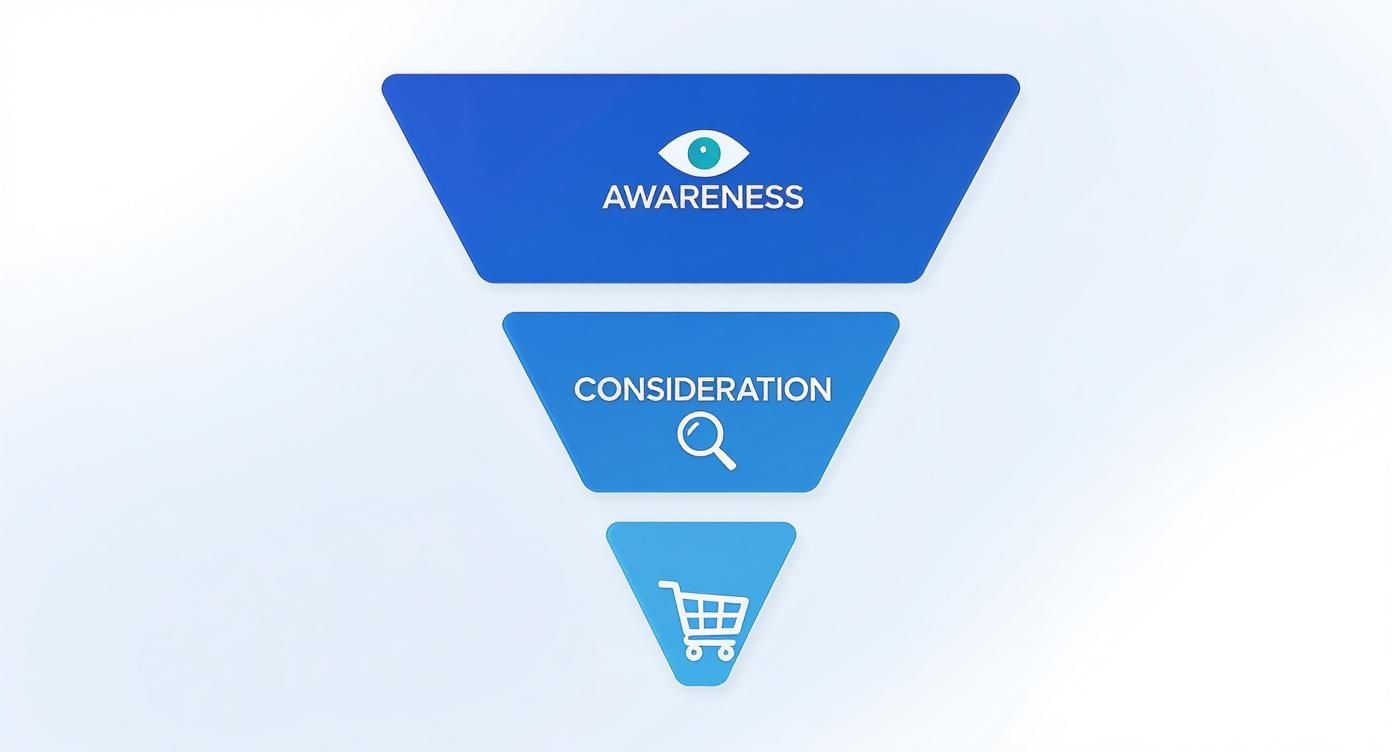
As you can see, the number of people gets smaller as you move down, but their interest and readiness to buy gets a whole lot stronger. That’s the funnel in action.
A Closer Look at Each Stage of the Funnel
Alright, you’ve got the map. Now it's time to explore the territory. Every stage of the funnel represents a totally different mindset for your potential customer, and that means you need a distinct game plan for each one.
Getting this right is the difference between a smooth journey that ends with a happy customer and a confusing path that leads straight to a dead end.
We’ll break down the four essential stages: Awareness, Consideration, Conversion, and Loyalty. By looking at the goals and tactics for each, you'll start to see how these pieces lock together to build a customer experience that actually gets results.
Stage 1: The Awareness Stage (Top of the Funnel)
This is the very top of your funnel (TOFU), where strangers first realize they have a problem and stumble across you as a potential solution. They are absolutely not ready to buy. They're just window shopping for information. Your main job here? Attract a wide audience and make a killer first impression.
Picture this: someone just launched a home-based business and is drowning in disorganized chaos. They don't know about specific project management tools, so they hit up Google with something like, "how to manage my time better working from home."
This is your moment to be the hero with genuinely helpful, educational content—no hard sell allowed.
Key Goal for Awareness: Teach your audience and cement your brand as a helpful authority. The focus is 100% on providing value, not pushing a product.
Here’s what works at this stage:
- SEO-Optimized Blog Posts: Articles that directly answer the burning questions your ideal customers are typing into search engines.
- Social Media Content: Engaging videos, slick infographics, and posts that stop the scroll and introduce your brand’s personality.
- Paid Advertising: Smart ad campaigns on platforms like Google or Facebook to reach a broad but highly relevant audience.
Your goal is to become the trusted resource they remember, setting the stage for the next step in their journey.
Stage 2: The Consideration Stage (Middle of the Funnel)
You've got their attention. Now the journey moves to the middle of the funnel (MOFU). In the Consideration stage, these prospects are now actively digging in, researching, and comparing different solutions to their problem. They know you exist, but now they’re trying to figure out if you're the right choice.
Our home business owner has now found a few software options. They're comparing features, devouring reviews, and trying to figure out which tool offers the best bang for their buck. This is where you have to build deeper trust and show them exactly why your solution smokes the competition.
Your content needs to pivot from broad "how-to" articles to specific, solution-focused information. Show them you’re the expert who can solve their problem.
Winning tactics for the Consideration stage include:
In-Depth Guides and Whitepapers: Offer meaty resources that dive into the nuances of their problem and your unique solution.
Webinars and Product Demos: Host live or on-demand sessions that show your product in action and let people ask questions.
Case Studies and Testimonials: Nothing builds trust like social proof. Show them how real people just like them found success with you.
At this point, you’re no longer just a helpful voice in the crowd—you’re a serious contender for their business.
Stage 3: The Conversion Stage (Bottom of the Funnel)
Welcome to the bottom of the funnel (BOFU). The finish line is in sight. Your prospect has done their homework, weighed their options, and is ready to pull the trigger. The Conversion stage is where you give them that final, confident nudge to take action—whether that's making a purchase, signing up for a trial, or booking a call.
The mission here is simple: make the process as smooth and frictionless as possible. Any tiny bit of hesitation or confusion can send a potential customer running for the hills. In fact, sky-high cart abandonment rates, often topping 70%, prove just how critical an easy checkout is.
Your messaging should be crystal clear, direct, and compelling, reminding them of the value you offer and creating a little friendly urgency.
Effective conversion tactics are all about making it easy to say yes:
- Clear Calls-to-Action (CTAs): Use strong, action-oriented language on your buttons. Think "Get Started Today" or "Claim Your Discount."
- Optimized Landing Pages: Make sure your sign-up or purchase pages are clean, fast, and dead simple to navigate.
- Limited-Time Offers or Discounts: Give them a good reason to act now instead of putting it off until "later."
This is the moment of truth where all your hard work pays off, and a carefully nurtured lead becomes a paying customer.
Stage 4: The Loyalty & Advocacy Stage
Hold on—the journey isn't over just because they bought something. The final, and arguably most important, stage of a modern funnel is Loyalty and Advocacy. It is way, way cheaper to keep a customer than to find a new one, making this stage the secret engine for long-term growth.
Your goal is to turn that first-time buyer into a repeat customer and, eventually, a raving fan who tells their friends about you. This demands ongoing engagement and a consistently awesome experience after the sale. When you nail this, you create a powerful feedback loop that sends brand new prospects right back to the top of your funnel.
A well-tended email list is your secret weapon here. For more on that, check out our guide on effective email list management strategies.
This stage is all about building a real relationship through things like:
- Onboarding Emails: Welcome new customers and show them how to get the most value from their purchase right away.
- Exclusive Content and Offers: Make your customers feel like insiders with deals or information nobody else gets.
- Loyalty Programs: Reward repeat business with points, discounts, or other perks that keep them coming back.
How to Measure and Analyze Funnel Performance
Running a conversion funnel without data is like driving blind. Sure, you're moving, but you have no clue if you’re actually heading toward your destination or about to drive off a cliff. To figure out what's working (and more importantly, what isn’t), you have to measure, analyze, and let the numbers steer.
But the goal isn't just to hoard data. The real magic happens when you turn those raw numbers into insights that show you the health of your customer journey. By tracking the right metrics, you can spot exactly where your funnel is "leaking" customers and plug the holes to stop the bleeding.
Key Metrics to Track at Each Funnel Stage
Every stage of the funnel has a different job to do, which means you need to track different Key Performance Indicators (KPIs) to see if it's succeeding. Focusing on the right metrics at the right time gives you a crystal-clear picture of how people are moving from one step to the next.
1. Awareness Stage Metrics
Up here at the top, the name of the game is getting noticed. You're trying to attract a broad audience and make a killer first impression. Success is all about reach and getting that initial flicker of interest.
- Website Traffic: Are your blog posts, ads, and social media efforts actually bringing people to your digital doorstep? This is your baseline.
- Impressions: How many times did your content—like an ad or a social post—get displayed to users? This shows you the sheer size of your potential audience.
- Click-Through Rate (CTR): What percentage of people who saw your content actually clicked on it? A high CTR is a huge signal that your message is hitting the mark.
2. Consideration Stage Metrics
In the middle of the funnel, you're nurturing that initial spark of interest and building trust. These metrics tell you how well you're engaging people who are actively looking for solutions like yours.
- Lead Conversion Rate: This is a big one. It's the percentage of visitors who take a specific action, like downloading your guide or signing up for a webinar. It tells you if you're turning casual browsers into real, qualified leads.
- Time on Page: How long are people sticking around to read your content? If they're spending several minutes on a case study, it suggests your material is valuable and holding their attention.
- Email Open/Click Rates: For anyone on your email list, are they actually opening your messages and clicking the links? These numbers reveal if your nurture sequences are compelling or just getting ignored.
3. Conversion Stage Metrics
Down at the bottom, it's all about closing the deal. These KPIs tell you how good you are at turning interested prospects into paying customers.
- Conversion Rate: The ultimate scoreboard. What percentage of users completed the main goal, whether that's making a purchase or booking a consultation?
- Cart Abandonment Rate: A classic e-commerce metric. How many people add items to their cart but bail before checking out? A high rate here often points to friction in your payment process.
- Cost Per Acquisition (CPA): How much marketing money does it cost you to land one new customer? Keeping this number in check is absolutely essential for staying profitable.
Pinpointing Leaks with Funnel Analysis
Once you have your numbers, the real work begins: funnel analysis. This is where you use analytics tools to see how users move through each stage and—crucially—where they drop off.
You might find, for example, that you’re getting tons of traffic to a landing page (great Awareness) but almost no one is filling out the form (terrible Consideration). That insight tells you exactly where to focus. Stop worrying about ads for a minute and fix that landing page—maybe the copy is weak, the form is too long, or the call-to-action is confusing.
A deep dive into funnel analysis is a non-negotiable for growth. Companies that get serious about funnel analytics have reported boosting their conversion rates from 1.5% to over 4%—effectively tripling their sales potential. To see the full breakdown, check out the research on funnel analysis and its impact on sales.
Tools like Google Analytics are indispensable for this. By setting up specific goals, you can build reports that map out the entire customer journey. If you need a hand getting that set up, our guide on setting up Google Analytics goals will walk you through it. This is how you stop guessing and start making data-backed decisions that actually move the needle.
Real-World Conversion Funnel Examples
Theory is great, but seeing a funnel in action is where the lightbulb really goes off. The beauty of this framework is its flexibility—it morphs to fit just about any industry, business model, or customer whim you can think of.
So, let's ditch the abstract diagrams and look at some real-world blueprints. We’ll trace the customer’s path from "who are you?" to "take my money" for three totally different businesses: an e-commerce store, a local service pro, and a B2B consultant.
The E-Commerce Store Journey
Picture a boutique brand selling handcrafted leather journals. Their ideal customer hangs out on Instagram, loves quality craftsmanship, and probably has a thing for nice pens. Here’s how their funnel might play out.
- Awareness: The brand drops a stunning Instagram video ad. It’s not a sales pitch; it’s a beautifully shot mini-documentary showing the intricate process of making a journal. The ad is targeted to users following high-end stationery accounts or those with interests in writing. It’s a pure scroll-stopper.
- Consideration: A user, intrigued, taps "Learn More" and lands on a blog post titled "5 Journaling Techniques to Boost Your Creativity." The article is genuinely helpful, subtly framing the brand’s journals as the perfect tool for the job. Tucked at the bottom is a call-to-action: sign up for our newsletter and get 15% off.
- Conversion: The prospect subscribes and instantly gets a welcome email with their discount code. One click takes them to a slick product page with gorgeous photos, detailed descriptions, and glowing customer reviews. The checkout is buttery smooth, offering quick options like Apple Pay to make buying as painless as possible.
The Local Plumber Appointment
Now, let's switch gears to a local plumber. Their funnel is all about speed and solving an immediate, often panicky, problem. The goal isn't just a website click; it’s a booked appointment—fast.
A local service funnel capitalizes on urgency. The path from discovering a problem to seeking a solution is often incredibly short, making search visibility and quick contact options absolutely critical.
A homeowner walks into their kitchen to find a puddle under the sink. Their journey doesn’t start with casual browsing; it starts with a frantic, problem-solving mindset.
Awareness: They whip out their phone and search Google for "emergency plumber near me." Our plumber’s business pops up right at the top, thanks to a killer Google Business Profile and smart local SEO.
Consideration: They tap the search result, landing on a clean, mobile-friendly website. The first things they see are crucial trust signals: a "24/7 Emergency Service" banner, a local phone number, and a badge proudly displaying 500+ five-star reviews.
Conversion: The site has a huge "Click to Call" button and a simple "Book Online" form. The homeowner calls directly, speaks with a real person, and locks in a same-day appointment. The moment that job is on the calendar, the conversion is complete.
The B2B Consulting Client
Finally, let’s look at a B2B marketing consultant who helps tech startups with lead generation. Their sales cycle is much longer, and the funnel is built on a slow burn of education and proving deep expertise. The prize is a high-ticket consultation call.
- Awareness: The consultant pushes out an in-depth whitepaper, "The Ultimate Guide to SaaS Lead Generation in 2024," using targeted LinkedIn ads and guest spots on popular industry blogs.
- Consideration: A marketing manager at a startup downloads the guide, trading their email for the valuable info. This kicks off an automated email sequence. Over the next few weeks, they receive a drip-feed of value: case studies, invites to exclusive webinars, and links to blog posts that solve more of their lead-gen headaches.
- Conversion: The final email in the sequence isn't a sales pitch—it's an offer for a free, no-strings-attached "Lead Gen Strategy Session." A link sends the prospect to a calendar page where they can book a call directly. This highly qualified lead is now at the finish line, ready for a real sales conversation.
Proven Tactics to Optimize Your Conversion Funnel
Knowing your funnel is half the battle. Actually improving it? That’s where the real growth is hiding. Funnel optimization isn't a one-and-done task; it’s a constant cycle of testing, learning, and tweaking to make the journey from "Who are you?" to "Take my money!" as smooth as possible.
Think of it like plumbing. Your goal is to find and plug every single "leak"—any spot where a potential customer drops out. It could be a boring blog post that fails to grab them, a confusing signup form, or a checkout page that springs surprise shipping fees on them. By tightening up each stage, you boost efficiency, slash customer acquisition costs, and watch your revenue climb.
Let’s get our hands dirty. Here’s a practical toolkit of proven strategies, broken down by funnel stage, to help you turn those insights into action.
Strengthening The Top Of The Funnel (TOFU)
This is your first impression. The goal at the awareness stage is simple: attract the right crowd with content that’s genuinely valuable and engaging. You’re not just casting a wide net; you’re casting a smart one.
First off, get serious about your content marketing. Move beyond random blog posts and start building "topic clusters"—think a massive pillar page on a core subject, supported by a web of smaller articles that all link back to it. This strategy screams "authority" to search engines, helping you rank higher and pull in super-relevant traffic.
Next, level up your social media game.
- Embrace Video: Whip up short, snappy videos for TikTok and Instagram Reels. Answer common questions, show off your brand's personality, or just do something fun.
- Feature Your Fans: Encourage customers to share photos or stories with your product. Resharing this user-generated content is pure gold for building social proof and authenticity.
- Run Smart Ads: Use the powerful targeting tools on social platforms to get in front of new audiences based on their interests, online behaviors, and demographics.
These moves ensure you're pulling in prospects who are far more likely to be interested in what you’re selling from the get-go.
Nurturing The Middle Of The Funnel (MOFU)
Okay, you’ve got their attention. Now what? The consideration stage is all about building trust and proving you're the best solution out there. This is where you nurture those leads and give them the juicy details they need to make a call.
Email marketing is your best friend here. Set up automated nurture sequences that drip-feed helpful content over time. Instead of just hammering them with sales pitches, send them case studies, in-depth guides, or webinar invites. Position yourself as a trusted advisor, not just another vendor.
Retargeting is the other heavy hitter in the MOFU.
Segment Your Audience: Don’t show the same ad to everyone. Create different retargeting lists. Someone who visited a specific product page needs a different message than someone who just read a blog post.
Offer Real Value: Your retargeting ads can’t just say, "Hey, come back!" Give them a reason. Offer a new piece of content, a customer testimonial, or a small discount to sweeten the deal.
Be Everywhere (Politely): Run your campaigns across social media and display networks. The goal is to stay top-of-mind while they do their research, without being annoying.
This persistent, value-first approach keeps your brand in the conversation and gently nudges leads toward making a decision.
Maximizing Conversions At The Bottom Of The Funnel (BOFU)
This is it—the moment of truth. An interested prospect is on the verge of becoming a customer. Your job here is to eliminate every last bit of friction and build enough confidence for them to finally click "buy."
Your checkout or conversion page is ground zero. It's almost unbelievable, but cart abandonment rates often soar past 70% in major markets. That means most people who add items to their cart never finish the purchase. Why? Usually, it's because of a clunky process or unexpected costs.
Pro Tip: Look at your forms. Are you asking for their life story? Cut it down to the absolute essentials. Every field you remove can give your conversion rate a little boost. Offering a guest checkout is another killer tactic for reducing friction.
Here are a few more high-impact actions to take:
- A/B Test Your Calls-to-Action (CTAs): Don't just guess. Test everything—button colors, text ("Buy Now" vs. "Get Started"), and placement. Let the data tell you what works.
- Flash Your Trust Signals: Plaster security badges, customer reviews, and money-back guarantees near the conversion button. These small details can soothe any last-minute anxieties.
- Create a Little Urgency: Use limited-time offers, countdown timers, or "only 3 left in stock!" indicators. A gentle nudge can be all it takes to get someone over the finish line.
To help you visualize where to apply these ideas, here’s a quick breakdown of tactics for each funnel stage.
Funnel Optimization Tactics by Stage
This table highlights some of the most effective strategies you can deploy at each stage, outlining their main goal and the kind of results you can expect.
| Awareness (TOFU) | SEO-driven Topic Clusters | Attract relevant organic traffic | Higher search rankings, increased brand visibility |
|---|---|---|---|
| Awareness (TOFU) | Engaging Social Video Content | Capture attention and build an audience | Increased reach, higher engagement rates |
| Consideration (MOFU) | Email Nurture Sequences | Build trust and educate leads | Higher lead-to-opportunity rate, shorter sales cycle |
| Consideration (MOFU) | Behavioral Retargeting | Stay top-of-mind with warm leads | Increased return traffic, improved brand recall |
| Conversion (BOFU) | A/B Testing CTAs & Forms | Remove friction and increase action | Higher conversion rates, lower cart abandonment |
| Conversion (BOFU) | Adding Social Proof (Reviews) | Build confidence at the point of sale | Increased trust, higher final purchase rate |
Think of this table as a starting menu. The key is to test these tactics, measure their impact, and continuously refine your approach based on what your audience actually responds to.
These refinements can make a massive difference to your bottom line. To get a bird's-eye view of more strategies, dig into these conversion optimization best practices. And for an even deeper dive, check out the comprehensive guide on conversion optimization best practices our team here at Rebus put together.
Got Questions About Funnels? We've Got Answers.
Alright, so you’ve got the basic idea of a conversion funnel. But once you start trying to put it into practice, the real-world questions pop up fast. This is where the theory ends and the work begins.
Let's cut through the noise and tackle the questions we hear most often. Think of this as your quick-and-dirty guide to getting it right.
Aren’t All Funnels Just the Same Thing?
You’ve probably heard “sales funnel,” “marketing funnel,” and “conversion funnel” thrown around like they’re interchangeable. They’re related, for sure, but they’re not identical triplets. Knowing the difference helps you focus on the right goal.
- The Marketing Funnel: This is the big kahuna. It covers the entire journey, from a total stranger hearing your name for the first time all the way to them becoming a die-hard fan who tells their friends about you. Its job is massive: build awareness, reel in leads, and nurture those long-term relationships.
- The Sales Funnel: This one’s a specialist. It’s a slice of the bigger marketing funnel that zooms in on one thing: turning a qualified lead into a paying customer. The finish line here is always a closed deal.
- The Conversion Funnel: This is the most flexible of the bunch. It can be built for any specific action you want someone to take, not just a sale. You can have a conversion funnel for getting newsletter sign-ups, driving free trial registrations, or even getting people to RSVP to a webinar.
A smart marketing plan uses all of them. The marketing funnel is the overall game plan, and inside it, you’ll have specific sales and conversion funnels doing the heavy lifting.
How Long Does This Actually Take to Build?
This is the classic "how long is a piece of string?" question. There’s no magic number. A simple, effective funnel can be up and running in a few days. A super-complex B2B funnel with a dozen channels and nurturing sequences? That could take weeks or even months to get right.
The timeline really boils down to a couple of things.
First, how complicated is your customer's path to purchase? A straightforward e-commerce buy is way faster to build than a long B2B sales cycle with multiple decision-makers who all need different information. Second, how many channels are you juggling? If you’re just running some social ads to a landing page, that’s one thing. If you’re weaving together SEO, email campaigns, retargeting ads, and content marketing, it’s going to take longer.
Key Takeaway: Don't try to build the Taj Mahal on day one. Start simple. Launch a basic funnel, get some real data flowing, and then improve it piece by piece. Progress beats perfection every single time.
What Are the Biggest Funnel Screw-Ups to Avoid?
Building a funnel is easy. Building one that actually works is another story. We see businesses make the same few mistakes over and over again. Dodge these, and you’re already way ahead of the game.
The most common blunder? Serving the wrong content at the wrong time. Slapping a "Buy Now" button on a top-of-funnel blog post is like proposing on a first date. It's just too much, too soon. Your content has to match where the person is in their journey.
Another killer mistake is creating too much friction. Every extra form field they have to fill out, every confusing step in your checkout, every surprise shipping fee—it's all another reason for them to bail. Your job is to make their journey as smooth as a freshly paved road.
But the absolute biggest mistake is failing to measure and adapt. A funnel isn't a crockpot; you can't just "set it and forget it." If you’re not tracking your metrics and figuring out where people are dropping off, you’re flying blind. A data-driven approach is the only way to find the leaks and plug them for good.
Ready to build a conversion funnel that drives real results without the guesswork? The expert team at Rebus specializes in mapping customer journeys and optimizing every stage for maximum impact. From defining your strategy to measuring performance, we provide the expertise needed to turn strangers into loyal customers. Visit us at https://rebusadvertising.com to learn how we can help you grow.