
What Is Search Intent A Guide to Unlocking SEO Success
Search intent is the real reason someone punches words into a search bar. It’s not just about the keywords they type; it’s about the mission they’re on. Are they trying to learn something new, find a specific website, or pull out their credit card?
That's the whole game.
Understanding the Why Behind Every Search
Think of your customer trying to solve a puzzle. Their search query is just the first clue they give you. Search intent is the why behind that clue—their ultimate goal for that search session. Nailing this is the single most important part of modern SEO. Seriously.
For years, SEO was all about keywords. You’d stuff your pages with every possible term, hoping to match what people were typing. That whole approach is a dinosaur now. Search engines like Google are ridiculously good at figuring out the meaning behind a search, not just matching words on a page.
Here's a better way to think about it: a search for "best running shoes for beginners" isn't just a jumble of words. It's a flare gun in the sky. It signals someone needs guidance, comparisons, and solid advice before they're ready to buy anything. They're researching, not shopping.
Missing that distinction is like a hardware store clerk trying to sell a hammer to someone who just asked for instructions on how to hang a picture. You’re pushing a solution before you even understand the problem.
The Core of Modern SEO Strategy
When you align your content with search intent, you stop being a digital library and start being a problem-solver. This shift in thinking is critical for a few big reasons:
- You'll Rank Higher: Google’s entire mission is to give people the most satisfying answer. When your content nails the user's intent, Google sees it as a quality result and bumps you up in the rankings. Simple as that.
- You'll Get Better Traffic: Attracting visitors who find exactly what they were looking for means lower bounce rates, more time spent on your page, and more engagement. These are powerful signals telling search engines your page is the real deal.
- You'll Convert More People: By meeting users right where they are—whether they're just kicking the tires, comparing options, or ready to pull the trigger—you build trust. That trust is what gently guides them toward becoming a customer.
Getting this right is non-negotiable. The sheer scale is mind-boggling; Google handles around 13.7 billion searches every single day. And a wild 46% of those searches have local intent, showing just how specific people's goals are. For a deeper dive, you can check out the latest Google search statistics.
This concept is the foundation for everything else in a winning SEO strategy. It’s how you turn random searches into real connections.
To make this crystal clear, let's break down the main types of intent. Think of these as the primary "modes" a searcher is in when they come looking for answers.
Search Intent At a Glance
Here’s a quick cheat sheet to the core types of search intent. It maps out what the user is trying to accomplish and what their keywords might look like.
| Informational | I need to learn something. | "how to tie a tie" |
|---|---|---|
| Navigational | I want to go to a specific site. | "twitter login" |
| Transactional | I want to buy something. | "buy nike air max 90" |
| Commercial | I'm planning to buy something soon. | "best running shoes for flat feet" |
Understanding these categories is your first step. Now, let’s dig into what each one really means and how you can spot it in the wild.
The Four Core Types of Search Intent
Not every Google search is the same. Far from it. A user typing in "how to change a tire" is on a completely different mission than someone searching "buy Michelin tires near me." Getting this difference is everything if you want to create content that actually connects with people and, just as importantly, gets ranked.
Think of search intent as the four main "modes" a searcher can be in. Once you learn to spot them, you can anticipate what your audience needs and serve up the perfect piece of content. It’s all about understanding the "why" behind the words they type.
This simple diagram breaks it down perfectly: every search starts with a goal, which then shapes the user's question and the specific words they use.
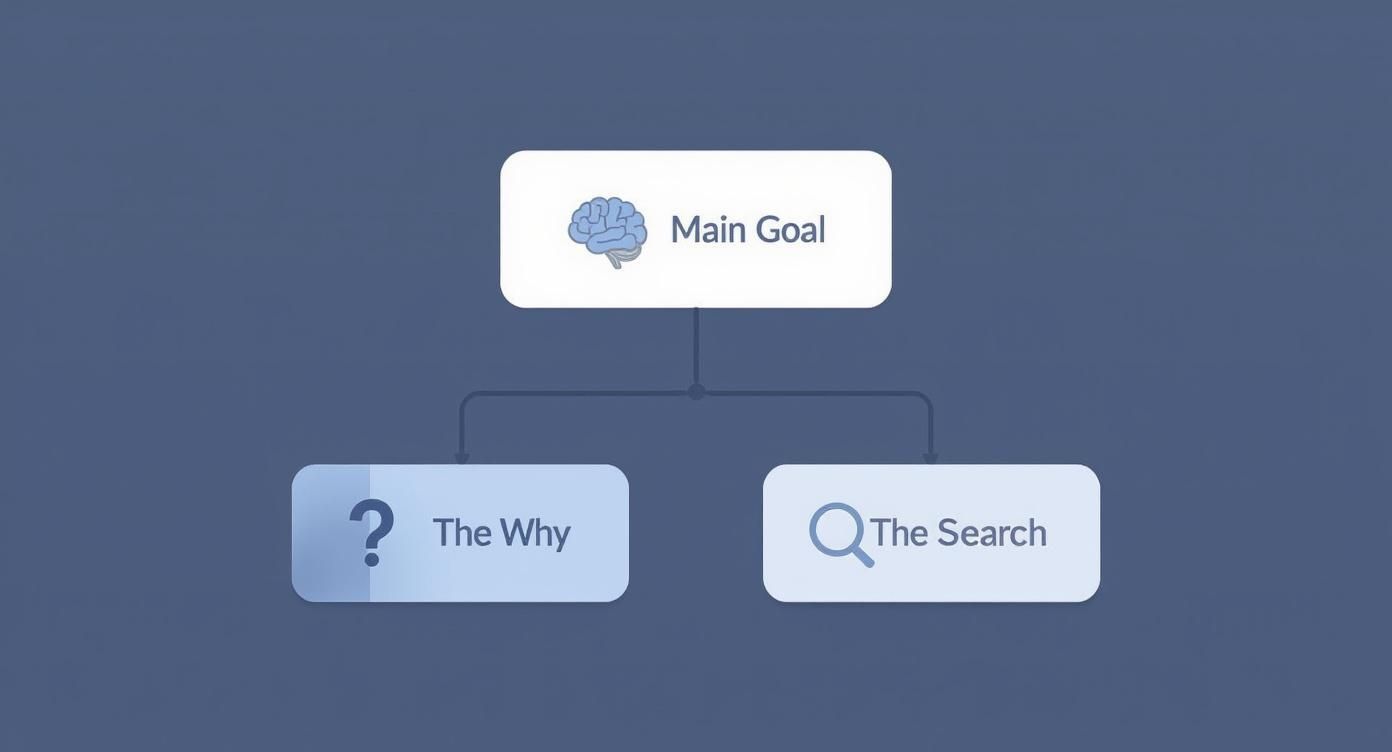
As you can see, it's not random. There's a direct line from their core need to the query they enter into the search bar.
And these motivations aren't split evenly. The overwhelming majority of searches are driven by one simple thing: the desire to learn. The data is pretty clear on this—informational intent accounts for a massive 52.65% of all Google searches. For a deeper dive, you can explore the latest search engine optimization statistics.
So, let's break down these four types of search intent, one by one.
Informational Intent: The Learners
This is the big one. When someone has informational intent, they're looking for an answer. They have a question, a problem, or a curiosity, and they expect Google to provide the knowledge. They're in pure learning and discovery mode.
These queries are often phrased as questions, using words like "how to," "what is," "why," or "guide." But they can also be super simple, like "Thomas Edison" or "content marketing."
Core Purpose: The user wants to find an answer, learn a skill, or understand a concept. They're hunting for knowledge, not a product page.
- SaaS Example: A user searches for "how to improve team collaboration." They aren't ready to buy project management software yet; they're looking for strategies and tips.
- eCommerce Example: Someone searches for "what is the best material for winter coats." This is the top of the funnel—they're gathering facts before they even think about specific brands.
- Local Service Example: A homeowner searches for "signs of a roof leak." They want to play detective and diagnose a problem, not call a roofer just yet.
For these queries, your job is to be the best teacher. Think comprehensive blog posts, in-depth guides, step-by-step tutorials, and helpful infographics.
Navigational Intent: The Finders
With navigational intent, the user already knows exactly where they want to go. They're just using the search engine as a shortcut to get to a specific website or page. It’s like typing "Starbucks" into your GPS instead of the full street address.
These searches almost always include a brand name, a product name, or a specific website you'd recognize.
Core Purpose: The user wants to reach a particular online destination. They're using the search bar as a high-speed teleporter.
- SaaS Example: "HubSpot login" or "Slack pricing page." The user knows the brand and is heading straight for a specific part of their site.
- eCommerce Example: "Amazon order tracking" or "Zappos homepage." They aren't browsing; they are on a mission to a known destination.
- Local Service Example: "Rebus Advertising contact." The user is specifically trying to find your business, not one like it.
Owning your branded navigational terms is non-negotiable. When someone searches for your company by name, you absolutely have to be the #1 result. No excuses.
Commercial Intent: The Investigators
This is that crucial middle ground between learning and buying. The user is serious about making a purchase soon, but they haven't picked a winner yet. They're in investigation mode, actively comparing options and hunting for the best possible choice.
Keywords here often include modifiers like "best," "top," "review," "comparison," or "vs."
Core Purpose: The user wants to evaluate their options before pulling out their credit card. They are looking for expert reviews, detailed comparisons, and solid analysis.
- SaaS Example: "Salesforce vs HubSpot" or "best email marketing software." The user is weighing their options to see which platform is the right fit.
- eCommerce Example: "iPhone 15 Pro review" or "top rated running shoes for men." They are deep in the research phase and just a step away from a decision.
- Local Service Example: "best personal injury lawyer in Chicago." They're looking for social proof and evidence of expertise to help them choose the right firm.
This is your chance to build some serious trust. Content like ridiculously detailed product reviews, "best of" listicles, and head-to-head comparison pages are absolute gold for capturing this audience.
Transactional Intent: The Buyers
We've arrived at the final stage. The user has done their homework, made a decision, and is ready to act. That action is usually a purchase, but it could also be signing up for a trial, downloading an app, or filling out a contact form.
Transactional keywords are specific and action-oriented. You'll see words like "buy," "order," "coupon," "discount," "price," or even a specific product model number.
Core Purpose: The user is ready to convert. They want a fast, direct path to completing their goal with zero friction.
- SaaS Example: "buy Asana business plan" or "Canva Pro free trial." They're ready to commit.
- eCommerce Example: "buy Nike Air Force 1 size 10" or "Samsung TV discount code." These are bottom-of-the-funnel queries with blinking neon "buy now" signs.
- Local Service Example: "schedule appointment with dentist near me." They've moved past research and are ready to book.
For these queries, you need to clear the runway. Your product pages, pricing pages, and sign-up forms must be perfectly optimized for a seamless experience. Any little obstacle or moment of confusion can cost you the conversion.
Identifying Search Intent by Keyword Modifiers
One of the quickest ways to decode a user's intent is by looking at the "modifiers" they add to their core search term. These little words are huge clues.
This table breaks down some of the most common modifiers and how they map to the four intent types.
| Informational | who, what, where, when, why, how, guide, tutorial, ideas, examples | "how to tie a tie" |
|---|---|---|
| Navigational | [brand name], [product name], login, pricing, contact | "Twitter login" |
| Commercial | best, top, review, comparison, vs, alternatives, pros and cons | "best coffee maker review" |
| Transactional | buy, order, purchase, coupon, discount, deal, for sale, price | "buy Adidas running shoes" |
Keep this table handy. When you're doing keyword research, looking for these modifiers will help you instantly categorize queries and understand the user's underlying goal. It's a simple but powerful way to make sure your content strategy is perfectly aligned with what people are actually looking for.
How to Uncover Search Intent Like a Pro
Understanding the theory behind search intent is one thing. But becoming a pro means knowing how to spot it in the wild.
The single most reliable way to figure out what a user really wants is to look at what Google already thinks the answer is. The search giant invests billions into understanding its users, so the Search Engine Results Page (SERP) is your ultimate cheat sheet.
Think of the SERP as a detailed map of user expectations. Once you learn to read its signals, you can move from guessing what people want to knowing with a high degree of certainty. This isn't about complex algorithms; it's about sharp observation and interpretation.
By deconstructing what's already working, you can reverse-engineer a winning content strategy, ensuring what you create aligns perfectly with what both users and search engines are looking for.
Decode the SERP with a Simple Analysis
The first and most powerful step is just to do it. Perform a manual search for your target keyword and see what shows up on page one. Pay close attention to the types of content and features Google chooses to display. This isn't just a list of links; it's a curated collection of what Google has determined to be the most satisfying results.
Here’s what to look for:
- Content Types: Are the top results mostly blog posts and guides? That’s a massive signal for informational intent. If you see a wall of product pages or e-commerce category pages, the intent is clearly transactional. A mix of in-depth reviews and comparison articles points directly to commercial investigation.
- Ranking Titles and URLs: Look at the language used in the page titles. Do they start with "How to," "What is," or "A Guide to"? That's a strong informational signal. Titles packed with words like "Best," "Top 10," or "Review" scream commercial intent. URLs are also a dead giveaway—a URL like /blog/how-to-do-x is a world away from /products/buy-product-y.
- SERP Features: Google sprinkles the results page with special features that offer huge clues about user goals. The presence of a "People Also Ask" box, for instance, tells you searchers have tons of follow-up informational questions. Video carousels, shopping ads, and image packs all tell a story about what kind of content users prefer for that specific query.
By simply observing these three elements—content type, title language, and SERP features—you can accurately diagnose the dominant intent for almost any keyword in under five minutes.
For example, take a look at the results for "best running shoes for beginners." The page is dominated by list-style articles ("The 10 Best..."), buying guides, and reviews from trusted sources. This confirms a strong commercial investigation intent.
Dig into Your Own Data with Google Search Console
While SERP analysis is crucial for new content, your existing data holds a goldmine of intent-related insights for keywords you already rank for. Google Search Console (GSC) is a free and incredibly powerful tool that shows you the exact queries people use to find your site.
Here’s a simple process to uncover intent in GSC:
Navigate to the Performance Report: Open your GSC property and head to the "Performance" report.
Filter by a Specific Page: Choose a page on your site you want to analyze, like a popular blog post or a key service page.
Analyze the Queries: Now, look at the list of queries driving clicks and impressions to that page. You'll often discover that a single page ranks for dozens, or even hundreds, of different keywords.
This is where the magic happens. A powerful technique to directly understand what users are seeking is through search query analysis. You might find your informational blog post on "how to improve sales" is also getting impressions for commercial terms like "best sales CRM for small business."
This reveals a content gap and a golden optimization opportunity. The search intent behind those commercial queries isn't fully met by your current page. That insight tells you to either update the existing post to include a comparison of CRMs or create a brand new piece of content specifically targeting that commercial intent.
It's a data-driven way to ensure every single page on your site is working as hard as possible to meet user needs.
Matching Your Content Strategy to User Intent
Alright, so you’ve cracked the code on what your audience is really asking for. Now comes the fun part: giving them exactly what they want. Creating content that perfectly satisfies a user’s goal is where you stop just showing up in search results and start actually winning them.
Get this part wrong, and it’s game over. Offering a detailed product page to someone who just wants a simple "how-to" guide is like trying to sell a hammer to someone who just asked for building instructions. It's a total mismatch.
The key is to map the right content format to the right intent. This isn't about throwing spaghetti at the wall to see what sticks; it's a strategic move that aligns what you create with what your audience expects to find. Nail this alignment, and you’ll see your rankings, engagement, and conversions climb.
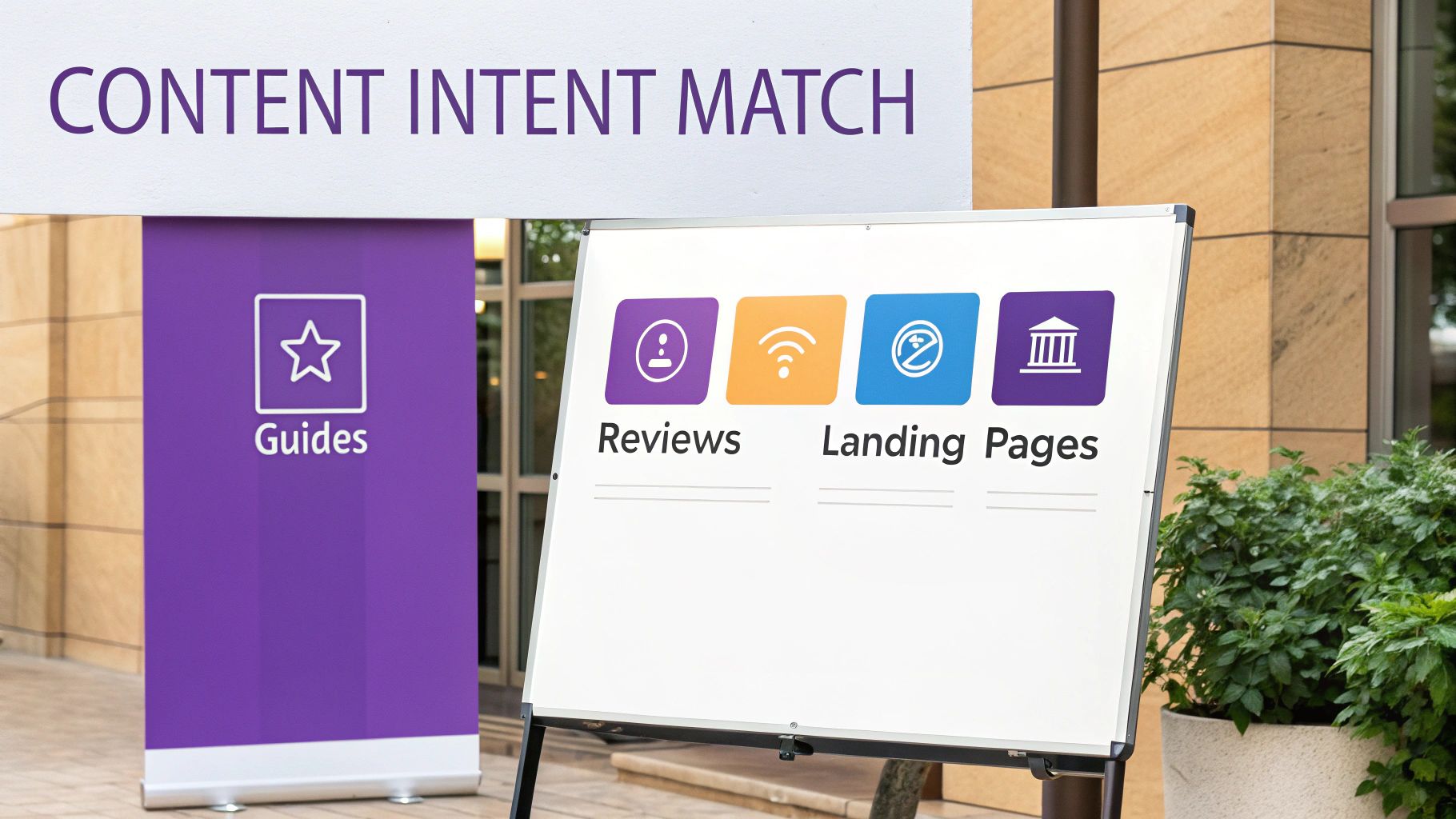
This whole process ensures every single page you publish has a clear job to do, perfectly tailored to a specific user need.
Content for Informational Intent Learners
When someone has informational intent, they’re in learning mode. They’re hungry for knowledge, answers, and guidance. Your content's only job at this stage is to be the best damn teacher on the subject. If you try to push a sale here, you'll just scare them away.
The goal is to build trust by providing pure, unadulterated value, no strings attached.
- In-Depth Blog Posts and Guides: These are your bread and butter. A monster guide on "How to Start a Podcast" directly answers their question and instantly positions you as an authority.
- Step-by-Step Tutorials: For any "how-to" query, a crystal-clear tutorial with screenshots or a video is pure gold. It walks the user through a process, solving their problem right then and there.
- Infographics and Checklists: These formats are awesome for breaking down complex info into something snackable and shareable. A simple checklist for "What to Pack for a Camping Trip" is insanely useful.
When you satisfy informational intent, you become a trusted resource. You're the expert they'll remember and come back to when they're finally ready to buy.
This is also where knowing your audience inside and out becomes non-negotiable. To create informational content that truly hits the mark, you need to understand who your customer is and what keeps them up at night. Learning how to create buyer personas is the foundational work that helps you craft content that speaks directly to their questions.
Content for Commercial Intent Investigators
Users with commercial intent are on a mission. They're sizing up their options, reading reviews, and doing their homework before they pull out their wallets. Your content needs to help them make a smart, informed decision—and position your solution as a top contender.
Here, you can be more direct about your products, but the focus has to stay on helpful, honest analysis, not a hard sell.
- Detailed Comparison Pages: An article like "HubSpot vs. Salesforce" that brutally breaks down features, pricing, and the pros and cons is exactly what an investigator needs. You're doing the heavy lifting for them.
- "Best Of" Listicles: A post titled "The 10 Best CRMs for Small Businesses" is a godsend. It curates the top options in a category, saving the user from hours of mind-numbing research.
- Expert Reviews: Deep, unbiased reviews of products or services build incredible trust. They offer a third-party perspective that gives users the confidence to make a choice.
Content for Transactional Intent Buyers
When a user has transactional intent, the research phase is officially over. They’ve made up their mind and are ready to act—buy, sign up, schedule a demo, whatever. Your one and only job is to get out of their way and make it ridiculously easy for them to convert.
Clarity, speed, and simplicity are everything. Any friction at this stage can kill the sale.
- Optimized Product Pages: These pages need killer photos, clear and concise descriptions, transparent pricing, and a big, obvious call-to-action (CTA). Everything should be designed for a frictionless purchase.
- Streamlined Landing Pages: For lead gen or sign-ups, you need a focused landing page with a dead-simple form. It should be completely free of distractions and guide the user to one single action.
- Pricing and Service Pages: No one wants to solve a puzzle. Clear, easy-to-scan pricing tiers or service descriptions let users quickly pick the right option and move forward.
By strategically matching your content format to each stage of search intent, you're building a seamless and effective journey for your customers. You’re no longer just creating random content; you’re building a system that anticipates what people need and delivers the perfect answer at the perfect time.
Optimizing On-Page Elements for Search Intent
Alright, so you've created a killer piece of content that perfectly matches what a user is looking for. Huge win. But don't pop the champagne just yet. Now you have to send up massive, unmissable smoke signals to both Google and your future visitor, screaming, "Hey! This page is exactly what you need."
This is where your on-page SEO chops come in. Think of your amazing content as the product itself. The on-page elements—your titles, headings, and internal links—are the packaging. Lousy packaging can make a great product look cheap and untrustworthy. Great packaging confirms the user made the right choice before they've even seen what's inside.
Crafting Titles and Metas That Scream Relevance
Your title tag and meta description are your digital storefront sign. They're the first thing anyone sees in the search results, and they have one job: convince the right person to click. This isn't about jamming keywords in; it's about making a promise that your content delivers on their goal.
A killer meta description can be the difference between a click and a scroll-by. To nail it, you have to get inside the user's head for that specific query.
- For Informational Intent: Your title should sound like an answer. Think "How to..." or "A Complete Guide to..." The meta description should either give a quick summary of the answer or tease the goldmine of knowledge waiting for them.
- For Commercial Intent: The title needs to build instant confidence. Sprinkle in words like "Best," "Review," or "Top 5." These signal you're helping them compare options and make a smart choice. Your meta can highlight a key finding or a unique selling point that sets you apart.
- For Transactional Intent: Be direct. Get straight to the point. Use action words like "Buy," "Order," or "Get" in the title. The meta description should grease the wheels, mentioning things like price, free shipping, or a limited-time offer.
Learning how to write meta descriptions that vibe with user intent is a non-negotiable skill. It’s what gets your door kicked open while your competitors are still fumbling for their keys.
Structuring Content with Intent-Driven Headings
Once someone clicks, your page has about three seconds to prove they made the right decision. People don't read online; they scan like caffeinated squirrels. Your headings (H2s, H3s, etc.) are the signposts that guide their frantic eyes.
Your heading structure should tell a story that mirrors the user's thought process. It should start with the main answer and then progressively dive into related sub-topics they're likely curious about.
Take an informational query like "how to brew cold brew coffee." A smart heading structure wouldn't be random. It would flow logically: "What You'll Need," "Step-by-Step Brewing Instructions," "Common Mistakes to Avoid," and maybe "How to Store Your Cold Brew." This setup satisfies the main goal and answers the follow-up questions they haven't even thought of yet. That's how you keep them glued to the page.
Using Internal Links to Guide the User Journey
Internal links aren't just some dusty SEO tactic. They're the breadcrumb trails you leave to guide visitors through your site. A well-placed internal link can seamlessly transition someone from one stage of intent to the next, building trust and nudging them closer to becoming a customer.
It's all about connecting the dots:
- From an informational post ("What Is Content Marketing?"), you can link to a commercial guide ("Best Content Marketing Tools").
- From that commercial guide, you can then link to a transactional landing page ("Get a Quote for Our Content Services").
Each link is a logical next step, serving the user who is getting more and more invested in what you have to say.
Aligning Your Calls-to-Action with Intent
Finally, the call-to-action (CTA) is your closing argument. A mismatched CTA is like a record scratch at a party—jarring and weirdly aggressive. You wouldn't scream "Buy Now!" on a page that's just explaining a basic concept. The CTA must match where the user is in their journey.
- Informational Pages: Keep it low-pressure. Think soft CTAs like "Download our free guide" or "Subscribe for more tips."
- Commercial Pages: You can be a bit more direct. Offer a middle-ground CTA like "Watch a demo," "See pricing," or "Compare features."
- Transactional Pages: Now's the time to be bold. This is where you use hard CTAs like "Buy Now," "Add to Cart," or "Sign Up Today."
When you optimize these on-page elements, you're doing more than just feeding an algorithm. You’re crafting a smooth, intuitive experience that tells every single visitor, "You're in the right place. We've got you."
Measuring the Success of Your Intent-Based SEO
So, you've gone all-in on optimizing for search intent. Great. But how do you prove it's actually working? Chasing raw traffic numbers is an old-school game that doesn't tell the whole story. The real proof is in the pudding—or in this case, the analytics.
When your content perfectly nails a user's goal, their behavior changes. They don't just land and leave; they stick around, click deeper, and are far more likely to take the action you want them to. That's the behavior that shows up in your data.
An intent-focused strategy is measured not by how many people arrive, but by how many found exactly what they were looking for. Success means deeper engagement and more meaningful actions, not just higher traffic numbers.
This means you need to start tracking the metrics that reveal the true story of user satisfaction. A solid intent-based SEO strategy will create a ripple effect, boosting the numbers that actually matter.
Key Metrics for Intent-Based Success
Forget obsessing over total visitors for a minute. Let's dive into the metrics that give you direct feedback on how well you're answering the "why" behind every search.
- Time on Page and Dwell Time: When someone camps out on your page, it's a massive thumbs-up. It signals your content is a perfect match for their informational or commercial quest.
- Low Bounce Rate: A low bounce rate is your best friend. It means visitors didn't hit your page, say "nope," and immediately pogo-stick back to Google for a better answer. You've satisfied their query.
- Conversion Rate: This is the ultimate bottom line for transactional and commercial intent. Are people buying, filling out forms, or booking demos? This metric is the clearest proof that your content isn't just attracting eyeballs—it's driving business.
- SERP Feature Ownership: Did you snag a Featured Snippet? Or maybe you're dominating the "People Also Ask" box? This is Google literally telling the world your content is the definitive answer for a specific question. It's a direct win for informational intent.
To really get a grip on this, you have to define what a "win" looks like for each page. This is where setting up specific goals in Google Analytics comes in. By tracking the right actions, you can stop guessing and start showing everyone the real-world value of your SEO work.
Got Questions About Search Intent? Let's Clear Things Up.
Even after you’ve wrapped your head around the basics, some tricky questions always pop up. It’s the details that separate a good SEO strategy from a great one. Let’s tackle a few common head-scratchers so you can move forward with total confidence.
Can a Single Keyword Have More Than One Intent?
You bet it can. This is what we call mixed intent, and it’s way more common than you'd think, especially for broader, high-volume keywords.
Take a simple query like "macbook pro." What does that person really want? It could be anything:
- Navigational: They’re just trying to get to Apple's official product page, fast.
- Informational: They're hunting for deep-dive specs, screen dimensions, or performance reviews.
- Transactional: They've already decided and are pulling out their credit card, ready to buy.
When Google sees a query like this, it hedges its bets. The SERP will often be a mashup of results—an official Apple link, a few YouTube reviews, and a couple of e-commerce listings from Best Buy or Amazon. Your job is to figure out the dominant intent or, if you're feeling ambitious, build a killer page that somehow manages to satisfy all those needs at once.
How Does Voice Search Change the Game?
Search intent is absolutely everything for voice search. Think about how people talk to Siri or Alexa—their queries are longer, more conversational, and almost always informational. Nobody says, "Hey Google, running shoes." They ask, "What’s the fastest way to get a wine stain out of a carpet?"
If you want to win at voice, you need to create super concise, direct answers to very specific questions. The best way to do this? Structure your content to snag Featured Snippets. Those little answer boxes at the top of the results are often the exact text that voice assistants read back to the user.
Should I Make a Separate Page for Every Single Intent?
Not always. The real question to ask is how different the user goals are.
If two keywords have nearly identical intent—like "how to tie a tie" and "tie a tie instructions"—they absolutely belong on the same page. Cramming them into separate articles would be redundant and just confuse Google.
But if the intent is worlds apart—like "best running shoes" (commercial) versus "buy Nike running shoes" (transactional)—then you almost certainly need two different pages. Each one has a distinct job to do, and a page that tries to do both will probably fail at both. You have to tailor each page perfectly to the user's specific mission.
Ready to turn search intent into a powerful growth engine for your business? At Rebus, we craft data-driven SEO strategies that connect you with your audience at every stage of their journey. Learn how our expert team can elevate your brand and drive measurable results.